

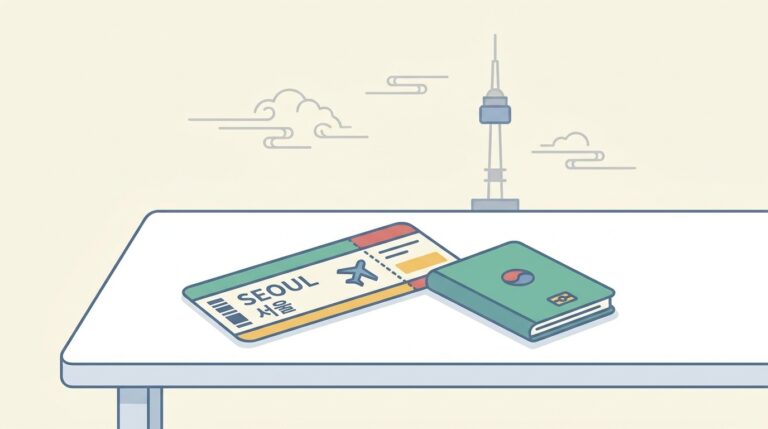
Phase 1: Empathy (Welcome to Your Korea Travel Adventure!)
안녕하세요! 매일한글 에디터입니다. (Annyeonghaseyo! I am your Daily Hangul editor.)
Close your eyes and picture this: You have just finished binge-watching a cozy K-drama like Hometown Cha-Cha-Cha or Crash Landing on You. The wanderlust hits you hard. You pull up your laptop, determined to turn your Seoul travel dreams into reality. You open a ticketing service, or perhaps you are standing right in front of an airline counter at the airport. Your heart flutters with excitement—and then suddenly, your palms get sweaty.
“Wait… how do I ask for a round-trip ticket in Korean? What if they ask me whether I want an aisle or window seat and I freeze?”
If you have ever felt that sudden surge of airport anxiety, take a deep breath. You are not alone! Over the past ten years of coaching beginner Korean learners, I have heard this exact story dozens of times. Many A2 learners know how to introduce themselves, but the moment real travel logistics kick in, textbook grammar fades away and panic takes over.
Here is the great news: booking a flight ticket does not require mastering hundreds of complicated grammar rules. With just three core phrase structures and a little cultural know-how, you can confidently navigate ticket desks, talk to ticketing agents, and step onto that plane to Incheon with pride. Let us dive in together, step by step!
Phase 2: Core Expressions Breakdown
Here are the three must-know expressions you will use whenever you book travel tickets in Korean.
1. 서울행 왕복표 한 장 주세요. (Seoul-haeng wangbokpyo han jang juseyo.)
- Pronunciation: [Seoul-haeng wang-bok-pyo han jang ju-se-yo] (Sounds like: “Seoul-hang” like hanging out, “wang-bok-pyo” with a snappy ‘pyo’, and “juseyo” like juice-say-yo)
- Meaning: Literal: “Seoul-bound round-trip ticket one sheet please.” / Natural: “One round-trip ticket to Seoul, please.”
- K-Culture Moment: In airport-based K-dramas like Where Stars Land, ticket counters are bustling places where travelers state their destination and ticket type in crisp, clear sentences.
- Editor’s Insight: Look at the building blocks:
서울(Seoul) +행(bound for) +왕복표(round-trip ticket) +한 장(one sheet/counter for tickets) +주세요(please give me). If you only want a one-way ticket, simply swap왕복표with편도표(pyeondopyo)!- Situation Spectrum: Casual: 🚫 | Semi-formal: ✅ | Formal: ✅
- 🤔 Think About It: In English, we say “A round-trip ticket to Seoul” (Ticket first, destination last). In Korean, the destination comes first (
서울행). Why do you think Korean builds sentences from the macro context (destination) down to the specific item (ticket)?2. 다음 주 금요일 표 있어요? (Daeum ju geum-yo-il pyo isseoyo?)
- Pronunciation: [Dae-um ju geum-yo-il pyo it-seo-yo] (Think: “Dah-eum joo”, “geum-yo-il” flowing softly, “isseoyo” like east-saw-yo)
- Meaning: Literal: “Next week Friday ticket exists?” / Natural: “Do you have tickets for next Friday?”
- K-Culture Moment: Think of K-Pop idol tour managers calling airlines to book urgent schedule changes—they always start by checking date availability with this snappy question.
- Editor’s Insight:
있어요?(Isseoyo?) is your absolute superpower at level A2. You do not need complex phrases like “Could you tell me if there are any available flights…”. Just say[Time/Date] + 표 (ticket) + 있어요?and native speakers instantly understand.- Situation Spectrum: Casual: ⚠️ (with close friends, say 있어?) | Semi-formal: ✅ | Formal: ✅
- 🤔 Think About It: Notice the complete lack of auxiliary verbs like “do” or “would”. Korean relies on rising intonation at the end of the sentence to show you are asking a question.
3. 창가 자리로 부탁해요. (Chang-ga jari-ro butak-haeyo.)
- Pronunciation: [Chang-ga ja-ri-ro bu-tak-hae-yo] (Sounds like: “Chahng-gah” + “jah-ree-roh” + “boo-tahk-hae-yoh”)
- Meaning: Literal: “Window side seat-toward I request.” / Natural: “A window seat, please.”
- K-Culture Moment: Every scenic K-drama travel montage begins with the main character gazing thoughtfully through the airplane window as the clouds float by.
- Editor’s Insight: The particle
로/으로(-ro/-euro) indicates direction or choice. If you prefer the aisle to stretch your legs, just swap창가(window) with복도(aisle) to say:복도 자리로 부탁해요(Bokdo jari-ro butakhaeyo).- Situation Spectrum: Casual: 🚫 | Semi-formal: ✅ | Formal: ✅
- 🤔 Think About It: While
주세요(juseyo) means “give me”,부탁해요(butakhaeyo) literally means “I entrust this favor to you.” It sounds warm, respectful, and very polite when dealing with service staff.
Phase 3: Textbook Korean vs. Real Korean
Textbooks often teach polite formulas meant for formal essays, but real-life travel counters are fast-paced and natural!
Situation 1: Asking for a one-way ticket
- 📖 교과서 한국어 (Textbook Korean): 저는 편도 티켓을 한 장 구입하고 싶습니다. (Jeoneun pyeondo tiket-eul han jang gu-iphago sipsumnida. – I desire to purchase one one-way ticket.)
- 🗣️ 진짜 한국어 (Real Korean): 편도로 한 장 주세요. (Pyeondo-ro han jang juseyo. – One-way, please!)
- 💡 왜 다를까? (Why is it different?): Native speakers drop unnecessary subjects like
저는(I) and replace literary verbs like구입하다(to purchase) with the versatile주세요(please give).
Situation 2: Asking if any seats remain
- 📖 교과서 한국어 (Textbook Korean): 혹시 잔여 좌석이 남아 있습니까? (Hoksi janyeo jwaseok-i nama itsumnikka? – Perchance, do remaining seating units exist?)
- 🗣️ 진짜 한국어 (Real Korean): 남은 자리 있어요? (Nameun jari isseoyo? – Are there any seats left?)
- 💡 왜 다를까? (Why is it different?):
좌석(jwaseok) sounds like a formal safety announcement. In spontaneous conversation, native Koreans instinctively choose everyday words like자리(jari – seat/spot).
Phase 4: K-Culture Deep Dive & Non-Verbal Manners
4-1. 눈치 (Nunchi) & Airport Etiquette
In Korea, communication is never just words—it is posture, eye contact, and mutual consideration.
* Two-Hand Rule (두 손 예절): When handing your passport, booking reference, or credit card to the airline agent, always hold it with both hands, or support your right wrist/forearm lightly with your left hand. Handing things with one hand can come across as dismissive.
* The Attentive Nod (목례 – Mok-rye): Make brief, polite eye contact, followed by a slight downward nod of your head when receiving your boarding pass. It signals gratitude and respect without needing a deep 90-degree bow.
4-2. The “Palli-Palli” Culture at Incheon Airport
Incheon International Airport regularly ranks as one of the best and fastest airports in the world. Why? Korea’s famous 빨리빨리 (Palli-palli – Quick, quick!) culture! Ticketing staff take immense pride in lightning-fast, smooth check-ins. Having your destination, passport, and preferred dates ready to state clearly will earn you appreciative smiles from Korean agents.
Phase 5: Real-Life Roleplay Scenario
Setting: Airline Service Counter at the airport.
Characters:
* 민지 (Minji): An efficient, warm ticketing agent wearing a neat airline uniform.
* 당신 (You): An excited traveler planning a weekend hop to Jeju Island.
— Dialogue Start —
- 민지: 어서 오세요! 어디로 가세요?
(Eoseo oseyo! Eodiro gaseyo?)
“Welcome! Where are you traveling to?”
🎭 Hands folded neatly, bowing slightly with a welcoming smile. -
당신: 안녕하세요! 제주도행 왕복표 있어요?
(Annyeonghaseyo! Jejudo-haeng wangbokpyo isseoyo?)
“Hello! Do you have round-trip tickets to Jeju Island?”
🎭 Smiling and leaning forward slightly. -
민지: 네, 있습니다. 언제 출발하세요?
(Ne, itsumnida. Eonje chulbalhaseyo?)
“Yes, we do. When are you departing?”
🎭 Typing smoothly on her computer keyboard. -
당신: 이번 주 토요일 오전 표로 주세요.
(Ibeon ju toyoil ojeon pyo-ro juseyo.)
“Tickets for this Saturday morning, please.”
🎭 Checking your phone calendar with your left hand. -
민지: 오전 9시 비행기 있습니다. 좌석은 창가 쪽으로 해 드릴까요?
(Ojeon ahopsi bihaenggi itsumnida. Jwaseog-eun chang-ga jjok-euro hae deurilkkayo?)
“We have a 9:00 AM flight. Shall I arrange a window seat for you?”
🎭 Glancing up from the monitor to check your preference. -
당신: 네! 창가 자리로 부탁해요.
(Ne! Chang-ga jari-ro butak-haeyo.)
“Yes! A window seat, please.”
🎭 Nodding with an appreciative grin. -
민지: 여권과 카드 보여주시겠어요?
(Yeogwon-gwa kadeu boyeojusigesseoyo?)
“Could you please show me your passport and payment card?”
🎭 Holding both open hands out politely to receive them. -
당신: 여기 있어요. 감사합니다!
(Yeogi isseoyo. Gamsahamnida!)
“Here they are. Thank you!”
🎭 Handing over your passport and card using both hands.
— Dialogue End —
🔀 Interactive Branching Moment!
Imagine Minji asks you: “돌아오는 날은 언제로 하시겠어요?” (When would you like to return?)
What do you answer?
- Option A: 일요일 저녁 비행기로 부탁해요. (Ilyoil jeonyeok bihaenggi-ro butakhaeyo.)
Feedback: [BEST CHOICE! 🌟] Perfectly polite, specific, and uses the-ro butakhaeyostructure. Minji can find your return flight instantly. - Option B: 아무 때나 싼 거 줘. (Amu ttaena ssan geo jwo.)
Feedback: [BAD CHOICE! ❌] This uses informal banmal (줘) without honorifics. It sounds rude to an agent, and “whenever cheap” is too vague. - Option C: 그냥 편도로 바꿀게요. (Geunyang pyeondo-ro bakkulgeyo.)
Feedback: [RISKY CHOICE! ⚠️] Grammatically correct (“I will just change to one-way”), but switching from round-trip to one-way mid-conversation can reset your booking search and increase ticket costs!
Phase 6: 10-Second Emotion Shadowing Drill
Practice reading these out loud! Pay attention to the pauses marked with / and inject the suggested emotion.
[😊 Exciting & Hopeful]
서울행 왕복표 / 한 장 주세요!
(Seoul-haeng wangbokpyo / han jang juseyo!)
One round-trip ticket to Seoul, please!-
[🤔 Polite & Inquiring]
다음 주 금요일에 / 남은 자리 있어요?
(Daeum ju geum-yo-il-e / nameun jari isseoyo?)
Are there any seats left / for next Friday? -
[✨ Friendly & Warm]
경치 보고 싶어요. / 창가 자리로 부탁해요!
(Gyeongchi bogo sipeoyo. / Chang-ga jari-ro butakhaeyo!)
I want to see the view. / Window seat, please!
Phase 7: K-Culture Mini Dictionary
Here are four essential vocabulary items every traveler must pack:
- 편도 (Pyeondo)
Translation: One-way
Real-life Usage: Use it when you are taking an open-ended backpacking trip:편도로 결제할게요(Pyeondo-ro gyeoljehalgeyo – I will pay as a one-way). -
왕복 (Wangbok)
Translation: Round-trip
Real-life Usage: Most airlines offer discounts on round-trips:왕복 할인 있어요?(Wangbok harin isseoyo? – Is there a round-trip discount?). -
직항 (Jikhang)
Translation: Direct / Non-stop flight
Real-life Usage: When booking online, check the filter for직항만 보기(View direct flights only) to avoid long layovers. -
경유 (Gyeong-yu)
Translation: Layover / Transfer / Transit
Real-life Usage: If you have a stopover in Tokyo or Taipei on the way to Seoul, the flight will be marked as1회 경유(1 stopover).
Phase 8: Traveler’s Survival Kit
Survival Expressions TOP 3
-
여권 여기 있어요. (Yeogwon yeogi isseoyo.)
Pronunciation: [Yeo-gwon yeo-gi it-seo-yo]
Pro Tip: Say this as you hand over your passport with two hands. It makes an instantly polite first impression. -
짐 부칠게요. (Jim buchilgeyo.)
Pronunciation: [Jim bu-chil-ge-yo]
Pro Tip: “짐” means luggage and “부치다” means to check in. Use this when placing your heavy suitcase onto the weigh scale. -
탑승구 어디예요? (Tapseunggu eodiyeyo?)
Pronunciation: [Tap-seung-gu eo-di-ye-yo]
Pro Tip: If you are lost in a giant terminal looking for your gate, show your boarding pass to any airport staff and ask this.
Editor’s Travel Note 💡
- Flight Search Tip: When comparing domestic flights inside Korea (e.g., Gimpo to Jeju or Busan), search through 네이버 항공권 예약 서비스 (Naver Flight Booking Service). It aggregates Korean low-cost carriers (Jeju Air, T’way, Jin Air) that global aggregators sometimes miss!
- Payment Tip: Most domestic ticket counters in Korea accept international Visa and Mastercard, but they love contactless tap or mobile payment. Keep your passport and physical card ready together.
Phase 9: “한 발 더 깊이” (One Step Deeper)
In English-speaking travel desks, asking “Can I get a ticket?” focuses on individual capability and transaction. In Korean culture, service exchanges are grounded in mutual harmony (정 – Jeong and 존칭 – Honorifics). When you use endings like ~해 드릴까요? (Shall I do this for you?) and respond with ~부탁해요 (I entrust this to you), the conversation shifts from a cold mechanical transaction to a collaborative human exchange. By speaking even simple Korean at the counter, you show genuine respect for the local community, and Korean service agents will often go out of their way to find you the best seat available!
💬 Your Turn: Which seat do you prefer on flights to Korea—창가 자리 (window seat) to take photos of Seoul from above, or 복도 자리 (aisle seat) to stretch your legs? Leave a comment below and practice writing your answer in Korean!
Phase 10: FAQ & Avoiding Misunderstandings
Q: Can I just use English at Korean airline counters?
A: Major international counters at Incheon and Gimpo have English-speaking staff. However, domestic terminals (like flying from Seoul to Jeju or Yeosu) and regional discount counters often operate primarily in Korean. Greeting them and stating your ticket preference in Korean makes the process twice as fast and much friendlier!
Q: What is the difference between “표” (pyo) and “티켓” (tiket)?
A: They mean the exact same thing! 표 (pyo) is the native Korean word, while 티켓 (tiket) is borrowed from English. In spoken conversation, native speakers use 표 far more frequently (e.g., 비행기표, 기차표).
Q: How do I specify business class or economy class?
A: Economy is 일반석 (il-ban-seok) or 이코노미 (ikonomi). Business class is 비즈니스석 (bijeuniseu-seok). You can say: 일반석으로 주세요 (Ilbanseok-euro juseyo – Economy class, please).
🚨 Common Mistakes Alert (흔한 실수 TOP 3)
- Mistake: Saying “티켓 원해요” (Tiket wonhaeyo) to mean “I want a ticket.”
- Correct Action: Native speakers rarely use the verb 원하다 (to want) in customer service. Always use
[Noun] + 주세요(pyo juseyo)!
- Correct Action: Native speakers rarely use the verb 원하다 (to want) in customer service. Always use
- Mistake: Pointing with a single index finger when choosing seats on the agent’s screen.
- Correct Action: Point with an open palm or gently indicate: “이 자리 좋아요” (I jari joayo – This seat is good).
- Mistake: Forgetting to specify round-trip vs. one-way upfront.
- Correct Action: Always lead with either
왕복(wangbok) or편도(pyeondo) before asking for dates to save re-booking time.
- Correct Action: Always lead with either
Phase 11: Action Mission & Engagement
- 🥉 Bronze Mission (Solo Practice): Stand in front of your mirror with your passport in both hands. Say out loud three times:
서울행 왕복표 한 장 주세요! - 🥈 Silver Mission (Social Media / Study Group): Send a message to your Korean study buddy or post on your story:
다음 여행은 한국이에요! 창가 자리로 갈 거예요.(Next trip is Korea! I’m going with a window seat.) - 🥇 Gold Mission (Real-World Action): Next time you book travel or visit a Korean travel agency/airline desk, initiate the check-in entirely in Korean using our Phase 5 dialogue!
- 🎮 K-Culture Mission: Watch any episode of a travel variety show like Youth Over Flowers or a drama airport scene. Listen closely: can you spot the words
표(ticket),출발(departure), or도착(arrival)?
Phase 12: Interactive Quiz Challenge
Test what you learned today before you take off!
Question 1. Situational Judgment
You want to ask an agent for an aisle seat on a flight departing this Friday. What is the most natural sentence?
* A) 이번 주 금요일 복도 자리로 부탁해요.
* B) 금요일 비행기 아무 데나 앉을래.
* C) 복도 좌석을 지금 당장 구입하겠습니다.
👉 Click to view answer & explanation
Answer: A) 이번 주 금요일 복도 자리로 부탁해요.
Explanation: Option A is natural, polite, and clearly states both the day (금요일) and seat type (복도 자리). Option B is informal/rude banmal (앉을래), and Option C sounds like an overly aggressive textbook robot!
Question 2. Fill-in-the-Blank
Complete the sentence to say: “One-way ticket to Jeju, please!”
제주행 ______ 한 장 주세요. (Jeju-haeng ______ han jang juseyo.)
👉 Click to view answer & explanation
Answer: 편도표 (or 편도)
Explanation: 편도 (pyeondo) means one-way. Together with 표 (pyo), 편도표 means a one-way ticket. (Full sentence: 제주행 편도표 한 장 주세요).
Question 3. Cultural True or False
“When handing your passport or payment card to an airline clerk in Korea, handing it casually with one hand shows comfortable confidence.” (True / False)
👉 Click to view answer & explanation
Answer: False! ❌
Explanation: In Korean etiquette, handing documents or payment cards with one hand can appear careless or dismissive. Always hand your passport over with both hands or support your right arm with your left hand to demonstrate warmth and respect.







