

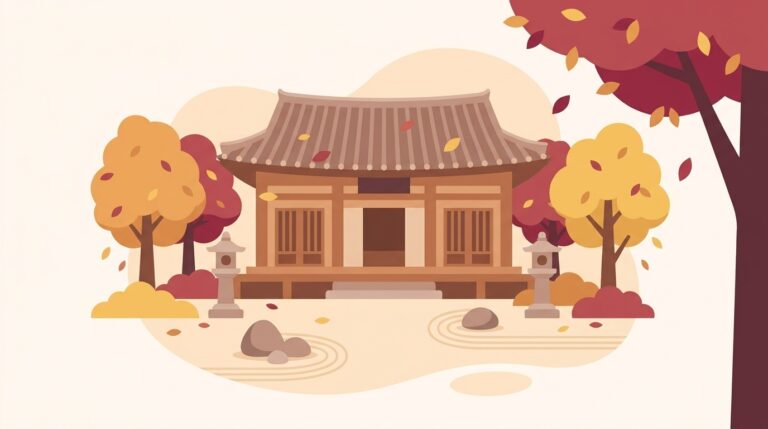
Phase 1: Empathy (스토리 몰입형 오프닝)
안녕하세요! 매일한글 에디터입니다.
Have you ever walked into a serene mountain temple in Korea like Bulguksa or Bongeunsa, inhaling the tranquil scent of cedar and incense, only to freeze right at the doorstep? Many K-Drama lovers know this iconic scene: the female lead in a historical drama softly kneels on a silk cushion, lights an incense stick, and clasps her hands together with teary eyes to pray for her family.
Inspired by that quiet beauty, you take off your shoes and step into the temple hall (Daeungjeon). But suddenly, your heart races: Which cushion can I step on? Where do I put my hands? What if I accidentally offend a monk? One of our beginner students, Sarah from Chicago, recently told us: “I stood by the doorway for ten minutes holding a bag of offering rice, terrified I’d do something disrespectful, so I ended up leaving without making my wish!”
Don’t worry—you don’t need to be a Buddhist monk to experience the deep healing of a Korean temple. Today, we’re unlocking the gentle art of 불공 드리기 (making Buddhist offerings and prayers) with easy A2-level Korean. By the end of this guide, you will know exactly what to say, how to bow gracefully, and how to leave your worries behind in complete peace.
Phase 2: 핵심 표현 3선 심층 분석
1. 마음이 편안해져요. (Maeum-i pyeon-an-hae-jyeo-yo.)
- Pronunciation: [Mae-um-ee pyun-an-hae-jyu-yo] (Think of ‘Mae’ like ‘May’ and ‘pyeon’ like ‘pun’ with a soft ‘y’)
- Meaning: Literal: “My mind/heart becomes comfortable.” | Real Nuance: “I feel so peaceful / at ease.”
- K-Culture Moment: You hear this in healing dramas whenever characters sit quietly on the wooden veranda (toenmaru) of a temple listening to the wind chimes (punggyeong).
- Editor’s Insight: 마음 (Maeum) means both “heart” and “mind.” In Korean culture, peace isn’t just a mental state; it’s a feeling that settles deep inside your chest.
- Situation Spectrum: Casual (마음이 편안해 ⚠️) | Semi-formal (마음이 편안해요 ✅) | Formal (마음이 편안해집니다 ✅)
- 🤔 Think About It: In English, we often say “I feel relaxed.” Why does Korean specifically highlight the “heart/mind becoming comfortable”?
2. 소원을 빌러 왔어요. (So-won-eul bil-leo wash-eo-yo.)
- Pronunciation: [So-won-eul beel-luh wat-uh-yo] (Rhymes with ‘bill’ + ‘uh’)
- Meaning: Literal: “I came to beg/pray for a wish.” | Real Nuance: “I’m here to make a wish / offer a prayer.”
- K-Culture Moment: In K-Dramas like Our Blues, local characters visit a temple before major life milestones—like a college exam or welcoming a newborn—saying this exact line to the temple guide.
- Editor’s Insight: The verb 빌다 (bilda) originally meant to earnestly beg or plead. When used with 소원 (wish), it carries humble, heartfelt devotion rather than demanding something from fate.
- Situation Spectrum: Casual (소원 빌러 왔어 ⚠️) | Semi-formal (소원 빌러 왔어요 ✅) | Formal (소원을 빌러 왔습니다 ✅)
- 🤔 Think About It: Notice how Korean uses “come in order to” (-(으)러 오다). How does stating your purpose upfront change how welcoming the other person feels?
3. 공양미 어디에 올려요? (Gong-yang-mi eo-di-e ol-lyeo-yo?)
- Pronunciation: [Gong-yang-mee uh-dee-eh ohl-lyuh-yo] (Gong-yang sounds like ‘gong’ + ‘yawn’)
- Meaning: Literal: “Where do I raise/place the offering rice?” | Real Nuance: “Where should I place this offering rice?”
- K-Culture Moment: Often seen in historical sageuk dramas where characters purchase a white bag of rice at the temple entrance to offer at the altar for good karma.
- Editor’s Insight: 공양미 (Gongyangmi) is ceremonial raw rice offered to the Buddha. The verb 올리다 (ollida) means “to elevate/lift up,” showing deep humility and respect toward the sacred space.
- Situation Spectrum: Casual (공양미 어디에 올려? 🚫) | Semi-formal (공양미 어디에 올려요? ✅) | Formal (공양미를 어디에 올리면 됩니까? ✅)
- 🤔 Think About It: Why does Korean use the verb “to raise up” (올리다) rather than simply “to put down” (놓다) when presenting an offering?
Phase 3: 교과서 한국어 vs 진짜 한국어
Situation 1: Expressing Your Prayer Wish
- 📖 교과서 한국어 (Textbook): 저는 부처님께 가족의 건강을 간절히 기도합니다. (Jeo-neun bu-cheo-nim-kke ga-jok-ui geon-gang-eul gan-jeol-hi gi-do-ham-ni-da. / “I earnestly pray to Buddha for my family’s health.”)
- 🗣️ 진짜 한국어 (Real-life Native): 가족들 건강하게 해 달라고 빌었어요. (Ga-jok-deul geon-gang-ha-ge hae dal-la-go bil-eoss-eo-yo. / “I prayed for my family to stay healthy.”)
- 💡 왜 다를까? Textbook Korean sounds like a script from a documentary. Real Koreans talk about prayer using the warm everyday pattern ~해 달라고 빌다 (“to pray asking for something”).
Situation 2: Asking Permission to Step Inside
- 📖 교과서 한국어 (Textbook): 제가 법당 내부에 들어가도 괜찮겠습니까? (Je-ga beop-dang nae-bu-e deul-eo-ga-do gwaen-chan-ket-seum-ni-kka? / “Would it be acceptable if I enter the interior of the dharma hall?”)
- 🗣️ 진짜 한국어 (Real-life Native): 안에 들어가 봐도 돼요? (An-e deul-eo-ga bwa-do dwae-yo? / “May I step inside and take a look?”)
- 💡 왜 다를까? Religious spaces are solemn, but everyday Buddhist volunteers (Bosal-nim) prefer gentle, humble, and conversational questions over stiff bureaucratic jargon.
Phase 4: K-Culture 딥다이브 & 비언어적 매너
4-1. 눈치 (Nunchi) & Temple Manners
- The Threshold Rule (문턱 밟지 않기): When entering the temple hall, never step directly onto the wooden door sill (문턱). Step over it! In traditional beliefs, stepping on the threshold invites bad luck or disrespects the guardian spirits.
- Side Doors Only (옆문 이용): The large central door is reserved for monks. Visitors and laypeople enter through the side doors (우측문/좌측문).
- Hapjang (합장 – Palms Together): Whenever you meet a monk or pass before the Buddha statue, press your palms flat together at chest height and bow your head slightly. It silently communicates: “My mind and your mind are one.”
4-2. Culture Code: Modern Healing & Templestay
Temples in Korea are no longer just places for senior citizens. Thanks to shows like Netflix’s Chef’s Table featuring Monk Jeong Kwan, young Koreans frequently head out on weekend 템플스테이 (Templestay) programs to disconnect from competitive city life, eat vegan temple food (사찰음식), and practice 108배 (108 prostrations) to empty their minds (마음 비우기).
Phase 5: 실전 롤플레이 시나리오
Setting: Bongeunsa Temple, a quiet oasis surrounded by skyscrapers in Gangnam, Seoul. The autumn breeze carries the sound of wooden clappers (moktak).
Characters:
* Alex: A beginner traveler visiting a Korean temple for the first time.
* Bosal-nim (보살님): A gentle elderly female Buddhist volunteer wearing a gray hanbok vest.
Alex: 저… 실례합니다. 안에 들어가 봐도 돼요?
(Jeo… sil-lye-ham-ni-da. An-e deul-eo-ga bwa-do dwae-yo?)
“Um… excuse me. May I look inside?”
🎭 Clasping hands together timidly near the side entrance
Bosal-nim: 네, 신발 벗고 조용히 들어오세요.
(Ne, sin-bal beot-go jo-yong-hi deul-eo-o-se-yo.)
“Yes, please take off your shoes and enter quietly.”
🎭 Pointing warmly to the wooden shoe rack by the step
Alex: 네, 감사합니다. 저 소원을 빌러 왔어요.
(Ne, gam-sa-ham-ni-da. Jeo so-won-eul bil-leo wash-eo-yo.)
“Yes, thank you. I came here to make a wish.”
🎭 Holding a small bag of offering rice carefully with both hands
Bosal-nim: 어머, 그래요? 공양미는 저기 불단 위에 올리시면 돼요.
(Eo-meo, geu-rae-yo? Gong-yang-mi-neun jeo-gi bul-dan wi-e ol-li-si-myeon dwae-yo.)
“Oh, really? You can place your offering rice on the altar over there.”
🎭 Whispering softly and gesturing toward the golden altar
Alex: 알겠습니다. 절은 어떻게 해요?
(Al-get-seum-ni-da. Jeol-eun eo-tteoh-ge hae-yo?)
“Got it. How do I bow?”
🎭 Glancing at the square cushions on the wooden floor
Bosal-nim: 방석 위에 무릎 꿇고 삼배를 하세요.
(Bang-seok wi-e mu-reup kkwul-go sam-bae-reul ha-se-yo.)
“Kneel on the cushion and bow three times.”
🎭 Demonstrating a calm Hapjang posture with palms joined
Alex: 네. 여기 오니까 마음이 정말 편안해져요.
(Ne. Yeo-gi o-ni-kka maeum-i jeong-mal pyeon-an-hae-jyeo-yo.)
“Yes. Coming here makes my heart feel so peaceful.”
🎭 Breathing out a long, relieved sigh with a gentle smile
Bosal-nim: 다행이네요. 부처님이 소원을 꼭 들어주실 거예요.
(Da-haeng-i-ne-yo. Bu-cheo-nim-i so-won-eul kkok deul-eo-ju-sil geo-ye-yo.)
“I’m glad. Buddha will surely listen to your wish.”
🎭 Bowing her head slightly in warm encouragement
🔀 인터랙티브 분기점 (Interactive Choice)
You just finished your 3 prostrations before the altar. How do you leave the hall?
- Option A: Stand up quietly, step backward 2-3 paces while facing the Buddha statue with hands together (합장), then turn toward the side door.
👉 Feedback [Best]: Perfect Nunchi! Never immediately turn your back squarely on the altar. Backing up slightly shows top-tier cultural respect. - Option B: Turn around immediately, pull out your smartphone, and snap a selfie using the front camera flash.
👉 Feedback [Bad]: Major faux pas! Indoor photography during prayers—especially with flash—disrupts everyone’s meditation. - Option C: Shout “감사합니다! (Thank you!)” across the room to the monk at the front.
👉 Feedback [Risk]: Your intention is sweet, but temple halls require library-level silence. A silent nod is much better.
Phase 6: 10초 감정 섀도잉 드릴
Master the natural rhythm and intonation by pausing at the / marks!
[🙏 차분하고 조심스럽게 - Calm & Respectful]
저… / 실례합니다. / 안에 / 들어가 봐도 돼요?
(Jeo… / sil-lye-ham-ni-da. / An-e / deul-eo-ga bwa-do dwae-yo?)-
[✨ 진심을 담아 따뜻하게 - Earnest & Warm]
가족들 / 건강하게 / 해 달라고 / 빌었어요.
(Ga-jok-deul / geon-gang-ha-ge / hae dal-la-go / bil-eoss-eo-yo.) -
[😌 깊은 안도감을 느끼며 - Deeply Relaxed & Peaceful]
여기 오니까 / 마음이 / 정말 / 편안해져요.
(Yeo-gi o-ni-kka / maeum-i / jeong-mal / pyeon-an-hae-jyeo-yo.)
Phase 7: K-Culture 미니 사전
- 불공 (Bul-gong): Buddhist worship / offering rites. Frequently used when visiting temples on lunar calendar holidays (초하루 or Buddha’s Birthday).
- 합장 (Hap-jang): Pressing palms together at the chest. The universal Buddhist gesture of greeting, gratitude, and peace.
- 문턱 (Mun-teok): Raised wooden door threshold. In Korean architecture, stepping over it without touching it is a sign of good upbringing.
- 삼배 (Sam-bae): Bowing three times (prostrations). Represents honoring the Buddha, his teachings (Dharma), and the community (Sangha).
Phase 8: 여행자를 위한 생존 키트
Survival Expressions TOP 3
- 사진 찍어도 돼요? (Sa-jin jjik-eo-do dwae-yo?)
Pro Tip: Always ask before photographing monks or indoor altars. Outdoor temple grounds are usually fine! - 신발 어디에 둬요? (Sin-bal eo-di-e dwo-yo?)
Pro Tip: Temple halls have wooden shelving right outside the entrance. Slip your shoes in neatly facing forward. - 조용히 할게요. (Jo-yong-hi hal-ge-yo.)
Pro Tip: If your phone rings or your friend talks loudly, whisper this to show you are self-aware.
Editor’s Travel Note
- Navigation: Searching for remote mountain temples in Google Maps often leads to dead ends. Use the 네이버 지도 앱 다운로드 (Naver Map App Download) to check accurate temple shuttle buses and walking trails.
- Temple Stays: If you want an overnight experience with monks, book directly via the 템플스테이 공식 예약 사이트 (Official Templestay Reservation Site).
Phase 9: “한 발 더 깊이” (생각 질문)
In Western wish-making (like blowing birthday candles or wishing on shooting stars), the wish is often deeply individualistic and kept secret. In Korean temple culture, however, making a wish (소원 빌기) almost always begins with collective well-being: the health of one’s parents, peace in the family, or safety for loved ones. Praying is not seen as demanding personal riches from the universe, but rather clearing out internal clutter (마음 비우기) to make room for kindness.
💬 Your Turn: When you visit a peaceful place, what kind of wish do you find yourself thinking about first? Share your thoughts in the comments below!
Phase 10: FAQ & 오해 방지
Q: Can non-Buddhists or foreigners enter the main Buddha hall?
A: Absolutely! Korean temples are open to everyone regardless of faith or nationality, as long as you remove your shoes, step over the door sill, and maintain quiet respect.
Q: Do I have to buy expensive offering items to pray?
A: Not at all. While buying offering rice (공양미) or a candle (초) for 3,000–5,000 KRW supports the temple, simple respectful bowing (삼배) with pure sincerity (정성) is completely free and welcome.
Q: Can I wear shorts or sleeveless tops when visiting a temple in summer?
A: It’s best to dress modestly. Extremely short shorts, miniskirts, or deep tank tops are considered inappropriate inside sacred halls. Bringing a light scarf or linen trousers is highly recommended.
🚨 흔한 실수 (Common Mistakes) 경고판
- Mistake: Stepping firmly on the wooden threshold (문턱).
Correct Action: Step cleanly over it into the room. - Mistake: Walking directly across the front of someone doing deep prostrations.
Correct Action: Walk along the back wall or side edges of the hall to avoid blocking their line of sight to the altar. - Mistake: Sitting with legs outstretched pointing your feet straight at the Buddha statue.
Correct Action: Cross your legs (양반다리) or kneel (무릎 꿇기) so the soles of your feet face away from the altar.
Phase 11: 액션 미션 & 참여 유도
- 🥉 Bronze Mission (Solo): Stand in front of a mirror, bring your hands together in 합장 (Hapjang), and practice saying: “마음이 편안해져요.” three times.
- 🥈 Silver Mission (Social): Share a photo of a serene spot you like on Instagram or X, using the caption: “소원을 빌러 왔어요. 마음이 편안해져요! #DailyHangul #TempleKorean”
- 🥇 Gold Mission (Real Life): Next time you visit a temple or quiet cultural landmark in Korea, politely whisper to the attendant: “안에 들어가 봐도 돼요?”
- 🎮 K-Culture Mission: Watch an episode of a historical drama (Sageuk) or reality show like Three Meals a Day and spot someone making the 합장 gesture!
Phase 12: 인터랙티브 퀴즈 챌린지
1. Situational Judgment
You bought a bag of offering rice (공양미) at a temple shop. You step inside the main hall. What is the most appropriate question to ask the volunteer?
* A) 이거 환불해 주세요. (I-geo hwan-bul-hae ju-se-yo.)
* B) 공양미 어디에 올려요? (Gong-yang-mi eo-di-e ol-lyeo-yo?)
* C) 밥솥이 어디 있어요? (Bap-sot-i eo-di iss-eo-yo?)
Click to reveal answer & explanation
Correct Answer: B
Explanation: Option B politely asks where to offer the rice. Option A asks for a refund, and Option C asks where the rice cooker is! (Remember, offering rice is raw and placed symbolically on the altar, not cooked on the spot!)
2. Fill-in-the-Blank
Fill in the missing verb marker:
“가족 건강하게 해 달라고 [ _______ ].” (I prayed for my family’s health.)
Click to reveal answer & explanation
Correct Answer: 빌었어요 (bil-eoss-eo-yo)
Explanation: The past tense of 빌다 (to pray/wish) is 빌었어요.
3. Cultural True / False
Statement: When entering a Korean temple dharma hall, stepping on top of the door threshold (문턱) brings extra good luck.
Click to reveal answer & explanation
Correct Answer: False (X)
Explanation: You must never step on the threshold; always step over it! Stepping on it is considered impolite in traditional Korean architecture.







