

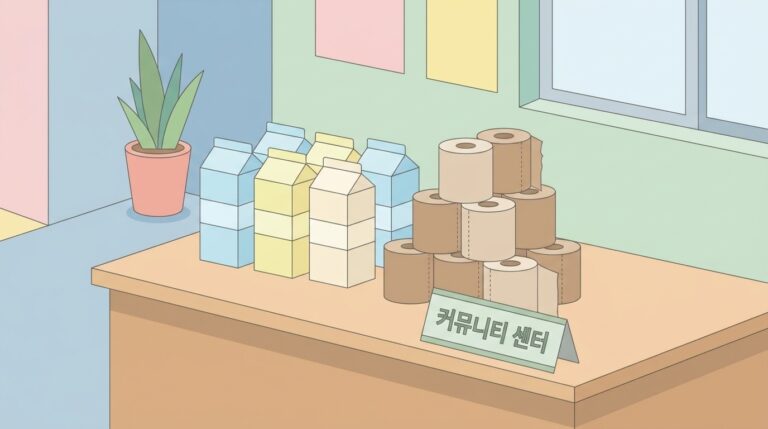
Phase 1: 공감 (Story-Driven Opening)
안녕하세요! 매일한글 에디터입니다.
If you have lived in South Korea for more than a week, you have likely encountered the formidable ritual known as bunri-baechool (분리배출, separate trash disposal). Picture this scenario straight out of an episode of My Liberation Notes or a relatable scene from I Live Alone: It is Sunday night. You are standing in the basement parking lot or recycling corner of your villa complex, meticulously rinsing an emptied carton of Seoul Milk (서울우유). You peel off the plastic cap, slice the cardboard down the seam with kitchen scissors, flatten it like an origami master, and hang it on your drying rack. Why? Because you heard through the local expat grapevine—or witnessed your seasoned Korean neighbor auntie (ajumma) do it—that if you take a stack of these spotless cartons to the local Jumin Center (주민센터 / Community Service Center), they will exchange them for premium rolls of toilet paper (hwajangji) or standard municipal trash bags (jongnyangje bongtu).
Yet, as an advanced learner walking into a bustling administrative ward office in Mapo-gu or Gangnam-gu, you feel that sudden prickle of anxiety. You know how to order an iced Americano with your eyes closed, but how do you navigate the high-context, ultra-bureaucratic, yet delightfully transactional world of municipal eco-rewards without sounding like an archaic textbook robot? Based on authentic field inquiries from our advanced students who wanted to integrate into authentic neighborhood life, this comprehensive guide offers the refined idioms, administrative register, and nuanced socio-cultural codes necessary to claim your green rewards like a born-and-raised local.
Phase 2: 핵심 표현 3선 심층 분석 (Deep-Dive Core Expressions)
1. 우유팩 깨끗이 씻어서 말려 왔는데, 화장지로 교환 가능한가요?
- Pronunciation: Uyu-paek kkaekkeusi ssiseoseo mallyeo wanneunde, hwajangji-ro gyohwan ganeunghangayo? (Pronunciation tip: Link ssiseoseo smoothly like “see-seo-seo”, and softly articulate the nasal -ngayo at the end like a gentle musical hum).
- Meaning: “I washed and dried these milk cartons thoroughly; can I exchange them for toilet paper?”
- K-Culture Moment: Seen frequently in slice-of-life variety programs where celebrities proud of their thrifty household hacks (sal-lim 9-dan) bring stacks of cartons into their local ward office with understated pride.
- Editor’s Insight: Notice the use of the background-setting connective particle -neunde (왔는데). At a C2 level, you do not just command “Please exchange this” (교환해 주세요). You establish the context that you fulfilled the required conditions (washing and drying) before posing the polite administrative question. This displays deference to the civil servant’s protocol.
- Situation Spectrum: Casual: ⚠️ | Semi-formal: ✅ | Formal: ✅
- 🤔 Think About It: In many Western municipalities, recycling is collected anonymously in large curbside bins. Why do you think Korea’s civic culture emphasizes in-person administrative exchanges for mundane items like paper cartons?
2. 혹시 종이팩 수거 보상 사업 아직 진행 중인가요?
- Pronunciation: Hoksi jong-i-paek sugeo bosang sa-eop ajik jinhaeng jung-ingayo? (Pronunciation tip: Pronounce sa-eop with a crisp glottal release between sa and eop, avoiding blending it into a single sluggish syllable).
- Meaning: “By any chance, is the paper carton collection incentive program still running?”
- K-Culture Moment: An essential phrase used by proactive apartment council leaders in community K-dramas when local district budgets (gu-cheong yesan) deplete toward late autumn.
- Editor’s Insight: The administrative terminology shines here. Instead of simply saying uyu-paek bakkwojuneun geo (milk carton changing thing), you elevate the conversation by utilizing Sino-Korean compound nouns: sugeo (collection), bosang (compensation/incentive), and sa-eop (program/initiative). Starting with hoksi (by any chance) cushions the inquiry.
- Situation Spectrum: Casual: 🚫 | Semi-formal: ✅ | Formal: ✅
- 🤔 Think About It: How does utilizing institutional vocabulary (sugeo bosang sa-eop) shift the civil servant’s perception of your fluency compared to everyday conversational phrases?
3. 자원 순환 차원에서 소소하게 동참해 보려고요.
- Pronunciation: Jawon sunhwan cha-woneseo sosokage dongchamhae boryeogoyo. (Pronunciation tip: The double consonant in sosohage requires a soft, clean breath; keep the rhythm bouncing naturally).
- Meaning: “I’d like to take part in a modest way for the sake of resource circulation.”
- K-Culture Moment: The quintessential humble-brag line an environmentally conscious protagonist in an indie K-film delivers when praised by an elder for being civic-minded.
- Editor’s Insight: This phrase delivers the golden mean of Korean social aesthetics: public-spirited virtue (jawon sunhwan, circular economy) balanced by traditional modesty (sosohage, in a modest/small way). It softens what could otherwise seem like a purely transactional pursuit of free household goods.
- Situation Spectrum: Casual: ⚠️ | Semi-formal: ✅ | Formal: ✅
- 🤔 Think About It: Compare the humility of sosohage with English expressions like “doing my part.” What does the deliberate downplaying of one’s virtue say about Korean interpersonal etiquette?
Phase 3: 교과서 한국어 vs 진짜 한국어 (Textbook vs. Authentic Korean)
Situation 1: Inquiring about the carton-to-tissue exchange ratio
- 📖 교과서 한국어 (Textbook):
우유팩을 몇 개 주면 화장지를 한 개 줍니까?
(Uyu-paek-eul myeot gae jumyeon hwajangji-reul han gae jumnikka? – “If I give how many milk cartons, do you give one roll of toilet paper?”) - 🗣️ 진짜 한국어 (Real-World C2):
교환 기준이 어떻게 돼요? 킬로그램(kg) 단위로 재나요, 아니면 개수 기준인가요?
(Gyohwan gijun-i eotteoke dwaeyo? Killogeuraem dan-wiro jaenayo, animyeon gaesu gijun-ingayo? – “What are the exchange criteria? Do you weigh it by the kilogram, or go by unit count?”) - 💡 왜 다를까? (Why the Difference?): Local administrative districts (gu or dong) enforce differing bylaws. Some measure dry cartons by weight (e.g., 1kg of cartons for 2 rolls), while others count standard 1,000ml cartons (e.g., 10 to 20 cartons for 1 roll). A native resident directly asks for the operational metrics (gijun) rather than phrasing it like an elementary math problem.
Situation 2: Distinguishing aseptic foil-lined packs from standard fresh cartons
- 📖 교과서 한국어 (Textbook):
이 은색이 있는 두유 팩도 받아 줍니까?
(I eunsaek-i inneun duyu paek-do bada jumnikka? – “Do you accept this soymilk carton that has silver inside?”) - 🗣️ 진짜 한국어 (Real-World C2):
멸균팩도 일반 종이팩이랑 합산해서 쳐주시나요?
(Myeolgyun-paek-do ilban jong-i-paek-irang hapsanhaeseo chyeojusinayo? – “Do you count aseptic packs together with regular cartons toward the total?”) - 💡 왜 다를까? (Why the Difference?): Advanced natural Korean leverages precise industry classifications: myeolgyun-paek (sterilized/aseptic packs with aluminum linings) versus ilban jong-i-paek (refrigerated cartons). The colloquial administrative verb chyeojuda (to credit / count favorably toward a value) captures the exact conversational nuance among adults.
Phase 4: K-Culture 딥다이브 & 비언어적 매너 (Deep-Dive & Manners)
4-1. 눈치 (Nunchi) & Administrative Bureaucracy Etiquette
- The Two-Handed Handover: Never dump your milk cartons onto the counter. Present them neatly bound by rubber bands or packed in a paper bag. Hand the bundle over using both hands—or supporting your right forearm with your left hand—demonstrating respect for the civil servant (jumu-gwan).
- The Golden Timing (12:00–13:00 Lunch Trap): Never visit between 12:00 PM and 1:00 PM. While government centers operate staggered lunch rotations, staff levels are minimal, and handling physical items like scales and paper stock creates unwanted friction during their break hours. The optimal window is a calm 10:30 AM or 2:30 PM.
- The Visual Inspection (검수, Geomsu): The civil servant will quickly check whether the cartons are fully dried and free of sour milk odor. Stand upright, maintain soft eye contact, and nod appreciatively as they check your items.
4-2. The Cultural Code: From Post-War Scarcity to Hyper-Modern Eco-Virtue
Korea’s passion for carton collection stems from historical resource management. Wood pulp in South Korea is almost entirely imported. High-grade milk cartons are made from virgin long-fiber chemical pulp (cheon-yeon-peolpeu), which is far too valuable to be discarded into standard cardboard scrap. The government established this incentive scheme not merely to collect waste, but to reinforce an ethic of bunri-baechool that dates back to the Saemaeul Undong (New Village Movement) spirit of communal uplift.
Phase 5: 실전 롤플레이 시나리오 (Interactive Roleplay Scenario)
Setting: The Civil Affairs Office (Min-won-sil) of Yeoman-dong Community Service Center, Mapo-gu. Rain is drizzling outside. The air smells of wet umbrellas and hot barley tea. Civil servant Ms. Park (Park Jumu-gwan) is stamping documents behind Counter 3.
Characters:
* 민원인 (Visitor / You): A linguistically adept foreign resident bearing a neat bundle of 20 dried milk cartons.
* 박 주무관 (Civil Servant Park): A polite, slightly hurried, yet dedicated administrative officer.
- 민원인: 안녕하세요, 주무관님. 우유팩 교환 사업 담당 창구가 여기가 맞을까요?
- Annyeonghaseyo, jumu-gwan-nim. Uyu-paek gyohwan sa-eop damdang chang-gu-ga yeogi-ga majeulkkayo?
- “Hello, officer. Is this the right counter for the milk carton exchange initiative?”
🎭 (Demeanor: Polished smile, holding the paper bag containing cartons with both hands)
- 박 주무관: 네, 맞습니다! 오늘 가져오신 팩 이쪽에 올려두시겠어요?
- Ne, matseumnida! Oneul gajyeo-osin paek i-jjoge ollyeo-dusigesseoyo?
- “Yes, that’s correct! Could you place the cartons you brought today right here?”
🎭 (Demeanor: Gesturing toward the digital scale on the side counter)
- 민원인: 깨끗하게 세척해서 바짝 말려왔습니다. 대략 스무 장 정도 되는데 한번 확인해 주시겠어요?
- Kkaekkeutage secheokhaeseo bajjak mallyeowatseumnida. Daeryak seumu jang jeongdo doeneunde hanbeon hwaginhae jusigesseoyo?
- “I washed them thoroughly and dried them completely. There are about twenty; would you mind taking a look?”
🎭 (Demeanor: Untying the neat hemp twine bundle gently)
- 박 주무관: 어머, 정말 꼼꼼하게 손질해 오셨네요! 원래 멸균팩은 단가가 달라서 따로 분리해야 하는데, 일반 우유팩만 모아오셔서 일 처리가 빠르겠어요.
- Eomeo, jeongmal kkomkkomhage sonjilhae osyeotneyo! Wonlae myeolgyun-paek-eun dan-ga-ga dallaseo ttaro bunrihaeya haneunde, ilban uyu-paek-man mo-a-osyeoseo il cheori-ga ppareugesseoyo.
- “Oh my, you prepped them so meticulously! Usually aseptic cartons have a different rate and must be separated, but since you brought only regular cartons, this will be quick.”
🎭 (Demeanor: Flipping through the cartons with an impressed expression)
- 민원인: 혹시 마포구는 교환 기준이 롤 화장지인가요, 아니면 종량제봉투도 선택 가능한가요?
- Hoksi Mapo-gu-neun gyohwan gijun-i rol hwajangji-in-gayo, animyeon jongnyangje-bongtu-do seontaek ganeunghangayo?
- “By the way, does Mapo District issue toilet paper rolls, or can we also opt for standardized trash bags?”
🎭 (Demeanor: Inquiring with natural curiosity)
- 박 주무관: 저희 동은 우유팩 1kg당 롤 화장지 두 개 또는 10리터 종량제봉투 한 장 중에서 고르실 수 있어요. 지금 저울에 달아보니 딱 1kg 나오네요!
- Jeohui dong-eun uyu-paek il-kil-lo-geuraem-dang rol hwajangji du gae ttoneun sip-liteo jongnyangje-bongtu han jang jung-eseo goreusil su isseoyo. Jigeum jeo-ul-e daraboni ttak il-kil-lo-geuraem na-oneyo!
- “In our ward, you can pick between two rolls of toilet paper or one 10-liter trash bag per 1kg of cartons. Putting them on the scale now, it’s exactly 1kg!”
🎭 (Demeanor: Tapping the digital ledger screen and pointing to the shelf behind her)
- 민원인: 생활 밀착형 혜택이라 아주 쏠쏠하네요. 저는 롤 화장지로 부탁드리겠습니다.
- Saenghwal milchak-hyeong hyetaek-ira aju ssolssolhaneyo. Jeoneun rol hwajangji-ro butakdeurigesseumnida.
- “This everyday practical benefit feels delightfully rewarding. I’ll take the toilet paper, please.”
🎭 (Demeanor: Delivering a lighthearted chuckle and signing the ledger book)
- 박 주무관: 자, 여기 엠보싱 화장지 두 롤 드렸습니다. 명부에 성함이랑 연락처만 간단히 기재해 주세요. 수고 많으셨어요!
- Ja, yeogi embosing hwajangji du rol deuryeotseumnida. Myeongbu-e seongham-irang yeollakcheo-man gandanhi gijaehae juseyo. Sugo maneusyeosseoyo!
- “Here you are, two rolls of embossed toilet paper. Please just write your name and contact number on the roster. Thank you for your effort!”
🎭 (Demeanor: Offering the branded tissue pack over the desk with both hands)
🔀 Interactive Branching Moment: What should you say after receiving your tissue?
- Choice A: “이거 공짜로 받으니까 기분 째지네요! 매주 올게요.” (Igeogongjjarobadeunikka gibun jjaejineyo! Maeju olgeyo.)
- Choice B: “소소하지만 환경보호에도 일조하는 것 같아 보람 있네요. 다음번에도 잘 모아서 오겠습니다. 수고하세요!” (Sosohajiman hwan-gyeongboho-edo iljohaneun geot gata boram itneyo. Da-eumbeon-edo jal mo-aseo ogesseumnida. Sugohaseyo!)
- Choice C: “봉투는 안 주나요? 들고 가기 불편한데 비닐봉지 하나만 주세요.” (Bongtaneun an junayo? Deulgo gagi bulpyeonhande binilbongji hanaman juseyo.)
Feedback:
* Choice A (Risk): While colloquial, gibun jjaejineyo (I feel wildly stoked) and focusing aggressively on gongjja (freebies) damages your image in a public office setting.
* Choice B (Best): Pure cultural mastery. Combining iljo-hada (to contribute/play a part) and boram itda (to be deeply rewarding/meaningful) showcases elite civic refinement.
* Choice C (Bad): Asking for a disposable plastic bag (binilbongji) at an eco-incentive recycling exchange desk will trigger instant administrative side-eye. Carry your own eco-bag! (Eko-baek).
Phase 6: 10초 감정 섀도잉 드릴 (10-Second Emotional Shadowing Drill)
Repeat these three lines aloud, observing the emotional cue and cadence pauses marked by /.
[😊 공손하고 조심스럽게 - Polite & Circumspect]
우유팩 깨끗이 세척해서 말려왔는데요, / 교환 창구가 / 여기가 맞을까요?
Uyu-paek kkaekkeusi secheokhaeseo mallyeowanneundeyo, / gyohwan chang-gu-ga / yeogi-ga majeulkkayo?
(I’ve cleaned and dried milk cartons… is this counter the right one?)-
[😌 뿌듯하고 세련되게 - Proud & Refined]
소소하지만 / 자원 순환에 동참하니까 / 환경도 지키고 / 보람도 크네요.
Sosohajiman / jawon sunhwan-e dongchamhanikka / hwan-gyeong-do jikigo / boram-do keuneyo.
(Though modest, participating in resource cycling protects nature and feels rewarding.) -
[🤝 유쾌하고 화답하듯 - Upbeat & Gracious]
덕분에 생활에 보탬이 됩니다. / 다음에도 / 부지런히 모아서 찾아뵐게요!
Deokbune saenghwal-e botaem-i doemnida. / Da-eum-edo / bujireonhi mo-aseo chajabwoelgeyo!
(Thanks to this, it helps household living. I’ll collect diligently and return next time!)
Phase 7: K-Culture 미니 사전 (Mini-Dictionary)
- 행정복지센터 (Haengjeong Bokji Senteo) | Noun | Officially titled Community Service Center (formerly called Dongsamuso or Jumin Center). This local civil administrative hub handles resident registration (deungbon), welfare distributions, and neighborhood eco-initiatives.
- 종량제봉투 (Jongnyangje Bongtu) | Noun | Volume-rate standard municipal garbage bags. In Korea, you cannot throw away non-recyclable domestic waste in standard bags; you must purchase these government-stamped bags, which fund municipal waste treatment.
- 분리배출 (Bunri Baechool) | Noun | Literal meaning: separate discharge. The stringent Korean discipline of categorizing discardables into clear PET bottles, regular plastics, vinyl, aluminum cans, glass, and cartons.
- 자원순환 (Jawon Sunhwan) | Noun | Resource circulation / Circular economy. An advanced keyword ubiquitous in government public campaigns, corporate ESG reports, and civic environmental drives.
Phase 8: 여행자를 위한 생존 키트 (Traveler’s Survival Kit)
TOP 3 Survival Phrases
- 근처에 행정복지센터가 어디에 있나요?
- Geuncheo-e haengjeong bokji senteo-ga eodie innayo?
- Pro Tip: Use this when exploring residential neighborhoods if you need clean restrooms or local civic resources.
- 종이팩 수거 요일이 따로 정해져 있나요?
- Jong-i-paek sugeo yoil-i ttaro jeonghaejyeo innayo?
- Pro Tip: Certain districts (gu) only conduct exchanges on specific days, such as “Recycling Wednesdays” (Jaewalyong Day).
- 종량제봉투 어디서 사요?
- Jongnyangje bongtu eodiseo sayo?
- Pro Tip: Essential for long-term Airbnb visitors. You buy these at convenience stores or local supermarkets at the cashier counter.
Editor’s Travel Note: Living Like a Local
To locate your neighborhood administrative hub without typing complex Korean addresses, consult the Naver Map Application Search. Simply type 주민센터 into the search bar, and it will pinpoint the exact administrative zone you reside in. Make sure to download the Smart Seoul Map Official Guide to examine district-by-district zero-waste incentive programs (Zero Seoul initiatives).
Phase 9: “한 발 더 깊이” (Cultural Philosophical Essay)
In South Korea, recycling is not merely an environmental task; it functions as a modern manifestation of pumasi (품앗이)—the ancient agrarian ethic of communal mutual aid. When citizens meticulously wash, cut, and stack their milk cartons before surrendering them to their local community center, they are participating in a silent social contract that values collective well-being over individual convenience. Receiving a roll of toilet paper in return is not viewed as a simple purchase; it is a tangible validation from the community that your mundane labor has preserved the collective harmony of the nation’s shared space.
💬 Your Turn: Does your home country offer direct municipal tangible rewards (like household goods or cash deposits) for everyday recycling, or is it governed purely by voluntary bin disposal? Share your neighborhood’s eco-traditions in the comments below!
Phase 10: FAQ & 오해 방지 (FAQ Schema)
Q: Do all Community Service Centers in Seoul exchange milk cartons for toilet paper?
A: While the vast majority of autonomous districts (gu) participate, each municipal council determines its own budget and distribution policies. Some offer toilet paper, others offer 10L garbage bags, and some offer rechargeable transit card credits or eco-mileage. Always call or check your local district office (gu-cheong) website under the cleaning administration (Cheongso Haengjeong-gwa) section before making the trek.
Q: Can I bring unwashed cartons if I have a large volume?
A: Absolutely not. Unwashed or unflattened cartons will be rejected on the spot. Sour dairy residue contaminates storage bins and makes pulp processing impossible. To be eligible, cartons must be rinsed clean, opened completely flat along the bottom fold, and dried thoroughly.
Q: Are almond milk or soy milk boxes treated the same as regular milk cartons?
A: They are categorized as myeolgyun-paek (aseptic packs) if they have an aluminum inner lining. Some community centers accept them on an identical weight-exchange basis, while others maintain a lower exchange rate or accept them exclusively on designated monthly collection days. Ask your officer: “멸균팩도 수거 대상인가요?” (Myeolgyun-paek-do sugeo daesang-in-gayo? – “Are aseptic packs also eligible for collection?”).
🚨 Common Mistakes Alert (흔한 실수)
- Throwing wet cartons into a sealed plastic bag: Even 24 hours sealed while damp produces mold and foul odors. Always ensure they are bone-dry.
- Leaving plastic spout rings attached: Modern milk cartons frequently feature plastic screw caps. You must remove the plastic ring assembly (peullaseutik kaep) completely before flattening.
- Visiting on national holidays or elections: Korean Community Centers act as primary voting stations during elections and are strictly closed for administrative services on national red days (gonghyu-il).
Phase 11: 액션 미션 & 참여 유도 (Action Missions)
- 🥉 Bronze Level: Wash, cut open, and flatten your next three milk cartons or plant-milk boxes at home. Dry them completely on your dish rack.
- 🥈 Silver Level: Snap an aesthetic photo of your neatly stacked, flat-folded cartons with the caption: “자원 순환 실천 중! 주민센터 교환 준비 완료” and tag your Instagram or Threads post with #매일한글 #ZeroWasteKorea.
- 🥇 Gold Level: Visit your local Haengjeong Bokji Center with at least ten dried cartons, ask the officer for the exchange counter using our core dialogue, and successfully exchange them for toilet paper or a trash bag!
🎮 K-Culture Mission: On your next viewing of an episode of I Live Alone (나 혼자 산다) or Omniscient Interfering View (전지적 참견 시점), look closely at the kitchen drying racks of Korean celebrities. Spot whether they dry their paper cartons alongside their dishes!
Phase 12: 인터랙티브 퀴즈 챌린지 (Interactive Quiz)
1. Situation Judgment Quiz:
You arrive at the Community Service Center with 15 flattened cartons. The civil servant mentions they only accept cartons on “재활용의 날” (Recycling Days) in this particular neighborhood. What is the most refined C2 response?
* (A) “왜요? 다른 동네는 다 해주는데 왜 여기만 안 해줘요?”
* (B) “아, 동마다 지침이 다른 줄 몰랐네요. 이번 주 재활용 지정 요일이 언제인지 알려주실 수 있나요?”
* (C) “그냥 이번 한 번만 특별히 바꿔주시면 안 돼요?”
2. Fill in the Blank:
“자원 ______ 차원에서 소소하게 참여하고 있습니다.”
* (A) 순환 (sunhwan – circulation)
* (B) 소멸 (somyeol – extinction)
* (C) 방치 (bangchi – neglect)
3. True or False:
All carton exchange programs in Korea only accept dairy milk cartons, and never accept plant milk (almond, oats, soy) aseptic cartons under any circumstances.
* (True / False)
👉 Click here to reveal the answers and explanations!
Answers:
1. (B) In advanced Korean administrative dialogue, arguing (A) or begging for exceptions (C) diminishes your standing. Inquiring politely about local guidelines displays sophistication.
2. (A) 순환 (sunhwan) – The correct compound noun is 자원 순환 (Resource Circulation).
3. False – Many districts accept aseptic packs (myeolgyun-paek), though they may weigh or sort them separately from chilled paper cartons.







