

Phase 1: Empathy & Story Opening
안녕하세요! 매일한글 에디터입니다. (Hello! This is your Daily Hangul editor.)
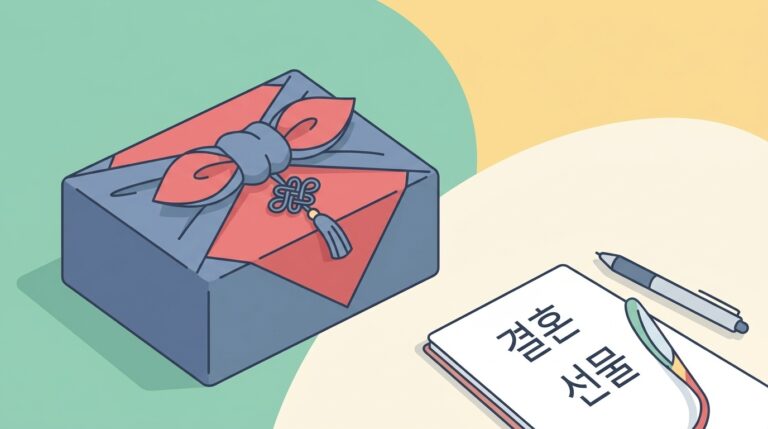
Picture this classic K-Drama scene: It is an evening in a quiet Seoul residential neighborhood when suddenly, booming shouts echo between apartment blocks: “함 사세요! 함 사세요!” (Buy the wedding box!). Out on the street, the groom’s closest buddies are making a dramatic entrance. The lead friend, known as the hamjinabi, wears a hilarious dried squid mask (ojingeo gamyeon) over his face and carries a heavy wooden box wrapped in crimson and royal blue silk (bojagi). With every single footstep forward, the friends stop, playfully demanding envelopes of pocket money, laughter, and drinks from the bride’s waiting family before relinquishing the treasure.
For many international partners stepping into the world of Korean wedding traditions, this spectacle—along with the intricate web of yedan (gifts from the bride’s family to the groom’s) and yemul (gifts exchanged between the couple)—can feel intensely overwhelming. You might ask yourself: Am I supposed to buy expensive luxury goods? What happens if I use the wrong honorifics with my prospective in-laws? Will I commit an unforgivable cultural faux pas?
Breathe easy! Having guided hundreds of intercultural couples through family meetings over the past decade, I can tell you that modern Koreans value genuine emotional sincerity (jeongseong) far more than outdated, expensive checklists. In this guide, tailored specifically for intermediate learners (CEFR B2), you will unlock the authentic vocabulary, nuanced etiquette, and cultural context you need to navigate Korean wedding gift customs with effortless confidence.
Phase 2: Core Expressions Deep Dive
Here are three foundational expressions you will encounter when discussing or experiencing traditional Korean wedding gifts.
1. 함 사세요! (Ham saseyo!)
- Pronunciation: [Ham sa-se-yo] (Sounds like the English word Hum followed by saw-say-yo)
- Meaning: Literal: “Buy the wedding chest!” | Nuance: A boisterous, festive street ritual call announcing that the groom’s symbolic gift delivery has arrived.
- K-Culture Moment: Seen in neighborhood dramas like Reply 1988 and family weekend series where the entire neighborhood gathers around to watch the bride’s family negotiate with the groom’s friends.
- Editor’s Insight: Although contemporary city apartments often skip the loud street spectacle due to noise complaints, the phrase remains a cultural shorthand for entering the final stage of wedding preparation.
- Situation Spectrum: Casual: ✅ | Semi-formal: ⚠️ | Formal: 🚫
- 🤔 Think About It: Why do you think Korean tradition involved the whole neighborhood in what seems like a private family exchange?
2. 약소하지만 정성껏 준비했습니다. (Yaksohajiman jeongseongkkeot junbihaesseumnida.)
- Pronunciation: [Yak-so-ha-ji-man jeong-seong-kkeot jun-bi-haet-seum-ni-da] (Pronounce yak-so crisply, with a gentle nasal flow on jeong-seong)
- Meaning: Literal: “It is meager, but we prepared it with wholehearted devotion.” | Nuance: The quintessentially polite, humble formula used when presenting wedding gifts or envelopes to elders.
- K-Culture Moment: A prospective bride presenting a bespoke silk envelope containing yedan money to her partner’s parents during their formal gift exchange.
- Editor’s Insight: In Korea, directly boasting about the cost or grandeur of a gift is considered uncouth. Lowering your own offering through the word 약소하다 (yaksohada – humble/modest) elevates the honor and status of the receiver.
- Situation Spectrum: Casual: 🚫 | Semi-formal: ⚠️ | Formal: ✅
- 🤔 Think About It: In your native culture, do you praise a gift when giving it, or do you downplay it out of humility?
3. 서로 부담 갖지 말고 간소하게 해요. (Seoro budam gatji malgo gansohage haeyo.)
- Pronunciation: [Seo-ro bu-dam gat-ji mal-go gan-so-ha-ge hae-yo] (Rhythmically bounce across seoro and land softly on hae-yo)
- Meaning: Literal: “Let us not carry burden for one another and keep it simple.” | Nuance: A progressive and widely appreciated agreement between modern families to streamline or eliminate costly traditional gift rituals.
- K-Culture Moment: Contemporary in-laws sitting together at a sanggyeonrye (formal family meeting) agreeing to invest money into the couple’s housing instead of luxury goods.
- Editor’s Insight: 부담 (budam – emotional/financial pressure) is a central concept in Korean social dynamics. Using this phrase shows empathy, emotional intelligence, and mutual respect.
- Situation Spectrum: Casual: ⚠️ | Semi-formal: ✅ | Formal: ✅
- 🤔 Think About It: How does your home culture handle the financial friction that often accompanies formal weddings?
Phase 3: Textbook Korean vs Real Korean
Situation 1: Presenting a gift to the parents-in-law
- 📖 교과서 한국어 (Textbook Korean):
이것은 제가 부모님께 드리는 예단 선물입니다. (Igeoseun jega bumonimkke deurineun yedan seonmurimnida. – “This is the wedding gift that I am giving to the parents.”) - 🗣️ 진짜 한국어 (Real Korean):
어머님 아버님, 부족하지만 예쁘게 봐주셨으면 좋겠습니다. (Eomeonim abeonim, bujokhajiman yeppeuge bwajusyeosseumyeon jokkessseumnida. – “Mother, Father, though it may fall short, we hope you look upon us with warm fondness.”) - 💡 왜 다를까? (Why is it different?): Textbook Korean dryly labels the physical object (this is a gift), whereas genuine Korean communicative etiquette focuses on interpersonal humility and asking for future familial affection (look upon me kindly).
Situation 2: Discussing wedding gift budgets with friends or a partner
- 📖 교과서 한국어 (Textbook Korean):
우리는 전통 혼례 예물을 교환하지 않기로 결정했습니다. (Urineun jeontong hollye yemureul gyohwanhaji ankiro gyeoljeonghaesseumnida. – “We have decided not to exchange traditional wedding ceremony gifts.”) - 🗣️ 진짜 한국어 (Real Korean):
저희 예단 예물은 과감하게 생략하고 신혼집에 올인하기로 했어요. (Jeohui yedan yemureun gwagamhage saengnyakhago sinhonjibe olinhagiro haesseoyo. – “We decided to boldly skip yedan and yemul, and go all-in on our newlywed home.”) - 💡 왜 다를까? (Why is it different?): Modern Korean millennials and Gen-Z favor direct, expressive conversational phrasing like 과감하게 생략하다 (to boldly skip) and loanwords like 올인하다 (to go all-in) to emphasize practical priorities.
Phase 4: K-Culture Deep Dive & Non-Verbal Etiquette
4-1. 눈치 (Nunchi) & Gestures
When interacting with Korean wedding traditions, how you present yourself speaks louder than words:
* Two-Handed Rule (두 손 사용): Always hand over and receive wedding-related boxes, silk wrappings, or envelopes with both hands. Support your right wrist or forearm lightly with your left hand as a gesture of deep reverence.
* The Art of the Bojagi (보자기): Traditional ham and yedan items are wrapped in silk cloth using intricate knotting art (maedeup). Never rip open or casually toss aside a bojagi in front of elders. Treat the wrapping itself as a piece of living art.
* Eye Contact and Posture: Maintain soft eye contact rather than an intense, unblinking stare. Nod thoughtfully while listening to elder family members, inclining your upper body at about 15 to 30 degrees.
4-2. Cultural Code Analysis: The Soul of Ham and Bongchaetteok
Traditionally, the ham contained three sacred items: the honseo (a letter of marriage vows written by the groom’s father expressing gratitude), the chaedan (red and blue silk fabrics for the bride to make clothes), and symbolic trinkets such as five colored grains (ogok) warding off evil spirits and wishing for fertility.
When the ham finally crosses the threshold into the bride’s family home, it is placed directly on a traditional steamed rice cake called 봉채떡 (Bongchaetteok). Made from glutinous sweet rice and layered with red beans, this cake must not be cut with a metal knife! Instead, it is gently scooped with a wooden spoon or broken by hand. The stickiness of the glutinous rice represents the couple’s lifelong bond sticking together tenaciously, while the red beans deter negative energy. Watching this sequence unfold in dramas illustrates that Korean gift-giving was never about consumer materialism—it was an elaborate blessing of protection and enduring unity.
Phase 5: Real-World Roleplay Scenario
Setting: A serene private room in a traditional Hanok tea house in Insadong, Seoul. The groom’s mother (Eomeonim) sits across from the prospective bride/groom learner (You). A beautifully wrapped silk yedan envelope lies on the wooden table.
- 어머님 (Eomeonim): 바쁜 와중에 이렇게 먼 길 오느라 고생 많았어요. (Bappeun wajunge ireoke meon gil oneura gosaeng manasseoyo. – 🎭 Gently pouring warm green tea into your cup with a calm, discerning smile – “You went through a lot of trouble traveling such a long way while busy.”)
- You: 아닙니다, 어머님. 초대해 주셔서 감사할 따름이에요. (Animnida, eomeonim. Chodaehae jusyeoseo gamsahal ttareumieyo. – 🎭 Receiving the teacup with both hands and bowing your head politely – “Not at all, Mother. I am solely grateful for your invitation.”)
- 어머님 (Eomeonim): 우리 집안 식구들이 워낙 격식을 안 따져서, 결혼 준비가 번거롭지 않았으면 좋겠는데 말이오. (Uri jiban sikgudeuri wonak gyeoksigeul an ttajyeoseo, gyeolhon junbiga beongeoropji anasseumyeon jokkennende mario. – 🎭 Taking a slow sip of tea, gauging your thoughts on the upcoming traditions – “Our family really doesn’t care much for formalities, so I hope wedding prep hasn’t felt cumbersome.”)
- You: 약소하지만 저희 부모님의 마음을 담아 정성껏 준비했습니다. (Yaksohajiman jeohui bumonimui maeumeul dama jeongseongkkeot junbihaesseumnida. – 🎭 Carefully sliding the silk-wrapped envelope forward with both hands – “It is modest, but we prepared it with sincere hearts containing our parents’ blessings.”)
- 어머님 (Eomeonim): 아이고, 아무것도 안 챙겨와도 된다고 신신당부했거늘… 참 곱기도 해라. (Aigo, amugeotdo an chaenggyeowado doendago sinsindangbuhaetgeoneul… cham gopgido haera. – 🎭 Touching the embroidered silk cloth affectionately with a softened expression – “Oh dear, I insisted you shouldn’t prepare a single thing… yet it is so exquisitely beautiful.”)
- You: 부족하지만 저희 두 사람 예쁘게 지켜봐 주세요. (Bujokhajiman jeohui du saram yeppeuge jikyeobwa juseyo. – 🎭 Smiling warmly with humble eye contact – “Though we have shortcomings, please look upon the two of us with warmth and guidance.”)
- 어머님 (Eomeonim): 그래요. 예단보다도 두 사람이 아끼며 사는 모습이 가장 큰 선물이지요. (Geuraeyo. Yedanbodado du sarami akkimiya saneun moseubi gajang keun seonmurijiyo. – 🎭 Nodding approvingly and placing her hand over yours – “Indeed. More than any wedding gift, seeing you two cherish one another is the greatest gift of all.”)
- You: 네, 어머님 말씀 가슴에 새기고 행복하게 잘 살겠습니다. (Ne, eomeonim malsseum gaseume saegigo haengbokhage jal salgetseumnida. – 🎭 Gently bowing in affirmation – “Yes, I will engrave your words into my heart and live a very happy life.”)
🔀 Interactive Branching Choice
When the mother-in-law sighs and says, “We told you not to bring anything!”, how do you reply?
- Option A: “돈 얼마 안 들었으니 그냥 받으세요.” (Don eolma an deureosseuni geunyang badeuseyo. – “It didn’t cost much money, so just take it.”)
- Option B: “어머님 말씀대로 안 하려다가 예의상 억지로 챙겼어요.” (Eomeonim malsseumdaero an haryeodaga ye-uisang eokjiro chaenggyeosseoyo. – “I wasn’t going to, but I forced myself to prepare it out of politeness.”)
- Option C: “약소하지만 부모님께서 꼭 전해드리라고 하셨습니다. 예쁘게 봐주세요.” (Yaksohajiman bumonimkkeseo kkok jeonhaedeurirago hasyeotseumnida. Yeppeuge bwajuseyo. – “It is modest, but my parents insisted on sending it. Please look upon us kindly.”)
Decision Feedback:
* Option A [Bad]: Mentioning money (돈) directly and telling an elder to “just take it” sounds abrasive and lacks cultural tact.
* Option B [Risk]: Saying you did it “out of forced obligation” (억지로) makes the gift feel like a burdensome chore rather than a heartfelt gesture.
* Option C [Best]: Politeness perfection! Attributing the gesture to your parents’ respect for her family fulfills traditional protocol while remaining deeply humble.
Phase 6: 10-Second Emotional Shadowing Drill
Train your intonation and pacing with these situational voice exercises. Pause at the slashes (/).
- [😊 정중하고 겸손하게 – Respectful and humble]:
약소하지만 / 저희 부모님의 정성을 담아 / 준비했습니다.
(Yaksohajiman / jeohui bumonimui jeongseongeul dama / junbihaesseumnida.)
“Though modest / we prepared this / carrying our parents’ heartfelt devotion.” -
[🎉 장난스럽고 흥겹게 – Playful and celebratory]:
함 사세요! / 발걸음이 무거워서 / 한 발짝도 못 갑니다!
(Ham saseyo! / balgeoreumi mugeowoseo / han baljjakdo mot gamnida!)
“Buy the wedding chest! / Our feet are so heavy / we can’t move a single step!” -
[🤝 진심을 담아 따뜻하게 – Sincere and conciliatory]:
서로 부담 갖지 말고 / 우리 힘으로 / 간소하게 시작해요.
(Seoro budam gatji malgo / uri himeuro / gansohage sijakhaeyo.)
“Let’s not burden each other / and let’s start simply / with our own strength.”
Phase 7: K-Culture Mini Dictionary
- 함 (Ham): The traditional wooden chest sent from the groom’s family to the bride’s home prior to the wedding, sealing the marital contract with symbolic gifts.
- 예단 (Yedan): Formal gifts (traditionally luxury silks, bedding, silver spoons, and monetary allowances) given by the bride’s family to the groom’s family as a courtesy for welcoming her into their lineage.
- 예물 (Yemul): The reciprocal exchange of personal valuables (such as wedding bands, watches, or jewelry) strictly between the bride and groom.
- 봉채비 (Bongchaebi): A traditional return allowance sent back from the groom’s parents to the bride to cover her personal wedding attire after receiving the yedan money envelope.
Phase 8: Survival Kit for Travelers & Expats
Top 3 On-the-Ground Phrases
- 보자기 포장 가능한가요? (Bojagi pojang ganeunghangayo?)
- “Is traditional silk bojagi wrapping available?”
- Pro Tip: Use this at department stores or Korean herbal medicine shops when buying gifts for your in-laws.
- 격식 차리지 않고 편하게 뵙고 싶습니다. (Gyeoksik chariji anko pyeonhage boepgo sipseumnida.)
- “I would like to meet comfortably without rigid formalities.”
- Pro Tip: Excellent intermediate phrase to break tension before an initial family dinner.
- 마음만 감사히 받겠습니다. (Maeumman gamsahi batgetseumnida.)
- “I will gratefully accept your kind intentions alone (without the material gift).”
- Pro Tip: The polite, standard formula for declining an extravagant present from Korean elders without offending them.
Editor’s Travel & Cultural Note
If you are shopping for authentic bojagi cloths, wooden geese (wonangsori), or bespoke wedding gift sets in Seoul, head straight to the second floor of Gwangjang Market or Dongdaemun Shopping Complex. Avoid hailing random street cabs in heavy traffic hours; navigate smoothly by checking transit times through the 네이버 지도 앱 다운로드. When preparing cash gift envelopes (chuuigeum or yedan-bi), ensure your Korean won bills are crisp, uncreased bank notes fresh from the ATM, and seal them with an elegant Korean paper knot.
Phase 9: “One Step Deeper” (Reflective Thought)
Traditional Korean wedding customs like ham and yedan originated in a society where marriage represented an alliance between two extended clans (jiban dae jiban) rather than an isolated union of two individuals. While some critics argue that exorbitant yedan demands once sparked modern familial tensions, today’s generation has repurposed these rituals into artistic celebrations of gratitude. The underlying essence remains unchanged: honoring the family that raised your partner. As contemporary society transitions toward simplified, micro-weddings, the outward forms evolve, but the core virtue of mutual respect endures.
💬 Your Turn: In your home country, do weddings focus purely on the bride and groom, or do families exchange symbolic gifts? Drop your thoughts in the comments below!
Phase 10: FAQ & Common Mistakes
Q: Is the traditional “Ham” delivery ritual still common in modern Seoul?
A: The raucous nighttime street performance involving squid masks is rare in high-rise apartment complexes today due to noise restrictions. However, the symbolic act of the groom delivering a curated ham box or suitcase directly to the bride’s parents during an intimate family dinner is still widely practiced.
Q: How much money is typically exchanged in modern Yedan?
A: While tradition once dictated complex ratios, modern couples usually agree either to skip cash yedan entirely or exchange a symbolic amount (commonly 5 to 10 million KRW), with roughly half returned as bongchaebi. Always discuss this transparently with your partner first!
Q: What should I wear if I attend a Ham ceremony or formal family meeting?
A: Opt for modest, semi-formal business attire. Men should wear a tidy suit or tailored blazer; women should wear a neat dress or conservative pant suit with subdued tones, avoiding loud patterns or overly casual denim.
🚨 Common Mistakes Alert!
- Mistake: Opening a gift or money envelope immediately in front of the in-laws.
- Correct Action: Set the envelope aside gently with both hands after thanking them. Open it privately later unless elders explicitly instruct you to examine it together.
- Mistake: Using casual contractions like “이거 받으세요” (Take this) with elders.
- Correct Action: Always elevate the recipient with the honorific verb form: “어머님, 약소하지만 받아주세요” or “약소하지만 준비했습니다”.
- Mistake: Assuming yedan and yemul mean the same thing.
- Correct Action: Keep your terms straight: yedan (예단) goes to the family elders; yemul (예물) is exchanged between the bride and groom.
Phase 11: Action Missions & Engagement
- 🥉 Bronze Mission (Solo Practice): Stand before a mirror and practice delivering Expression #2 (약소하지만 정성껏 준비했습니다) using two hands and a 30-degree bow.
- 🥈 Silver Mission (Social Share): Share your favorite Korean wedding ritual detail on your Instagram Story or X and tag
@DailyHangulwith the hashtag#KoreanWeddingCulture. - 🥇 Gold Mission (Real-World Application): When giving a gift to any Korean friend, colleague, or teacher this week, substitute the basic “선물이에요” with “약소하지만 받아주세요” (It’s modest, but please accept it).
- 🎮 K-Culture Drama Hunt: Watch an episode of an iconic family K-Drama (such as Father is Strange or Reply 1988) and spot the dried squid mask (ojingeo gamyeon) during a ham entrance scene!
Phase 12: Interactive Quiz Challenge
Test your cultural mastery! Check your answers below.
1. [Situation Judgement]
You are presenting a formal holiday gift set to your Korean fiancé’s parents for the first time. Which phrase sounds most culturally elegant and appropriate for a B2 speaker?
a) “이거 진짜 비싸게 주고 샀어요!”
b) “약소하지만 저희 부모님과 제 정성을 담았습니다.”
c) “그냥 심심해서 백화점에서 하나 골랐어요.”
2. [Fill in the Blank]
In Korean wedding culture, the reciprocal personal jewelry exchanged between the bride and groom is called ( ____ ), while gifts sent from the bride to the groom’s family are called ( ____ ).
3. [True / False Cultural Check]
During the traditional ham ceremony, the bride’s family cuts the bongchaetteok (steamed rice cake) with a sharp stainless steel kitchen knife to symbolize cutting away bad luck.
( True / False )
🔍 Click here to see the answers and explanations!
- Answer: b) “약소하지만 저희 부모님과 제 정성을 담았습니다.”
- Explanation: Option (a) boasts about price, which is culturally inappropriate, while (c) sounds overly indifferent. Option (b) embodies traditional Korean humbleness and family respect.
- Answer: 예물 (Yemul) / 예단 (Yedan)
- Explanation: Yemul is for the couple; yedan is dedicated to the extended family.
- Answer: False
- Explanation: Metal knives are strictly avoided so as not to “sever” the marital bond! The cake is traditionally scooped with a wooden paddle or broken apart by hand to preserve unbroken harmony.
- Explanation: Metal knives are strictly avoided so as not to “sever” the marital bond! The cake is traditionally scooped with a wooden paddle or broken apart by hand to preserve unbroken harmony.







