

Candlelight in Gwanghwamun: Master Advanced Korean for Civic Culture and Modern History
Phase 1: Empathy & Immersion (The Warm Welcome)
안녕하세요! This is your Daily Hangul editor.
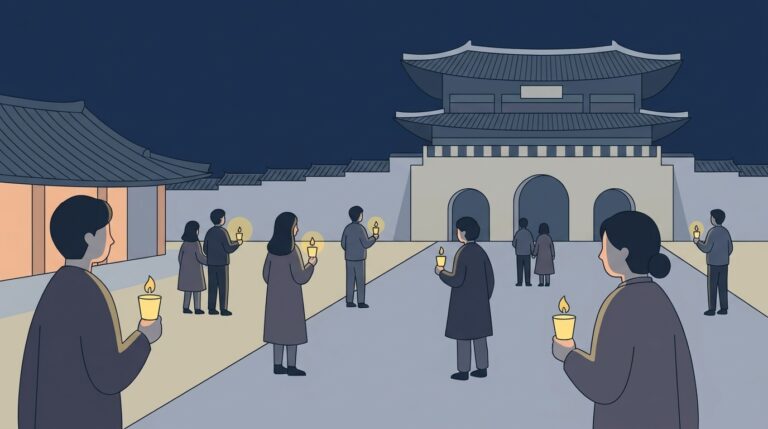
Picture this: You are standing in the middle of Gwanghwamun Square on a crisp Saturday evening in November. The city lights of Seoul fade behind a mesmerizing sea of glowing LED candles. Around you, families are pushing strollers, university students are sharing thermal hand warmers, and high schoolers are singing upbeat choruses in unison. There is no violence, no tear gas—only a rhythmic, thunderous chant echoing off the ancient palace walls. You turn to your Korean friend, wanting to comment on this breathtaking civic phenomenon, but your mind freezes. You only know textbook terms like 시위 (siwi, protest) or 정치 (jeongchi, politics), which feel far too clumsy, harsh, or elementary for such a profound moment.
Many of our advanced C1 learners tell us that discussing modern Korean history, collective sentiment, and civic consciousness is their biggest barrier to building authentic, intellectual friendships in Korea. This guide is crafted from real classroom debriefs and field interviews with native Korean thinkers and journalists. By mastering these expressive, socio-political nuances, you will elevate your Korean conversation from simple daily small talk to deep, emotionally resonant cultural dialogue. Let us walk into the square together.
Phase 2: In-Depth Breakdown of 3 Core Expressions
1. 민심이 들끓다 (Minsimi deulkkeulta)
- Pronunciation: [Minsimi deulkkeulta] (Pronunciation clue: Think of ‘mean-sheem-ee’ followed by the sound of a heavy teapot violently whistling: ‘deul-kkeul-tah’)
- Meaning:
- Literal: “The people’s heart boils up.”
- Actual Nuance: Public sentiment is boiling over with indignation or fervent civic demand.
- K-Culture Moment: Frequently headlines prime-time news reports in investigative political dramas like Stranger (비밀의 숲) when public fury forces government prosecutors to reopen high-profile corruption trials.
- Editor’s Insight: 민심 (民心) is not merely a polling statistic; in Korean collective consciousness, it carries a sacred, almost spiritual mandate. Saying 민심이 들끓다 captures systemic righteous indignation rather than individual petty anger.
- Situation Spectrum: Casual (⚠️ – sounds dramatic) | Semi-formal (✅) | Formal (✅)
- 🤔 Think About It: In English, we often say “public opinion turned sour” or “people took to the streets.” Does viewing public anger as “boiling liquid” evoke a different civic responsibility in your home culture?
2. 목소리를 내다 (Moksorireul naeda)
- Pronunciation: [Moksorireul naeda] (Pronunciation clue: ‘Mohk-so-ree-reul’ flowing softly into a decisive ‘neh-dah’)
- Meaning:
- Literal: “To produce or emit a voice.”
- Actual Nuance: To courageously speak out, take a public stand, or exercise one’s civic duty against silence or injustice.
- K-Culture Moment: Heard during student union meetings or in docudramas depicting the 1987 June Democratic Struggle, as ordinary citizens encourage peers not to stay bystander.
- Editor’s Insight: While textbook Korean teaches 말하다 (to speak) or 주장하다 (to claim), 목소리를 내다 reflects moral bravery. In a society historically guided by collective harmony, “emitting your voice” symbolizes deliberate civic participation.
- Situation Spectrum: Casual (✅) | Semi-formal (✅) | Formal (✅)
- 🤔 Think About It: Is “raising your voice” in your country perceived as disruptive or constructive? How does that compare with the Korean concept of civic solidarity?
3. 성숙한 시민 의식 (Seongsuk-han simin uisik)
- Pronunciation: [Seongsuk-han simin uisik] (Pronunciation clue: ‘Seong-sook-hahn’ followed by clean, staccato syllables ‘shee-meen wee-sheek’)
- Meaning:
- Literal: “Mature citizen consciousness.”
- Actual Nuance: Exemplary civic maturity characterized by nonviolent protest, public order, and community stewardship.
- K-Culture Moment: Celebrated in national documentaries when millions of demonstrators gather in Seoul and leave behind spotless avenues, personally bagging litter after historic rallies.
- Editor’s Insight: This phrase represents contemporary South Korean pride. Having transitioned from military dictatorship to democratic vibrancy within a single generation, Koreans use this term to affirm their democratic identity.
- Situation Spectrum: Casual (⚠️ – scholarly tone) | Semi-formal (✅) | Formal (✅)
- 🤔 Think About It: What constitutes “maturity” in a democracy? Is it institutional trust, peaceful assembly, or passionate dissidence?
Phase 3: Textbook Korean vs. Real Korean
Scenario 1: Describing a massive, peaceful assembly
- 📖 교과서 한국어 (Textbook):
- 이번 집회의 참가자 수가 아주 많고 평화롭습니다.
- (Ibeon jiphoe-ui chamgaja suga aju manko pyeonghwaropseumnida.)
- “The number of participants in this rally is very large and peaceful.”
- 🗣️ 진짜 한국어 (Real-World C1):
- 광화문 일대에 평화로운 촛불의 물결이 끝없이 이어지고 있어요.
- (Gwanghwamun ildae-e pyeonghwaroun chotbul-ui mulgyeori kkeuteopsi ieojigo isseoyo.)
- “Across the Gwanghwamun area, a peaceful wave of candlelight stretches on endlessly.”
- 💡 Why the difference? Native speakers describe historic public gatherings through vivid, collective imagery (촛불의 물결, wave of candlelight) rather than cold analytical headcounts.
Scenario 2: Resonating with widespread public consensus
- 📖 교과서 한국어 (Textbook):
- 저는 국민들의 생각에 전적으로 동의합니다.
- (Jeoneun gukmindeur-ui saenggake jeonjeogeuro dong-uihamnida.)
- “I agree completely with the citizens’ thoughts.”
- 🗣️ 진짜 한국어 (Real-World C1):
- 시민들의 자발적인 외침에 저 역시 깊이 공감하지 않을 수 없네요.
- (Simindeur-ui jabaljeogin oechime jeo yeoksi gipi gonggamhaji aneul su eomneyo.)
- “Seeing the voluntary outcry of citizens, I cannot help but deeply empathize.”
- 💡 Why the difference? Advanced natural Korean often utilizes litotes/double negatives (~하지 않을 수 없다, cannot help but…) to convey profound moral resonance and emotional refinement.
Phase 4: K-Culture Deep Dive & Non-Verbal Nuance
4-1. Nunchi & Public Protest Etiquette
Korean candlelight assemblies (촛불 집회) are fundamentally “festival-style assemblies” (축제형 집회). Families bring toddlers, and neighbors distribute free paper cups and hot barley tea.
* Body Language & Nunchi: Aggressive gestures, yelling insults at police lines, or disorderly pushing violate the tacit social contract. Nod along with speeches, hold your light steadily at chest height, and sway in cadence with crowd songs.
* The Golden Rule: When the gathering disperses, immediately observe your surroundings. Koreans will instinctively bend down to pick up discarded paper cups and flyers. Reaching down to assist without being asked is the ultimate showcase of Korean nunchi and civic manners.
4-2. Cultural Code: Pop Culture as Civic Anthem
During the 2016–2017 candlelight demonstrations, something remarkable happened: rather than conventional military marches or aggressive anthems, the crowd adopted Girls’ Generation’s (소녀시대) debut single, Into the New World (다시 만난 세계). The track transformed into a modern democratic hymn. The lyric “너를 생각만 해도 난 강해져” (Just thinking of you makes me strong) evolved from adolescent romance into a symbol of civic solidarity. In modern Korea, K-pop, festival arts, and constitutional history intertwine organically in public plazas.
Phase 5: Real-World Roleplay Scenario
Setting & Characters
- Location: A warm pojangmacha (street tent bar) in Jongno-3ga on an autumn evening, bustling with steaming fishcake broth.
- Character: Min-woo (민우), a 34-year-old documentary director with deep civic passion and articulate speech.
Dialogue
- Min-woo:
오늘 광화문 광장 가봤어요? 시민들이 든 촛불을 보는데 가슴이 뭉클하더라고요.
(Oneul Gwanghwamun gwangjang gabaesseoyo? Simindeuri deun chotbureul boneunde gaseumi mungkeulhadoragoyo.)
“Did you check out Gwanghwamun Square today? Seeing the candles held by citizens really touched my heart.”
🎭 Taking off his wool scarf and shaking the evening chill from his coat. -
Learner (You):
네, 저도 잠시 들렀는데, 그 질서정연한 모습에 큰 감명을 받았어요.
(Ne, jeodo jamsi deulleonneunde, geu jilseojeong-yeonhan moseube keun gammyeong-eul badasseoyo.)
“Yes, I stopped by for a bit too, and I was deeply impressed by how orderly it was.”
🎭 Smiling warmly while handing Min-woo a cup of hot broth. -
Min-woo:
맞아요. 과거의 격렬했던 시위와 달리, 이제는 가족 단위로 참여하는 성숙한 광장 문화가 자리 잡았죠.
(Majayo. Gwagoeo-ui gyeongnyeolhaetdeon siwiwa dalli, ijeneun gajok danwiro chamyeohaneun seongsuk-han gwangjang munhwaga jari jabatjyo.)
“Exactly. Unlike the turbulent demonstrations of the past, a mature public square culture where whole families participate has settled in.”
🎭 Nodding thoughtfully while pouring a glass of barley tea. -
Learner (You):
단순한 분노 표출이 아니라, 더 나은 사회를 위해 목소리를 내는 과정처럼 느껴졌어요.
(Dansunhan bunno pyochuri anira, deo naeun sahoereul wihae moksorireul naeneun gwajeongcheoreom neukkyeojyeosseoyo.)
“It felt like a constructive process of speaking up for a better society, rather than mere venting of anger.”
🎭 Leaning forward with attentive, respectful eye contact. -
Min-woo:
정확한 통찰이에요! 결국 민심이 들끓는다는 건 우리 사회가 여전히 역동적으로 살아 숨 쉰다는 증거니까요.
(Jeonghwak-han tongcharieyo! Gyeolguk minsimi deulkkeulneundaneun geon uri sahoega yeojeonhi yeokdongjeogeuro sara sum swindaneun jeungeonikkayo.)
“Spot-on insight! After all, the fact that public sentiment boils up proves our society is still dynamically breathing and alive.”
🎭 Tapping the table lightly with an enthusiastic grin. -
Learner (You):
역사의 굴곡 속에서도 평화로운 방식으로 민주주의를 지켜낸 점이 대단해요.
(Yeoksa-ui gulgok sogeseodo pyeonghwaroun bangsigeuro minjuju-uireul jikyeonaen jeomi daedanhaeyo.)
“It is incredible how, despite the twists and turns of history, you protected democracy peacefully.”
🎭 Speaking in an appreciative, contemplative tone. -
Min-woo:
외국인 친구에게 이런 깊이 있는 이야기를 들으니 더 뜻깊네요. 오늘 정말 뜻깊은 대화였어요.
(Oeguk-in chingu-ege ireon gipi inneun iyagireul deureuni deo tteutgimneyo. Oneul jeongmal tteutgipeun daehwayeosseoyo.)
“Hearing such deep reflections from an international friend makes it even more meaningful. A truly enriching chat today.”
🎭 Raising his soju glass in a gentle toast. -
Learner (You):
저 역시 한국 현대사의 생생한 현장을 직접 체감할 수 있어서 영광이었습니다.
(Jeo yeoksi Hanguk hyeondaesa-ui saengsaenghan hyeonjang-eul jikjeop chegamhalsu isseoseo yeong-gwang-ieotseumnida.)
“It was truly an honor for me as well to witness the living frontline of modern Korean history.”
🎭 Clinking glasses lightly with both hands held politely on the cup.
🔀 Interactive Branching Decision Point
Min-woo sighs and asks: “한국의 이런 집회 문화를 처음 봤을 때, 솔직히 어떤 느낌이 먼저 들었어요?” (When you first saw this protest culture in Korea, honestly, what feeling hit you first?)
- Option A: “시끄럽고 교통이 통제돼서 솔직히 길 찾기가 너무 불편했어요.” (To be honest, it was just noisy and the traffic detours made getting around frustrating.)
- Feedback (Bad): While honest about practical inconvenience, this response reduces a profound democratic legacy to a commuter complaint, abruptly cutting off intellectual rapport.
- Option B: “한국 정치는 너무 과격해서 외국인 입장에서는 좀 무섭게 느껴져요.” (Korean politics seems overly radical, so it feels a bit frightening from an expat’s view.)
- Feedback (Risk): Misreads non-violent candlelight gatherings as hostile riots, inadvertently showing ignorance toward modern constitutional victories and peaceful civic assembly norms.
- Option C: “분노의 표현에 그치지 않고, 축제처럼 연대하며 희망을 노래하는 모습이 참 인상 깊었습니다.” (Rather than stopping at anger, the way people united like a festival and sang for hope was deeply impressive.)
- Feedback (Best): Demonstrates sophisticated C1 socio-cultural awareness, validating the positive democratic identity Koreans take pride in.
Phase 6: 10-Second Emotion Shadowing Drill
Practice these natural cadences with authentic emotional pitch! The slashes (/) indicate breath pauses.
[🔥 엄숙하고 결연하게 / Solemn & Resolute]- 민심의 외침을 / 더 이상 외면해서는 안 됩니다.
- (Minsim-ui oechimeul / deo isang oemyeonhaeseoneun an doemnida.)
- “The outcry of the people / must no longer be turned away from.”
[🕊️ 따뜻하고 감탄하며 / Warm & Admiring]- 수많은 촛불이 모여 / 평화로운 광장을 만들어 가는 모습이 / 참 아름다워요.
- (Sumanheun chotburi moyeo / pyeonghwaroun gwangjang-eul mandeureo ganeun moseubi / cham areumdawoyo.)
- “Seeing countless candles gather / to create a peaceful public square / is truly beautiful.”
[🤝 진심 어린 공감을 담아 / Sincere & Empathetic]- 비록 국적은 다르지만 / 시민들의 간절한 마음에 / 저 역시 깊이 공감합니다.
- (Birok gukjeogeun dareujiman / simindeur-ui ganjeolhan maeume / jeo yeoksi gipi gonggamhamnida.)
- “Though my nationality is different / with the earnest heart of the citizens / I, too, deeply resonate.”
Phase 7: K-Culture Mini Dictionary
- 촛불 혁명 (Chotbul hyeokmyeong) | The Candlelight Revolution
- Usage: Refers historically to the massive 2016–2017 peaceful assemblies that led to constitutional presidential impeachment. Used in sociopolitical discourse, media documentaries, and academic papers.
- 광장 문화 (Gwangjang munhwa) | Public Square Culture
- Usage: The historical concept of the central agora (광장) where Koreans congregate to debate, celebrate World Cup victories, or mobilize civic reforms.
- 연대감 (Yeondaegam) | Sense of Solidarity
- Usage: Essential in professional non-profit work, labor relations, or social movements to describe mutual belonging across social barriers.
- 평화 시위 (Pyeonghwa siwi) | Peaceful Demonstration
- Usage: Standard terminology contrasting civic discipline with historical or overseas violent protests.
Phase 8: Traveler’s Survival Kit
Survival Expressions TOP 3
- 집회 때문에 도로가 통제되나요? (Jiphoe ttaemune doroga tongjedoenayo?)
- Pro Tip: Use this at taxi stands or hotel lobbies near downtown to check for major street closures.
- 지하철역 출구가 폐쇄되었나요? (Jihacheol-yeok chulguga paeswaedoeeonnayo?)
- Pro Tip: Stations like Gwanghwamun or Anguk occasionally close specific stairwells during massive turnouts to prevent overcrowding.
- 집회 행렬은 평화적으로 지나갈 예정입니다. (Jiphoe haengnyeoreun pyeonghwajeogeuro jinagal yejeong-imnida.)
- Pro Tip: Knowing this helps you understand subway broadcast announcements so you don’t panic.
Editor’s Travel Note
When major civic assemblies occur in downtown Seoul (Gwanghwamun, City Hall, Yeouido), surface bus traffic is diverted. Make sure to download the 네이버 지도 앱 다운로드 to view real-time transit detours and check subway line updates via the official Seoul Metro real-time alert feed before heading out.
Phase 9: “One Step Deeper” (Humanities Essay)
Korean contemporary history is defined by a unique transition from grief to agency—transforming Han (한, collective sorrow) into Heung (흥, communal vitality). From the April 19 Revolution of 1960 and the May 18 Gwangju Democratic Uprising to the June Democratic Struggle of 1987, democratic milestones in Korea were rarely granted from above; they were extracted through collective bodily presence. The modern candlelight assembly marks a triumph where the fear of state violence gave way to carnival-like solidarity. When Koreans hold a small candle, they are not simply displaying dissent; they are inheriting an intergenerational promise that ordinary citizens remain the sovereign architects of the Republic.
💬 Your Turn: How does civic participation manifest in your home country? Is public protest viewed primarily as disruption, or as a festival of democracy? Share your thoughts below in Korean or English!
Phase 10: FAQ & Avoiding Misunderstandings
Q: Is it safe for foreign tourists or residents to walk near candlelight rallies in Seoul?
A: Yes, exceptionally so. South Korean candlelight rallies are celebrated globally for their non-violent, family-oriented atmosphere. While avoiding confrontational political shouting matches with counter-protesters is always wise, walking along the perimeter and observing the assembly is safe.
Q: Can I use the word ‘데모’ (Demo) when speaking with native Koreans?
A: It is better to use 집회 (jiphoe, assembly) or 평화 시위 (pyeonghwa siwi, peaceful protest). 데모 (from “demonstration”) was widely used during the turbulent 1970s and 1980s and often carries an outdated or confrontational connotation of tear gas and riot shields.
Q: Does participating in or watching a rally label someone as politically biased?
A: Observing or discussing the phenomenon through historical and civic lenses (성숙한 시민 의식, 광장 문화) is respected as cultural literacy. Engaging in inflammatory partisan rhetoric, however, should be avoided unless you are in a close, trusted personal circle.
🚨 흔한 실수 (Common Mistakes) Warning Board
- Mistake 1: Translating “civil rights protest” into aggressive terms like 폭동 (pokdong, riot).
- Correct Action: Use 평화 집회 (peaceful assembly) or 시민 운동 (civic movement).
- Mistake 2: Assuming participants are angry radicals.
- Correct Action: Recognize that participants often include seniors, parents, teachers, and students expressing civic care.
- Mistake 3: Littering when leaving a gathering area.
- Correct Action: Hold your trash or join volunteers separating recyclables on the street corners.
Phase 11: Action Mission & Participation
- 🥉 Bronze Mission (Solo Mastery): Record yourself reading the 3 Emotion Shadowing sentences in Phase 6 with accurate pitch pauses. Listen back and check your rhythm.
- 🥈 Silver Mission (Social Sharing): Post a photo of Gwanghwamun or Seoul’s evening skyline on Instagram/Threads and caption it using the phrase: 성숙한 시민 의식이 돋보이는 광화문의 밤 (A night in Gwanghwamun where mature civic consciousness shines).
- 🥇 Gold Mission (Real Life Application): At your next language exchange or dinner with Korean friends, ask: “한국의 광장 문화에 대해 어떻게 생각하세요?” (What are your thoughts on Korea’s public square culture?) and actively use 목소리를 내다 in your response.
- 🎮 K-Culture Mission: Watch episode 1 of the documentary or political drama Stranger (비밀의 숲) and spot when the term 민심 (the people’s heart) appears in the dialogue.
Phase 12: Interactive Quiz Challenge
1. Situational Judgment
When your Korean colleague says, “어제 광화문 집회 다녀왔는데 분위기가 참 뭉클했어요,” what is the most sophisticated and culturally empathetic C1 response?
* ① “집회 가면 다치니까 다음부턴 절대 가지 마세요.”
* ② “민심이 모여 평화롭게 목소리를 내는 모습이 정말 인상적이었겠네요.”
* ③ “정치인들은 다 똑같은데 굳이 왜 가셨어요?”
🔍 Click here to reveal Answer & Explanation
- Correct Answer: ②
- Explanation: Option ② uses advanced concepts (민심, 목소리를 내다) and empathizes with the emotional weight of peaceful assembly. Options ① and ③ show dismissive cynicism and poor situational sensitivity.
2. Fill-in-the-Blank
Fill in the blank with the correct Sino-Korean term for public sentiment:
부패 사건에 대한 보도가 이어지자 마침내 ( )이/가 들끓기 시작했다.
🔍 Click here to reveal Answer & Explanation
- Correct Answer: 민심 (Minsim)
- Explanation: 민심이 들끓다 is the fixed idiomatic collocation representing the boiling over of public sentiment against injustice.
3. True / False Cultural Check
Statement: Korean candlelight assemblies are traditionally characterized by confrontational street riots where ordinary citizens and families generally stay indoors.
🔍 Click here to reveal Answer & Explanation
- Correct Answer: False
- Explanation: Korean candlelight demonstrations are globally recognized as peaceful, festival-like family assemblies where citizens clean up afterward, demonstrating 성숙한 시민 의식.







