

Phase 1: Empathy (Real-Life Cafe Dilemma)
안녕하세요! 매일한글 에디터입니다. (Hello! I’m your Daily Hangul editor!)
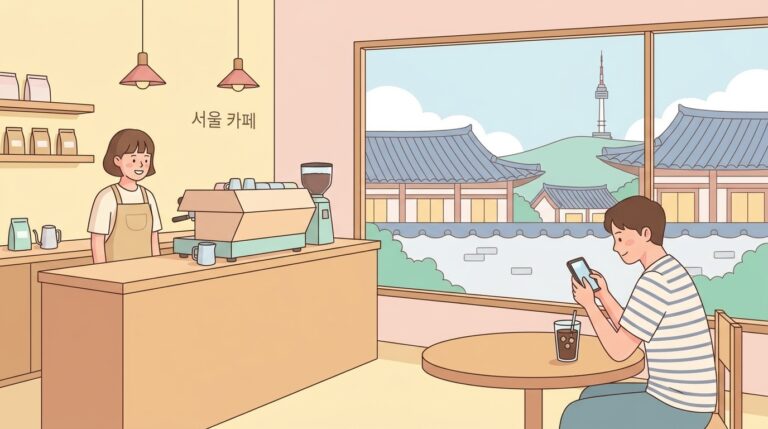
Picture this: You have just walked into a stunning, sun-drenched cafe in the aesthetic alleys of Yeonnam-dong, Seoul. The jazz playlist is smooth, the aroma of freshly roasted espresso fills the air, and you proudly ordered an icy “Ah-Ah” (아이스 아메리카노 – Iced Americano) using your best beginner Korean. You sink into a plush chair, pull out your laptop or phone to upload your gorgeous travel reels, and suddenly—disaster strikes. Your international eSIM signal drops to zero bars, or your roaming data crawls to a halt.
You desperately need the Wi-Fi. You look around, but the tiny chalkboard behind the busy barista is covered in tiny, indecipherable scribble. Your heart beats faster: “What if I butcher the pronunciation? What if the barista is too busy to understand my English?” You freeze, staring at your disconnected screen, feeling like an isolated outsider in a buzzing city.
Take a deep breath! Over the past ten years coaching absolute beginners at Daily Hangul, I have seen hundreds of travelers experience this exact moment of cafe panic. Today, we are going to fix that forever. With just one or two simple, polite beginner phrases, you will walk up to any counter in South Korea and get connected in seconds. No stress, no stuttering—just pure, effortless local confidence!
Phase 2: Top 3 Core Expressions Deep-Dive
Here are the three golden keys to unlocking Wi-Fi in any Korean cafe.
1. 와이파이 비밀번호가 뭐예요? (Waipai bimilbeonhoga mwoyeyo?)
- Pronunciation: Why-pie bee-meel-bun-ho-gah mwo-yeh-yo? (Tip: Think of “bimil” sounding like “be meal” said quickly!)
- Meaning: Literal: “What is the Wi-Fi secret number?” | Natural: “What is the Wi-Fi password?”
- K-Culture Moment: Think of romantic K-dramas where the stressed lead sits down in a cafe to work on a presentation and politely asks the barista for connectivity.
- Editor’s Insight: In Korean, the word for password is 비밀번호 (bimilbeonho), which literally breaks down to 비밀 (secret) + 번호 (number). Even when a password contains letters, Koreans still say “secret number”!
- Situation Spectrum: Casual ⚠️ | Semi-formal (Polite) ✅ | Formal ✅
- 🤔 Think About It: In English, we say “pass-word”, focusing on words. In Korean, it is “secret-number” because early pin-codes dominated digital security. How does your native language describe digital access codes?
2. 와이파이 돼요? (Waipai dwaeyo?)
- Pronunciation: Why-pie dweh-yo? (Tip: “dwae” sounds just like the start of “dwelling” without the -lling!)
- Meaning: Literal: “Does Wi-Fi become?” | Natural: “Is there Wi-Fi here? / Does the Wi-Fi work?”
- K-Culture Moment: Walking into a cozy, traditional Hanok tea cafe in Ikseon-dong where you are not quite sure if modern high-speed internet reaches through old clay walls.
- Editor’s Insight: 돼요? (dwaeyo?) is Korea’s ultimate magic word. From asking if a credit card works to checking if a seat is open, asking if something “becomes” (돼요?) covers dozens of everyday situations.
- Situation Spectrum: Casual ⚠️ | Semi-formal (Polite) ✅ | Formal ⚠️
- 🤔 Think About It: Korean culture often prioritizes brevity and high-context meaning. Two tiny words communicate everything you need without overcomplicating grammar.
3. 영수증에 있어요? (Yeongsujeunge isseoyo?)
- Pronunciation: Yung-soo-jeung-eh ee-ssuh-yo? (Tip: “Yeong” sounds like “young”, and “jeung” rhymes with “sung”.)
- Meaning: Literal: “Is it on the receipt?” | Natural: “Is the Wi-Fi info printed on the receipt?”
- K-Culture Moment: Watching busy startup founders in Gangnam glance down at their printed slip while balancing a paper coffee cup and their smartphone.
- Editor’s Insight: In 80% to 90% of Korean franchise and indie cafes, the network name (SSID) and password are automatically printed at the top or bottom of your paper receipt. This question saves both you and the barista time!
- Situation Spectrum: Casual ⚠️ | Semi-formal (Polite) ✅ | Formal ✅
- 🤔 Think About It: Printing passwords on receipts reflects Korea’s hyper-efficient “Ppalli-Ppalli” (hurry-hurry) customer service culture. It minimizes delays for everyone in line!
Phase 3: Textbook Korean vs. Real Spoken Korean
Many old-school textbooks teach stilted, archaic Korean that will make local baristas look at you like you stepped out of a 1980s documentary. Let’s see the contrast!
Scenario 1: Asking for the password
- 📖 Textbook Korean: 무선 인터넷 암호를 가르쳐 주시겠습니까? (Museon inteonet amhoreul gareuchyeo jusigesseumnikka? – “Would you please instruct me on the wireless internet cipher?”)
- 🗣️ Real Spoken Korean: 와이파이 비밀번호가 뭐예요? (Waipai bimilbeonhoga mwoyeyo? – “What’s the Wi-Fi password?”)
- 💡 Why is it different?: Nobody in a modern cafe says “wireless internet cipher” (무선 인터넷 암호). Koreans naturally borrowed “와이파이” (Wi-Fi) and combined it with the everyday standard “비밀번호”.
Scenario 2: Asking if internet connection is available
- 📖 Textbook Korean: 이곳에서 인터넷 접속이 가능합니까? (Igoseseo inteonet jeopsogi ganeunghamnikka? – “Is internet access feasible at this location?”)
- 🗣️ Real Spoken Korean: 여기 와이파이 돼요? (Yeogi waipai dwaeyo? – “Does Wi-Fi work here?”)
- 💡 Why is it different?: Spoken Korean favors conversational verbs like 되다 (dwoeda – to work, to function) rather than stiff Chinese-character nouns like “접속 가능” (access feasibility).
Phase 4: K-Culture Deep Dive & Non-Verbal Manners
4-1. 눈치 (Nunchi) & Cafe Gestures
Before rushing to the counter while the barista is steaming milk and shouting out order numbers, use your 눈치 (Nunchi – social awareness / reading the room):
1. Check the receipt first: Look closely at your order slip. Search for terms like WIFI, ID, or PW / P/W.
2. Scan the counter perimeter: Most cafes display a small transparent acrylic stand near the straw and napkin station with the Wi-Fi name and password.
3. Approaching the counter: If you cannot find it, approach during a calm lull. Give a gentle nod (around 15 degrees) and say 저기요 (Jeogiyo – Excuse me) in a soft, polite tone. Pointing gently toward your phone screen makes your intention immediately obvious!
4-2. The “Cagongjok” (카공족) Cultural Phenomenon
In Korea, cafes are not just places to grab a quick roast; they function as public study hubs and decentralized offices. Students and remote freelancers who frequent cafes to study and work are affectionately called 카공족 (Cagongjok – Cafe Study Tribe). Because of this culture, fast gigabit Wi-Fi and power outlets under almost every bench seat are practically guaranteed. As long as you order at least one drink per person every few hours, you are welcomed to settle in and enjoy the digital oasis!
Phase 5: Real-Life Roleplay Scenario
Setting: Cafe Haru, a cozy cafe in Hongdae. Indie pop is playing. You are seated at a table, but your laptop refuses to load your map. You walk up to Minjun, the friendly twenty-something barista.
- Turn 1 (You): 🎭 Politely approaching the counter with a slight nod
저기요, 와이파이 비밀번호가 뭐예요? (Jeogiyo, waipai bimilbeonhoga mwoyeyo?)
“Excuse me, what is the Wi-Fi password?” -
Turn 2 (Minjun – Barista): 🎭 Smiling and pointing toward the printed receipt in your hand
영수증 아래쪽에 적혀 있어요! (Yeongsujeung araejjoge jeokhyeo isseoyo!)
“It is written at the bottom of your receipt!” -
Turn 3 (You): 🎭 Glancing at the receipt and tilting your head in mild confusion
아, 영수증을 버렸어요. (A, yeongsujeungeul beoryeosseoyo.)
“Ah, I threw away the receipt.” -
Turn 4 (Minjun – Barista): 🎭 Tapping a tiny wooden stand beside the napkin container
괜찮아요! 여기 안내판에도 있어요. (Gwaenchannayo! Yeogi annaepannedo isseoyo.)
“No problem! It’s also right here on this sign.” -
Turn 5 (You): 🎭 Looking closely at the tiny handwritten letters
이거 소문자예요? (Igeo somunjayeyo?)
“Are these lowercase letters?” -
Turn 6 (Minjun – Barista): 🎭 Nodding clearly
네, 다 소문자예요. (Ne, da somunjayeyo.)
“Yes, all lowercase.” -
Turn 7 (You): 🎭 Typing it in, seeing the Wi-Fi icon light up, and smiling
와, 연결됐어요! 감사합니다. (Wa, yeongyeoldwaesseoyo! Gamsahamnida.)
“Wow, it’s connected! Thank you.” -
Turn 8 (Minjun – Barista): 🎭 Giving a warm friendly bow
맛있게 드세요! (Masitge deuseyo!)
“Enjoy your drink!”
🔀 Interactive Decision Point
Suppose the barista is extremely busy blending a complicated frappe when your Wi-Fi drops. What do you do?
- Option A: Wave your phone vigorously while shouting “와이파이! 와이파이!” from across the room.
- Feedback: [BAD] Loud shouting breaks the calm cafe ambiance and creates unnecessary stress for the barista.
- Option B: Check your order receipt or look on the counter near the pick-up counter for a printed stand first.
- Feedback: [BEST] 9 times out of 10, the password is right there! This is top-tier Korean Nunchi.
- Option C: Walk straight behind the counter to read the sticker on the back of the internet router.
- Feedback: [RISK] Never cross into the private employee work area behind the counter. Wait for the barista to finish their step, then ask politely.
Phase 6: 10-Second Emotion Shadowing Drill
Read these aloud while matching the cadence and emotional markers!
[😊 Polite & Soft-spoken]
저기요… / 와이파이 비밀번호 / 뭐예요?
(Jeogiyo… / waipai bimilbeonho / mwoyeyo?)-
[🤔 Curious & Inquiring]
영수증에… / 적혀 있어요?
(Yeongsujeunge… / jeokhyeo isseoyo?) -
[🎉 Relieved & Cheerful]
와! / 연결됐어요! / 감사합니다!
(Wa! / yeongyeoldwaesseoyo! / gamsahamnida!)
Phase 7: K-Culture Mini Dictionary
- 비번 (Bibeon): Slang abbreviation of 비밀번호 (Password). Young Koreans almost always shorten it to 비번 in casual chats and text messages.
- 영수증 (Yeongsujeung): Receipt. Essential in Korea, not only for proof of purchase but often containing bathroom door passcodes and Wi-Fi credentials.
- 카공족 (Cagongjok): Portmanteau of 카페 (Cafe) + 공부 (Studying) + 족 (Tribe/Group). Refers to students and digital nomads studying in coffee shops.
- 소문자 / 대문자 (Somunja / Daemunja): Lowercase letters / Uppercase letters. Extremely useful when verifying complex network passwords with baristas!
Phase 8: Survival Kit for Travelers
Top 3 Survival Phrases
- 비밀번호 적어주실 수 있어요? (Bimilbeonho jeogeojusil su isseoyo?)
- Pro Tip: If the Wi-Fi password is 16 characters long and confusing, hand the barista a notebook or your phone notes app with this phrase to let them type it.
- 화장실 비밀번호는 뭐예요? (Hwajangsil bimilbeonhoneun mwoyeyo?)
- Pro Tip: In urban Korean cafes, restrooms often use digital door locks. This phrase uses the exact same grammatical structure as the Wi-Fi question!
- 콘센트 어디에 있어요? (Konsenteu eodie isseoyo?)
- Pro Tip: Need to charge your dying battery? Ask where the electrical wall outlet is located.
Editor’s Travel Note
- Always keep navigation apps ready! Download the [Naver Map app download for seamless Seoul navigation] rather than relying on Google Maps, which has limited walking route features in South Korea due to national mapping security laws.
- Most independent cafes in Korea are strictly card-only or app-pay (Apple Pay, Samsung Pay, or transit T-Money cards). Cash is rarely preferred!
Phase 9: “One Step Deeper” (Cultural Reflection)
In many Western countries, asking for Wi-Fi can feel like requesting an exclusive favor, sometimes locked behind customer portals with time limits or paid vouchers. In South Korea, high-speed public connectivity is viewed almost like tap water or clean air: a basic, universally accessible social courtesy. This digital generosity is deeply intertwined with Korea’s rapid post-war modernization, where communal infrastructure became a cornerstone of civic pride.
💬 Your Turn: What is the Wi-Fi culture like in your home country? Do cafes freely provide open internet, or do they encourage you to unplug? Share your stories in the comments below!
Phase 10: FAQ & Avoiding Misunderstandings
Q: What if the Wi-Fi network requires a Korean phone number verification?
A: Most independent and major chain cafes (like Ediya, Twosome Place, or Mega Coffee) provide standard password-protected routers without mobile number authentication. If you run into a public telecommunications hotspot (like T-Free or KT GiGA) requiring SMS verification, ask the staff for the cafe’s private customer network instead.
Q: Can I say “비번 뭐예요?” directly to the staff?
A: If you are at a casual cafe frequented by college students and you speak with a bright, polite tone (“저기요, 비번 뭐예요?”), they will understand completely. However, as an A1 beginner, stick to the full polite form 비밀번호가 뭐예요? (bimilbeonhoga mwoyeyo?) to ensure you sound respectful.
Q: What does “와이파이 안 돼요” mean if the barista says it to me?
A: It means “The Wi-Fi isn’t working right now.” If an internet router is temporarily down or undergoing maintenance, you might hear this phrase.
🚨 Common Mistakes Alert!
- Mistake: Pronouncing Wi-Fi as “Wee-Fee”.
- Correct Action: Koreans pronounce it identical to American English: 와이파이 (Wa-i-pa-i).
- Mistake: Demanding the password with just the single English word “Password?”.
- Correct Action: Even if your grammar is imperfect, starting with 저기요 (Jeogiyo) and ending with ~뭐예요? (~mwoyeyo?) conveys warmth and cultural respect.
- Mistake: Tossing your paper receipt into the trash can immediately at the counter.
- Correct Action: Always inspect the receipt first! Both the Wi-Fi key and the locked restroom entry code are frequently printed right along the bottom.
Phase 11: Action Mission & Community Challenge
- 🥉 Bronze Mission (Solo Practice): Look at your home or office router right now. Point your finger and say aloud 3 times: “와이파이 비밀번호가 뭐예요?”
- 🥈 Silver Mission (Social Share): Snap a photo of your favorite coffee mug or workspace, upload it to Instagram or Threads, and caption it: “여기 와이파이 돼요? (Does Wi-Fi work here?)” Tag
@DailyHangul! - 🥇 Gold Mission (Real-Life Conquest): Walk into an authentic Korean cafe or bakery in your city (or in Korea!), order your favorite drink, and ask the cashier for the password completely in Korean.
🎮 K-Culture Mission: Watch an episode of a modern slice-of-life K-drama (like Hospital Playlist or Our Beloved Summer). Listen closely whenever the characters hang out in a cafe. Can you catch them asking for a receipt (영수증) or checking their connection?
Phase 12: Interactive Quiz Challenge
Test your new skills! Click the dropdown toggles below to verify your answers.
Quiz 1. Real-Life Situation Judgment
You just ordered an iced latte at a trendy cafe in Busan. You want to ask the barista if there is Wi-Fi available in the shop. Which phrase is the most natural and polite?
* A) 와이파이 줘. (Waipai jwo.)
* B) 와이파이 돼요? (Waipai dwaeyo?)
* C) 무선 인터넷 암호 등록해 주세요. (Museon inteonet amho deungrokhae juseyo.)
👉 Click here for the Answer & Explanation
Correct Answer: B) 와이파이 돼요? (Waipai dwaeyo?)
Explanation: Option B is polite, natural, and standard for everyday conversation. Option A is informal/rude banmal (dropping honorifics), and Option C is an awkward, overly robotic phrase that native speakers do not use.
Quiz 2. Fill-in-the-Blank
Complete the natural Korean sentence asking for the password:
“와이파이 ___________ 뭐예요?”
👉 Click here for the Answer & Explanation
Correct Answer: 비밀번호가 (bimilbeonhoga)
Explanation: The full polite question is “와이파이 비밀번호가 뭐예요?” (What is the Wi-Fi password?). In fast casual speech, locals sometimes omit the particle -가 and say “와이파이 비밀번호 뭐예요?”.
Quiz 3. True or False Cultural Check
Statement: In South Korea, it is considered rude to look at your cafe receipt for the Wi-Fi password before asking the staff.
👉 Click here for the Answer & Explanation
Correct Answer: False!
Explanation: It is actually preferred and appreciated! Checking your receipt first shows great Nunchi (social etiquette) because it saves the busy barista from having to read out long alphanumeric codes.







