

Navigating Breakups Gracefully: How to Say “Let’s Just Be Friends” in Korean
Phase 1: 공감 (Empathy & The Emotional Opening)
안녕하세요! 매일한글 에디터입니다.
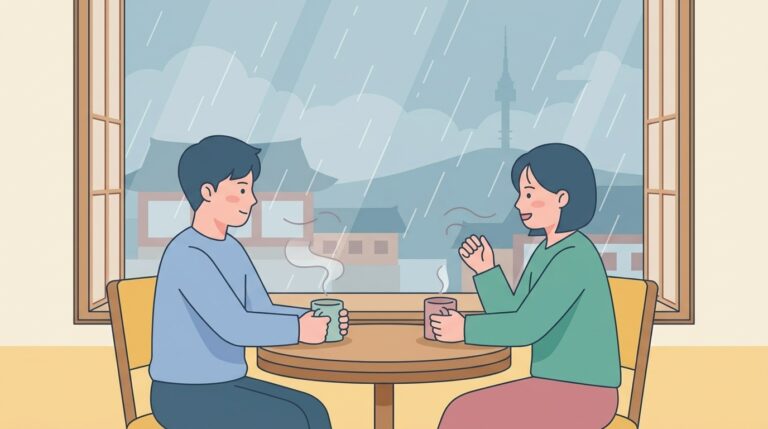
Picture this classic K-Drama scene: rain tapping rhythmically against the glass of a quiet cafe in Yeonnam-dong. Two cups of iced Americano sit between you and someone you care about deeply, the ice melting into small puddles of condensation. Your partner stirs their straw quietly, looks down, sighs, and gently says, “우리… 그냥 좋은 친구로 지내는 게 어떨까?” (Uri… geunyang joeun chinguro jinaeneun ge eotteolkka? / “What if… we just stay good friends?”).
Your stomach drops. In Western dating culture, “Let’s be friends” often sparks an immediate, frank debate: “Do you mean right now? Or do you just want an easy out?” But in Korea, the dynamics of romantic breakups—and the transition into becoming 친구 (chingu, friends)—carry layers of social etiquette, subtle non-verbal cues (눈치, nunchi), and emotional preservation.
Many of our intermediate learners come to us with a genuine pain point: “When a Korean partner says let’s be friends, do they actually want to hang out next weekend, or are they politely saying goodbye forever? And how do I respond without sounding overly cold or desperate?”
This guide draws directly from real learner experiences and contemporary Korean relational norms. By the end of this lesson, you will master the exact phrases native speakers use to navigate the delicate boundary of parting ways with dignity, softness, and emotional intelligence.
Phase 2: 핵심 표현 3선 심층 분석 (Top 3 Essential Expressions)
1. 우리 그냥 좋은 친구로 지내자 (Uri geunyang joeun chinguro jinaja)
- Pronunciation: [Oo-ree geun-yang jo-eun chin-goo-ro jee-nae-ja] (Sounds like “Ooh-ree” + “good” with an ‘n’ + “chin-goo” like a friend’s warm nickname)
- Meaning: Literal: “Let’s just stay as good friends.” / Actual Nuance: “Our romantic chapter has run its course, but I want to end this without resentment and preserve our mutual respect.”
- K-Culture Moment: You hear this in romance dramas like Twenty-Five Twenty-One or Our Beloved Summer when both leads acknowledge that life paths are diverging, softening an agonizing farewell into a peaceful pact.
- Editor’s Insight: The operative word here is 그냥 (geunyang – just/simply). It acts as an emotional cushion. In Korean social discourse, jumping directly to “헤어지자” (Let’s break up) feels like an emotional guillotine. Adding 그냥 좋은 친구로 softens the blow by prioritizing human warmth over abrupt severance.
- Situation Spectrum: Casual: ✅ | Semi-formal: ⚠️ | Formal: 🚫
- 🤔 Think About It: In your native language, does suggesting friendship soften the blow of a breakup, or is it seen as insincere? How does prioritizing harmony change the way we say goodbye?
2. 편한 사이로 남자 (Pyeonhan sairo namja)
- Pronunciation: [Pyeon-han sah-ee-ro nahm-ja] (Pronounce ‘Pyeon’ like ‘pyun’ in punny, and ‘sairo’ like sigh-ro)
- Meaning: Literal: “Let’s remain as a comfortable relationship.” / Actual Nuance: “The romantic pressure and tension between us have become too heavy. Let’s strip away romantic expectations and return to ease.”
- K-Culture Moment: A staple in realistic modern romance shows like Lovestruck in the City or dating reality series like EXchange (환승연애), where ex-partners discuss why their intense romance burned them out.
- Editor’s Insight: 편하다 (pyeonhada) means comfortable or relaxed. When Koreans say this, they are often admitting that being a couple started creating mutual exhaustion (밀당, jealousy, societal expectations). Shifting back to a “comfortable bond” is an invitation to exhale.
- Situation Spectrum: Casual: ✅ | Semi-formal: ✅ | Formal: 🚫
- 🤔 Think About It: Is “comfort” (편안함) an asset or a romance-killer in your culture? Why do you think Korean couples view returning to comfort as a sign of maturity?
3. 더 좋은 사람 만날 수 있을 거야 (Deo joeun saram mannal su isseul geoya)
- Pronunciation: [Deo jo-eun sah-rahm mahn-nahl soo eess-eul geo-yah] (Rhymes smoothly: ‘Deo’ like duh, ‘saram’ with a rolled r)
- Meaning: Literal: “You will be able to meet a better person.” / Actual Nuance: “You deserve someone who can love you the way you need to be loved—and that person isn’t me.”
- K-Culture Moment: Spoken during tearful late-night conversations on a park bench under yellow streetlights, usually right before standing up to walk in opposite directions.
- Editor’s Insight: While Westerners might sometimes interpret this as cliché or patronizing, in Korean communication it shifts the fault entirely onto oneself. It is an act of conversational self-lowering to protect the partner’s self-esteem.
- Situation Spectrum: Casual: ✅ | Semi-formal: ⚠️ | Formal: 🚫
- 🤔 Think About It: Why does taking the blame oneself (“You deserve better”) hold so much cultural currency in East Asian communication etiquette?
Phase 3: 교과서 한국어 vs 진짜 한국어 (Textbook vs. Real-Life Korean)
Situation 1: Calling for a mutual stop
- 📖 교과서 한국어 (Textbook):
- 우리 이제 헤어집시다. (Uri ije heeojipsida.)
- “Let us break up now.”
- 🗣️ 진짜 한국어 (Real-Life):
- 우리 여기서 그만하는 게 맞는 것 같아. (Uri yeogiseo geumanhaneun ge manneun geot gata.)
- “I think stopping right here is the right thing for both of us.”
- 💡 왜 다를까? (Why the difference?):
The textbook imperative -ㅂ시다 sounds like an official boardroom announcement. Real Koreans rely heavily on softening hedges like -는 것 같아 (it seems like) to convey firm boundaries without sounding cold or confrontational.
Situation 2: Suggesting returning to regular acquaintances
- 📖 교과서 한국어 (Textbook):
- 우리는 친구가 되어야 합니다. (Urineun chinguga doeeoya hamnida.)
- “We must become friends.”
- 🗣️ 진짜 한국어 (Real-Life):
- 그냥 원래처럼 좋은 동생/오빠/친구로 남는 게 낫겠어. (Geunyang wonraecheoreom joeun dongsaeng/oppa/chinguro namneun ge natgesseo.)
- “It would be better if we just stayed good friends/siblings like we used to be.”
- 💡 왜 다를까? (Why the difference?):
Koreans often date within pre-existing social circles (university clubs, mutual friends, workplaces). Phrasing the breakup as returning to the status quo (원래처럼, wonraecheoreom) reassures both sides that social harmony in the group will not be destroyed.
Phase 4: K-Culture 딥다이브 & 비언어적 매너 (Deep Dive & Non-Verbal Manners)
4-1. 눈치 (Nunchi) & Body Language
- Softened Eye Contact: Unlike Western communication where intense, direct eye contact signals sincerity, keeping your eyes locked onto an ex-partner during a Korean breakup can feel aggressive. Keep your gaze angled slightly downward, looking up periodically with a gentle, regretful expression.
- The Two-Handed Cup Grip: Notice how characters hold their coffee cup with both hands during emotional talks? It anchors body language, projects vulnerability, and shows you are listening intently rather than rushing away.
- The Mindful Silence (침묵): Do not rush to fill 3 to 5 seconds of silence. In Korean emotional dialogue, silence signifies weight and respect for the years or months spent together.
4-2. Culture Code: Does “친구로 지내자” Really Mean Staying Friends?
In reality dating shows like EXchange (환승연애), you often see exes interact with incredible emotional restraint. But let’s be honest: in 80% of real-life Korean breakups, “우리 좋은 친구로 지내자” is actually a polite ritual of closure (의례적 이별).
It translates functionally to: “Let’s harbor no hard feelings, let’s not badmouth each other to mutual friends, and if we cross paths on Instagram or at a friend’s wedding, let’s exchange a warm nod.” If you genuinely want to remain buddy-buddy and grab chicken and beer (치맥) next Tuesday, wait at least several months until emotional neutrality is reached. Jumping straight into casual hangouts can violate the implicit Korean boundary of post-breakup respect (예의).
Phase 5: 실전 롤플레이 시나리오 (Interactive Roleplay Scenario)
Setting: A quiet indie cafe in Hapjeong with low jazz music playing. Rain is drizzling outside. You are sitting across from Minjun (민준), your Korean partner of eight months. The conversation has grown quiet.
- 민준 (Minjun): (커피 잔을 만지작거리며 한숨을 쉰다) 요즘 우리 자주 다투기도 했고… 서로 많이 지친 것 같아.
(Keopi janeul manjijakgeorimyeo hansumeul swinda) Yojeum uri jaju datugido haetgo… seoro mani jichin geot gata.
(🎭 Fiddling with his coffee cup, sighing softly) We’ve been arguing a lot lately… and I feel like we’re both really exhausted. - You: 응, 나도 느껴. 우리 둘 다 마음고생 많았지.
Eung, nado neukkyeo. Uri dul da maeumgosaeng manatji.
(🎭 Nodding with an understanding gaze) Yeah, I feel it too. We’ve both been through a lot of heartache. - 민준 (Minjun): (고개를 들어 당신을 조심스럽게 바라보며) 널 미워해서가 아니야. 그냥 우리… 좋은 친구로 남는 게 어떨까?
(Gogaereul deureo dangsineul josimseureopge barabomyeo) Neol miwohaeseoga aniya. Geunyang uri… joeun chinguro namneun ge eotteolkka?
(🎭 Lifting his head to look at you gently) It’s not because I resent you. What if we… just remained good friends? - You: 친구로… 지내자는 거지?
Chinguro… jinaejaneun geoji?
(🎭 Pausing to reflect his words) You mean… staying as friends? - 민준 (Minjun): 응. 연인으로서 욕심내다 보니까 소중한 사람까지 잃게 될까 봐 무서워.
Eung. Yeonineuroseo yoksimnaeda bonikka sojunghan saramkkaji ilke doelkka bwa museowo.
(🎭 Speaking with a subdued tone) Yeah. Being greedy as lovers made me scared that I might lose someone truly precious altogether. - You: 네 말이 무슨 뜻인지 알아. 우리 좋았던 기억까지 망치고 싶진 않아.
Ne mari museun tteusinji ara. Uri joatdeon gieokkkaji mangchigo sipjin ana.
(🎭 Lowering your tone calmly) I know what you mean. I don’t want to ruin our good memories either. - 민준 (Minjun): 이해해 줘서 고마워. 앞으로도 네가 진심으로 잘 지냈으면 좋겠어.
Ihaehae jwoseo gomawo. Ap-eurodo nega jinsimeuro jal jinaesseumyeon jokgesseo.
(🎭 Offering a bittersweet, slight smile) Thank you for understanding. I truly hope you do well from here on out. - You: 응, 너도. 우리 편한 사이로 지내면서 서로 응원해 주자.
Eung, neodo. Uri pyeonhan sairo jinaemyeonseo seoro eung-wonhae juja.
(🎭 Offering a reassuring nod) Yeah, you too. Let’s stay on comfortable terms and root for each other.
🔀 Your Interactive Branch Point: How do you deliver your final sentence?
- Option A: “그래, 우리 각자 시간 좀 갖고 편한 사이로 남자. 그동안 고마웠어.”
(Sure, let’s take some time for ourselves and remain on comfortable terms. Thank you for everything.) - Option B: “친구? 장난해? 날 사랑하긴 했어?”
(Friends? Are you kidding me? Did you ever even love me?) - Option C: “좋아! 그럼 내일 바로 영화 보러 갈래? 친구니까 괜찮지?”
(Great! Then do you want to go watch a movie tomorrow? Since we’re friends now, it’s fine, right?)
Feedback:
* Option A (BEST): 🌟 Exemplary Korean breakup diplomacy! You acknowledge the need for personal space (각자 시간 좀 갖고), preserve dignity, and show gratitude for the shared history.
* Option B (BAD): 💥 High confrontation. In Korean relational dynamics, this triggers intense guilt and will likely cause the other party to shut down completely and initiate immediate blocking (차단).
* Option C (RISK): ⚠️ Total tone-deafness! It ignores the unspoken Korean consensus that “let’s be friends” implies an emotional buffer period. Expect awkward stammering and ghosting.
Phase 6: 10초 감정 섀도잉 드릴 (10-Second Emotional Shadowing Drill)
Read these sentences out loud, obeying the pause marks (/) and channeling the emotional stage directions.
[🥺 Bittersweet and gentle]
우리 / 여기서 그만하는 게 / 서로를 위해 맞을 것 같아.
(Uri / yeogiseo geumanhaneun ge / seororeul wihae majeul geot gata.)
I think / stopping right here / is the right choice for both of us.-
[😔 Calm, collected, and mature]
좋은 추억으로 간직할게. / 너도 아프지 말고 / 밥 잘 챙겨 먹어.
(Joeun chueogeuro ganjikhalge. / Neodo apeuji malgo / bap jal chaenggyeo meogeo.)
I’ll treasure these as good memories. / Don’t get sick, / and make sure you eat well. -
[🤝 Peaceful closure]
시간이 좀 지나면, / 우리 편하게 인사할 수 있는 사이로 남자.
(Sigani jom jinamyeon, / uri pyeonhage insahal su inneun sairo namja.)
Once some time passes, / let’s remain people who can greet each other comfortably.
Phase 7: K-Culture 미니 사전 (Mini Dictionary: 4 Essential Breakup Terms)
- 인연 (Inyeon – Karmic Tie / Destined Connection)
Usage: Even when breaking up, Koreans often say, “우린 인연이 여기까지였나 봐” (I guess our destined tie only lasted this far). It reframes a painful ending not as anyone’s personal failure, but as natural fate. - 정 (Jeong – Deep Attachment / Bond of Shared Time)
Usage: Even when passion (사랑) dies, lingering affection (정) remains. People stay cordial post-breakup out of respect for the 정 accumulated between them. - 안전이별 (Anjeon-ibyeol – Safe & Peaceful Breakup)
Usage: A term frequently discussed among Korean 20s and 30s. It emphasizes parting ways cleanly and safely without stalking, dramatic arguments, or emotional retaliation. - 잠수이별 (Jamsu-ibyeol – Ghosting Breakup)
Usage: Literal: “Submarine breakup.” Going off the radar and cutting all contact without closure. Widely regarded in Korea as the worst, most ill-mannered way to end a relationship.
Phase 8: 여행자를 위한 생존 키트 (Traveler’s Survival Kit)
Top 3 Emotional Boundary Phrases
- 생각할 시간이 좀 필요해. (Saenggakhal sigani jom piryohae.)
Translation: “I need some time to think.”
Pro Tip: Use this when feelings are running high and you want to prevent saying something regrettable. - 더 이상 연락 안 했으면 좋겠어. (Deo isang yeollak an haesseumyeon jokgesseo.)
Translation: “I’d prefer if we didn’t contact each other anymore.”
Pro Tip: Use this when someone ignores the “let’s stay friends” boundary and keeps calling you at 2:00 AM. - 그동안 고마웠어. 잘 지내. (Geudong-an gomaweosseo. Jal jinae.)
Translation: “Thank you for everything during this time. Take care.”
Pro Tip: The ultimate, unmistakable period mark on a Korean relationship. Saying 잘 지내 signals finality.
Editor’s Travel & Comfort Note
If you find yourself nursing a broken heart while living in or traveling through Seoul:
* Find Solitude at the River: Grab a pair of earphones and take an evening walk across the Mapo Bridge or along Yeouido Hangang Park. Seoul’s riverside nightscape has a meditative, healing power.
* Solo Karaoke Catharsis: Search for a nearby coin noraebang (코인노래방) using your 네이버 지도 앱 다운로드. Belting out dramatic ballads alone for 3,000 KRW is authentic Korean post-breakup therapy!
Phase 9: “한 발 더 깊이” (Cultural Essay: The Philosophy of Inyeon)
In contemporary Western culture, radical transparency and blunt individualism are often prized: if romance ends, a clean, immediate severing of ties is considered empowering. In Korea, however, relationships do not exist in an atomized vacuum.
Every connection carries 인연 (Inyeon)—the idea that even brushing past someone on a bustling subway platform requires thousands of lifetimes of karmic overlap. Therefore, declaring “우리 그냥 좋은 친구로 지내자” is not necessarily a calculated lie or a cop-out. It is an ancient cultural reflex designed to honor the Inyeon you shared. It is the language of graceful de-escalation: ensuring that two human beings, who once held each other’s deepest vulnerabilities, step away with their dignity intact.
💬 Your Turn: Have you ever experienced a breakup where keeping the peace was more important than having the final word? How does this compare with dating norms in your home country? Share your thoughts below!
Phase 10: FAQ & 흔한 실수 경고판 (FAQ & Common Mistakes)
Q: If my Korean ex said “우리 편한 친구로 지내자”, can I text them funny memes next week?
A: Almost certainly no. In Korean conversational pragmatics, this phrase serves as a polite exit ramp, not an invitation to daily texting. Give it at least 2 to 3 months of radio silence. Let the emotional dust settle completely before testing the waters of platonic friendship.
Q: What is the biggest difference between “헤어지자” and “그만 만나자”?
A: 헤어지자 (Heeojija) is direct and definitive: “Let’s break up.” 우리 그만 만나자 (Uri geuman mannaja) literally means “Let’s stop seeing each other.” The latter is widely used when things never became fully official (like a 썸 / sseom phase) or when dating felt casually prolonged without a future.
Q: Why do Koreans ask “밥 잘 챙겨 먹어” (Make sure to eat well) when breaking up?
A: In Korea, asking about someone’s meals is the ultimate expression of basic human care (정). When a partner says this at the end of a relationship, it signifies: “I can no longer be your lover, but as a fellow human being, I hope you stay healthy and nourished.”
🚨 Common Mistakes Board (흔한 실수 TOP 3)
- The “Immediate Besties” Fallacy: Calling or asking them out for coffee 48 hours later because they said 친구로 지내자.
Correct Action: Treat the phrase as a dignified farewell gesture. Provide mutual space. - Using Overly Rigid Textbook Honorifics: Saying “저는 당신과 친구가 되기를 원합니다” (I desire to become your friend).
Correct Action: Use natural conversational forms like “우리 그냥 편한 친구로 남자”. - Publicly Airing the Breakup on Social Media: Posting cryptic angry quotes or unfollowing their entire friend group instantly.
Correct Action: Korean dating culture values discretion. Quietly archive couples’ photos without dramatic announcements.
Phase 11: 액션 미션 & 참여 유도 (Action Mission)
- 🥉 Bronze Mission (Solo Drill): Practice shadowing the phrase “우리 여기서 그만하는 게 맞는 것 같아” three times in front of the mirror, matching the calm, non-confrontational Korean intonation.
- 🥈 Silver Mission (Journaling): Write a 3-sentence diary entry in Korean imagining a mature closure using terms like 인연, 좋은 추억, and 편한 사이.
- 🥇 Gold Mission (Real Context Application): Next time you watch a romance K-Drama, actively listen for variations of 친구로 or 그만하자. Write down the timestamp and the exact line in our community comments!
🎮 K-Culture Media Mission: Watch Episode 16 of Our Beloved Summer (그 해 우리는) or review an episode of EXchange Season 2. Observe how ex-couples interact when discussing their past—notice how often they rely on quiet sighs, downward glances, and warm wishes for each other’s future.
Phase 12: 인터랙티브 퀴즈 챌린지 (Interactive Quiz Challenge)
Q1. Situational Judgment:
Your Korean partner says: “우리 싸우지 말고, 그냥 예전처럼 편한 친구로 지내자.” What is the culturally appropriate reaction?
(A) Shout “No! We are lovers or we are strangers!”
(B) Calmly accept their feeling: “응, 네 마음 이해해. 그동안 고마웠어.”
(C) Immediately suggest going to a theme park this Saturday as friends.
Q2. Fill in the Blank:
“우리 좋았던 기억은 소중히 간직하고, 앞으로는 서로 응원해 주는 좋은 _________ 남는 게 어떨까?”
(Hint: Fill in the word meaning “friends/acquaintances remaining together”)
Q3. True or False:
In Korean culture, telling an ex “더 좋은 사람 만날 수 있을 거야” is an insult implying they had poor taste in dating you. (True / False)
👉 Click here for Answers & Explanations
- Q1 Answer: (B)
Explanation: Acknowledging their perspective and thanking them for the time spent together demonstrates emotional maturity and aligns with Korean breakup etiquette. - Q2 Answer: 친구로 / 사이로 (chinguro / sairo)
Explanation: Both 좋은 친구로 남다 (remain as good friends) and 좋은 사이로 남다 (remain on good terms) are naturally used here. - Q3 Answer: False
Explanation: It is actually an act of self-deprecation (겸양). The speaker is taking the blame, suggesting they were inadequate for you and wishing you future happiness.







