

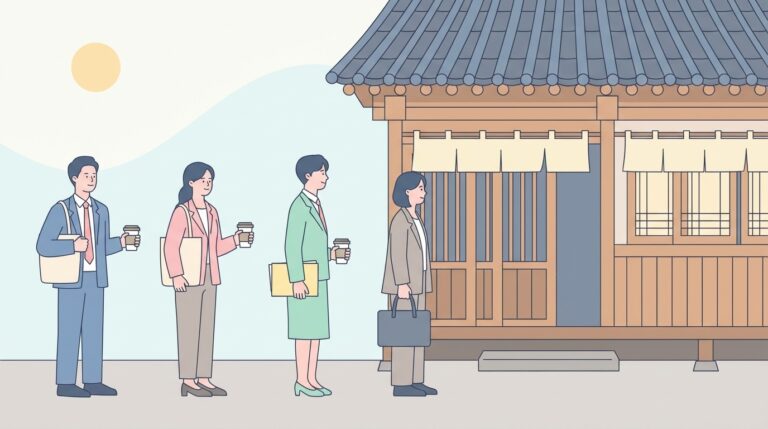
Surviving the Korean Office Lunch Rush: How to Queue at Famous Restaurants Like a Local
Phase 1: Empathy (Real-Life Lunch Rush in Seoul)
안녕하세요! 매일한글 에디터입니다. (Hello! This is your Daily Hangul editor.)
Picture this: It is 11:48 AM in a buzzing business district like Gangnam or Yeouido. You hear the sharp click of office keycards, and suddenly, half the building begins an Olympic-level brisk walk toward the elevators. Your Korean teammates suddenly quicken their pace, and before you know it, you are standing outside a legendary kimchi-jjigae or tonkatsu eatery staring at an intimidating line wrapping around the corner. Everyone has an exact 60-minute lunch break, the clock is ticking, and the restaurant host is calling out names and numbers at lightning speed.
Many of our intermediate learners tell us: “I know how to order food from a textbook, but the sheer chaos of lunchtime queues paralyzes me. I don’t know what to say to the host, how to tell my team about the wait, or how to reserve a spot without sounding awkward!” Don’t worry. Navigating a bustling lunchtime hotspot is the ultimate badge of honor in Korean office culture. By learning these three high-impact phrases and cultural cues, you won’t just survive the lunch rush—you will earn instant respect from your Korean colleagues as a savvy, proactive teammate!
Phase 2: Core Expressions Deep Dive
1. 웨이팅 얼마나 걸려요? (Waiting eolmana geollyeoyo?)
- Pronunciation: [We-i-ting eol-ma-na geol-lyeo-yo?] (Think of saying “waiting” with a crisp Korean flat ‘t’, followed by “all-mah-nah gull-yaw-yo”)
- Meaning: “How long is the wait?” (Direct: Waiting how much does it take?)
- K-Culture Moment: In modern Korean workplace dramas like Business Proposal or Misaeng, you will frequently see junior employees jogging five minutes ahead of the team to check the queue status at popular lunch spots.
- Editor’s Insight: Koreans borrow the English word “waiting” (웨이팅) as a noun meaning “queue” or “waitlist”. Asking this politely using “-요” (-yo) shows consideration for the busy server while getting straight to the point.
- Situation Spectrum: Casual: ✅ | Semi-formal: ✅ | Formal: ⚠️ (In very formal corporate settings, say “대기 시간이 얼마나 되나요?” [Daegi sigani eolmana doenayo?])
- 🤔 Think About It: In your home country, do people use English loanwords to describe everyday queuing, or do you have a dedicated cultural term for hot restaurant waiting lines?
2. 몇 분이세요? / 저희 네 명이에요. (Myeot bun-iseyo? / Jeohui ne myeong-ieyo.)
- Pronunciation: [Myeot bun-i-se-yo? / Jeo-hui ne myeong-i-e-yo.] (Sounds like: “Myut boon-ee-say-yo? / Jaw-hee nay myung-ee-ay-yo”)
- Meaning: “How many in your party? / There are four of us.”
- K-Culture Moment: The restaurant host will glance at you with pen and paper in hand, shouting over the sizzling grills: “몇 분이세요?” Answering immediately with a finger sign and “저희 네 명이에요” guarantees you won’t lose your spot to the group behind you.
- Editor’s Insight: Notice the honorific counter difference: The host asks with “분” (bun – honorific counter for people), but when speaking of your own group, you humble yourselves by using “명” (myeong – neutral counter) and “저희” (jeohui – humble form of “we/us”). Mixing these up is a classic learner slip!
- Situation Spectrum: Casual: ✅ | Semi-formal: ✅ | Formal: ✅
- 🤔 Think About It: Why does Korean use distinct counters for honoring the listener versus referencing one’s own company? How does this reflect the boundary of respect in teamwork?
3. 번호표 먼저 뽑아 둘게요. (Beonhopyo meonjeo ppoba dulgeyo.)
- Pronunciation: [Beon-ho-pyo meon-jeo ppo-ba dul-ge-yo.] (“Bun-ho-pyo mun-juh poh-bah dool-gay-yo” with a punchy double ‘pp’)
- Meaning: “I’ll pull a queue number first.” / “I’ll register our spot in advance.”
- K-Culture Moment: When leaving the office lobby, a proactive junior staffer (maknae) whips out their smartphone or hurries ahead, saying this phrase to keep the senior colleagues from waiting outdoors.
- Editor’s Insight: The auxiliary pattern “-아/어 둘게요” (-a/eo dulgeyo) means “I will do this in advance for later convenience.” It conveys thoughtfulness, efficiency, and high corporate Nunchi.
- Situation Spectrum: Casual: ✅ | Semi-formal: ✅ | Formal: ✅
- 🤔 Think About It: In Korean work life, anticipation is considered a key virtue. Does your culture appreciate someone making reservations ahead without being asked?
Phase 3: Textbook Korean vs. Real Korean
Situation 1: Asking if there is a long queue
- 📖 교과서 한국어 (Textbook Korean): 줄이 길게 서 있습니까? (Juri gilge seo itseumnikka?) — “Are people standing in a long line?”
- 🗣️ 진짜 한국어 (Real Korean): 지금 웨이팅 길어요? (Jigeum waiting gireoyo?) — “Is the wait long right now?”
- 💡 왜 다를까? (Why is it different?): Textbook Korean uses rigid grammatical constructions and purely Sino-Korean vocabulary. Modern Koreans universally use “웨이팅” (waiting) to refer to restaurant queues, blending natural rhythm with urban slang.
Situation 2: Suggesting to eat somewhere else because of the wait
- 📖 교과서 한국어 (Textbook Korean): 대기 시간이 길어서 다른 식당으로 이동합시다. (Daegi sigani gireoseo dareun sikdangeuro idonghapsida.) — “Let us move to another dining establishment because the wait time is long.”
- 🗣️ 진짜 한국어 (Real Korean): 여기 줄 너무 긴데, 다른 데 갈까요? (Yeogi jul neomu ginde, dareun de galkkayo?) — “The line is way too long here, should we go somewhere else?”
- 💡 왜 다를까? (Why is it different?): Workplace peers rarely speak in formal public announcements. “다른 데 갈까요?” (dareun de galkkayo) is warm, collaborative, and allows everyone to agree without feeling pressured.
Phase 4: K-Culture Deep Dive & Non-Verbal Manners
4-1. 눈치 (Nunchi) & Body Language in the Waiting Area
- The Quick Hand Signal: When the server calls “몇 분이세요?”, don’t just speak—raise your hand at chest level showing the number of fingers (two, three, or four). Lunch counters are loud, and visual confirmation speeds up seating.
- The Full Party Rule (일행 동시 입장): Most buzzing Seoul lunch spots have a strict rule: your entire party must be physically present before you are seated. If you sit down while your coworker is still walking over, the restaurant may pass your turn. Always message your group: “다 와 가세요?” (Are you almost here?)
- Nunchi at the Tablet Kiosk: Many restaurants now place a touch-screen tablet (such as CatchTable or Tableing) near the entrance. Instead of pacing around, immediately step up to the tablet, type in your Korean mobile number, input party size, and tap confirm.
4-2. Cultural Code: The Sacred 12:00 PM Oasis
In Korean corporate life, lunch is more than refueling—it is emotional decompression. Because Korean professionals work intensive hours, sharing delicious, piping-hot food (Matjip tour) serves as stress relief. That’s why office workers willingly queue for 20 minutes for a bowl of authentic stew. Joining the queue enthusiastically shows you share the team’s passion for everyday joy!
Phase 5: Real-World Roleplay Scenario
Setting: 11:52 AM outside ‘Seoul Doenjang’, a renowned stew spot in Gwanghwamun. The line already snakes onto the sidewalk. You are with Assistant Manager Kim (김 대리) and Manager Park (박 과장).
Characters:
* 김 대리 (Assistant Manager Kim): Fast-paced, always hungry, knows every lunch spot.
* 식당 직원 (Hostess): Crisp, efficient, handling 30 orders a minute.
* You (The Sharp Foreign Teammate): Ready to shine with great Korean.
- 김 대리: (시계를 보며 한숨을 쉰다) 으아, 벌써 줄이 이렇게 길다니! 과장님 오시기 전에 자리 잡아야 하는데요.
(Eua, beolsseo juri ireoke gildani! Gwajangnim osigi jeone jari jabaya haneundeyo.)
🎭 Looking at his watch nervously “Ugh, the line is already this long! We need to grab a table before Manager Park arrives.” - You: 🎭 (식당 앞 키오스크를 가리키며) 제가 번호표 먼저 뽑아 둘게요!
(Jega beonhopyo meonjeo ppoba dulgeyo!)
🎭 Pointing at the queue kiosk near the door “I’ll register our queue number first!” - 식당 직원: 🎭 (문 앞 명부를 확인하며 큰 소리로) 다음 대기자분, 몇 분이세요?
(Daeum daegijabun, myeot bun-iseyo?)
🎭 Checking the waitlist sheet and calling out loudly “Next on the waitlist, how many in your party?” - You: 🎭 (손가락 세 개를 펴 보이며) 저희 세 명이에요! 혹시 웨이팅 얼마나 걸려요?
(Jeohui se myeong-ieyo! Hoksi waiting eolmana geollyeoyo?)
🎭 Holding up three fingers clearly “There are three of us! By any chance, how long will the wait be?” - 식당 직원: 앞에 세 팀 남아서 한 10분 정도 걸려요. 일행 다 오셨어요?
(Ape se tim namaseo han sip-bun jeongdo geollyeoyo. Ilhaeng da osyeosseoyo?)
“There are three teams ahead, so it takes about 10 minutes. Is your whole party here?” - You: 🎭 (스마트폰을 확인하며) 과장님 거의 다 도착하셨대요!
(Gwajangnim geoui da dochakhasyeottaeyo!)
🎭 Glancing at your phone screen “Manager Park says he is almost here!” - 김 대리: 🎭 (감탄하며 엄지를 치켜세운다) 오, 완벽해요! 10분이면 딱 좋네요. 미리 메뉴 골라 둘까요?
(O, wanbyeokhaeyo! Sip-bun-imyeon ttak jonnaeyo. Miri menyu golla dulkkayo?)
🎭 Giving an impressed thumbs-up “Oh, perfect! 10 minutes is just right. Shall we pick our menu items in advance?” - You: 🎭 (미소 지으며 메뉴판을 건넨다) 네, 차돌 된장찌개로 통일할까요?
(Ne, chadol doenjangjjigaero tong-il-halkkayo?)
🎭 Smiling as you hand over the menu “Yes, shall we all go with the beef brisket soybean stew?”
🔀 Interactive Decision Fork
As you reach the front of the queue, the hostess shouts: “세 분 지금 바로 들어오세요! (Party of three, please enter right now!)”, but Manager Park is still 1 minute away at the crosswalk. What do you do?
- Option A: Politely tell the server: “일행이 바로 앞 횡단보도에 있어서 1분만 기다려 주실 수 있나요?” (Our companion is at the crosswalk right in front, could you give us just one minute?)
- Outcome (Best): Honesty + accuracy! The hostess will either hold the door for 60 seconds or seat the next party of two while keeping you next in line.
- Option B: Run inside, take the seats alone, and avoid eye contact while pretending your coworkers are already in the restroom.
- Outcome (Bad): High friction! If the lunch rush is busy, servers may ask you to step aside, creating an awkward scene.
- Option C: Say nothing, walk back to the end of the line, and take a new number.
- Outcome (Risk): You lose another 20 minutes, your team misses lunch hour, and Manager Park feels guilty for being late.
Phase 6: 10-Second Emotion Shadowing Drill
Read these aloud while mimicking the exact workplace energy!
[😰 발을 동동 구르며 초조하게 / Anxiously checking the crowd]
줄이 너무 긴데 / 혹시 웨이팅 얼마나 걸려요?
(Juri neomu ginde / hoksi waiting eolmana geollyeoyo?)
“The line is so long… / By any chance, how long is the wait?”-
[🫡 싹싹하고 빠릿빠릿하게 / Bright, proactive junior colleague tone]
과장님! / 제가 번호표 먼저 뽑아 둘게요!
(Gwajangnim! / jega beonhopyo meonjeo ppoba dulgeyo!)
“Manager Park! / I’ll grab our waiting ticket first!” -
[😋 침 꼴깍 삼키며 기대감에 / Excited anticipation for lunch]
10분만 기다리면 된대요. / 금방 들어가겠어요!
(Sip-bun-man gidarimyeon doendaeyo. / Geumbang deureogagesseoyo!)
“They said we only need to wait 10 minutes. / We’ll be inside in no time!”
Phase 7: K-Culture Mini Dictionary
- 웨이팅 (Waiting): The act of queuing or being on a waitlist. Used as both noun and verb: 웨이팅 걸다 (to join a waitlist).
- 맛집 (Matjip): A famous, delicious restaurant verified by word-of-mouth. The quest to find these is called 맛집 탐방 (Matjip expedition).
- 번호표 (Beonhopyo): Paper or digital queue ticket. In modern restaurants, this is often handled via tablet kiosks.
- 일행 (Ilhaeng): Companions / party members. You will constantly hear servers ask: “일행분 다 오셨나요?” (Are all your companions here?).
Phase 8: Survival Kit for Travelers & Expats
TOP 3 Survival Phrases
- 몇 자리 남았어요? (Myeot jari namasseoyo?)
- Meaning: “How many tables/seats are left?”
- Pro Tip: Use this if you are dining solo or as a pair; sometimes single bar seats (honbap) are available immediately!
- 포장도 줄 서야 하나요? (Pojangdo jul seoya hanayo?)
- Meaning: “Do I have to wait in line for takeout as well?”
- Pro Tip: Many famous spots let takeout customers bypass the dining queue completely.
- 대기 명단 어디에 적어요? (Daegi myeongdan eodie jeogeoyo?)
- Meaning: “Where do I write my name on the waiting list?”
- Pro Tip: Look near the entrance door for a clipboard or stand before joining the line.
Editor’s Travel Note
Before heading to hotspots in Seongsu, Hongdae, or Euljiro, make sure to check queue status on the Naver Map app or register via the CatchTable Global app guide. Some restaurants allow “remote queueing” (won-gyeok waiting), meaning you can secure your ticket on your phone while still walking from the subway!
Phase 9: “One Step Deeper” (Cultural Reflection)
In many Western cultures, waiting 40 minutes for lunch might feel inefficient or frustrating. However, in Korea, standing in line at a Matjip is viewed as a communal reward. Sharing this brief anticipation bonds colleagues outside the formal office hierarchy. When a team stands together in the chilly wind laughing and deciding on stews, the boundary between “boss” and “subordinate” gently softens. Lunch is the sacred neutral ground of Korean corporate life.
💬 Your Turn: How long would you be willing to wait in line for an unbelievable meal with your colleagues? Tell us your personal record in the comments below!
Phase 10: FAQ & Common Mistakes
Q: Can I put my name down on the waiting list if my friend hasn’t arrived yet?
A: Yes! You can write your name and party size (e.g., 2명). However, keep in mind that most popular restaurants will not seat you until your entire party is physically standing at the entrance. Send your friend a friendly message to hurry!
Q: What if the tablet kiosk requires a Korean phone number (+82), but I only have an international roaming SIM?
A: If you don’t have a 010 Korean number to receive KakaoTalk queue alerts, don’t walk away. Gently approach the door staff and say: “외국인이라 전화번호가 없는데 적어주실 수 있나요?” (I am a foreigner without a local phone number, could you write me down?). Staff will usually write your name manually on their memo pad.
Q: Is it considered rude to order our dishes while still waiting in line?
A: Not at all—in fact, it is celebrated! Busy lunch restaurants often hand out menus to people in line to speed up kitchen prep. Saying “미리 주문할게요!” (We will order in advance!) makes the staff’s job much easier.
🚨 Common Mistakes Warning Board
- Mistake: Calling your own group “저희 네 분” (Jeohui ne bun).
- Correct Action: Use “분” only for others! Refer to your own party as “저희 네 명” (Jeohui ne myeong).
- Mistake: Wandering off for coffee while on a high-turnover lunch queue.
- Correct Action: Seoul lunch queues move remarkably fast. If you miss your call number twice, your ticket gets canceled automatically. Stay within earshot!
- Mistake: Assuming the queue starts at the door when there’s a tablet inside.
- Correct Action: Never stand blindly behind a crowd. Always walk to the front door first to check for a digital tablet kiosk or paper clipboard.
Phase 11: Action Mission & Engagement
- 🥉 Bronze Mission (Solo Practice): Read the Shadowing Drill out loud 3 times. Focus on saying “저희 세 명이에요” with clean counter pronunciation.
- 🥈 Silver Mission (Social Share): Next time you grab food at a Korean restaurant, take a snap of the queue or menu and post on Instagram with the caption: “오늘 점심 웨이팅 도전! #DailyHangul”.
- 🥇 Gold Mission (Real Life Action): Next time you visit a restaurant in Korea or a Korean district, initiate the interaction first: ask the host “웨이팅 얼마나 걸려요?” and flash your party count with your fingers!
- 🎮 K-Culture Mission: Watch an episode of a workplace K-drama (like Misaeng or Gaus Electronics). Spot the exact moment the team heads out for lunch—notice who walks in front and who secures the table!
Phase 12: Interactive Quiz Challenge
1. Situational Judgment
You arrive at a packed dumpling house with 3 colleagues. The server approaches you and asks: “몇 분이세요?” What is the most natural, polite response?
* (A) 저희 네 분이에요.
* (B) 우리 네 사람이다.
* (C) 저희 네 명이에요.
* (D) 네 개 주세요.
2. Fill-in-the-Blank
Complete the sentence meaning: “I’ll pull a queue number first!”
“제가 번호표 먼저 [ _____ ] 둘게요!”
* (A) 먹어 (meogeo)
* (B) 뽑아 (ppoba)
* (C) 버려 (beoryeo)
* (D) 닫아 (dada)
3. True / False Cultural Trivia
Statement: In fast-paced Korean business districts, it is completely normal and acceptable for one person to sit at a 4-person table for 25 minutes during peak 12:00 PM lunch while waiting for their colleagues to leave the office.
* True
* False
👉 Click to reveal answers & explanations!
- Answer: (C) 저희 네 명이에요.
- Explanation: When counting your own group, use the humble pronoun 저희 (jeohui) and the neutral counter 명 (myeong). 분 (bun) is an honorific reserved for customers or honored third parties.
- Answer: (B) 뽑아 (ppoba)
- Explanation: 뽑다 (ppopda) means to pull or draw out (a ticket/number). Combined with -아 둘게요, it creates 뽑아 둘게요 (I will draw a ticket in advance).
- Answer: False
- Explanation: Doing this will cause immense stress to the restaurant staff during the 12:00 PM rush! Most restaurants have a strict 일행 동시 입장 (simultaneous entry for the entire party) rule. Always wait outside until all members arrive.
- Explanation: Doing this will cause immense stress to the restaurant staff during the 12:00 PM rush! Most restaurants have a strict 일행 동시 입장 (simultaneous entry for the entire party) rule. Always wait outside until all members arrive.







