

안녕하세요! 매일한글 에디터입니다.
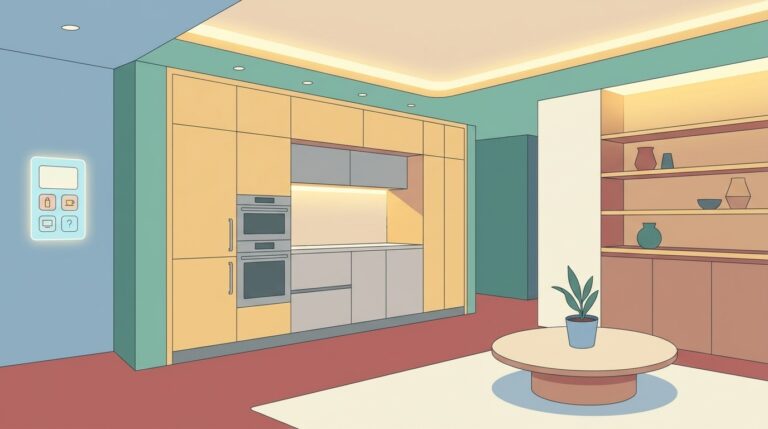
Imagine stepping into a newly renovated, high-end apartment in Seoul’s Seongsu-dong or Hannam-dong. You gaze around looking for the refrigerator, the microwave, or the air conditioning controls, but all you see are sleek, seamless matte panels and warm ambient coves. Where are the appliances? Suddenly, with a whispered voice command or a single tap on a wall-mounted panel, a flush cabinet reveals a dual-zone kimchi cellar, the motorized blinds descend in quiet unison, and the recessed magnetic track lighting softens to 2700 Kelvin.
Welcome to modern Korea’s design obsession: hyper-minimalist built-in architecture powered by invisible smart-home IoT. However, when foreign expats or advanced learners try to discuss these installations with local contractors (인테리어 실장님), carpenters, or brand technicians, they hit an immediate linguistic wall. Textbooks teach you words like “냉장고를 벽에 넣다” (to put a fridge in a wall), but on a real Korean job site, saying that will get you polite smiles and misaligned cabinetry. To navigate high-end Korean interior design at a C2 mastery level, you need the sophisticated, highly specialized lexicon of architectural alignment, bespoke appliance tailoring, and network ecosystem handshakes.
This masterclass draws directly from on-site fieldwork with Seoul’s premier interior project managers, giving you the exact vernacular needed to command and appreciate cutting-edge Korean living spaces.
1. 일체감을 살려 빌트인으로 마감하다 (Ilchegam-eul sallyeo bilteu-in-euro magamhada)
- Pronunciation: [Il-che-gam-eul sal-lyeo bil-teu-in-eu-ro ma-gam-ha-da] (Think: Eel-chay-gahm-ool sahl-lyuh bill-teu-een-oo-raw mah-gahm-hah-dah)
- Meaning: Literally “to finish as a built-in while preserving unity/cohesion”; nuanced as achieving a perfectly flush, seamless aesthetic where appliances melt invisibly into architectural surfaces.
- K-Culture Moment: Seen on architectural home tours like Where is My Home? (구해줘! 홈즈) or celebrity interior reveals on I Live Alone (나 혼자 산다) when guests admire a kitchen where the bespoke refrigerator door is completely flush with the surrounding cabinetry.
- Editor’s Insight: In high-end Korean interior architecture, “일체감” (ilchegam – a sense of unified oneness) is the golden standard. When combined with “마감하다” (to finish/trim a surface), it conveys an ultra-clean, intentional alignment where appliances are treated as structural materials rather than standalone gadgets.
- Situation Spectrum: Casual ⚠️ | Semi-formal ✅ | Formal ✅
- 🤔 Think About It: Why does contemporary Korean design prize “일체감” (oneness) so deeply compared to the individualistic, eclectic freestanding appliance culture common in many Western homes?
2. 스마트홈 플랫폼에 기기를 물려놓다 (Seumateuhom peullaetpom-e gigireul mullyeonota)
- Pronunciation: [Seu-ma-teu-hom peul-laet-pom-e gi-gi-reul mul-lyeo-no-ta] (Think: Soo-mah-too-home pull-let-form-ay gee-gee-rool mool-lyuh-no-tah)
- Meaning: Literally “to bite/hook devices onto a smart home platform”; nuanced as seamlessly binding hardware (lighting, HVAC, built-ins) into a centralized IoT ecosystem.
- K-Culture Moment: When a tech-savvy character in a K-drama shows off their automated morning routine through Samsung SmartThings or LG ThinQ, where opening the door automatically disarms security and turns on ambient lighting.
- Editor’s Insight: The verb “물리다” (mullida – to interlock, bite, or mesh gears) is quintessential native engineering slang. Saying “연결하다” (to connect) sounds generic and textbook-ish. Saying “플랫폼에 물려놓다” proves you understand industrial mechanics and modern IoT architecture.
- Situation Spectrum: Casual ✅ | Semi-formal ✅ | Formal ⚠️
- 🤔 Think About It: What does the physical metaphor of “biting gears” (물리다) reveal about how Koreans conceptualize tight, unyielding digital integration?
3. 선과 면을 정돈하여 여백의 미를 구현하다 (Seon-gwa myeon-eul jeongdonhayeo yeobaek-ui mireul guhyeonhada)
- Pronunciation: [Seon-gwa myeon-eul jeong-don-ha-yeo yeo-baek-ui mi-reul gu-hyeon-ha-da] (Think: Sun-gwah myun-ool jung-dawn-hah-yuh yuh-beck-wee mee-rool goo-hyun-hah-dah)
- Meaning: Literally “to organize lines and planes to manifest the beauty of empty space”; nuanced as achieving hyper-minimalist architectural serenity by eliminating visual clutter, trim, and protruding hardware.
- K-Culture Moment: Featured in luxury architectural magazines like Space (공간) or design documentaries profiling modern reinterpretations of traditional Hanok aesthetics inside Gangnam penthouses.
- Editor’s Insight: This phrase bridges traditional Korean aesthetic philosophy (여백의 미, the beauty of negative space) with ultra-modern smart interiors (무몰딩, 히든도어, 매립등). It signals to any architect or contractor that you care about spatial harmony, not just flashy gadgets.
- Situation Spectrum: Casual 🚫 | Semi-formal ✅ | Formal ✅
- 🤔 Think About It: How does the ancient Korean concept of “Yeobaek” (negative space) survive and evolve inside a digitized 21st-century smart apartment?
Situation 1: Discussing flush cabinetry dimensions with an interior contractor
- 📖 교과서 한국어: 이 냉장고는 수납장과 같은 깊이로 만들어져서 벽에 딱 맞게 들어갑니다. (I naengjanggo-neun sunapjang-gwa gateun gipi-ro mandeureojyeoseo byeok-e ttak matge deureogamnida. / This refrigerator was made with the same depth as the cabinet, so it fits squarely into the wall.)
- 🗣️ 진짜 한국어: 도어 단차 없이 키친핏으로 라인 딱 맞춰서 장 짰습니다. (Doe-eo dancha eopsi kicheon-pis-euro rain ttak matchwoseo jang jjasseumnida. / We built the custom cabinet flush to the kitchen-fit specs with zero door elevation gap.)
- 💡 왜 다를까?: Native designers use industry buzzwords like “키친핏” (Kitchen-fit – standard 700mm counter-depth appliances) and “단차” (step/elevation difference). Describing the carpentry process as “장을 짜다” (weaving/building custom cabinetry) immediately commands professional respect.
Situation 2: Inquiring about central IoT wallpad synchronization
- 📖 교과서 한국어: 환풍기와 조명이 벽에 달린 컴퓨터 제어 장치에 연결되어 함께 작동합니까? (Hwanpunggi-wa jomyeong-i byeok-e dallin keompyuteo jeeo jangchi-e yeongyeoldoeeo hamkke jakdonghamnikka? / Are the ventilator and lighting connected to the wall-mounted computer control device to operate together?)
- 🗣️ 진짜 한국어: 공기청정 환기 시스템이랑 전동 커튼 전부 월패드에 연동 물려 있나요? (Gonggicheongjeong hwangi siseutem-irang jeondong keoteun jeonbu wolpaedeu-e yeondong mullyeo innayo? / Are the ERV ventilation system and motorized curtains all integrated into the wallpad network?)
- 💡 왜 다를까?: In Korean multi-family housing, the central console is universally called the “월패드” (Wallpad). Real homeowners speak of holistic climate recovery systems (“공기청정 환기 시스템”) and ask if components are “연동 물려 있는지” (interlocked in synchronization).
4-1. 눈치 (Nunchi) & Spatial Etiquette on Job Sites
When inspecting a high-end interior site in Korea, avoid sweeping your hands abruptly across newly painted zero-trim drywall (무몰딩 도장). Instead, demonstrate spatial reverence: step back, slightly lower your gaze to scan horizontal joint lines, and use an open palm gesture while speaking. When pointing out microscopic alignment issues (오차), never bluntly say “틀렸어요” (It is wrong). Master the respectful Korean softner: “소장님, 여기 라인이 1~2밀리 정도 살짝 떠 보이는 것 같은데, 혹시 마감 보정이 가능할까요?” (Foreman, the line looks like it floats about 1-2 millimeters off; could we possibly adjust the finishing trim?). This shows sharp discernment without bruising the artisan’s professional pride.
4-2. The Cultural Code: From Conspicuous Consumption to Architectural Invisibility
In previous decades, Korean luxury meant visible flex: a massive, patterned double-door refrigerator jutting proudly into the dining area. Today, peak prestige in Seoul is the Hidden Interior (히든 인테리어). Korean elites spend tens of thousands of dollars not to showcase appliances, but to make them vanish behind matched architectural panels using custom carpentry (장짜기). Coupled with the hyper-connectivity of South Korea’s telecom infrastructure, the ultimate modern flex is living in what feels like a tranquil Zen sanctuary, entirely orchestrated beneath the surface by automated IoT routines.
Setting: A sleek renovation site inside an Acro River Park apartment overlooking the Han River. Dust hangs in the sunlight; exposed concrete meets immaculate walnut architectural paneling.
Characters: You (The discerning homeowner/designer) and Park So-jang (박 소장, Veteran site foreman, perfectionist craftsman).
- You: 소장님, 주방 쪽 키친핏 냉장고장은 도어 단차 없이 완벽하게 플러시 마감으로 떨어지는 거죠? (Sojangnim, jubang jjok kicheon-pit naengjanggo-jang-eun doe-eo dancha eopsi wanbyeok-hage peulleosi magam-euro tteoreojineun geojyo? / Foreman Park, the kitchen-fit fridge cabinetry is going to drop in completely flush without any door step-gaps, right?)
🎭 Action Direction: Holding up the technical blueprint, using your thumb and index finger to trace an invisible flush line across the cabinet frame. -
Park So-jang: 그럼요! 냉장고 도어 열림 각도까지 계산해서 좌우 이격 10밀리 딱 잡고 칼같이 맞췄습니다. (Geureomyo! Naengjanggo doe-eo yeollim gakdo-kkaji gyesanhayeo jwau igeok sip-milli ttak japgo kal-gachi matchwosseumnida. / Absolutely! We calculated the door swing angle, set the clearance margins to precisely 10 millimeters, and cut it razor-sharp.)
🎭 Action Direction: Confidently tapping the laser-level tripod set up on the floor. -
You: 다행이네요. 그리고 시스템 에어컨이랑 마그네틱 트랙 조명은 전부 스마트홈 IoT 허브에 물려주실 수 있나요? (Dahaeng-ineyo. Geurigo siseutem eeokeon-irang mageunetik teuraek jomyeong-eun jeonbu seumateuhom IoT heobeu-e mullyeojusil su innayo? / That is a relief. And could you ensure the ducted system AC and magnetic track lighting are all bound to the smart home IoT hub?)
🎭 Action Direction: Pointing smoothly up toward the recessed ceiling cove without touching the fresh plaster finish. -
Park So-jang: 물론입니다. 통신 방식이 지그비(Zigbee) 기반이라 스마트싱스랑 단지 월패드 양쪽에 다 연동 잡아드릴 겁니다. (Mullon-imnida. Tongsin bangsik-i jigeubi giban-ira seumateusingseu-rang danji wolpaedeu yangjjok-e da yeondong jabadeuril geomnida. / Of course. Since the protocol is Zigbee-based, we will establish integration across both SmartThings and the complex’s main wallpad.)
🎭 Action Direction: Nodding in approval, swiping through the wiring terminal specs on his rugged smartphone. -
You: 완벽하네요. 루틴 세팅해서 귀가 모드 켜면 조명이랑 냉난방이 한 번에 유기적으로 연동되게끔 하려고요. (Wanbyeok-haneyo. Rutin seting-haeseo gwiga modeu kyeomyeon jomyeong-irang naengnanbang-i han beon-e yugijeok-euro yeondongdoegikkeum haryeogoyo. / Perfect. I am setting automated routines so the ‘Homecoming Mode’ triggers the lighting and climate control in organic tandem.)
🎭 Action Direction: Smiling knowingly, tilting your head to visualize the lighting sequence. -
Park So-jang: 센스 있으시네요. 요즘 하이엔드 현장은 잡다한 스위치 다 매립하고 깔끔하게 선 정돈하는 게 기본입니다. (Senseu itseusineyyo. Yojeum haiendeu hyeonjang-eun japdahan seuwichi da maeriphago kkalkkeum-hage seon jeongdonhaneun ge gibon-imnida. / You have impeccable taste. In high-end sites these days, concealing extraneous switches and cleaning up visual lines is standard.)
🎭 Action Direction: Sweeping his arm across the unbroken walnut panel wall. -
You: 맞아요. 몰딩이나 돌출된 하드웨어 없이 공간의 일체감을 극대화하는 게 이번 인테리어의 핵심이니까요. (Majayo. Mholding-ina dolchuldoen hadeu-we-eo eopsi gonggan-ui ilchegam-eul geukdaehwahaneun ge ibeon interi-eo-ui haeksim-inikkayo. / Exactly. Maximizing spatial cohesion without moldings or protruding hardware is the very core of this renovation.)
🎭 Action Direction: Exchanging an affirming, collegial nod with the foreman. -
Park So-jang: 걱정 마세요. 가전이 가구 속으로 자연스럽게 녹아들도록 빈틈없이 마무리 짓겠습니다. (Geokjeong maseyo. Gajeon-i gagu sog-euro jayeonseureopge noga-deuldorok binteum-eopsi mamuri jitgesseumnida. / Rest assured. I will finish this flawlessly so the appliances dissolve naturally right into the cabinetry.)
🎭 Action Direction: Putting his hands firmly behind his back, exuding the pride of a master craftsman.
🔀 Interactive Scenario Branching
During the carpentry phase, you notice the built-in microwave trim sticks out 5mm past the cabinet frame because of an unexpected electrical junction box depth behind the wall. How do you respond?
- Option A: “소장님, 그냥 귀찮으니까 튀어나온 대로 두고 대충 실리콘으로 둘러주세요.” (Foreman, it’s tedious so just leave it protruding and slap some silicone around it.)
- Feedback (Bad): Instant loss of design credibility. In high-end Korean construction, settling for sloppy silicone caulk signals that you don’t respect the design parameters, and tradespeople may cut corners elsewhere.
- Option B: “소장님, 벽 쪽 복스 까대기를 조금 더 해서라도 단차 없이 플러시하게 매립할 수 있을까요? 일체감이 깨지면 안 되니까요.” (Foreman, could we chisel the wall box slightly deeper to recess it completely flush without a step? We cannot sacrifice visual unity.)
- Feedback (Best): Flawless C2 professional demeanor. Using technical terms like “까대기” (chiseling/wall-grooving) and “단차 없이 플러시하게 매립하다” commands immediate respect and gets the problem solved accurately.
- Option C: “이거 계약서랑 다르잖아요! 당장 뜯어내고 내일까지 새 장으로 다시 짜오세요!” (This is different from the contract! Rip it out immediately and build a new cabinet by tomorrow!)
- Feedback (Risk): Extreme emotional escalation breaks the working harmony (깁스 푼 관계). Construction delays and passive resistance from the crew are almost guaranteed.
Practice these lines aloud, syncing breath and pitch with the emotional tags.
- [🧐 꼼꼼하고 예리하게 / Meticulous & Discerning]
“도어 단차 없이 / 키친핏 라인에 딱 맞춰서 / 마감 부탁드립니다.”
(Doe-eo dancha eopsi / kicheon-pit rain-e ttak matchwoseo / magam butakdeurimnida.)
Pro Tip: Drop your pitch slightly on “딱 맞춰서” to emphasize uncompromising precision. -
[🤝 신뢰감 넘치는 태도로 / Confident & Professional]
“지그비 허브 연동으로 / 조명이랑 시스템 에어컨까지 / 전부 한 묶음으로 물려주세요.”
(Jigeubi heobeu yeondong-euro / jomyeong-irang siseutem eeokeon-kkaji / jeonbu han mukkeum-euro mullyeojuseyo.)
Pro Tip: Keep the rhythm flowing smoothly through “전부 한 묶음으로” without pausing between syllables. -
[🤩 감탄하며 세련되게 / Sophisticated & Delighted]
“몰딩 하나 없이 / 가전이 벽면 속으로 / 완전히 녹아들었네요.”
(Mholding hana eopsi / gajeon-i byeongmyeon sog-euro / wanjeonhi noga-deureonneyo.)
Pro Tip: Lengthen the vowel on “완전히-” while softening your vocal attack on “녹아들었네요” to convey effortless luxury.
-
키친핏 (Kitchen-fit / Kicheon-pit)
- Meaning: Built-in Depth Standard (Approx. 650–700mm).
- Usage: Refers to appliances manufactured specifically to align flush with standard Korean lower cabinetry lines without protruding into the kitchen walkway.
- 장짜기 (Custom Cabinetry Fabrication / Jang-jjagi)
- Meaning: Tailor-made carpentry for appliances.
- Usage: The customized craft of building surrounding structural millwork to house ovens, robot vacuum docking stations, and multi-door refrigerators seamlessly.
- 월패드 (Integrated Home Wallpad / Wolpaedeu)
- Meaning: Central Smart Home Intercom & Automation Tablet.
- Usage: The centralized touchscreen interface mounted on the living room wall controlling communal elevator dispatch, utility monitoring, EV charging, and indoor smart ecosystems.
- 무몰딩 & 히든도어 (Zero-Molding & Hidden Flush Doors / Mu-molding & Hideun-doe-eo)
- Meaning: Trimless minimalist interior design.
- Usage: High-end architectural techniques that eliminate decorative baseboards, crown moldings, and protruding door frames to achieve pure geometric planes.
Survival Expressions for Design Showrooms & Installations
- “이 모델, 저희 집 장 깊이랑 도어 단차 없이 딱 맞아떨어질까요?”
(I model, jeohui jip jang gipi-rang doe-eo dancha eopsi ttak maja-tteoreojilkkayo?)- Pro Tip: Use this at Samsung D’light, LG Best Shop, or Hanssem design showrooms when verifying flush-mount specs with retail floor engineers.
- “외부 스마트폰 앱에서도 월패드 제어가 실시간으로 양방향 동기화되나요?”
(Oebu seumateupon aep-eseodo wolpaedeu jeeo-ga silsigan-euro yangbanghyang donggihwadoenayo?)- Pro Tip: Crucial when confirming that physical switch inputs synchronize instantaneously with mobile software status indicators.
- “로봇청소기 직배수 스테이션 매립할 하부장 타공 작업 가능한가요?”
(Robot-cheongso-gi jikbaesu seuteisyeon maerip-hal habujang tagong jageop ganeung-han-gayo?)- Pro Tip: Korea’s newest smart trend is installing auto-refilling robot mops hidden inside cabinetry. “타공” (tagong) means drilling precision holes for water supply and drainage pipes.
Editor’s Living Note: Navigating Korean Smart Ecosystems
When outfitting a home in Korea, standard international smart home setups often fail because modern residential towers utilize closed, highly secure proprietary intranet systems.
* Ensure you download the designated local apartment management tool via the 아파트너 앱 공식 다운로드 portal to connect to your building’s gate pass and elevator call systems.
* For home appliance integration, set your account region to South Korea on the 스마트싱스 공식 사이트 or LG ThinQ 서비스 포털 to unlock localized APIs like laundry cycle notifications linked directly to KakaoTalk.
Modern Korean interior architecture is not merely about minimalist form; it is a profound sociological mirror of Korea’s high-density collective habitat. Because nearly 60% of South Koreans reside in high-rise apartments with standardized, rigid floor plans, the desire to assert autonomy manifests not through structural alterations, but through the radical refinement of visual noise and total technological mastery. By eliminating moldings and encasing appliances within monolithic walls, the resident cleanses their private sanctuary from the overwhelming sensory stimulation of the megalopolis outside. In this context, smart IoT integration is not an ostentatious indulgence—it is the modern Korean’s ritual of carving out internal psychological peace through absolute spatial control.
💬 Your Turn: Does your native culture embrace visible, proud mechanical appliances, or does it strive to make technology invisible like contemporary Seoul? Have you ever experienced smart-home miscommunications? Share your thoughts below in Korean or English!
Q: Can foreign smart home hubs (like Apple HomeKit or Google Home) be directly linked to Korean apartment wallpads?
A: Generally, not out-of-the-box. Most Korean apartment complexes utilize proprietary telecommunication protocols (such as Commax, Hyundai HT, or wallpad systems by Kocom) governed by strict domestic cybersecurity regulations. To bridge these to Apple HomeKit or Google Assistant, Korean power-users typically install an intermediate local server running Home Assistant or use Zigbee bridge modules wired directly behind light switches.
Q: What is the crucial difference between ‘오브제/비스포크’ and true architectural built-ins?
A: While marketing lines like Samsung Bespoke and LG Objet Collection offer “Kitchen-fit” (키친핏) models designed to simulate built-ins, they are technically freestanding appliances engineered with special pivot hinges and flat panels. True architectural built-ins (완전 매립형 빌트인) require custom structural cabinetry panels attached directly to the appliance chassis with zero visible clearances, necessitating precise mechanical ventilation vents beneath the baseboard.
Q: Why do Korean contractors emphasize ‘무몰딩’ (zero-molding) so intensely when installing built-in systems?
A: Because conventional moldings (crown molding, baseboards) create visual interruptions that ruin the line alignment between custom furniture and appliances. Zero-molding requires extensive plasterboard framework and leveling (퍼티 및 도장 작업), providing an uncompromising, planar canvas that allows custom appliance cabinetry to appear as a natural extension of the wall itself.
🚨 Common Mistakes (흔한 실수) Warning Board
- Mistake: Asking the carpenter to make a cabinet with “전혀 빈틈없이” (zero clearance whatsoever).
- Correct Action: Appliances generate heat and require hinge radius clearances. Always specify standard operational margins: “도어 열림 반경이랑 방열을 고려해서 유격 10에서 15밀리만 잡아주세요.” (Please leave a 10 to 15mm clearance for heat dissipation and door swing radius.)
- Mistake: Assuming all Samsung or LG appliances fit into standard cabinets.
- Correct Action: Freestanding models are 800-900mm deep, which protrude aggressively into living spaces. Always emphasize the keyword “키친핏 전용 모델” (exclusive kitchen-fit models) before ordering.
- Mistake: Confusing “연결” (simple connection) with “루틴 자동화 연동” (routine automation synchronization).
- Correct Action: Clearly request sensor logic: “단순 앱 등록이 아니라, 월패드 센서랑 묶어서 귀가 모드 루틴으로 연동 짜주세요.” (Not just basic app registration, but weave it into an automated Homecoming routine linked with the wallpad sensors.)
- 🥉 Bronze Tier (Solo Drill): Stand in front of your kitchen and record a 30-second video in Korean analyzing the visual lines: identify where appliances align (선이 정돈되다) or where they create visual breaks (단차가 생기다).
- 🥈 Silver Tier (Community Connection): Find a Korean architectural YouTube video (search terms: “온라인 집들이”, “신축 인테리어 룸투어”) and leave a comment in advanced Korean complimenting their IoT or kitchen-fit execution using the phrase “선과 면의 일체감이 돋보이네요!”
- 🥇 Gold Tier (Real-World Execution): Visit a local electronics showroom or an interior consulting firm in Seoul. Inquire about fitting an automated IoT ecosystem using at least three core terms from today’s guide (키친핏, 물려놓다, 일체감).
- 🎮 K-Culture Mission: Watch an episode of a high-end luxury K-drama (such as Queen of Tears or The Glory) and spot three architectural scenes where appliances are built flush into walls without visible handles. Take note of how the lighting routines harmonize with the characters’ movements!
1. Situational Judgment
You are remodeling your kitchen and want the dishwasher front panel to match your walnut cabinets perfectly without any visible digital buttons. Which sentence communicates this to your project manager at a native C2 level?
* A) 식기세척기 버튼이 안 보이게 그냥 나무 판자로 덮어버리세요.
* B) 식기세척기는 도어 부착형 빌트인 모델로 골라서, 가구장 도어와 완벽하게 일체화되도록 전면 패널 마감해 주세요.
* C) 식기세척기를 부엌 바닥 아래로 깊숙이 숨겨서 넣어주시면 좋겠습니다.
2. Fill-in-the-Blank
조명과 난방을 개별적으로 켜지 않고, 중앙 제어 장치인 ________에 한 번에 ________ 놓으면 외출 시 버튼 하나로 모든 전원을 소등할 수 있습니다.
3. True or False Cultural Insight
In modern Korean high-end apartment interiors, leaving traditional crown moldings and thick decorative baseboards around custom built-in appliances is considered the gold standard of contemporary luxury.
* (True / False)
👉 Click to reveal answers & in-depth explanations!
- Answer: B
- Explanation: Option B uses nuanced, professional terminology: “도어 부착형 빌트인 모델” (door-attached built-in model) and “가구장 도어와 완벽하게 일체화되도록 전면 패널 마감” (front panel finishing to seamlessly unify with cabinetry doors). Option A sounds unrefined and dismissive, while Option C is architecturally absurd.
- Answer: 월패드 (Wallpad) / 물려 (mullyeo)
- Explanation: The centralized console is the 월패드, and the native industrial idiom for binding devices into a synced network is 물려놓다.
- Answer: False
- Explanation: High-end Korean smart architecture currently champions 무몰딩 (zero molding), 마이너스 몰딩 (negative reveal molding), and 무문선 (frameless doors) to highlight pure architectural lines and seamless built-in integration.
- Explanation: High-end Korean smart architecture currently champions 무몰딩 (zero molding), 마이너스 몰딩 (negative reveal molding), and 무문선 (frameless doors) to highlight pure architectural lines and seamless built-in integration.







