

Phase 1: 공감 (Story-driven Opening)
안녕하세요! 매일한글 에디터입니다! (Hello! I’m your Daily Hangul editor!)
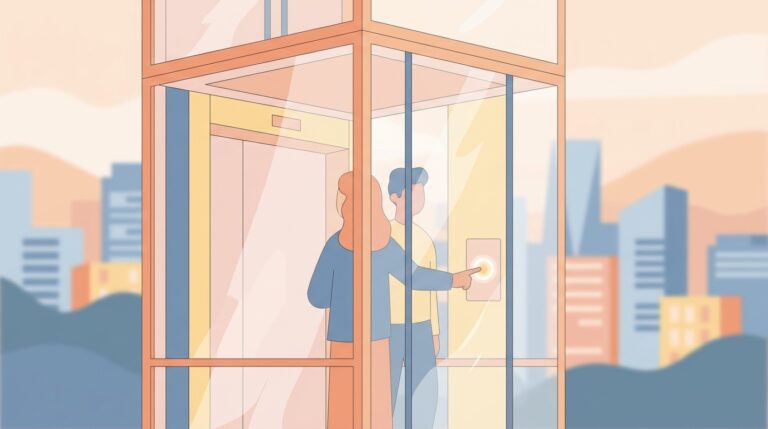
Picture this: You step into a sleek glass elevator in a bustling high-rise in Gangnam. Before the doors even begin to slide shut naturally, the person standing near the buttons vigorously presses the “닫힘” (Close) button four times in rapid succession—click-click-click-click. For many international travelers and learners, this moment triggers immediate panic: “Is this person furious? Did I walk too slowly? Am I breaking some secret elevator rule?”
Take a deep breath! You haven’t offended anyone. What you just witnessed is the quintessential heartbeat of modern Korea: 빨리빨리 (Ppalli-Ppalli, Hurry-Hurry) culture. In Korea, waiting 3.5 seconds for automated elevator doors to glide shut feels like an eternity. Over the past 10 years of mentoring Korean learners, I’ve heard this exact story dozens of times. By mastering the linguistic nuances and unwritten rules of Korean elevators, you won’t just avoid awkward elevator freezes—you’ll naturally blend into the urban rhythm of Seoul like a seasoned local.
Phase 2: 핵심 표현 3선 심층 분석 (Core Expressions)
1. 닫힘 버튼 좀 눌러주세요 (Dathim beoteun jom nulleojuseyo)
- Pronunciation: [Dathim beoteun jom nulleojuseyo] (Sounds like: “Dat-him buh-teun jom nool-luh-joo-seh-yo”)
- Meaning: Literal: “Please press the close button.” | Real Nuance: “Could you tap ‘Close’ for us so we can get moving?”
- K-Culture Moment: In office K-Dramas like Misaeng, junior staff trapped in the back of a crowded elevator casually ask the person standing next to the panel to tap close.
- Editor’s Insight: Adding 좀 (jom – please/a little bit) softens the urgency. Without “좀”, it can sound like a direct order. Use it when you are too far from the button panel to reach it yourself.
- Situation Spectrum:
- Casual (Friends/Peers): ⚠️ (Use “닫힘 눌러줘” instead)
- Semi-formal (Colleagues/Strangers): ✅ (Perfect!)
- Formal (Senior executives): 🚫 (Better to press it quietly yourself without commanding)
- 🤔 Think About It: In your country, does asking someone to hurry the elevator feel rude or efficient?
2. 먼저 타세요 (Meonjeo taseyo)
- Pronunciation: [Meonjeo taseyo] (Sounds like: “Muhn-juh tah-seh-yo”)
- Meaning: Literal: “Please ride first.” | Real Nuance: “Go ahead, after you!”
- K-Culture Moment: When an elevator opens and you make awkward eye contact with someone holding an iced Americano in both hands.
- Editor’s Insight: 먼저 (Meonjeo) means “ahead” or “first”. Combining it with the polite imperative -세요 (-seyo) demonstrates prompt consideration, proving that Korean speed culture can still be deeply polite.
- Situation Spectrum:
- Casual: ⚠️ (Say “먼저 타!”)
- Semi-formal: ✅ (Standard courteous behavior)
- Formal: ✅ (Polite and respectful)
- 🤔 Think About It: Why does speed culture in Korea prioritize yielding quickly rather than waiting patiently?
3. 잠시만요, 같이 타요! (Jamsimanyo, gachi tayo!)
- Pronunciation: [Jamsimanyo, gachi tayo!] (Sounds like: “Jahm-see-mahn-yo, gah-chee tah-yo!”)
- Meaning: Literal: “Just a moment, let’s ride together!” | Real Nuance: “Hold the door, I’m jumping in!”
- K-Culture Moment: The classic scene where the protagonist sprints across the lobby just as the elevator chime rings.
- Editor’s Insight: At the B1 level, replace simple shouting with this smooth combination. 잠시만요 buys you 2 seconds, while 같이 타요 conveys friendly cooperation.
- Situation Spectrum:
- Casual: ✅
- Semi-formal: ✅
- Formal: ⚠️ (Use “잠시만 기다려 주시겠습니까?” in VIP settings)
- 🤔 Think About It: Notice how the sentence uses the inclusive “같이 (together)” rather than “기다려요 (wait for me)”. How does this reflect collective bonding?
Phase 3: 교과서 한국어 vs 진짜 한국어 (Textbook vs. Real Korean)
Situation 1: Telling people the elevator door is closing
- 📖 교과서 한국어 (Textbook): 문이 닫히니 조심하십시오. (Muni dathini josimhapsio.) – The door is closing, so please be careful.
- 🗣️ 진짜 한국어 (Real Korean): 문 닫혀요! (Mun dathyeoyo!) – Doors closing!
- 💡 왜 다를까?: Native Koreans prioritize speed and brevity. Standard recorded elevator announcements use formal speech, but actual passengers simply alert each other with a punchy three-syllable warning.
Situation 2: Asking someone which floor they are heading to
- 📖 교과서 한국어 (Textbook): 어느 층으로 가시기를 원하십니까? (Eoneu cheungeuro gasigireul wonhasimnikka?) – Which floor would you desire to go to?
- 🗣️ 진짜 한국어 (Real Korean): 몇 층 가세요? (Myeot cheung gaseyo?) – Which floor?
- 💡 왜 다를까?: Standing in front of the control panel automatically turns you into the temporary “elevator captain.” A short, friendly 몇 층 가세요? is natural and efficient.
Phase 4: K-Culture 딥다이브 & 비언어적 매너 (Nunchi & Cultural Code)
4-1. 눈치 (Nunchi) & Gestures: The Elevator Dance
If you stand closest to the button panel, Korean 눈치 (Nunchi – social situational awareness) assigns you an unspoken role: The Gatekeeper.
1. The Safety Finger: When people enter or exit, keep your index finger firmly pressed on the 열림 (Open) button. Do not trust the elevator sensors—they close fast!
2. The Double Tap: Once the last person’s foot is inside, immediately press 닫힘 (Close). If you just stand there looking at your phone while the door sits open for 4 idle seconds, you might sense quiet sighing behind you.
3. Subtle Head Nod: If someone holds the door for you, deliver a brisk 15-degree nod with a quick “감사합니다 (Gamsahamnida).”
4-2. 문화 코드: Why the Obsession with Speed?
Korea’s 빨리빨리 is not merely impatience; it is an urban survival philosophy forged during the rapid economic development of the late 20th century. In modern Seoul, saving 5 seconds on every elevator ride adds up across a jam-packed workday. Pressing the “닫힘” button isn’t seen as aggressive; rather, keeping doors unnecessarily open is viewed as wasting everyone’s shared time!
Phase 5: 실전 롤플레이 시나리오 (Interactive Roleplay)
- Setting: 1:55 PM. You and your Korean co-worker, Min-woo, are sprinting toward the elevator to attend a crucial 2:00 PM team presentation.
- NPC Min-woo: High-energy, carrying a laptop, hyper-conscious of the clock.
Turn 1
민우: 아, 엘리베이터 문 닫힌다! 빨리요!
(A, ellibeiteo mun dathinda! Ppalliyo!)
“Ah, the elevator doors are closing! Hurry!”
🎭 발걸음을 재촉하며 로비를 전속력으로 달린다.
Turn 2
You: 잠시만요, 같이 타요!
(Jamsimanyo, gachi tayo!)
“Wait a second, let us hop on too!”
🎭 한 손을 번쩍 들며 엘리베이터를 향해 외친다.
Turn 3
승객 (Stranger inside): 네, 들어오세요!
(Ne, deureooseyo!)
“Yes, come on in!”
🎭 열림 버튼을 꾹 누른 채 문을 활짝 열어둔다.
Turn 4
You: 휴, 감사합니다!
(Hyu, gamsahamnida!)
“Phew, thank you so much!”
🎭 가쁜 숨을 몰아쉬며 고개를 숙여 인사한다.
Turn 5
민우: 혹시 닫힘 버튼 좀 눌러주시겠어요? 저희가 좀 급해서요.
(Hoksi dathim beoteun jom nulleojusigesseoyo? Jeohuiga jom geuphaeseoyo.)
“Could you please press the close button? We are in a bit of a rush.”
🎭 손목시계를 애타게 확인하며 버튼 패널 쪽 승객을 바라본다.
Turn 6
승객: 네, 닫았습니다! 몇 층 가세요?
(Ne, dadatseumnida! Myeot cheung gaseyo?)
“Sure, closing now! Which floor are you going to?”
🎭 닫힘 버튼을 두 번 연속으로 탁탁 누르며 묻는다.
Turn 7
민우: 12층이요!
(Sibicheung-iyo!)
“12th floor, please!”
🎭 안도의 한숨을 내쉰다.
Turn 8
You: 먼저 내리세요! 저희는 12층이에요.
(Meonjeo naeriseyo! Jeohuineun sibicheung-ieyo.)
“Please exit first! We are heading to the 12th.”
🎭 7층에서 내리는 다른 사람을 위해 살짝 옆으로 비켜선다.
🔀 인터랙티브 분기점 (Branching Point)
You enter a crowded elevator and end up standing right against the button panel. The doors remain open. What do you do?
- Option A: Stand still and wait for the automated sensor timer to close the door naturally.
- Feedback [Bad]: Expect subtle shifting feet and gentle clearing of throats behind you. You failed the unspoken “Elevator Captain” duty!
- Option B: Check if anyone is running in, then immediately tap the “닫힘” button while asking, “몇 층 가세요?”
- Feedback [Best]: 100/100 Nunchi mastery! Everyone inside will silently view you as an elite local.
- Option C: Repeatedly smash the “열림” (Open) button by mistake because the Korean characters look similar.
- Feedback [Risk]: Everyone misses their green light, and the doors stay wide open. Remember: 닫 (flat top, closed mouth) = Close, 열 = Open!
Phase 6: 10초 감정 섀도잉 드릴 (Emotion Shadowing Drill)
Read aloud along the slash / marks for rhythm and match the indicated emotion!
[😰 숨차고 다급하게 / Frantic & breathless]
잠시만요! / 같이 / 타요!
(Jamsimanyo! / gachi / tayo!)-
[😊 친절하고 싹싹하게 / Courteous & friendly]
몇 층 / 가세요? / 눌러드릴게요.
(Myeot cheung / gaseyo? / nulleodeurilgeyo.)
(Which floor are you heading to? Let me press it for you.) -
[😌 안도하며 정중하게 / Relieved & polite]
감사합니다, / 먼저 / 내리세요.
(Gamsahamnida, / meonjeo / naeriseyo.)
Phase 7: K-Culture 미니 사전 (Key Vocabulary)
- 빨리빨리 (Ppalli-ppalli) | Hurry-hurry / Fast-paced lifestyle
The socio-cultural drive for maximum speed and efficiency in daily Korean life. - 닫힘 (Dathim) | Close (Door button)
The most worn-out button in any Korean building. Often paired with its opposite, 열림 (Yeollim – Open). - 칼퇴 (Kaltoe) | Leaving work on the dot (“Knife-sharp finish”)
A compound of 칼 (knife) and 퇴근 (leaving work). In elevators at 6:00 PM, people press buttons with laser focus to achieve 칼퇴. - 엘베 (El-be) | Elevator (Slang abbreviation)
Everyday short slang for 엘리베이터 (ellibeiteo). E.g., “엘베 앞이야” (I’m in front of the elevator).
Phase 8: 여행자를 위한 생존 키트 (Traveler Survival Kit)
Essential Survival Phrases TOP 3
- 몇 층 가세요? (Myeot cheung gaseyo?)
Pro Tip: If you are close to the keypad, say this with a warm smile. You’ll instantly earn local respect. - 문 좀 열어주세요! (Mun jom yeoreojuseyo!)
Pro Tip: If the door is closing on you from the inside, shout this clearly. - 먼저 내리세요. (Meonjeo naeriseyo.)
Pro Tip: Say this while flattening yourself against the side wall to let people exit crowded subway cars or elevators.
Editor’s Travel Note
Navigating Korean subway stations requires smart pathfinding since elevators are often reserved for strollers or seniors. To quickly find transfer elevators and avoid endless staircases, make sure to check 네이버 지도 길찾기 앱 설치 가이드 (Naver Map Navigation Guide). Always keep your T-Money transport card readily accessible—do not pause at turnstiles to dig through your backpack, or you’ll hold up the fast-moving pedestrian traffic!
Phase 9: “한 발 더 깊이” (Cultural Essay)
To outsiders, spamming the elevator close button might seem like an anxious personality quirk or outright impatience. Yet within Korean communal dynamics, time is treated as a shared public resource. Taking up unnecessary seconds of someone else’s day is perceived as inconsiderate. Pressing that close button quickly is actually a form of 배려 (Baeryeo – consideration): you are actively moving the collective group toward their destinations faster.
💬 Your Turn: Does your culture treat waiting in elevators as peaceful downtime, or do you also secretly hunt for the “Close” button? Share your thoughts below!
Phase 10: FAQ & 오해 방지 (FAQ Schema)
Q: Is pressing the close button multiple times considered rude in Korea?
A: Not at all! Unless you accidentally shut the door in someone’s face who is walking toward the elevator, pressing the close button immediately upon entering is standard urban etiquette in Korea.
Q: What if an elder enters after me? What is my elevator duty?
A: Immediately hold the 열림 (Open) button down with your hand, bow your head slightly, and say “먼저 타세요” (Meonjeo taseyo). Once they are safely aboard, ask “몇 층 눌러드릴까요?” (Which floor may I press for you?).
Q: Why do the buttons sometimes look faded or scratched?
A: Because thousands of people have tapped that specific “닫힘” button multiple times per trip! In older apartment complexes, you will frequently see protective plastic covers completely worn out over the close button.
🚨 흔한 실수 (Common Mistakes) TOP 3
- Confusing 열림 (Open) and 닫힘 (Close)
Wrong Action: Panic-pressing 열림 when you meant to close, causing awkward prolonged eye contact.
Correct Action: Memorize the first consonant! ㄷ (Dathim = Door closed like a box) vs ㅇ (Yeollim = Open circle). - Standing silently in front of the buttons without helping
Wrong Action: Staring blankly at the display board while people behind you struggle to stretch their arms to press their floors.
Correct Action: Ask 몇 층 가세요? right away. - Blocking the door when others need to exit
Wrong Action: Remaining rooted in the center of the elevator cab.
Correct Action: Step out temporarily onto the floor landing while holding the door edge, letting people exit, then step back in.
Phase 11: 액션 미션 & 참여 유도 (Action Missions)
- 🥉 Bronze Mission (Solo Shadowing): Stand in front of your mirror and practice saying “몇 층 가세요? 눌러드릴게요!” three times with a crisp nod.
- 🥈 Silver Mission (Social Share): Share this guide on Instagram or X with the caption: “Today I learned why Koreans press ‘Close’ on elevators!” and tag @DailyHangul.
- 🥇 Gold Mission (Real-world Challenge): Next time you step into an elevator in Korea (or with a Korean friend), bravely stand near the panel, press the button, and ask 몇 층 가세요?.
🎮 K-Culture Mission: Watch an episode of a workplace K-Drama (like Business Proposal or Agency). Spot the elevator scene and count how many seconds pass before someone presses the close button!
Phase 12: 인터랙티브 퀴즈 챌린지 (Interactive Quiz)
Q1. Situational Judgment
You are riding the elevator to the 10th floor. A colleague runs toward the doors shouting “같이 타요!”. What is your immediate response?
👉 Click to view the correct answer & explanation
Correct Answer: Press and hold the 열림 (Open) button and say “네, 들어오세요!”
Explanation: Never let the automated doors close when someone calls out. Use your hand to secure the open button so they don’t get trapped by the doors!
Q2. Fill-in-the-Blank
Complete the natural Korean phrase:
“Could you press the close button please?”
→ “______ 버튼 좀 눌러주세요.”
👉 Click to view the correct answer & explanation
Correct Answer: 닫힘 (Dathim)
Explanation: 닫힘 means ‘close/closing’. Remember: 닫힘 = Close, 열림 = Open!
Q3. True or False
In Korean apartment and office buildings, it is considered bad manners to press the 닫힘 (Close) button if nobody else is coming.
👉 Click to view the correct answer & explanation
Correct Answer: False!
Explanation: If the entryway is clear, pressing the close button immediately is the accepted social norm to ensure rapid transit.







