

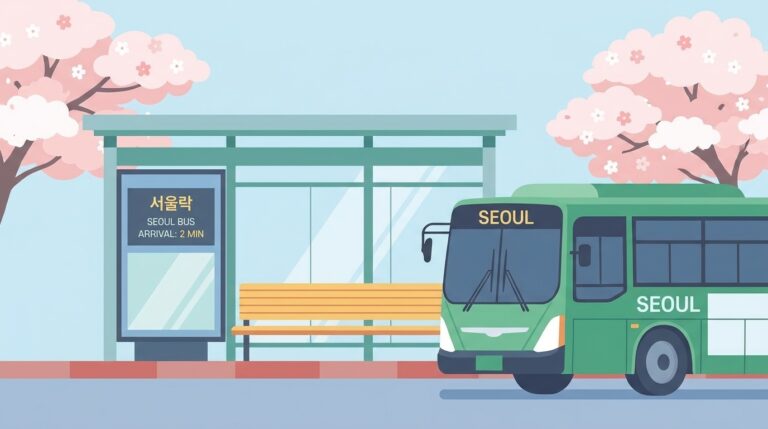
Finding Your Way: How to Ask for the Bus Stop in Korea Like a Local
Phase 1: Empathy (Story-Immersive Opening)
안녕하세요! 매일한글 에디터입니다. (Hello! I’m your Daily Hangul editor.)
Picture this: It’s 8:30 PM on a brisk evening in Seoul. You’ve just finished a warm, savory bowl of spicy tteokbokki tucked away in a vibrant alley near Mangwon Market. You pull out your smartphone to head back to your guesthouse, but your battery is blinking at a nerve-racking 6%. Even worse, your global map app is spinning endlessly—as many travelers quickly discover, international navigation apps don’t work reliably for walking directions in South Korea!
You see busy streets branching into three directions, glowing neon signs, and people hurrying home. You need to find the local green bus (마을버스) stop immediately, but you freeze. Do you wave frantically? Do you shout in English? For a second, you feel like the helpless protagonist in a K-Drama right before the scene fades to a commercial break.
Take a deep breath! Over the past decade coaching beginner learners at Daily Hangul, we have found that asking for the bus stop is the ultimate icebreaker. It transforms textbook learners into confident real-world navigators. Once you master these natural, polite phrases, you will never feel stranded on the streets of Korea again. Let’s make sure your Seoul adventure stays smooth and stress-free!
Phase 2: Core 3 Expressions Deep Dive
Here are the three foundational phrases you need to navigate any Korean neighborhood like an insider.
1. 버스 정류장이 어디예요? (Beoseu jeongryujangi eodiyeyo?)
- Pronunciation: [Beo-seu jeong-nyu-jang-i eo-di-ye-yo?] (Think of ‘beoseu’ like the English word ‘bus’ spoken softly, followed by ‘jeong-nyu-jang’ which rhymes with ‘song-you-calm’.)
- Meaning: Literal: “Bus stop where is it?” | Actual Nuance: “Excuse me, where is the bus stop?” (Simple, direct, and polite).
- K-Culture Moment: Seen in almost every slice-of-life drama when a character arrives in a quaint seaside town like Gangneung and asks the village elder where to wait for the local bus.
- Editor’s Insight: This is your trusty Swiss Army knife! While completely grammatically correct and respectful, adding a gentle “저기요…” (Jeogiyo / Excuse me) before it makes you sound 200% more natural.
- Situation Spectrum: Casual: ⚠️ (Use 반말 with close friends) | Semi-formal: ✅ (Ideal for strangers) | Formal: ✅
- 🤔 Think About It: Notice how Korean places the question word ‘어디’ (where) right in the middle rather than at the very beginning like in English. How does putting the topic first change how you visualize what you are seeking?
2. 저기요, 혹시 이 근처에 버스 정류장 있어요? (Jeogiyo, hoksi i geuncheoe beoseu jeongryujang isseoyo?)
- Pronunciation: [Jeo-gi-yo, hok-si i geun-cheo-e beo-seu jeong-nyu-jang is-seo-yo?] (Pronounce ‘hoksi’ like ‘hoke-see’, meaning ‘by any chance’.)
- Meaning: Literal: “Over there, by chance in this vicinity bus stop exists?” | Actual Nuance: “Excuse me, is there a bus stop anywhere near here by any chance?”
- K-Culture Moment: The classic line used when approaching someone waiting at a traffic light or a cashier inside a convenience store without coming across as demanding.
- Editor’s Insight: The magic ingredient here is 혹시 (hoksi). In Korean social dynamics, asking directly can feel slightly abrupt. Saying ‘혹시’ creates a polite buffer that gives the other person an easy out if they don’t know the answer.
- Situation Spectrum: Casual: ⚠️ | Semi-formal: ✅ (Gold Standard for street etiquette) | Formal: ✅
- 🤔 Think About It: Why do you think Korean communication favors softening words like ‘by any chance’ when speaking to people you meet for the first time?
3. 몇 번 버스 타야 해요? (Myeot beon beoseu taya haeyo?)
- Pronunciation: [Myeot beon beo-seu ta-ya hae-yo?] (Sounds like ‘Myut bun bus ta-ya hae-yo’.)
- Meaning: Literal: “What number bus must ride?” | Actual Nuance: “Which bus number should I take?”
- K-Culture Moment: When a group of university students in a campus drama are debating whether to catch the Blue 273 bus or the Green 7011 bus to reach Sinchon.
- Editor’s Insight: Use this when you’ve already found the stop, but the colorful board shows 12 different routes and your phone screen just went blank!
- Situation Spectrum: Casual: ⚠️ | Semi-formal: ✅ | Formal: ✅
- 🤔 Think About It: In Korean, public transit vehicles are categorized by counter numbers (번 / beon). How does categorizing objects with counters streamline daily navigation?
Phase 3: Textbook Korean vs. Real Korean
Let’s upgrade your Korean from robotic textbook dialogs to authentic street-smart phrasing!
Situation 1: Asking if a bus stop exists nearby
- 📖 교과서 한국어 (Textbook): 이 부근에 버스 정류소가 존재합니까? (I bugeune beoseu jeongnyusoga jonjaehamnikka? – “Does a bus stop station exist in this vicinity?”)
- 🗣️ 진짜 한국어 (Real Korean): 저기요, 여기 근처에 버스 정류장 있어요? (Jeogiyo, yeogi geuncheoe beoseu jeongryujang isseoyo? – “Excuse me, is there a bus stop around here?”)
- 💡 왜 다를까? (Why is it different?): Native speakers rarely say ‘버스 정류소’ or ‘존재합니까’ in speech. ‘정류소’ sounds like a municipal law document! Real locals stick to ‘정류장’ and soft, friendly polite endings (-아요/어요).
Situation 2: Asking which direction to walk towards
- 📖 교과서 한국어 (Textbook): 어느 방향으로 보행해야 합니까? (Eoneu banghyangeuro bohaenghaeya hamnikka? – “Toward which direction ought one to ambulate?”)
- 🗣️ 진짜 한국어 (Real Korean): 어느 쪽으로 가야 해요? (Eoneu jjogeuro gaya haeyo? – “Which way should I head?”)
- 💡 왜 다를까? (Why is it different?): Formal Sino-Korean terms like ‘방향’ (direction) and ‘보행’ (walk) are used in government manuals or navigation voice recordings. Everyday Koreans simply use ‘쪽’ (way/side) and the verb ‘가다’ (to go).
Phase 4: K-Culture Deep Dive & Non-Verbal Manners
4-1. 눈치 (Nunchi) & Polite Street Gestures
Approaching a stranger in Korea requires gentle body language. People in bustling cities like Seoul often walk swiftly with earphones in.
1. The Gentle Micro-Bow: Before speaking, pause one step away, give a slight 15-degree head nod, and say “저기요…” (Jeogiyo) softly. Never tap someone on the shoulder from behind—it can startle them.
2. The Open-Palm Direction: When a local points out the way, follow their fingers with your eyes rather than staring blankly at their face. If you point in confirmation, use a flat open palm instead of a single accusatory index finger.
4-2. The Hi-Tech Korean Bus Shelter Experience
If you watch modern K-Dramas like Our Beloved Summer or Extraordinary Attorney Woo, you will notice that Korean bus stops are architectural wonders:
* 온열의자 (Onyeol-uija / Heated Benches): During freezing winter months, the bench at the stop is heated! Don’t be surprised when you sit down and feel cozy warmth.
* 버스 도착 안내 단말기 (BIT – Bus Information Terminal): Every modern bus stop features a digital screen showing precisely when the bus arrives (e.g., “곧 도착” – Arriving soon, or “3분 후” – In 3 minutes) and whether seats are available!
Phase 5: Real-World Roleplay Scenario
Setting: A drizzly evening outside exit 3 of Hongik University Station. You meet a friendly local college student named Min-jun (민준) who is carrying an umbrella and checking his bus app.
- Turn 1 (You): 🎭 [Politely bowing slightly with your hands clasped in front]
저기요, 혹시 이 근처에 버스 정류장 있어요?
(Jeogiyo, hoksi i geuncheoe beoseu jeongryujang isseoyo?)
“Excuse me, is there a bus stop around here by any chance?” -
Turn 2 (Min-jun): 🎭 [Smiles warmly, taking out one earbud]
아, 네! 저쪽으로 조금만 가시면 나와요.
(A, ne! Jeojjogeuro jogeumman gasimyeon nawayo.)
“Ah, yes! If you go just a little that way, you’ll see it.” -
Turn 3 (You): 🎭 [Looking down the street, squinting slightly]
걸어서 얼마나 걸려요?
(Georeoseo eolmana geollyeoyo?)
“How long does it take on foot?” -
Turn 4 (Min-jun): 🎭 [Pointing with an open hand toward the convenience store ahead]
저기 편의점 보이시죠? 2분 정도만 걸어가시면 돼요.
(Jeogi pyeon-uijeom boisijyo? I-bun jeongdoman georeogasimyeon dwaeyo.)
“You see that convenience store over there, right? You just need to walk about two minutes.” -
Turn 5 (You): 🎭 [Showing your phone notes with relief]
혹시 7011번 버스 거기서 타요?
(Hoksi chil-cheon-sip-il-beon beoseu geogiseo tayo?)
“Do I catch bus number 7011 there by any chance?” -
Turn 6 (Min-jun): 🎭 [Checking his transit app screen]
네, 맞아요! 거기서 타시면 돼요.
(Ne, majayo! Geogiseo tasimyeon dwaeyo.)
“Yes, that’s right! You can take it from there.” -
Turn 7 (You): 🎭 [Bowing deeply with a grateful smile]
정말 감사합니다! 좋은 하루 보내세요.
(Jeongmal gamsahamnida! Joeun haru bonaeseyo.)
“Thank you so much! Have a great day.” -
Turn 8 (Min-jun): 🎭 [Nodding cheerfully]
조심히 가세요!
(Josimhi gaseyo!)
“Go safely!”
🔀 Interactive Choice Point
Min-jun points in a direction where the street forks. What do you say?
- Choice A: “오른쪽이에요, 왼쪽이에요?” (Oreunjjogieyo, oenjjogieyo? – Is it to the right or to the left?)
- Choice B: “야! 어디로 가라고?” (Ya! Eodiro garago? – Hey! Where did you say to go?)
- Choice C: “영어로 말해 주세요.” (Yeong-eoro malhae juseyo. – Please speak in English.)
Feedback:
* Option A (Best): 🌟 Excellent! Clear, concise, and natural A2 Korean. It shows respect and gets you the exact answer immediately.
* Option B (Bad): 🚫 Danger! “야” is casual slang you only use with your closest buddies or younger siblings. Using it with a stranger is extremely rude.
* Option C (Risk): ⚠️ While many young Koreans understand English, suddenly demanding English after starting in Korean might make the speaker self-conscious or flustered.
Phase 6: 10-Second Emotional Shadowing Drill
Practice reading these out loud with rhythm and emotional inflection! The / indicates a micro-pause.
[🤔 조심스럽고 공손하게 / Hesitant & ultra-polite]
저기요… / 혹시 이 근처에 / 버스 정류장 있어요?
(Jeogiyo… / hoksi i geuncheoe / beoseu jeongryujang isseoyo?)-
[👀 호기심 가득하고 명확하게 / Curious & clear]
신촌 가려면 / 몇 번 버스 / 타야 해요?
(Sinchon garyeomyeon / myeot beon beoseu / taya haeyo?) -
[😊 안도하며 환하게 웃으면서 / Relieved & beaming]
아, 저기 편의점 앞이군요! / 정말 감사합니다!
(A, jeogi pyeon-uijeom ap-igunyo! / Jeongmal gamsahamnida!)
Phase 7: K-Culture Mini Dictionary
- 버스 정류장 (Beoseu jeongryujang) | Bus Stop
The standard public transit bus shelter where local and intercity buses stop. You will spot them by their tall poles or glass canopy booths. - 환승 (Hwanseung) | Transit Transfer
Korea’s legendary transfer discount system! When switching between subway and bus (or between different bus routes) within 30 minutes, you get a massive fare discount—provided you tag your card when getting off! - 교통카드 (Gyotong kadeu) | Transportation Card (T-Money / Cashbee)
The rechargeable plastic or mobile card used across all Korean buses, subways, and even in taxis and convenience stores. - 막차 (Makcha) | The Last Bus/Train
The final run of public transportation for the night. In Korean nightlife culture, catching the ‘막차’ before 12:30 AM is a race against time, or else you stay out until the first morning train (첫차)!
Phase 8: Traveler’s Survival Kit
Top 3 Survival Phrases
- “이 버스 홍대 가요?” (I beoseu Hongdae gayo?)
- Meaning: “Does this bus go to Hongdae?”
- Pro Tip: When the bus pulls up, quickly ask the driver this sentence before tapping your card!
- “여기서 내려요!” (Yeogiseo naeryeoyo!)
- Meaning: “Getting off here!”
- Pro Tip: If the bus is packed and the exit doors are about to close, shout this firmly so the driver keeps the door open.
- “카드 찍어 주세요.” (Kadeu jjigeo juseyo.)
- Meaning: “Please tag my card / charge my transit card.”
- Pro Tip: Use this at convenience stores when handing over cash to top up your T-Money card.
Editor’s Travel Note
- Essential Navigation Apps: Never rely solely on foreign map services in South Korea. Instead, check out our recommended guides and proceed with the 네이버 지도 앱 다운로드 (Naver Map App) or 카카오맵 앱 다운로드 (KakaoMap App) for real-time bus countdowns down to the exact second!
- Tag On & Tag Off Rule: In Korea, you must tap your card upon boarding (front door) AND tap again when exiting (rear door). Forgetting to tap when exiting forfeits your transfer discount and charges a penalty fare on your next trip.
Phase 9: “A Step Deeper” (Reflective Essay)
In Korean society, public transit is more than just transportation; it is an unspoken exercise in communal harmony. Notice how people lower their voices when speaking on phone calls, instinctively offer seats to elders, and quietly form orderly lines at bus bays. When you ask a stranger for directions using gentle terms like “혹시” (hoksi), you are tapping into 정 (Jeong)—the warm, unspoken bond that encourages Koreans to step out of their way to assist visitors. Learning to ask respectfully honors this collective consideration.
💬 Your Turn: Have you ever experienced getting lost in a foreign country, or had a stranger show you kindness on public transit? Share your story in the comments below!
Phase 10: FAQ & Common Mistakes
Q: Can I pay with cash on buses in Seoul?
A: Most buses in Seoul are now completely “cashless” (현금 없는 버스). You must use a rechargeable transportation card (like T-Money) or a compatible foreign payment card. Always keep your transit card topped up!
Q: Why do buses have different colors in Seoul?
A: Seoul buses are color-coded by function! Blue buses (간선) connect suburbs to downtown; Green buses (지선) connect neighborhoods to subway stations; Red buses (광역) are express routes to satellite cities; and Yellow buses (순환) loop around downtown tourist zones.
Q: How do I know when my stop is next?
A: Automated announcements play in both Korean and English. The standard format is: “이번 정류장은 [Stop Name]입니다. 다음은 [Next Stop]입니다.” (This stop is…, next is…). Listen for 이번 (Ibeon – This stop) so you know when to press the stop bell!
🚨 Common Mistakes TOP 3
- Calling strangers “당신” (Dangsin): Never translate “you” directly into Korean. Saying “당신은 버스 정류장 알아요?” sounds aggressive or confrontational. Always begin with “저기요” (Jeogiyo) instead.
- Waiting inside the bus without ringing the bell: Unlike in some countries where buses stop automatically at every station, in Korea, if no one rings the red 하차벨 (Exit Bell) and nobody is waiting at the curb, the driver may skip the stop!
- Trying to exit through the front door: Board through the front door near the driver and exit through the middle/back door. Exiting through the front can cause a traffic jam with boarding passengers.
Phase 11: Action Missions & Engagement
- 🥉 Bronze Mission (Solo Practice): Stand in front of your mirror and practice the 3-step sequence: slight bow -> “저기요…” -> “혹시 버스 정류장 어디예요?” until it rolls off your tongue in under 3 seconds.
- 🥈 Silver Mission (Social Sharing): Record an audio clip of yourself saying “신촌 가려면 몇 번 버스 타야 해요?” and post it on your Instagram Story or language exchange app tagging
#DailyHangul. - 🥇 Gold Mission (Real Life Challenge): Next time you are in Korea or at a Korean community market, approach an information booth or clerk and ask for directions in Korean without resorting to English!
- 🎮 K-Culture Mission: Watch an episode of your favorite K-Drama set in Seoul (like My Liberation Notes or Itaewon Class). Watch for characters running to catch the bus and listen for the transit card chime: “환승입니다” (Transfer) or “티머니입니다”!
Phase 12: Interactive Quiz Challenge
Test what you learned today before your next Seoul excursion!
1. Situation Judgment: You are walking in Insa-dong and looking for the bus stop. How should you approach an elder waiting nearby?
* A) “야! 버스 어디 있어?”
* B) “저기요, 혹시 이 근처에 버스 정류장 있어요?”
* C) “당신, 버스 정류소에 가세요.”
2. Fill-in-the-Blank: Complete the question asking which bus number to take.
* “홍대 가려면 ______ 번 버스 타야 해요?”
3. True or False: In Korea, you only need to tap your transit card when getting onto the bus, never when getting off.
* [True / False]
👉 Click to reveal answers & explanations!
- Answer: B
Explanation: “저기요, 혹시 이 근처에 버스 정류장 있어요?” is polite, natural, and warm. Option A uses disrespectful informal language, while Option C inappropriately uses “당신”. - Answer: 몇 (Myeot)
Explanation: “몇 번” means “which number” when asking about buses, trains, or phone numbers. - Answer: False
Explanation: You must tap your card when getting off to receive transit transfer discounts and avoid extra distance penalties on your next trip!







