

Master Korean Variety Show Mukbang Slang: From ‘Geot-ba-sok-chok’ to Real Food Reactions
안녕하세요! 매일한글 에디터입니다. (Hello! This is your Daily Hangul editor.)
Picture this: It is midnight on a Friday. You are curled up on your sofa watching an episode of Tasty Guys (맛있는 녀석들) or Three Meals a Day (삼시세끼). The celebrity cast gathers around an iron skillet overflowing with sizzling pork belly and deep-red kimchi. One of them takes a bite, clamps their eyes shut, clenches their fists, and moans: “와, 겉바속촉 미쳤다! 국물은 완전 칼칼해!” The subtitles flash neon comic fonts with glowing flame effects across their face.
You pause the video. You open your standard language app or a traditional dictionary, and you look up 칼칼하다. The dictionary dryly reports: “Feeling a slight scratchiness or prickling dryness in the throat.” Wait, what? Why would someone look like they just entered culinary paradise if their throat is scratchy? And what about 맛있어요 (mas-iss-eoyo)? Why is nobody saying the basic textbook phrase you practiced fifty times?
If you have ever felt disconnected between textbook Korean and the explosive, mouth-watering vocabulary of Korean variety shows, you are not alone. As an intermediate B2 learner, you already understand core grammar, but authentic food culture requires sensory storytelling. In South Korea, food is not merely fuel—it is an emotional dialogue, a social bonding ritual, and the ultimate entertainment format. When you master these authentic food reactions, you will not only understand variety shows without frantic subtitle-glancing, but you will also make local friends, street food vendors, and restaurant owners (Imo!) beam with genuine delight. Let’s break down how Koreans truly react to food!
Phase 2: Core Mukbang & Cookbang Expressions Deep Dive
1. 겉바속촉 (Geot-ba-sok-chok)
- Pronunciation: [Geot-ba-sok-chok] (Sounds like gut-bah-soke-choke, spoken with snappy, rhythmic staccato beats like the crunch of a chip)
- Meaning: Literal: Outer crispy, inner moist (겉은 바삭하고 속은 촉촉하다) | Real Nuance: The holy grail texture profile for fried and baked delicacies.
- K-Culture Moment: Seen whenever an idol or comedian bites into Korean fried chicken, mandu (dumplings), or hotteok, complete with high-sensitivity ASMR audio amplification.
- Editor’s Insight: This portmanteau (줄임말) revolutionized Korean food marketing over the past decade. It is so common that even prestigious restaurant menus now boast their dish’s “겉바속촉ness.”
- Situation Spectrum: Casual: ✅ | Semi-formal: ✅ | Formal: ⚠️
- 🤔 Think About It: In English, we usually describe one dominant texture at a time (“crispy chicken”). Why does Korean culture value contrasting simultaneous sensations in a single bite?
2. 칼칼하다 (Kal-kal-ha-da)
- Pronunciation: [Kal-kal-ha-da] (Pronounce the K sharply with a crisp burst of air from the roof of the mouth, similar to clearing your throat cleanly: kahl-kahl-hah-dah)
- Meaning: Literal: Scratchy/dry | Real Nuance: Clean, crisp, peppery, non-greasy spiciness in soups and stews.
- K-Culture Moment: Celebrity chef Baek Jong-won taking a simmering spoonful of Dongtae-jjigae (pollack stew), letting out a satisfied exhale, and nodding approvingly.
- Editor’s Insight: English speakers often categorize spiciness simply by intensity (mild, medium, fiery). Korean distinguishes texture and temperature of heat. 칼칼하다 is the opposite of creamy or sweet spice; it cuts right through oiliness using ground chili flakes (고춧가루) and black pepper.
- Situation Spectrum: Casual: ✅ | Semi-formal: ✅ | Formal: ✅
- 🤔 Think About It: Can a soup be intensely spicy yet feel “cleansing” and “refreshing” in your native culture’s culinary philosophy?
3. 진실의 미간 (Jin-sil-ui Mi-gan)
- Pronunciation: [Jin-shil-ui mi-gan] (Flows as jin-sheel-we mee-gahn)
- Meaning: Literal: The glabella (brow) of truth | Real Nuance: The involuntary, furrowed scowl between your eyebrows when food tastes so transcendentally good you get angry.
- K-Culture Moment: Close-up variety show camera zooming into an actor’s face, pausing with a dramatic heartbeat sound effect right on their scrunched brow.
- Editor’s Insight: In Korean variety grammar, smiling when eating is considered polite, but furrowing your brow proves the reaction is completely unscripted and authentic.
- Situation Spectrum: Casual: ✅ | Semi-formal: ⚠️ | Formal: 🚫
- 🤔 Think About It: How does body language change when you eat among close friends versus an official dinner in your hometown?
Phase 3: Textbook Korean vs. Real Street Korean
Situation 1: Reacting to the First Bite of a Hot Dish
- 📖 교과서 한국어 (Textbook): “이 음식은 정말 맛있습니다.” (I eumsigeun jeongmal mas-itseumnida. / This food is truly delicious.)
- 🗣️ 진짜 한국어 (Real-life): “와, 미쳤다… 국물이 완전 끝내줘요!” (Wa, michyeotda… gukmuri wanjeon kkeunnaejwoyo! / Wow, insane… this soup is legendary!)
- 💡 왜 다를까? In casual culinary talk, modern Koreans frequently use hyperbole like 미쳤다 (literally “it’s crazy”) and 끝내주다 (to finish off/be top-tier) rather than the repetitive adjective 맛있다.
Situation 2: Enjoying a Spicier Dish Than Expected
- 📖 교과서 한국어 (Textbook): “조금 맵지만 먹을 수 있습니다.” (Jogeum maepjiman meogeul su itseumnida. / It is a bit spicy, but I can eat it.)
- 🗣️ 진짜 한국어 (Real-life): “맛있게 맵네요! 은근히 계속 땡기는 맛이에요.” (Mas-itge maepneyo! Eun-geun-hi gyesok ddaeng-gi-neun mas-ieyo. / It’s delicious spicy! It subtly keeps pulling me back for another bite.)
- 💡 왜 다를까? Koreans separate “painful spice” from “compulsive, addictive spice” (땡기는 맛). Pointing out that spice is 맛있게 맵다 compliments the chef’s balanced use of seasonings.
Phase 4: K-Culture Deep Dive & Non-Verbal Manners
4-1. Nunchi & The Art of Mukbang Body Language
When eating on camera or across from your Korean peers, verbal descriptions are only half the performance:
1. The Catching Hand (받침 손): Placing your left hand flat under your chin or spoon when guiding food into your mouth shows consideration for neatness, preventing broth splatters.
2. The Inhaling Exhale (하-아!): When piping hot soup enters your mouth, swallowing immediately without sound is impossible. Native speakers gently breathe in cool air while eating (호호 불기) followed by a guttural sigh of comfort (어우, 시원하다).
3. The Eye-Contact Nod: After taking a first bite, make eye contact with your companion, freeze for one second, and give two deliberate downward head nods. This confirms: “Yes, you chose the right restaurant.”
4-2. Cultural Code: Vicarious Satisfaction (대리만족)
Why did Mukbang explode into a global phenomenon in South Korea? The answer lies in the shift toward single-person households (일인 가구) combined with rigorous societal beauty standards. Watching someone eat enormous bowls of noodles with infectious joy provides 대리만족 (vicarious gratification) for viewers living alone or managing strict diets. Sharing food visually has become an antidote to urban loneliness.
Phase 5: Live Roleplay: Midnight at an Euljiro Pocha
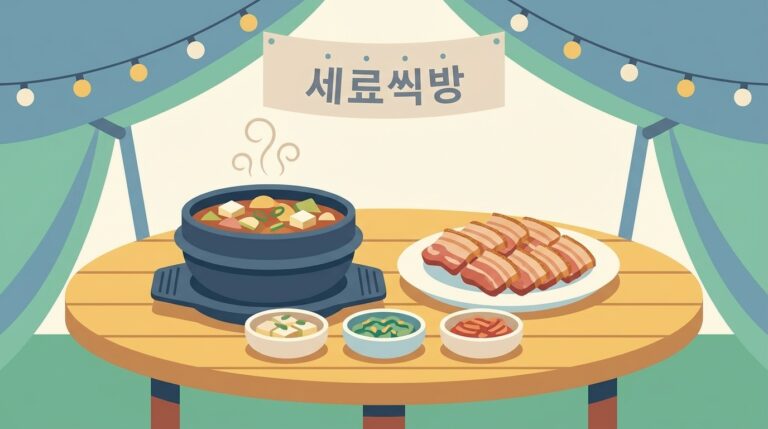
Setting: A steamy vinyl tent bar (포장마차) in Euljiro, Seoul. Rain patters against the plastic roof. You sit on a red plastic stool. The spirited owner, Auntie Min-jung (이모님), sets down a bubbling clay pot of Kimchi Jjigae with grilled pork belly.
- 이모님: “주문하신 통삼겹 김치찌개 나왔어요! 조심해, 뚝배기 엄청 뜨거워!” (Jumunhasin tongsamgyeop gimchijjigae nawasseoyo! Josimhae, ttukbaegi eomcheong tteugeowo! / Here is your thick pork belly kimchi stew! Careful now, the clay pot is sizzling hot!)
- 🎭 [You lean over the fragrant steam, widening your eyes in genuine awe]
- You: “우와, 비주얼 대박이네요! 냄새부터 장난 아니에요.” (Uwa, bijueol daebagineyo! Naemse-buteo jangnan anieyo. / Wow, the visuals are incredible! The aroma is already no joke.)
- 이모님: “그렇지? 우리 집 김치가 3년 묵은지거든. 식기 전에 국물 한번 떠먹어 봐요.” (Geureochi? Uri jip gimchiga samnyeon mugeunjigeodeun. Sikgi jeone gukmul hanbeon tteomeogeo bwayo. / Right? Our kimchi is three-year aged. Taste the broth before it cools.)
- 🎭 [You take a careful spoonful, blowing on it twice, then sip. You frown your eyebrows deeply in wonder]
- You: “크으… 이모님, 국물이 진짜 칼칼하고 시원해요! 속이 확 풀리는데요?” (Keu-eu… I-mo-nim, gukmuri jinjja kal-kal-ha-go si-won-hae-yo! Sogi hwak pul-ri-neun-de-yo? / Mmmph… Auntie, the broth is so crisply spicy and refreshing! It completely clears my stomach!)
- 이모님: (Smiling with hands on hips) “어머, 한국 사람 다 됐네! ‘칼칼하다’는 말은 어디서 배웠어? 고기도 먹어봐, 겉바속촉으로 구웠으니까.” (Eomeo, hanguk saram da dwaenne! ‘Kal-kal-ha-da’-neun mareun eodiseo baewosseo? Gogido meogeobwa, geot-ba-sok-chok-euro gu-weoss-eu-nikka. / Oh my, you’ve turned completely Korean! Where did you learn that word? Try the meat too, I grilled it crispy on the outside, juicy inside.)
- 🎭 [You dip a piece in salted sesame oil and take a bite with a crunch]
- You: “와, 삼겹살이 진짜 겉바속촉의 정석이네요. 진실의 미간 나오는 맛이에요!” (Wa, samgyeopsari jinjja geot-ba-sok-chok-ui jeongseog-ineyo. Jin-sil-ui mi-gan na-o-neun mas-ieyo! / Wow, this pork belly is the gold standard of crispy-outside-juicy-inside. It brings out the glabella of truth!)
- 이모님: “아이고, 말도 참 예쁘게 하네! 서비스로 계란말이 하나 말아줄게!” (Aigo, maldo cham yeppeuge hane! Seobiseuro gyeranmari hana marajulge! / Oh my, you speak so charmingly! I’m rolling up a free rolled omelet on the house!)
🔀 Interactive Decision Point
The omelet arrives steaming hot. Auntie looks at you expectantly. How do you respond?
- Option A: “이모님, 너무 배불러서 못 먹겠어요. 그냥 남길게요.” (Imo-nim, neomu baebulleoseo mot meokgesseoyo. Geunyang namgilgeyo. / Auntie, I’m too full to eat this. I’ll just leave it.)
- 🚫 Feedback (Bad): While honest, directly refusing a warm-hearted free service (서비스) from an elderly restaurant owner damages rapport and rejects their hospitality (정).
- Option B: “우와, 서비스까지 주시다니 감동이에요! 이거야말로 완벽한 꿀조합이네요!” (Uwa, seobiseukkaji jusidani gamdongieyo! Igeoyamallo wanbyeokhan kkul-jo-hab-ineyo! / Wow, giving this on the house touches my heart! This is truly the perfect food pairing!)
- 🌟 Feedback (Best): Spot on! Praising the generosity and recognizing the food combination (꿀조합) cements your status as a beloved regular customer.
- Option C: “이것은 얼마입니까? 영수증에 추가해 주세요.” (Igeoseun eolmaimnikka? Yeongsujeunge chugahae juseyo. / How much is this? Please add it to the receipt.)
- ⚠️ Feedback (Risk): Misses the cultural meaning of 서비스 (free promotional gift). You appear overly transactional and misunderstand Korean restaurant etiquette.
Phase 6: 10-Second Emotional Shadowing Drill
Read these variety show lines aloud. Pay attention to the pauses (/) and embody the bracketed emotions.
[🤤 황홀하고 격하게 감탄하며 / In ecstatic disbelief]- “와… / 겉은 진짜 바삭한데 / 속은 육즙이 팡 터져요!” (Wa… / geoteun jinjja basakhande / sogeun yukjeubi pang teojyeoyo! / Wow… / the outside is so crispy / while the inside bursts with juice!)
[🔥 매워서 헐떡이지만 숟가락을 놓지 못하며 / Panting from heat but helpless to stop]- “하- / 맵긴 매운데… / 이상하게 계속 땡겨요!” (Ha- / maepgin maeunde… / isanghage gyesok ddaeng-gyeoyo! / Phew- / it is spicy indeed… / but strangely it keeps pulling me back!)
[😍 시원한 국물을 들이켜고 감탄사 방출 / Gulping soup and venting sheer relief]- “으아- / 국물이 너무 칼칼해서 / 피로가 다 날아가는 기분이에요.” (Eua- / gukmuri neomu kal-kal-hae-seo / piroga da naraganeun gibunieyo. / Ahhh- / the broth is so crisply spicy / that all my fatigue feels blown away.)
Phase 7: K-Culture Mini Dictionary
- 맵부심 (Maep-bu-sim) | Noun | Spicy Pride. A combination of 매운맛 (spicy flavor) and 자부심 (pride). It refers to the badge of honor Koreans wear when effortlessly handling super-spicy foods like Buldak ramen.
- 완뚝 (Wan-ttuk) | Noun / Verb | Finishing an entire earthenware bowl clean. Short for 완전한 뚝배기 비우기. Leaving not a single grain of rice or drop of soup at the bottom of a hot stone bowl.
- 꿀조합 (Kkul-jo-hap) | Noun | Honey combination. Denotes two food or drink items that create unexpected synergy when consumed together (e.g., spicy tteokbokki with sweet fried sweet potatoes).
- 밥도둑 (Bap-do-duk) | Noun | Rice thief. Any side dish so savory, umami-rich, or seasoned (like soy-marinated raw crab 간장게장) that your bowl of steamed rice mysteriously vanishes before you notice.
Phase 8: Traveler’s Survival Kit
Top 3 Survival Expressions for Food Lovers
- “덜 맵게 해 주실 수 있나요?” (Deol maepge hae jusil su innayo? / Could you please make it less spicy?)
- Pro Tip: If your spice tolerance is low, say this before the order reaches the kitchen. Many Korean cooks assume baseline spice is mild.
- “여기 뭐가 제일 잘 나가요?” (Yeogi mwoga jeil jal nagayo? / What is the most popular dish here?)
- Pro Tip: Instead of asking for recommendations (추천), asking what “leaves the kitchen most” reveals what everyday locals actually order.
- “국물 리필 되나요?” (Gukmul ripil doenayo? / Can I get a refill of the broth?)
- Pro Tip: In most casual jjigae or tang restaurants, topping up plain broth is complimentary.
Editor’s Travel Note
Navigating Korea’s food scene requires more than vocabulary. To secure a table at viral mukbang locations without queuing for two hours, consider utilizing the 캐치테이블 실시간 맛집 예약 앱 for immediate table reservations. Furthermore, Google Maps does not provide accurate walking or transit routing across Seoul; always check transit transfers with the 네이버 지도 길찾기 및 대중교통 앱. When paying, remember that tipping is non-existent in Korea—polite verbal appreciation (“잘 먹었습니다!”) is the greatest tip you can leave.
Phase 9: 한 발 더 깊이 (One Step Deeper: Food as Community)
In Western individualist culinary habits, one person orders one plate. In Korea, dining is fundamentally shared: a single central burner with four spoons dipping into the same bubbling stew. This manifests the unique Korean concept of 정 (Jeong)—affection formed through shared space and collective vulnerability. In Korean variety shows, when a cast member begs for “한 입만!” (Just one bite!), they are not stealing resources; they are reaffirming intimacy. To eat together (식구, literally “eating mouths”) is to become family.
💬 Your Turn: Does your culture share dishes from a communal pot, or does everyone stick strictly to their own plate? Have you ever experienced an involuntary 진실의 미간? Share your favorite food memory in the comments below!
Phase 10: FAQ & Avoiding Misunderstandings
Q: Can I use “겉바속촉” when talking to elderly restaurant owners?
A: Yes! While it began as internet slang, it is now an affectionate, widely recognized culinary term across all generations. When used with polite verb endings (e.g., “정말 겉바속촉이네요!”), older shop owners will admire your fluency.
Q: Does “시원하다” (siwonhada) mean cold when eating boiling hot soup?
A: No! When Koreans drink boiling soup and exclaim “아, 시원하다!”, they mean the soup is deep, refreshing, and relieves bodily tension or hangovers. It refers to thermal sensation in cold drinks, but to internal physical relief in hot broths.
Q: Is it rude to make slurping noises while eating noodles?
A: Unlike certain other East Asian cultures where loud slurping is expected, Korean etiquette prefers moderate eating sounds. Small slurps while consuming hot ramyeon are natural, but exaggerated theatrical slurping outside of comedic variety shows is viewed as slightly untidy.
🚨 흔한 실수 (Common Mistakes) 경고판
- ❌ Mistake 1: Calling every spicy dish 맵다.
- 👉 Correct Action: Specify nuance! If it is clean and broth-based, use 칼칼하다. If it is sweet-spicy, use 달콤매콤하다.
- ❌ Mistake 2: Using 맛있어요 exclusively.
- 👉 Correct Action: Compliment specific textures: 쫄깃하다 (chewy/bouncy), 바삭하다 (crispy), or 부드럽다 (melt-in-your-mouth tender).
- ❌ Mistake 3: Saying “I’m full” by translating literally as “저는 가득 찼어요”.
- 👉 Correct Action: Say “배불러요” (Bae-bul-leo-yo) or express culinary respect: “너무 맛있어서 과식했어요!” (It was so good I overate!).
Phase 11: Action Missions
- 🥉 Bronze Mission (Solo Practice): Eat your next meal and narrate the textures out loud in Korean using at least two descriptive adjectives (바삭하다, 촉촉하다, 칼칼하다).
- 🥈 Silver Mission (Social Media): Post a picture of your favorite food on Instagram or Threads with the caption: “오늘의 겉바속촉 꿀조합! 진실의 미간 나오는 맛 🤤”.
- 🥇 Gold Mission (Real Life): Visit a local Korean restaurant or grocery counter, take a bite of stew or fried food, and compliment the staff directly: “이모님, 진짜 국물이 칼칼하고 맛있어요!”
- 🎮 K-Culture Variety Challenge: Watch one 10-minute clip of 맛있는 녀석들 (Tasty Guys) or 출장 십오야 (The Game Caterers) on YouTube without English subtitles and tally how many times you spot the actor’s 진실의 미간!
Phase 12: Interactive Variety Quiz Challenge
Q1. Situational Judgment
You are eating freshly made Haemul Pajeon (seafood scallion pancake) that has deeply browned edges and a soft, scallion-packed center. Which phrase is the most natural native reaction?
* A) “완전 맵부심 생기네요!”
* B) “와, 제대로 겉바속촉인데요?”
* C) “국물이 참 칼칼하네요!”
Q2. Fill in the Blank
When a stew is sharp, clean, and pleasantly spicy without feeling heavy or sweet, Koreans say the soup is ________.
* (힌트: ㅋ ㅋ ㅎ ㄷ)
Q3. True or False
In Korean variety culture, scrunching the muscles between your eyebrows (진실의 미간) when eating indicates that you dislike the seasoning.
* (True / False)
👉 Click here to reveal answers and explanations!
- Q1 Answer: B) “와, 제대로 겉바속촉인데요?”
- Explanation: Pajeon is fried on a flat griddle, giving it crunchy edges and a tender middle—the textbook definition of 겉바속촉. 맵부심 relates to handling extreme chili heat, and 칼칼하다 only describes soups or broths.
- Q2 Answer: 칼칼하다 (Kal-kal-ha-da)
- Explanation: 칼칼하다 describes the clear, peppery, non-sugary heat characteristic of Korean broths like Kimchi-guk or Maeun-tang.
- Q3 Answer: False
- Explanation: Furrowing the brow (진실의 미간) is the ultimate physical marker of overwhelming deliciousness! If you disliked it, you would display hesitation or polite indifference.
- Explanation: Furrowing the brow (진실의 미간) is the ultimate physical marker of overwhelming deliciousness! If you disliked it, you would display hesitation or polite indifference.







