

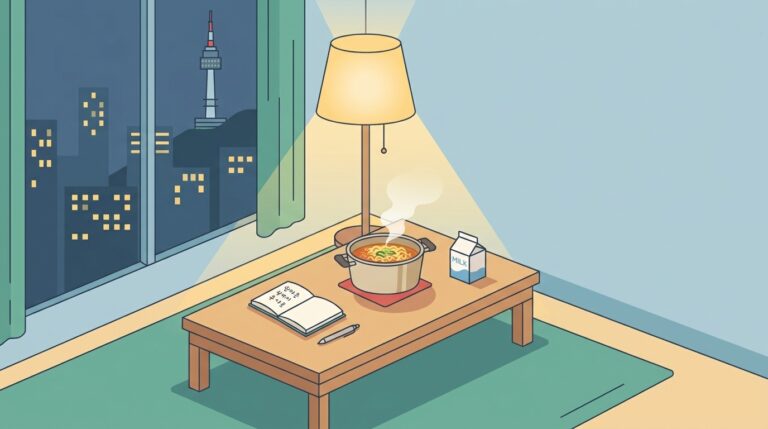
The Midnight Dilemma: How to Talk About Late-Night Cravings and Morning Puffy Face Like a True Korean
Phase 1: Empathy (Story-Immersive Opening)
안녕하세요! 매일한글 에디터입니다.
Picture this: It is 11:45 PM on a chilly Thursday evening in Seoul. You are wrapped in a cozy fleece blanket in your officetel, binge-watching your favorite K-drama. Just when you think you are ready to sleep, the male lead slurps down a steaming, crimson bowl of instant ramyeon topped with a perfectly gooey slice of cheddar cheese. Your stomach lets out an undeniable growl. You open your kitchen cabinet. There it is—a solitary pack of Shin Ramyun calling your name.
You fill the small yellow nickel-silver pot with water, turn on the gas stove, and then… sudden dread strikes. Tomorrow morning at 10:00 AM, you have an important job interview, a college presentation, or passport photo shoot. Your mind flashes to a terrifying visual: waking up with puffy eyelids and cheeks swollen like steamed dumplings. You look at the boiling water and whisper to yourself, “If I eat this right now, my face is going to blow up tomorrow.”
If you have ever spent time in Korea or watched Korean variety shows, you know that the fear of eolgul bugi (facial puffiness) is an intense national obsession. International learners often tell our Daily Hangul team: “I know how to say ‘I’m hungry,’ but how do I express that exact, funny agony of desperately wanting late-night snacks while dreading the puffy face tomorrow?” In this guide, drawn directly from native habits and real conversational feedback, you will master natural, intermediate-level Korean expressions that will instantly make your Korean friends laugh and nod in sympathetic agreement.
Phase 2: Top 3 Core Expressions In-Depth Analysis
1. 내일 얼굴 부으면 어떡하지? (Naeil eolgul bueumyeon eotteokhaji?)
- Pronunciation: [Nae-il eol-gul bu-eu-myeon eo-tteo-kha-ji?] (Think of bu-eu like blowing out a candle: boo-uh).
- Meaning: Literal: “What if my face swells tomorrow?” | Actual Nuance: “Ugh, what if I wake up looking like a completely different, swollen person tomorrow?”
- K-Culture Moment: In almost every behind-the-scenes K-pop vlog or reality show like I Live Alone, you will hear idols say this right before an album shoot while staring longingly at a midnight delivery box.
- Editor’s Insight: The verb 붓다 (but-da, to swell) has an irregular ‘ㅅ’ conjugation where the ‘ㅅ’ drops before a vowel (붓다 -> 부어 -> 부으면). Using 어떡하지 adds a relatable touch of cute helplessness rather than serious panic.
- Situation Spectrum: Casual ✅ | Semi-formal ⚠️ | Formal 🚫
- 🤔 Think About It: In many Western cultures, late-night snacking guilt centers purely on calories or weight gain. Why do you think Korean society places such a high, immediate concern on facial puffiness specifically?
2. 야식 먹고 자면 백퍼 붓는다. (Yasik meokgo jamyeon baekpeo bunneunda.)
- Pronunciation: [Ya-sik meok-go ja-myeon baek-peo bun-neun-da.] (Baek-peo sounds like back-fur, a slang contraction of baek peosenteu or 100%).
- Meaning: Literal: “If I eat late-night food and sleep, it swells 100%.” | Actual Nuance: “It’s a guaranteed fact: if I touch this food right now, my face is going to be huge tomorrow.”
- K-Culture Moment: Heard among college students crammed into a study room at 1:00 AM debating whether to split a box of fried chicken.
- Editor’s Insight: 백퍼 (baek-peo) is the ultimate colloquial emphatic marker. Notice the plain statement ending ~는다 (-neunda), which makes it sound like an unshakeable law of the universe that you are stating to yourself or close friends.
- Situation Spectrum: Casual ✅ | Semi-formal ⚠️ | Formal 🚫
- 🤔 Think About It: How does casual slang like 백퍼 compare to English phrases like “hands down” or “guaranteed” when making everyday predictions?
3. 우유 한 잔 마시고 잘까? (Uyu han jan masigo jalkka?)
- Pronunciation: [U-yu han jan ma-si-go jal-kka?] (U-yu sounds like “ooh-you”).
- Meaning: Literal: “Shall I drink a glass of milk and sleep?” | Actual Nuance: “Should I drink milk to counter the sodium so my face won’t swell up?”
- K-Culture Moment: A character in a K-drama sneaks into the kitchen at 2:00 AM, finishes a bowl of spicy noodles, and immediately pours cold milk into a mug with a satisfied sigh.
- Editor’s Insight: This is not just a bedtime drink; it is Korea’s most famous “scientific folk remedy.” Potassium in milk helps flush out sodium. Proposing this sentence shows you understand Korean late-night survival lore on a native level.
- Situation Spectrum: Casual ✅ | Semi-formal ✅ | Formal 🚫
- 🤔 Think About It: What kind of post-meal preventative tricks exist in your culture to avoid looking tired or bloated the following morning?
Phase 3: Textbook Korean vs. Real Korean
Situation 1: Talking about your face looking swollen after eating
- 📖 교과서 한국어: 야식을 먹으면 다음 날 아침 얼굴에 부종이 생깁니다. (Yasigeul meogeumyeon daeum nal achim eolgure bujongi saenggimnida.)
- “If one ingests late-night food, edema occurs on the face the following morning.”
- 🗣️ 진짜 한국어: 라면 먹고 자면 내일 얼굴 완전 보름달 돼. (Ramyeon meokgo jamyeon naeil eolgul wanjeon boreumdal dwae.)
- “If I crash after eating ramen, my face is going to turn into a total full moon tomorrow.”
- 💡 왜 다를까? Textbook Korean treats swelling like a clinical medical diagnosis (부종). Native speakers almost always use visual metaphors like 보름달 (full moon) or the beloved animated character 호빵맨 (Anpanman) to make fun of themselves.
Situation 2: Begging for just a small bite while trying to resist
- 📖 교과서 한국어: 저는 붓기를 피하기 위해 야식을 섭취하지 않겠습니다. (Jeoneun butgireul pihagi wihae yasigeul seopchwihaji ankkesseumnida.)
- “I shall not consume late-night food in order to avoid puffiness.”
- 🗣️ 진짜 한국어: 나 진짜 참을 건데… 딱 한 입만 먹어도 돼? (Na jinjja chameul geonde… ttak han imman meogeodo dwae?)
- *”I’m seriously going to hold back… but can I have just literally one single bite?”
- 💡 왜 다를까? Nobody uses formal medical terms when staring at delivery food. The word 딱 (ttak, just/exactly) paired with 한 입만 (han imman, just one bite) captures the universal, hilarious inner defeat everyone experiences.
Phase 4: K-Culture Deep Dive & Non-Verbal Manners
4-1. 눈치 (Nunchi) & Gestures
When Koreans express worry about facial swelling, words are almost always paired with physical comedy:
1. The V-Line Cup: Place both palms firmly against your jawline, fingers pointing toward your ears, gently lifting your cheeks. This mimics the coveted “sharp jawline” while dramatically lamenting the puffiness that threatens it.
2. The Horror Cheek-Tap: Lightly patting under your eyes with your fingertips while gasping: “어머, 내일 눈 안 떠지면 어떡해?” (“Oh no, what if my eyes can’t even open tomorrow?”).
3. Sharing Etiquette: If your roommate is cooking ramen late at night and you vowed not to eat, do not immediately grab a pair of chopsticks. Wait for them to ask you, playfully decline once, and then use the magical phrase: “국물만 한 숟가락만 먹을게” (“I’ll just have one spoonful of soup”).
4-2. Culture Code: The Sodium Battleground
In Korea, delivery culture (배달 문화) is among the fastest and most developed in the world. You can get piping-hot tteokbokki, jokbal (braised pig’s trotters), or fried chicken delivered to your doorstep at 3:00 AM. Because Korean late-night favorites (야식) are notoriously spicy and high in sodium, counter-measures have evolved into an entire industry.
Convenience stores feature dedicated shelves for 호박즙 (pumpkin extract juice) and 붓기차 (de-puffing teas), which idols and actors chug before shoots. Even K-pop stars routinely share their secret hacks: adding milk directly into ramyeon broth to prevent sodium absorption, or dipping cucumber slices in ice water for the eyes.
Phase 5: Real-Life Roleplay Scenario
Setting: A cozy one-room studio in Mapo-gu, Seoul. 11:50 PM. Minji has just placed a piping hot pot of ramyeon on the low wooden table. The spicy, savory aroma fills the small apartment.
- Minji: 와, 냄새 대박이다! 너 진짜 한 입도 안 먹을 거야? (Wa, naemsae daebagida! Neo jinjja han ipdo an meogeul geoya?)
- “Wow, this smells unbelievable! Are you seriously not going to take even one bite?”
🎭 행동 지문: Chopsticks poised in the air, smiling mischievously.
- You: 아, 진짜 고민된다… 내일 아침에 팀 미팅 있단 말이야. (A, jinjja gomindoenda… naeil achime tim miting itdan mariya.)
- “Ah, I’m seriously torn… I have that morning team meeting tomorrow, you know.”
🎭 행동 지문: Gripping your cheeks with both hands, looking at the bubbling pot.
- Minji: 미팅이야 뭐 어때! 맛있게 먹으면 0칼로리인 거 몰라? (Miting-iya mwo eottae! Masitge meogeumyeon yeong-kallori-in geo molla?)
- “Who cares about a meeting! Don’t you know food has zero calories if you enjoy it?”
🎭 행동 지문: Slurping a mouthful of noodles right in front of you with exaggerated relish.
- You: 그래도 라면 국물 마시고 자면 백퍼 얼굴 붓잖아! (Geuraedo ramyeon gungmul masigo jamyeon baekpeo eolgul打开 bunjana!)
- “Still, if I drink ramen broth and go straight to sleep, my face 100% swells up!”
🎭 행동 지문: Squinting your eyes to mimic what your swollen face will look like.
- Minji: 그러면 국물은 마시지 말고 면만 딱 두 젓가락만 먹어. (Geureomyeon gungmureun masiji malgo myeonman ttak du jeotgarakman meogeo.)
- “Then don’t drink the broth; just eat literally two chopstick-fuls of noodles.”
🎭 행동 지문: Handing you a pair of wooden chopsticks.
- You: 진짜 딱 두 젓가락이다? 내일 호빵맨 되면 네 탓이야! (Jinjja ttak du jeotgaragida? Naeil hoppangmaen doemyeon ne tasiya!)
- “Strictly two chopstick-fuls, deal? If I turn into Anpanman tomorrow, it’s all your fault!”
🎭 행동 지문: Reluctantly taking the chopsticks while laughing.
- Minji: 오케이! 대신 다 먹고 우유 한 모금 마시고 자자. 붓기 방지! (Okei! Daesin da meokgo uyu han mogeum masigo jaja. Butgi bangji!)
- “Deal! But let’s drink a sip of milk after this before bed. Puffiness prevention!”
🎭 행동 지문: Pointing at the milk carton in the fridge with a wink.
- You: 그래, 우유 마시면 좀 낫겠지? 잘 먹겠습니다! (Geurae, uyu masimyeon jom natgetji? Jal meokgetseumnida!)
- “Right, milk will make it a bit better, right? Thanks for the food!”
🎭 행동 지문: Eagerly grabbing the first bite.
🔀 Interactive Choice Point
What would you say if Minji offered you the pot right as you were heading to brush your teeth?
* Option A: “야, 유혹하지 마! 나 내일 증명사진 찍어야 해서 진짜 안 돼.” (Ya, yuhokhaji ma! Na naeil jeungmyeongsajin jjigeoya haeseo jinjja an dwae.)
* Option B: “야식을 먹는 행위는 소화 기관에 부담을 줍니다.” (Yasigeul meongneun haengwineun sohwa gigwane budameul jumnida.)
* Option C: “몰라, 다 먹어버릴래! 내일 일은 내일의 내가 해결하겠지!” (Molla, da meogeobeorillae! Naeil ireun naeirui naega haegyeolhagetji!)
Feedback:
* Option A (Best – Natural & Relatable): Perfect! It blends playful protest (유혹하지 마) with a valid cultural reason (taking ID photos requires an unswollen face).
* Option B (Bad – Robotic): Far too academic and clinical. You sound like a medical textbook rather than a close friend hanging out at midnight.
* Option C (Risk – Fun Slang, but Danger Tomorrow): A very trendy and native mindset (내일 일은 내일의 내가 = “Tomorrow’s me will deal with tomorrow’s problems”), but be prepared to wake up with swollen eyelids!
Phase 6: 10-Second Emotion Shadowing Drill
Practice these lines out loud with the exact emotional pitch and pause markers (/):
[🥺 아쉽고 애교 섞어서 / Tempted & Whining]
“나 진짜 안 먹으려고 했는데… / 딱 한 입만 먹으면 / 진짜 붓나?”
(Na jinjja an meogeuryeogo haenneunde… / ttak han imman meogeumyeon / jinjja bunna?)-
[😱 패닉에 빠져서 / Morning Panic]
“헐, 어떡해! / 라면 먹고 잤더니 / 눈이 안 떠져!”
(Heol, eotteokhae! / ramyeon meokgo jatdeoni / nuni an tteojyeo!) -
[😏 타협하며 / Playfully Compromising]
“국물은 안 마시고 / 우유 마시고 자면 / 괜찮겠지?”
(Gungmureun an masigo / uyu masigo jamyeon / gwaenchanketji?)
Phase 7: K-Culture Mini Dictionary
- 야식 (Yasik)
- Translation: Late-night meal/snack.
- Usage: Refers specifically to meals ordered or eaten after dinner hours (usually post-10 PM). In Korea, 야식 is an entire social bonding category, not just a guilty fridge raid.
- 붓기 / 부기 (Bugki / Bugi)
- Translation: Swelling / puffiness / edema.
- Usage: While 부기 is standard orthography, 붓기 is overwhelmingly favored in daily speech and on social media when talking about morning facial bloat.
- 호박즙 (Hobakjeup)
- Translation: Pumpkin extract juice pouch.
- Usage: The undisputed holy grail of puffiness relief in Korea. Popularized by plastic surgery recovery clinics, you will find working professionals and influencers sipping this before morning shoots.
- 한 젓가락만 (Han jeotgarakman)
- Translation: Just one chopstick-full.
- Usage: The ultimate lie between Korean friends. It starts with 한 젓가락만, but somehow half the bowl vanishes in that single swipe.
Phase 8: Survival Kit for Travelers
Top 3 Survival Expressions
- 혹시 덜 짜게 해주실 수 있나요? (Hoksi deol jpage haejusil su innayo?)
- Romanization: [Hok-si deol jja-ge hae-ju-sil su in-na-yo?]
- Pro Tip: Use this at late-night diners if you are extremely sensitive to salt and want to minimize next-day swelling.
- 편의점에 붓기차 있어요? (Pyeon-ui-jeome butgicha isseoyo?)
- Romanization: [Pyeon-ui-jeo-me but-gi-cha is-seo-yo?]
- Pro Tip: Convenience store clerks will instantly point you to corn silk tea (옥수수수염차) or pumpkin tea.
- 얼굴이 너무 부어서 사진 못 찍겠어요! (Eolguri neomu bueoseo sajin mot jjiggesseoyo!)
- Romanization: [Eol-gu-ri neo-mu bu-eo-seo sa-jin mot jjik-get-seo-yo!]
- Pro Tip: A charming and very natural excuse when friends want to take morning selfies while traveling.
Editor’s Travel Note
- Essential Apps: If you crave midnight fried chicken in your hotel, refer to the 배달의민족 앱 다운로드 가이드 to experience Korea’s doorstep delivery system. Most services accept foreign cards via localized web checkout.
- Next-Day Quick Fix: If you wake up with a swollen face before your tour in Bukchon Hanok Village, run into any Olive Young and look for cooling face rollers or pumpkin tea packs. Grabbing an iced Americano (아아) also acts as an immediate diuretic!
Phase 9: “한 발 더 깊이” (One Step Deeper)
In many parts of the world, late-night snacking is a solitary, guilt-ridden act committed in the dark in front of an open refrigerator. In Korea, however, 야식 is profoundly relational. It is the communal broth shared after intense overtime work, the university dorm bonding over delivery pizza, and the comforting ritual shared with family.
Yet, this warm community dynamic runs headfirst into another deeply entrenched aspect of modern Korean life: meticulous visual presentation and self-care (자기관리). The playful, obsessive fear of 얼굴 붓기 is where these two values collide. Koreans want to experience the emotional warmth of sharing ramen with loved ones, but they also care deeply about looking sharp and prepared the next morning. When you complain about your face swelling up, you aren’t just talking about your looks—you are demonstrating that you respect the balance between joy and discipline.
💬 Your Turn: Have you ever stayed up late eating your favorite comfort food before an important morning? What is your country’s go-to secret remedy for waking up refreshed? Let us know in the comments below!
Phase 10: FAQ & Avoiding Misunderstandings
Q: Why do Koreans specifically recommend drinking milk before sleeping after eating ramen?
A: Instant ramyeon is notoriously high in sodium. Potassium found in milk binds with sodium in the bloodstream and accelerates its excretion through urine, which noticeably reduces extracellular water retention in the facial tissues overnight.
Q: Is it grammatically correct to say ‘붓기’ or ‘부기’?
A: According to the National Institute of Korean Language (국립국어원), the standard spelling is 부기 (without the bottom ‘ㅅ’). However, in real life, over 90% of native Koreans write and pronounce it as 붓기 (but-gi). In casual speech, using 붓기 sounds far more colloquial and native!
Q: Can I use ‘얼굴 부었어요’ to describe someone else?
A: Be careful! Telling an acquaintance or superior “얼굴 부으셨네요” (Your face is swollen) can be perceived as an offensive critique of their appearance, implying they look tired, bloated, or neglected. Reserve this observation for yourself or very close friends.
🚨 Common Mistakes Warning Board
- Mistake 1: Using 뚱뚱해졌어요 (I became fat) instead of 부었어요 (My face swelled).
- Why: Gaining weight takes weeks; overnight changes are fluid retention (부기). Calling yourself 뚱뚱하다 over one bowl of ramen sounds overly dramatic and unnatural.
- Correct Action: Say “얼굴이 부었어요” (My face is puffy).
- Mistake 2: Mispronouncing the irregular verb 붓다 as 붓었어요.
- Why: The ‘ㅅ’ drops when followed by vowels. 붓다 + 었어요 becomes 부었어요 (bueosseoyo).
- Correct Action: Practice: 부어요, 부었어요, 부으면.
- Mistake 3: Saying 야식을 먹고 싶지 않습니다 in casual hangout settings.
- Why: Too stiff for midnight lounging.
- Correct Action: Say “나 참을래” (I’m going to hold back) or “내일 부어서 안 돼” (Can’t, I’ll swell tomorrow).
Phase 11: Action Missions
- 🥉 Bronze Mission (Solo Practice): Stand in front of your mirror tonight. Pretend you just smelled fresh ramen broth and recite: “내일 얼굴 부으면 어떡하지? 우유 마시고 잘까?” with genuine facial worry.
- 🥈 Silver Mission (Social Share): Next time you post a photo of a late-night snack or instant ramen on Instagram Stories, caption it with: “내일 얼굴 보름달 예약 🌕 (Reservation for a full-moon face tomorrow)” and tag us.
- 🥇 Gold Mission (Real-life Execution): When hanging out with Korean friends or chatting with your language exchange partner past 10:00 PM, steer the conversation toward delivery food and use the phrase: “야식 먹으면 백퍼 붓는데…”
- 🎮 K-Culture Mission: Watch an episode of any Korean variety show (such as Running Man or Omniscient Interfering View). Listen for the word 부기 or 붓다 during morning wake-up scenes. Note down how the cast members react to each other’s faces!
Phase 12: Interactive Quiz Challenge
Test your knowledge before you heat up that midnight kettle!
1. Situation Judgment: Your Korean friend is offering you spicy tteokbokki at 11:30 PM, but you have a job interview tomorrow at 9:00 AM. What is the most natural, native response?
* (a) 야식을 섭취하면 신체에 해롭습니다.
* (b) 안 돼, 나 내일 면접 있어서 얼굴 부으면 큰일 나!
* (c) 저는 내일 아침에 뚱뚱할 예정입니다.
2. Fill-in-the-Blank: Complete the classic Korean justification:
“라면 먹고 자도 국물 안 마시고 (_____) 한 잔 마시고 자면 덜 부어!”
* Hint: A white, calcium-rich drink in your fridge.
3. True or False Culture Check: In Korea, telling your manager “부장님, 오늘 아침에 얼굴이 많이 부으셨네요!” is a polite and caring way to show you are concerned about their health.
Click here to view answers and explanations
- Answer: (b) “안 돼, 나 내일 면접 있어서 얼굴 부으면 큰일 나!”
- Explanation: It directly ties the fear of swelling (얼굴 부으면 큰일 나) to an important next-day event. Option (a) is robotic, and option (c) confuses long-term weight gain with temporary water retention.
- Answer: 우유 (Uyu – Milk)
- Explanation: Drinking a glass of milk helps counteract the sodium in ramen broth, preventing extreme morning swelling.
- Answer: False (F)
- Explanation: Commenting directly on an elder’s or superior’s swollen face (얼굴이 붓다) implies they look unkempt or tired, which is considered rude. Keep these observations focused on yourself or very close friends!
- Explanation: Commenting directly on an elder’s or superior’s swollen face (얼굴이 붓다) implies they look unkempt or tired, which is considered rude. Keep these observations focused on yourself or very close friends!







