

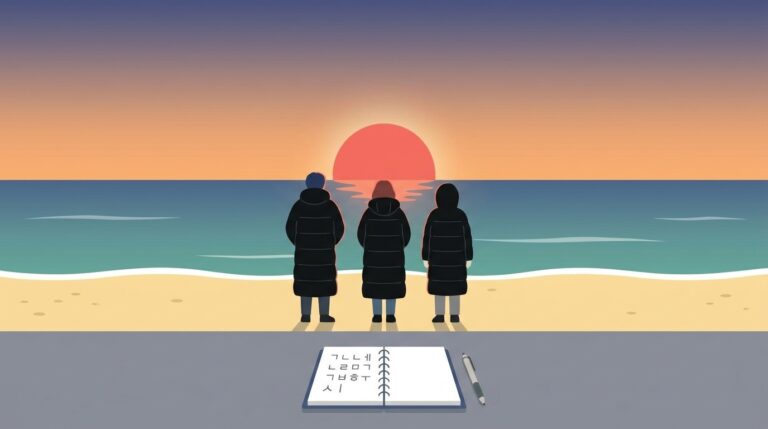
Phase 1: Empathy (Catching the First Light of the Year)
안녕하세요! 매일한글 에디터입니다. (Hello! This is your Daily Hangul editor!)
Picture this: It is 6:30 AM on January 1st at Jeongdongjin Beach. The wind whipping off the icy East Sea cuts right through your jeans, your fingers are clinging desperately to a lukewarm heat pack, and your breath comes out in thick clouds. Around you, thousands of Koreans are huddled together in matching ankle-length black padded coats, sharing sips of steaming fish-cake broth from paper cups, eyes fixed intently on the dark horizon.
You want to break the ice with the shivering travelers beside you or cheer along when the red rim of the sun finally breaks through the waves. But your mind suddenly goes blank, or worse, you blurt out rigid textbook Korean like: “안녕하십니까? 새해 복을 많이 받으십시오.” Suddenly, you sound like a Joseon Dynasty scholar greeting a royal court rather than a friend sharing a magical, bone-chilling winter morning!
Don’t worry. Thousands of our intermediate learners have felt that exact disconnect. In this guide, we are unlocking the warm, spirited, and natural Korean expressions you actually need to survive and savor a Korean winter sunrise trip (Haedoji, 해돋이). Let’s turn freezing morning air into unforgettable memories!
Phase 2: Deep Dive into 3 Core Expressions
1. 새해 복 많이 받으세요 (Saehae bok mani badeuseyo)
- Pronunciation: [Sae-hae bok mah-nee bah-deu-seh-yo] (Sounds like “Say-heh” + “Boke” + “Mahn-ee” + “Bah-deu-say-yo”)
- Meaning: Literal: “Please receive lots of New Year blessings/good fortune.” | Nuance: “Happy New Year! Wishing you prosperous days ahead!”
- K-Culture Moment: Every January 1st broadcast, variety show cast members (like in Running Man) bow toward the camera and chant this phrase together in unison.
- Editor’s Insight: This is the undisputed champion of New Year greetings. While traditional formal bowing (sebae) uses the formal ending -bunsio, in 95% of social interactions—whether with train conductors, locals on the beach, or your barista—this polite -yo ending strikes the sweet spot of warmth and respect.
- Situation Spectrum: Casual: ⚠️ (Use ‘새해 복 많이 받아’ with close peers) | Semi-formal: ✅ | Formal: ✅
- 🤔 Think About It: Notice how Koreans “receive” (bada) fortune rather than “have” a good year. What does this reveal about Korean views on luck and destiny arriving from the universe?
2. 소원 뭐 빌었어요? (Sowon mwo bireosseoyo?)
- Pronunciation: [Soh-won mwoh bee-ruh-ssuh-yoh] (Think “So-won” + “Mwah” + “Bee-ruh-so-yo”)
- Meaning: Literal: “What wish did you pray/make?” | Nuance: “What did you wish for just now?”
- K-Culture Moment: In K-dramas, whenever lead couples watch the sunrise or first snowfall, one character closes their eyes with clasped hands, and the other inevitably asks teasingly, “소원 뭐 빌었어요?”
- Editor’s Insight: The verb bida (빌다) specifically implies earnest supplication or making a heartfelt wish. Asking someone this right as the sun ascends is the ultimate Korean social bonding ritual on New Year’s Day.
- Situation Spectrum: Casual: ✅ (소원 뭐 빌었어?) | Semi-formal: ✅ | Formal: ⚠️
- 🤔 Think About It: In many cultures, sharing a wish is considered bad luck because “it won’t come true.” In Korea, playfully asking about New Year wishes fosters intimacy and mutual support.
3. 드디어 해 떴다! (Deudieo hae tteotda!)
- Pronunciation: [Deu-dee-uh hae dduht-dah!] (Emphasize the sharp, popping double-T sound: “Ddeot”)
- Meaning: Literal: “Finally the sun has risen!” | Nuance: “There it is! The sun is up!”
- K-Culture Moment: The moment the crowd on the beach spots the glowing red dot breaking the marine fog, a collective cheer ripples across the coastline: “와, 해 떴다!”
- Editor’s Insight: Deudieo (드디어) conveys prolonged waiting and hard-earned anticipation. Using the spontaneous exclamatory form (tteotda!) captures immediate raw excitement without sounding textbook-stiff.
- Situation Spectrum: Casual / Exclamatory: ✅ | Semi-formal: ⚠️ | Formal: 🚫
- 🤔 Think About It: Why do Koreans often use raw, un-conjugated past tense forms (-at/eotda) to announce things happening right before their eyes? It reflects visceral, present-moment realization!
Phase 3: Textbook Korean vs. Real Korean
Situation 1: Making small talk while waiting in the freezing wind
- 📖 교과서 한국어: “날씨가 매우 춥습니다. 일출을 기다리고 계십니까?” (The weather is very cold. Are you waiting for the sunrise?)
- 🗣️ 진짜 한국어: “오늘 날씨 진짜 대박이죠? 해 보러 오셨어요?” (Today’s weather is totally intense, isn’t it? Did you come to see the sun too?)
- 💡 왜 다를까? Koreans bond over shared physical struggles. Using colloquial adverbs like jin-jja (진짜) and trendy emphasis like daebak (대박) creates an immediate, warm camaraderie against the sub-zero chill.
Situation 2: Reacting to the beauty of the first sunrise
- 📖 교과서 한국어: “새해 첫 태양이 매우 아름답고 웅장합니다.” (The first sun of the New Year is very beautiful and magnificent.)
- 🗣️ 진짜 한국어: “와, 기다린 보람이 있네요! 너무 예쁘다…” (Wow, it was totally worth the wait! It’s so gorgeous…)
- 💡 왜 다를까? Real locals use emotional idioms such as boram-i itda (보람이 있다 – to be rewarding/worth the effort) to capture the emotional payoff of enduring hours of freezing anticipation.
Phase 4: K-Culture Deep Dive & Non-Verbal Etiquette
4-1. 눈치 (Nunchi) & Gestures on Sunrise Hills
- Clasping Both Hands (두 손 모으기): When the sun emerges, Koreans subtly clasp both palms at chest level, bow their heads slightly, and close their eyes for 10–20 seconds. Keep your voice down during this sacred collective minute—it’s a shared moment of silent prayer.
- The Photo-Swap Nunchi: After the wish, everyone scrambles for photos. If someone is struggling with selfie angles against the sunrise backlighting, gently offer: “사진 찍어 드릴까요?” (Sajin jjigeo deurilkkayo? / Would you like me to take your photo?). They will almost certainly return the favor with top-tier photographer effort!
4-2. Cultural Code: The ‘Haedoji’ Phenomenon
- Why freeze at dawn? In Korean cultural consciousness, starting the year with a Jeongdongjin or Pohang Homigot sunrise represents shedding bad luck (aek-un, 액운) and welcoming vitality. It’s often capped off by heading straight to a local diner for a boiling bowl of Tteokguk (떡국, rice cake soup) or Sundubu-jjigae (순두부찌개), symbolizing getting one year wiser and warming frozen bones.
Phase 5: Real Role-play Scenario
Setting: 6:55 AM at Jeongdongjin Beach. The sky is turning indigo and orange. You are standing next to Min-ho (민호), a friendly solo traveler wrapped in an oversized black down coat, bouncing on his heels to stay warm.
- 민호: “으아, 진짜 춥네요! 귀가 다 얼 것 같아요.”
(Eua, jinjja chupneyo! Gwiga da eol geot gatayo.)
🎭 [Bouncing on his feet, holding a steaming hot pack up to his freezing ear]
“Ugh, it’s so cold! I think my ears are going to freeze solid.” -
You: “진짜요! 그래도 해가 거의 다 뜬 것 같아요.”
(Jinjyayo! Geuraedo haega geoui da tteun geot gatayo.)
🎭 [Nodding warmly while pointing toward the glowing pink horizon]
“Totally! But it looks like the sun has almost completely risen.” -
민호: “저기 붉은빛 보이죠? 곧 나올 것 같아요!”
(Jeogi bulgeunbit boijyo? Got naol geot gatayo!)
🎭 [Eyes widening with genuine excitement as he points past the breakers]
“You see that red glow over there? It’s about to pop out!” -
You: “와, 드디어 나온다! 진짜 멋있네요!”
(Wa, deudieo naonda! Jinjja meositneyo!)
🎭 [Clasping your gloved hands together in sheer awe]
“Wow, it’s finally coming out! It is truly magnificent!” -
민호: “얼른 소원 비세요! 저는 이미 빌었어요.”
(Eolleun sowon biseyo! Jeoneun imi bireosseoyo.)
🎭 [Closing his eyes swiftly and taking a brief, respectful bow toward the sun]
“Hurry, make a wish! I’ve already made mine.” -
You: “저도 빌었어요. 민호 씨, 새해 복 많이 받으세요!”
(Jeodo bireosseoyo. Minho-ssi, saehae bok mani badeuseyo!)
🎭 [Smiling brightly and delivering a polite, cheerful head nod]
“I made mine too. Happy New Year, Min-ho!” -
민호: “감사해요! 그쪽도 새해 복 많이 받으시고 건강하세요!”
(Gamsahaeyo! Geujjokdo saehae bok mani badeusigo geonganghaseyo!)
🎭 [Beaming broadly, offering an extra warm hot pack from his coat pocket]
“Thank you! May you also receive abundant blessings and stay healthy!” -
You: “감사합니다! 이제 따뜻한 떡국 먹으러 가야겠어요.”
(Gamsahamnida! Ije ttatteuthan tteokguk meogeureo gayagesseoyo.)
🎭 [Laughing happily while rubbing your hands together]
“Thank you! Now I definitely need to head off for some warm rice cake soup.”
🔀 Interactive Decision Point
Min-ho offers you his spare unopened hand warmer. What do you say?
* Choice A: “아니요, 괜찮습니다. 전 필요 없습니다.” (Rigid and overly defensive) -> Bad: Shuts down the friendly atmosphere coldly.
* Choice B: “정말요? 감사합니다! 얼어 죽을 뻔했어요.” (Enthusiastic and natural) -> Best: Perfectly matches casual Korean friendliness and validates his generous gesture!
* Choice C: “이거 얼마예요? 돈 드릴게요.” (Offering to pay cash for a 1,000 KRW hand warmer) -> Risk: Creates awkward social friction over a small gesture of hospitality.
Phase 6: 10-Second Emotion Shadowing Drill
Practice matching natural pauses (/) and dynamic pitch contours!
[🥶 덜덜 떨며 극도의 추위를 표현하듯]
“바람이 너무 불어서 / 손발이 꽁꽁 얼 것 같아요!”
(Barami neomu bureoseo / sonbari kkongkkong eol geot gatayo!)
The wind is blowing so hard / my hands and feet feel frozen solid!-
[🤩 벅찬 감동과 경이로움을 담아서]
“와… / 드디어 해 떴다! / 기다린 보람이 진짜 있네!”
(Wa… / deudieo hae tteotda! / gidarin borami jinjja inne!)
Wow… / The sun is finally up! / It was genuinely worth the wait! -
[🥰 다정하고 따뜻한 미소로]
“올 한 해도 / 아프지 말고 / 새해 복 많이 받으세요!”
(Ol han haedo / apeuji malgo / saehae bok mani badeuseyo!)
This year as well / stay healthy without getting sick / and Happy New Year!
Phase 7: K-Culture Mini Dictionary (4 Key Terms)
- 해돋이 (Haedoji) [Hae-doh-ji]: New Year sunrise watching. Literally “the rising of the sun.” Often used interchangeably with Ilchul (일출), but Haedoji carries a more poetic, culturally celebratory connotation.
- 롱패딩 (Long-padding) [Long-pae-ding]: Full-length quilted winter down parkas extending below the knees. In Korea, this is not just fashion—it is survival armor for outdoor sunrise festivals!
- 떡국 (Tteokguk) [Ddeok-gook]: Sliced white oval rice cake soup simmered in beef broth. Eating a bowl on New Year’s Day traditionally marks turning one year older and symbolizes purity and wealth.
- 핫팩 (Hatpaek) [Haht-paek]: Disposable iron-powder hand warmers. Essential life-savers bought in bulk at convenience stores before boarding overnight sunrise trains.
Phase 8: Traveler’s Survival Kit
Top 3 Sunrise Survival Phrases
- “핫팩 있어요?” (Hatpaek isseoyo?)
Pronunciation: [Haht-paek ee-ssuh-yoh?]
Pro Tip: Convenience stores near coastal sunrise hubs sell out fast. Ask for them early! - “사진 한 장만 찍어 주실 수 있나요?” (Sajin han jangman jjigeo jusil su innayo?)
Pronunciation: [Sah-jin hahn jahng-mahn jee-guh joo-sheel soo een-nah-yoh?]
Pro Tip: Perfect polite request to ask fellow sunrise chasers for a milestone photo. - “따뜻한 국물 좀 더 주실 수 있어요?” (Ttatteuthan gungmul jom deo jusil su isseoyo?)
Pronunciation: [Ddah-ddeut-hahn goong-mool johm duh joo-sheel soo ee-ssuh-yoh?]
Pro Tip: When eating street food skewers nearby, ask kindly for extra steaming broth.
Editor’s Travel Note
- Train Bookings: Reserve your overnight night train tickets months in advance via 코레일톡 앱 승차권 예매. Sunrise trains to Gangneung and Jeongdongjin sell out within seconds in early December.
- Local Navigation: Coastal bus intervals run abnormally on January 1st due to gridlock. Plan your walking paths using 네이버 지도 앱 다운로드 to track real-time seaside routes and find open 24-hour warm restrooms.
Phase 9: A Step Deeper (Reflective Essay)
In Western cultures, New Year celebrations usually peak at midnight with fireworks, midnight kisses, and loud countdown parties. In contrast, the heart of Korea’s celebration beats in the freezing silence of dawn. Standing together on a bleak seashore while waiting for the horizon to ignite reflects a deeply communal resilience—the conviction that no matter how harsh the winter night has been, renewal and bright warmth (sae maeum sae tteut, 새 마음 새 뜻) will dawn if we stand together.
💬 Your Turn: Does your country celebrate the New Year under the stars at midnight, or do you have a morning tradition like Korea’s Haedoji? Share your culture’s tradition in the comments below!
Phase 10: FAQ & Common Mistakes
Q: Can I just say “새해 복 많이 받아” to everyone I meet on the beach?
A: No! Dropping the polite ending -yo turns it into informal speech (banmal). You should only say this to younger children or close friends. To strangers, always use: “새해 복 많이 받으세요!”
Q: What is the difference between 일출 (Ilchul) and 해돋이 (Haedoji)?
A: Ilchul (일출) is Sino-Korean and tends to be more scientific or observational (e.g., weather reports saying “일출 시간: 7시 38분”). Haedoji (해돋이) is pure Korean, carrying warm cultural weight referring to the traditional event of greeting that morning light.
Q: When is the appropriate time frame to say 새해 복 많이 받으세요?
A: You can start saying it in late December as a send-off, but its prime usage runs from January 1st all the way through Seollal (the Lunar New Year in late January or February). It never sounds awkward throughout January!
🚨 Common Mistakes Alert!
- Mistake 1: Saying “축하합니다!” (Congratulations) for New Year.
Correction: Koreans don’t usually “congratulate” New Year. Say 새해 복 많이 받으세요 (Receive good fortune), not 새해 축하해요. - Mistake 2: Speaking with stiff robotic historical phrasing (새해 복을 많이 받으십시오).
Correction: Use the natural, warm -seyo ending to build friendly rapport with peers. - Mistake 3: Not dressing in multiple thin layers under your long padding.
Correction: Coastal ocean gusts will penetrate standard winter clothing. Always wear thermal base layers (balyeol nae-ui, 발열 내의).
Phase 11: Action Mission & Engagement
- 🥉 Bronze Mission: Stand in front of your mirror, hold a mug of hot coffee, and practice saying “소원 뭐 빌었어요?” naturally in under 3 seconds.
- 🥈 Silver Mission: Find an Instagram photo or Reel of a Korean sunrise spot (like Namsan Tower or Jeongdongjin) and comment: “새해 복 많이 받으세요! 모두 건강하세요!”
- 🥇 Gold Mission: Send a KakaoTalk message or greeting card to a Korean-speaking friend or tutor wishing them a prosperous New Year using our Phase 5 dialogue phrases!
- 🎮 K-Culture Mission: Watch an episode of a winter-themed K-variety show (such as 2 Days & 1 Night) and see if you can spot cast members shouting “해 떴다!” when waking up outside.
Phase 12: Interactive Quiz Challenge
1. Situational Judgment:
You just finished making your sunrise wish, and a friendly elderly person beside you smiles and says, “새해 복 많이 받으세요.” What is your best response?
(A) “네, 당신도 받으세요.”
(B) “감사합니다! 어르신도 새해 복 많이 받으세요!”
(C) “축하합니다!”
2. Fill in the Blank:
“바람이 너무 많이 불어서 손발이 ______ 얼 것 같아요!” (Hint: Korean onomatopoeia for rock-hard freezing)
3. True or False:
Eating Tteokguk on New Year’s Day is only done for lunch and is considered taboo before seeing the sunrise. (T / F)
👉 Click here for Answers and Explanations!
- Answer: (B)
Explanation: Using “당신” (Dangsin) in (A) can sound confrontational or unnatural with elders. (C) is inappropriate for New Year. (B) is warm, polite, and uses respectful terms (Eoreusin). - Answer: 꽁꽁 (Kkong-kkong)
Explanation: Kkong-kkong (꽁꽁) expresses something freezing rock-solid, as in “꽁꽁 얼다”. - Answer: False
Explanation: Many Koreans seek out hot bowls of Tteokguk immediately after watching the sunrise at seaside diners as early as 7:30 or 8:00 AM!







