

Phase 1: Empathy (Story Opening)
안녕하세요! 매일한글 에디터입니다.
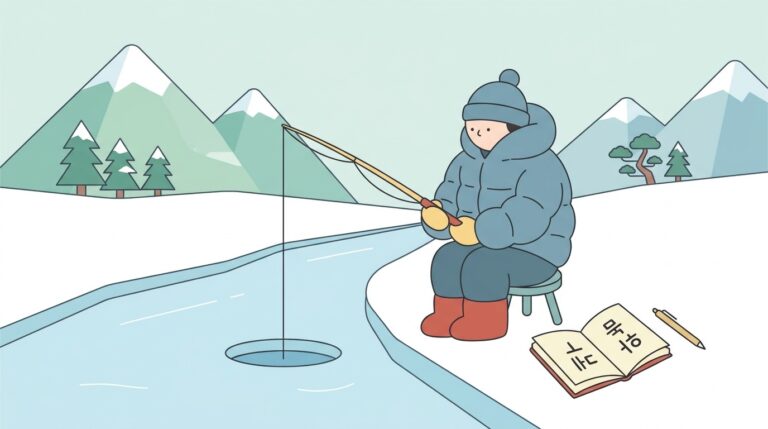
Imagine this: You are standing in the middle of a massive frozen river in Gangwon Province, enveloped by crisp mountain air and the energetic chatter of thousands of festival-goers. Your breath billows like white smoke, your cheeks are rosy from the crisp minus-ten wind, and in your hand is a small, translucent plastic fishing rod hovering over a small circular hole cut into 30 centimeters of crystal-clear ice. Around you, children are squealing with joy and local grandfathers are effortlessly pulling out shimmering, silvery trout—sancheoneo (산천어).
Meanwhile, you’ve been bobbing your little rod for forty-five minutes with zero bites. Your fingers are turning numb inside your gloves. You want to ask the friendly local gentleman kneeling next to you what rhythm he is using, or call over a festival volunteer to ask if your hook is too deep, but your mind freezes faster than the river. Should you say “물고기가 없어요”? Does that sound rude? What if you actually catch one—how do you take it to the grill tent without sounding like a textbook robot?
If you have ever felt trapped between formal textbook grammar and the rapid-fire slang of real-life Korean adventures, take a deep breath. Today, we are unlocking intermediate (B2) festival Korean specifically crafted for the world-renowned Hwacheon Sancheoneo Ice Festival. Based on real feedback from intermediate learners who wanted to break past classroom stiffness and share authentic warmth with locals, this guide will turn you from a frozen spectator into a confident festival insider.
Phase 2: Core Expressions Deep Dive
1. 손맛이 어때요? (Son-masi eottaeyo?)
- Pronunciation: [Son-ma-si eo-ttae-yo?] (Think: Sohn-mah-she uh-tae-yo)
- Meaning: Literal: “How is the hand-taste?” / Real Nuance: “How does the tug feel?” or “Are you getting that thrilling catch sensation?”
- K-Culture Moment: Seen often in variety shows like 2 Days & 1 Night or City Fisherman (도시어부), when cast members hook a big fish and scream about the electric vibration traveling up their arms into their hands.
- Editor’s Insight: In Korean, 손맛 (sonmat) does not refer to eating! It encapsulates the tactile vibration and thrilling resistance a fisherman feels when a fish pulls the line. Asking a nearby angler 손맛이 어때요? immediately marks you as someone who truly understands the soul of recreational fishing.
- Situation Spectrum:
- Casual (with friends/peers): 손맛 어때? (✅)
- Semi-formal (friendly stranger on the ice): 손맛이 어때요? (✅)
- Formal (corporate/official event): ⚠️ (Use 손맛은 좀 보셨습니까? to sound polished)
- 🤔 Think About It: English uses visual metaphors (“Did you see that catch?”), while Korean prioritizes tactile sensory connection (손맛, 눈맛). How does focusing on physical sensation change the way you bond with people around you?
2. 입질이 전혀 안 와요. (Ipjiri jeonhyeo an wayo.)
- Pronunciation: [Ip-ji-ri jeon-hyeo an wa-yo.] (Think: Eep-jee-ree jun-hyuh ahn wah-yo)
- Meaning: Literal: “Mouth-action does not come at all.” / Real Nuance: “The fish aren’t biting at all.”
- K-Culture Moment: Whenever an unlucky celebrity sits on a boat in a reality show with gloomy BG music, muttering to the camera while checking their untouched bait.
- Editor’s Insight: 입질 (ipjil) literally stems from ip (mouth) and -jil (repetitive action). It refers to the gentle nibbling of a fish on the bait. Informally in modern Korean slang, 입질이 오다 can also mean someone is taking the bait in a conversation or showing interest in a deal!
- Situation Spectrum:
- Casual: 입질이 1도 안 와. (✅ – trendy 1도 means ‘not even one bit’)
- Semi-formal: 입질이 전혀 안 와요. (✅ – perfect on the ice)
- Formal: 입질이 전혀 오지 않습니다. (✅)
- 🤔 Think About It: Why do you think Korean uses dynamic compound nouns like 입질 instead of simple passive verbs like “to be bitten”? What does this say about observer perspective?
3. 이거 회로 뜰 수 있나요? (Igeo hoero tteul su innayo?)
- Pronunciation: [I-geo hoe-ro tteul su in-na-yo?] (Think: Ee-guh hweh-roh ttuhl soo een-nah-yo)
- Meaning: Literal: “Can this be floated into raw slices?” / Real Nuance: “Can I get this prepared as sashimi/raw fish?”
- K-Culture Moment: At coastal fish markets or festival processing centers, where visitors hand over fresh catches to culinary masters wielding razor-sharp knives.
- Editor’s Insight: Notice the verb 뜨다 (tteuda). While learners often default to 만들다 (to make) or 자르다 (to cut), native speakers always say 회를 뜨다 (hoe-reul tteuda) for slicing fresh sashimi fillets. Using this specific collocation will make the festival vendors nod in instant respect.
- Situation Spectrum:
- Casual: 이거 회 떠줘! (🚫 – rude to older culinary masters)
- Semi-formal: 이거 회로 떠주세요. (✅)
- Polite Inquiry: 이거 회로 뜰 수 있나요? (✅)
- 🤔 Think About It: Notice how the culinary action (뜨다 – lifting/filleting cleanly off the bone) honors the technique of the artisan. Do you have specialized culinary verbs like this in your native language?
Phase 3: Textbook Korean vs. Real Korean
Situation 1: Asking someone nearby if they are having luck catching fish
- 📖 교과서 한국어 (Textbook): 여기서 물고기가 많이 잡힙니까? (Yeogiseo mulgogiga mani japhimnikka? / “Are many fish caught here?”)
- 🗣️ 진짜 한국어 (Real-life B2): 오늘 조황이 좀 어때요? 잘 잡혀요? (Oneul johwangi jom eottaeyo? Jal japhyeoyo? / “How is the catch today? Biting well?”)
- 💡 왜 다를까? (Why is it different?): Textbook passive formulations (잡힙니까?) feel detached and clinical, like a government fisheries surveyor. Real Korean anglers use 조황 (johwang, fishing conditions/catch status) or a warm, colloquial 잘 잡혀요? to create immediate camaraderie.
Situation 2: Asking a staff member where to get your fish grilled
- 📖 교과서 한국어 (Textbook): 물고기를 굽는 조리 장소가 어디에 위치해 있습니까? (Mulgogireul gumneun jori jangsoga eodie wichihae isseumnikka? / “Where is the cooking location that grills fish situated?”)
- 🗣️ 진짜 한국어 (Real-life B2): 이거 구이터가 어디 쪽이에요? (Igeo gu-i-teoga eodi jjogieyo? / “Which way is the grilling center for these?”)
- 💡 왜 다를까? (Why is it different?): Real Koreans use compound place words ending in -터 (-teo, site/ground, as in 구이터 – grilling zone, 낚시터 – fishing ground) paired with directional inquiry 어디 쪽 (eodi jjok, which side/direction) for efficient, natural flow.
Phase 4: K-Culture Deep Dive & Non-Verbal Manners
4-1. 눈치 (Nunchi) & Ice Etiquette
- The Ice Hole Perimeter: Never step across someone else’s drilled hole or cast your shadow directly over it. Sancheoneo are sharp-eyed predators; sudden shadows startle them.
- The Gentle Jigging (고패질 – Gopaejil): Aggressive jerking looks amateurish and scares the fish away. Lower your lure to about 20–30 cm above the riverbed, then rhythmically raise and drop your wrist every 3 to 4 seconds.
- Warmth Currency: If you want advice from an ajusshi (uncle) nearby, never just stare. Offer a warm canned coffee (따뜻한 캔커피) fresh from your jacket pocket or an extra hot pack (핫팩). Hand it with both hands, smile, and ask: “추우시죠? 이것 좀 드시면서 하세요.” (Chuusijyo? Igeot jom deusimyeonseo haseyo. / “Cold, isn’t it? Please have this while you fish.”) This instantly melts the winter chill!
4-2. Culture Code: 이한치한 (I-han-chi-han) & The Hearth Spirit
Koreans love the concept of 이열치열 (fight heat with heat in summer by eating boiling chicken soup), but winter brings its counterpart: 이한치한 (fight cold with cold). Standing on frozen water, or even participating in the famous bare-handed trout-catching contest (맨손잡기) wearing only shorts and t-shirts, is celebrated as a seasonal triumph over winter sluggishness. The true magic happens at the communal wood-fired ovens: strangers share salt, congratulate each other on their catches, and offer chunks of piping-hot roasted fish wrapped in foil.
Phase 5: Real Roleplay Scenario
- Setting: Sector 2 of the Hwacheon Stream ice rink. Wind is whistling softly.
- Characters: You (determined intermediate learner with an empty cooler) and 반장님 (Park Banjang-nim), a seasoned local volunteer in an orange insulated parka holding a plastic ice skimmer.
Dialogue:
1. You: 🎭 [Politely bowing slightly with two hands tucked into your pockets] 저기요, 반장님! 혹시 시간 잠깐 괜찮으세요? (Jeogiyo, banjangnim! Hoksi sigan jamkkan gwaenchaneuseyo? / “Excuse me, supervisor! Do you happen to have a quick moment?”)
2. Park Banjang-nim: 🎭 [Turning with a friendly grin, tapping his boots against the ice] 네! 왜 그래요? 아직 한 마리도 못 낚았어요?
(Ne! Wae geuraeyo? Ajik han marido mot nakkasseoyo? / “Yes! What’s up? Haven’t caught a single one yet?”)
3. You: 🎭 [Sighing playfully and pointing at the ice hole] 네, 입질이 전혀 안 와서요. 바닥 쪽을 노려야 하나요? (Ne, ipjiri jeonhyeo an waseoyo. Badak jjogeul noryeoya hanayo? / “Yeah, there are no bites at all. Should I aim closer to the bottom?”)
4. Park Banjang-nim: 🎭 [Peering down your hole] 아이고, 미끼 수심이 너무 깊네! 바닥에서 한 뼘 정도 띄워야 돼요.
(Aigo, mikki susimi neomu gimne! Badageseo han ppyeom jeongdo ttiwoya dwaeyo. / “Oh dear, your bait depth is way too deep! You need to float it about a hand span off the bottom.”)
5. You: 🎭 [Nodding with realization, carefully adjusting the reel] 아, 한 뼘이요? 고패질은 이 속도로 하면 될까요? (A, han ppyeom-iyo? Gopaejireun i sokdoro hamyeon doelkkayo? / “Ah, a hand span? Is this the right speed for jigging?”)
6. Park Banjang-nim: 🎭 [Gently holding your wrist to demonstrate the soft rhythm] 그렇지! 너무 흔들지 말고, 슬쩍 올렸다가 스르륵 내리고… 옳지, 딱 좋다!
(Geureochi! Neomu heundeulji malgo, seuljjeok ollyeottaga seureureuk naerigo… Olchi, ttak jota! / “That’s it! Don’t shake it wildly; gently lift it up, let it drift down… Perfect, right like that!”)
7. You: 🎭 [Feeling a sharp downward tug, eyes going wide] 어?! 잠깐만요, 묵직한 게 걸린 것 같아요! (Eo?! Jamkkanmanyo, mukjikan ge geollin geot gatayo! / “Uh?! Wait a second, I think something heavy hooked on!”)
8. Park Banjang-nim: 🎭 [Cheering loudly] 챔질해! 챔질! 줄 감아 올려요! (Chaemjilhae! Chaemjil! Jul gama ollyeoyo! / “Set the hook! Strike! Reel that line up!”)
🔀 Interactive Choice Branch
The fish is struggling at the edge of the hole! How do you react?
- Choice A: 냅다 낚싯대를 뒤로 던지며 소리를 지른다. (Throw the rod backward and scream.)
- Feedback (Bad): The thin mono-line will snap against the sharp edge of the ice hole, and the fish slips back into the icy deep. Stay composed!
- Choice B: 줄을 손으로 침착하게 잡고 입 주위를 확인하며 얼음 밖으로 끌어올린다. (Calmly grasp the line with your gloved hand, check the hook angle, and slide it onto the ice.)
- Feedback (Best): Perfect execution! Catching line near the opening minimizes tension snapping. Banjang-nim will shout: “나이스 손맛!” (Nice sonmat!)
- Choice C: 옆 사람에게 낚싯대를 쥐어주며 대신 당겨달라고 한다. (Shove your rod to the person next to you and ask them to pull.)
- Feedback (Risk): While Koreans love helping, giving up your rod ruins your own 손맛 and might cause the neighbor’s hook to tangle with yours!
Phase 6: 10-Second Emotion Shadowing Drill
Master intermediate cadence by practicing these pause breaks (/) and emotional cues:
[🥶 Freezing but determined]- 날씨는 / 진짜 칼바람인데, / 한 마리는 / 꼭 낚고 갈 거예요! (Nalssineun / jinjja kalbaraminde, / han marineun / kkok nakko gal geoyeyo! / “The wind is literally razor-sharp, / but I will definitely catch / at least one before leaving!”)
[🤩 Ecstatic & breathless]- 드디어 / 입질 왔어요! / 이거 손맛이 / 장난 아닌데요?! (Deudieo / ipjil wasseoyo! / Igeo sonmasi / jangnan aninde-yo?! / “Finally / a bite came! / The pull on this / is no joke?!”)
[😋 Anticipatory & hungry]- 갓 잡은 산천어는 / 구이 하나, / 회 하나로 / 부탁드릴게요! (Gat jabeun sancheoneoneun / gui hana, / hoe hanaro / butakdeurilgeyo! / “For these freshly caught trout, / please make one grilled, / and one as sashimi!”)
Phase 7: K-Culture Mini Dictionary
| Word (Hangul + Romanization) | Translation | Real-Life & Festival Usage Context |
|---|---|---|
| 산천어 (Sancheoneo) | Cherry salmon / Mountain trout | Known as the “Queen of Ravines.” Lives only in pristine first-grade cold fresh water (under 20°C). Rich in amino acids and prized for clean, sweet meat. |
| 고패질 (Gopaejil) | Lure jigging rhythm | The specific wrist action of lifting and dropping the artificial lure to mimic an injured minnow. The golden rule at Hwacheon: 부드러운 고패질 (smooth jigging). |
| 챔질 (Chaemjil) | Hook-setting / Strike | Jerking the rod upward firmly the exact split-second you sense a bite to anchor the hook into the fish’s lip. Missing the timing is called 헛챔질 (heot-chaemjil). |
| 화천사랑상품권 (Hwacheon Sarang Sangpumgwon) | Hwacheon Gift Certificate | Local currency voucher returned to you when purchasing festival admission. You can spend it like cash at local convenience stores, fuel stations, and food stalls. |
Phase 8: Survival Kit for Travelers
TOP 3 Survival Phrases
- 얼음 구멍 좀 뚫어주실 수 있나요? (Eoreum gumeong jom ttureojusil su innayo?)
- Pro Tip: If your hole freezes over, look for staff carrying iron crowbars (끌) and ask this with a bright smile.
- 미끼는 어떤 색깔이 잘 먹혀요? (Mikkineun eotteon saekkari jal meokhyeoyo?)
- Pro Tip: Water clarity shifts throughout the day. Bright pink or silver silicone lures work well early on; glow-in-the-dark or yellow works better in the late afternoon.
- 티켓에 포함된 상품권 여기서 쓸 수 있어요? (Tikese pohamdoen sangpumgwon yeogiseo sseul su isseoyo?)
- Pro Tip: Use your voucher at the roasting center (구이터) to offset the 3,000 KRW grilling fee.
Editor’s Travel Note
- Transport & Transit: Take the early morning intercity bus from Dong Seoul Bus Terminal to Hwacheon Bus Terminal (takes about 2 hours 10 mins). Make sure to check festival shuttles on Naver Map app for smooth transfer right to the river entrance.
- Warmth Armor: Double socks and heat-pack insoles (발바닥 핫팩) are non-negotiable. Sitting on cold plastic chairs drains body heat rapidly; bring a small foam camping pad (은박 돗자리 방석) to sit on.
- Limit: The festival enforces a strict rule: maximum 3 fish per person allowed outside the ice rink. Keep only what you can eat!
Phase 9: “One Step Deeper” (Reflections on Korean Culture)
In modern urban Korea, life moves at frantic Palli-Palli (hurry-hurry) speeds, where apartment dwellers rarely know their next-door neighbors. Yet standing shoulder-to-shoulder on a frozen riverbed reveals the resilient undercurrent of 정 (Jeong—communal affection). Out on the ice, age ranks soften: middle-aged uncles unprompted hand spare hooks to struggling foreigners, and strangers share thermal flasks of piping-hot corn silk tea. The festival isn’t just about hauling fish; it is an annual ritual where Koreans reclaim the warmth of rural community life against the harshest winter chill.
💬 Your Turn: Have you ever visited a winter festival where the harsh weather actually made people friendlier? What sensory details stood out to you? Share your stories in the comments below!
Phase 10: FAQ & Misconception Prevention
Q: Can I bring my own professional sea fishing rod to Hwacheon?
A: No, long casting rods and multi-hook treble rigs are strictly prohibited for safety reasons. You must use designated compact plastic jigging rods or small fly rods sold right at the festival booths.
Q: What should I do if I don’t catch any fish all day?
A: Don’t panic! Check the bare-handed trout catching pool (맨손잡기), or simply chat with local fishers near the exit around 4 PM. Generous visitors who caught their 3-fish limit often gift excess catch (나눔) to empty-handed travelers.
Q: Is it safe to eat the mountain trout raw on site?
A: Yes! Sancheoneo at the festival are sourced from certified pristine mountain waters. Use the official onsite processing facility (회 센터), where licensed staff sanitize and fillet the fish under strict hygienic standards.
🚨 Common Mistakes Warning Board
- Jerking the rod like a Hollywood whip: Snaps the 1.5-gauge fishing line. Correct Action: Keep your elbow steady and move only your wrist gently up and down 10 cm.
- Throwing cigarette butts or coffee cups into the ice holes: Pollutes drinking-water reservoirs downstream and incurs hefty fines. Correct Action: Use designated recycling bins behind the safety nets.
- Leaving the fish directly on top of the open ice to freeze rock-solid: Freezing turns the fish meat dry and mushy when cooked. Correct Action: Keep your catch alive inside your designated mesh bag (살림망) submerged in the water until you head to the grill.
Phase 11: Action Missions & Engagement
- 🥉 Bronze Mission (Solo Practice): Practice the shadowing sentence “입질이 전혀 안 와요, 수심을 얼마나 줘야 해요?” in front of your mirror with expressive hand gestures until you can say it under 4 seconds.
- 🥈 Silver Mission (Social Media): Post a photo of your warmest winter outfit on Instagram with the caption: “화천 산천어 축제 갈 준비 완료! 손맛 기대 중 🎣” and tag @DailyHangul.
- 🥇 Gold Mission (Real Field Execution): At a Korean local market or during your festival trip, order food using the verb 뜨다 or 굽다 naturally: “이거 구이터에서 구워주실 수 있나요?”
- 🎮 K-Culture Quest: Watch a winter episode of 2 Days & 1 Night (Season 4) or Three Meals a Day (삼시세끼) and spot the moment someone shouts “입질 왔다!” Note their facial expression!
Phase 12: Interactive Quiz Challenge
Test your festival-ready Korean before hitting the ice!
1. Situational Judgment: You are sitting on the ice and feel a sudden heavy vibration on your rod. What is the most natural Korean exclamation to your friend?
* (A) 나 지금 물고기를 체포했어!
* (B) 대박, 손맛 장난 아니다! 챔질해야 돼!
* (C) 물고기가 내 바늘에 진입했습니다.
2. Fill in the Blank: 회를 먹고 싶을 때 상인에게 사용하는 올바른 동사는?
* “이 산천어 신선한데, 회로 _____ 주실 수 있나요?”
3. True or False: In Korean festival culture, 손맛 refers exclusively to the delicious seasoning of a chef’s hand-prepared side dishes.
* (True / False)
🔍 Click here to reveal Answers & Detailed Explanations
- Answer: (B)
- Explanation: 손맛 장난 아니다 (The pull is no joke!) combined with 챔질 (hook strike) is 100% natural conversational Korean. (A) uses 체포하다 (arrest a criminal), and (C) sounds like an AI translating formal literature.
- Answer: 떠 (from 뜨다)
- Explanation: The full sentence is 회로 떠 주실 수 있나요? (Can you slice this into sashimi?). Never use 잘라 or 만들어 when ordering raw fish fillets!
- Answer: False
- Explanation: While 손맛 can mean a cook’s culinary touch in domestic kitchens, on the river it specifically denotes the tactile thrill of a fish fighting against your fishing rod!
- Explanation: While 손맛 can mean a cook’s culinary touch in domestic kitchens, on the river it specifically denotes the tactile thrill of a fish fighting against your fishing rod!







