

Phase 1: Empathy
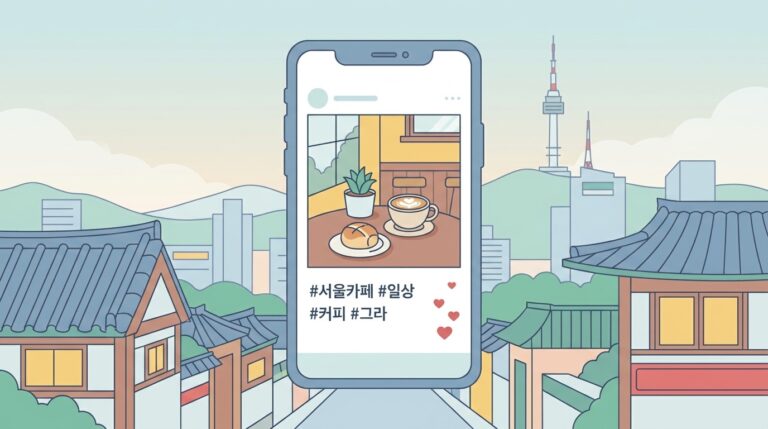
안녕하세요! 매일한글 에디터입니다. (Hello! This is your Daily Hangul editor.) Have you ever scrolled through Instagram after a dreamy trip to Seoul, looking at photos of that bubbling tteokbokki in Hongdae or your favorite idol’s comeback teaser, only to freeze when typing your caption? You want to connect with Korean friends, get likes from Seoulites, and feel like an insider, but typing simple English tags like #KoreaTrip feels like screaming into an empty void. You see tags like #맞팔, #일상, and #소통 everywhere, yet you are terrified of using them incorrectly. Over the past decade tutoring hundreds of beginners, I have watched so many learners unlock instant Korean friendships simply by switching three hashtag letters. Today, we will turn your social media into an authentic Korean community hub with zero stress!
Phase 2: Core Expressions Deep Dive
1. #맞팔 (Mat-pal)
- Pronunciation: [mat-pal] (Sounds like the English word “mat” followed by your buddy “pal”!)
- Meaning: Literal: “Mutual following” | Real Nuance: “F4F (Follow for follow) – Let’s be friends on SNS!”
- K-Culture Moment: You discover a cute independent cafe in Yeonnam-dong on Instagram. You leave a comment on the barista’s photo: “사진 예뻐요! #맞팔해요” (Sajin yeppeoyo! #Matpalhaeyo / “Pretty photo! Let’s follow each other!”).
- Editor’s Insight: This is a blend of 맞 (mat – mutually/facing each other) and 팔로우 (pal-lo-u – follow). Leaving this on peer accounts is the fastest way to get real Korean mutual followers as a beginner.
- Situation Spectrum: Casual (✅) / Semi-formal (⚠️) / Formal (🚫)
- 🤔 Think About It: In English, “F4F” can feel transactional, but in Korean, #맞팔 signals an invitation into someone’s everyday digital circle (일촌/소통 culture). How does your culture view reciprocating follows online?
2. #일상 (Il-sang)
- Pronunciation: [il-sang] (Sounds like “eel” + “song” with an open ‘ah’ sound)
- Meaning: Literal: “Everyday life” | Real Nuance: “Casual daily vibe / Photo dump / OOTD”
- K-Culture Moment: When a K-Drama lead posts an unfiltered mirror selfie holding an iced Americano between shoots, the caption is almost always just one word: #일상.
- Editor’s Insight: Koreans love documenting micro-moments. It shows you aren’t trying too hard; it marks comfortable authenticity rather than curated luxury.
- Situation Spectrum: Casual (✅) / Semi-formal (✅) / Formal (⚠️)
- 🤔 Think About It: Why do you think Korean youth cherish the tag “daily life” so deeply in a society known for its fast-paced, high-pressure lifestyle?
3. #먹스타그램 (Meok-seu-ta-geu-raem)
- Pronunciation: [meok-seu-ta-geu-raem] (“Meok” rhymes with “duck”, followed by “Instagram”)
- Meaning: Literal: “Eating Instagram” | Real Nuance: “Foodie post / Food porn / Must-eat spot”
- K-Culture Moment: The table is covered with sizzling Samgyeopsal (pork belly). Before anyone touches their chopsticks, phone cameras snap the shot from a top-down angle for #먹스타그램.
- Editor’s Insight: Created from 먹다 (meokda – to eat) + 인스타그램 (inseutageuraem). Searching this hashtag is 10 times better than any tourist guidebook for discovering hidden local restaurants.
- Situation Spectrum: Casual (✅) / Semi-formal (✅) / Formal (🚫)
- 🤔 Think About It: Food in Korea is communal. By sharing food photos tagged #먹스타그램, Koreans treat food as social bonding rather than solitary fuel.
Phase 3: Textbook Korean vs. Real Korean
Situation 1: Asking someone to follow you back
- 📖 교과서 한국어: 저를 팔로우해 주시겠습니까? (Jeoreul pallouhae jusigesseumnikka? / Would you please follow me back?)
- 🗣️ 진짜 한국어: 맞팔해요! (Matpalhaeyo! / Let’s mutual follow!)
- 💡 왜 다를까?: Traditional textbooks teach honorific full sentences that feel robotic in DM boxes and comments. Online spaces favor crisp, friendly short forms that sound welcoming.
Situation 2: Showing you love food
- 📖 교과서 한국어: 이 음식은 매우 맛있습니다. (I eumsigeun maeu masitseumnida. / This food is very delicious.)
- 🗣️ 진짜 한국어: 존맛탱! #JMT (Jonmattaeng! #JMT / So delicious! #JMT)
- 💡 왜 다를까?: Gen-Z and millennial Koreans express immediate sensory delight through acronyms and buzzwords rather than textbook adjectives.
Phase 4: K-Culture Deep Dive & Non-Verbal Manners
4-1. 눈치 (Nunchi) & Social Etiquette
Korean online culture has its own unwritten etiquette. Never spam an influencer or a senior colleague’s personal profile with #맞팔 (F4F) demands—it lacks Nunchi (tact). Also, when taking photos of delicious street food for your #먹스타그램 post, always ask permission if the stall owner’s face might appear in your frame with a polite nod and “사진 찍어도 돼요?” (Sajin jjigeodo dwaeyo? / May I take a photo?). Blur out bystander faces before uploading, as privacy is heavily guarded in Korea.
4-2. Culture Code: The Hashtag Food Hunt
In Korea, search engines like Google are rarely used to find hip cafes in neighborhoods like Seongsu-dong. Instead, locals open Instagram and search compound tags: [Location] + [Category] like #성수카페 (Seongsu Cafe) or #홍대맛집 (Hongdae Matjib). Adding #맛스타그램 (Taste-stagram) lets you view raw, unfiltered reviews from authentic local foodies.
Phase 5: Roleplay Scenario
- Setting: A sunlit indie cafe in Yeonnam-dong. You just took a photo of your croffle and met Minji, a friendly Korean student sitting at the next table holding a film camera.
-
Minji: 🎭 Smiles warmly, pointing at your dessert 사진 정말 잘 찍으시네요! (Sajin jeongmal jal jjigeusineyo! / You take such nice photos!)
- You: 🎭 Bashful smile 감사해요! 인스타에 올리려고요. (Gamsahaeyo! Inseuta-e olliryeogoyo. / Thank you! I’m going to post it on Instagram.)
- Minji: 🎭 Taps her chin thoughtfully 어떤 해시태그 써요? (Eotteon haesitaegeu sseoyo? / What hashtags do you use?)
- You: 🎭 Shows screen nervously 그냥 영어로 써요. (Geunyang yeong-eoro sseoyo. / I just use English.)
- Minji: 🎭 Waves hand enthusiastically 한국 태그 써봐요! #먹스타그램 추천해요. (Hanguk taegeu sseobwayo! #meokseutageuraem chucheonhaeyo. / Try Korean tags! I recommend #meokseutageuraem.)
- You: 🎭 Nods with excitement 오, #일상 도 괜찮아요? (O, #ilsang do gwaenchannayo? / Oh, is #ilsang good too?)
- Minji: 🎭 Gives two thumbs up 완전 좋아요! 우리 맞팔할래요? (Wanjeon joayo! Uri matpalhallaeyo? / Totally great! Shall we follow each other?)
- You: 🎭 Beams with confidence 네, 맞팔해요! (Ne, matpalhaeyo! / Yes, let’s follow each other!)
🔀 Interactive Choice Point
Minji offers her Instagram QR code. How do you respond?
* Option A: “팔로우했어요! 맞팔 부탁해요~” (Pallouhaesseoyo! Matpal butakhaeyo~ / I followed! Please follow back~) ➔ [Best]: Natural, warm, and polite for peer social networking!
* Option B: “저를 꼭 팔로우하십시오.” (Jeoreul kkok pallouhasipsio. / You must follow me back.) ➔ [Bad]: Excessively stiff command; sounds like a robot or military officer.
* Option C: “#맞팔 #선팔 #소통 #팔로워늘리기” (Reciting hashtags out loud) ➔ [Risk]: Spouting raw hashtags in spoken conversation sounds confusing and awkward.
Phase 6: 10-Second Emotion Shadowing Drill
[😊 Cheerful and friendly]
우리 / 맞팔해요! / 제 아이디예요. (Uri / matpalhaeyo! / Je aidiyeyo. / Let’s follow each other! / This is my ID.)-
[😋 Excited and mouth-watering]
오늘 점심은 / 삼겹살! / 완전 #먹스타그램! (Oneul jeomsimeun / samgyeopsal! / Wanjeon #meokseutageuraem! / Lunch today is / pork belly! / Total #foodstagram!) -
[☕ Relaxed and cozy]
조용한 카페에서 / 힐링 중, / 소소한 #일상. (Joyonghan kape-eseo / hilling jung, / sosohan #ilsang. / Healing at a quiet cafe, / small #dailylife.)
Phase 7: K-Culture Mini Dictionary
- 선팔 (Seon-pal) | First Follow / Following First | Short for 선팔로우 (following someone first before they follow you back).
- 소통 (So-tong) | Communication / Interaction | Used as #소통 to mean “Let’s chat, like each other’s posts, and stay active!”
- 오운완 (O-un-wan) | Workout Done Today | Acronym for “오늘 운동 완료”—the mega-popular Korean fitness hashtag on TikTok and IG.
- 인생샷 (In-saeng-syat) | Life Shot / Best Photo of One’s Life | Tag used when you take the most flattering picture possible at a travel spot.
Phase 8: Traveler’s Survival Kit
Top 3 Survival Expressions
- 인스타 감성이에요! (Inseuta gamseong-ieyo!)
- Meaning: “It has that Instagram aesthetic!”
- Pro Tip: Use this when admiring trendy cafes in Ikseon-dong or Seongsu.
- 인스타 아이디 있어요? (Inseuta aidi isseoyo?)
- Meaning: “Do you have an Instagram handle?”
- Pro Tip: Much more common among Korean 20-somethings than asking for phone numbers.
- 사진 한 장만 찍어주실 수 있나요? (Sajin han jangman jjigeojusil su innayo?)
- Meaning: “Could you take a quick photo of me?”
- Pro Tip: Hand your phone vertically; Koreans are world-class at framing full-body proportions!
Editor’s Travel Note
When hunting for trending foodie spots in Korea, Google Maps often lacks up-to-date operating hours. Instead, utilize the Naver Map search app alongside Instagram hashtag queries. Combine tags like #홍대맛집 with reviews to verify whether a spot is tourist bait or a true neighborhood gem.
Phase 9: A Step Deeper
Korean hashtag culture reflects the concept of 정 (Jeong – affectionate communal bonding) transformed into digital intimacy. Unlike Western hashtag use, which often serves purely descriptive categorization, Korean tags like #맞팔 (mutual follow) and #소통 (connection) serve as relational handshakes. Young Koreans use these tags to carve out cozy spaces of mutual validation and micro-friendships in an ultra-dense society.
💬 Your Turn: What is your absolute favorite photo on your camera roll right now? Which Korean hashtag from today fits it best? Tell us in the comments below!
Phase 10: FAQ & Common Mistakes
Q: Can I use #맞팔 on celebrity or K-pop idol accounts?
A: It’s better not to! Celebrities rarely follow individual fans back, so commenting “#맞팔해요” on BTS or NewJeans posts will make you look like a spam bot.
Q: What is the difference between #선팔 and #맞팔?
A: 선팔 (Seonpal) means “I took the initiative to follow you first,” while 맞팔 (Matpal) means “Let’s follow each other mutually.”
Q: Do people use these hashtags on TikTok and X (Twitter) too?
A: Yes! While originating heavily on Instagram, #먹스타그램, #일상, and #맞팔 are widely used across Korean TikTok and X.
🚨 Common Mistakes TOP 3
- Mistake: Writing spaces inside tags (e.g.,
#먹 스타 그램).- Correct Action: Keep tags unbroken without spaces:
#먹스타그램.
- Correct Action: Keep tags unbroken without spaces:
- Mistake: Using formal verbs in tags (e.g.,
#먹었습니다).- Correct Action: Use noun-based buzzwords (e.g.,
#먹방,#먹스타그램).
- Correct Action: Use noun-based buzzwords (e.g.,
- Mistake: Over-tagging with irrelevant words.
- Correct Action: Pick 3 to 5 highly relevant Korean tags to avoid shadowbans.
Phase 11: Action Mission & Participation
- 🥉 Bronze Mission: Write down
#맞팔,#일상, and#먹스타그램in your notebook three times while saying the pronunciation aloud. - 🥈 Silver Mission: Find your latest meal photo and leave a caption draft using
#먹스타그램and#일상. - 🥇 Gold Mission: Go to Instagram, search
#일상, find a Korean creator’s photo you love, and comment: “사진 멋져요! #소통해요” (Sajin meotjyeoyo! #Sotonghaeyo / “Cool photo! Let’s connect!”). - 🎮 K-Culture Mission: Watch a short clip of your favorite K-pop idol’s vlog or Instagram reel, and spot at least one Korean hashtag in the caption description!
Phase 12: Interactive Quiz Challenge
1. Situation Judgment: You just ate a mouth-watering bowl of spicy Shin Ramyun with extra cheese and want to post it. Which tag is most fitting?
* A) #운동
* B) #먹스타그램
* C) #공부스타그램
2. Fill in the Blank: If you followed someone first and want to tell them nicely in Korean: “____했어요! 맞팔해요!” (I followed you first! Let’s be mutuals!)
3. True or False: Leaving #맞팔 on an idol’s official company account is standard etiquette to become their friend.
👉 Click here to check your answers & explanations!
- Answer: B) #먹스타그램 (Foodstagram). #운동 is workout, and #공부스타그램 is studygram.
- Answer: 선팔 (Seon-pal). The sentence becomes “선팔했어요! 맞팔해요!”
- Answer: False. Official company accounts do not do mutual follows, and it can look like spam.







