

Phase 1: 공감 (Story-Immersive Opening)
안녕하세요! 매일한글 에디터입니다. (Hello! I am your Daily Hangul editor.)
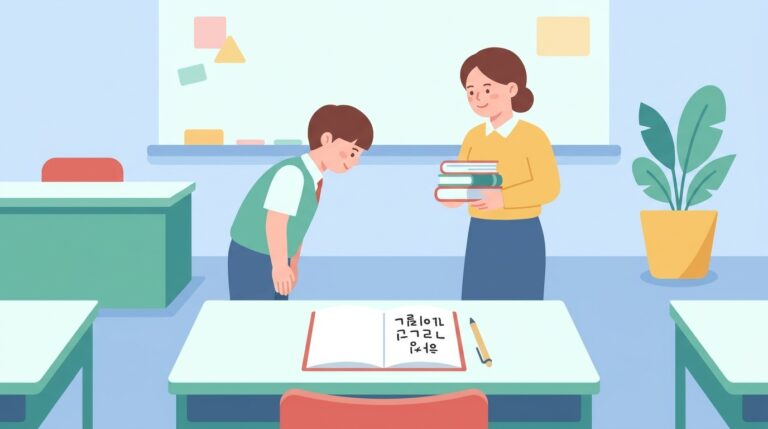
Picture this: You are sitting in your very first Korean language classroom in Seoul. The morning sunlight filters through the blinds, and your teacher—warm, smiling, and holding a dry-erase marker—asks the room if everyone understood the homework. You excitedly raise your hand and blurt out: “응, 알았어! (Eung, arasseo! – Yeah, got it!)”
Instantly, the entire room freezes. The student next to you gasps quietly, and your teacher blinks in stunned amusement. If you have watched K-dramas like Crash Course in Romance or Twenty-Five Twenty-One, you have seen this exact moment of shock whenever someone slips into informal speech (반말, Banmal) with an elder or mentor. You didn’t mean any disrespect—you just wanted to answer! But in Korean, how you speak to your teacher shapes the entire relationship.
Honorifics (존댓말, Jondaenmal) can feel like navigating an emotional minefield for beginners, but it does not have to be scary. Based on over ten years of coaching global learners right here in Korea, I have seen hundreds of students transform awkward hesitation into natural, heartfelt politeness. Once you grasp these conversational essentials, you won’t just avoid embarrassment—you will earn instant warmth, respect, and encouragement from every Korean teacher you meet.
Phase 2: 핵심 표현 3선 심층 분석 (Core 3 Expressions)
1. 선생님, 질문이 있어요! (Seonsaengnim, jilmun-i isseoyo!)
- Pronunciation: [seon-saeng-nim, jeel-moon-ee ee-sseo-yo] (Imagine saying “Sun-sang-neem”, then rhyming “jilmun” with “moon”).
- Meaning: Literal: “Teacher, a question exists!” | Nuance: “Teacher, I have a quick question!”
- K-Culture Moment: That classic K-drama classroom scene where an eager student gently waves their hand to ask for clarification during an intense study prep session.
- Editor’s Insight: In English, you might call your instructor “Professor Smith” or just “Excuse me.” In Korea, never use someone’s bare name or “You” (당신, Dangsin). Calling someone 선생님 (Seonsaengnim) honors both their knowledge and guidance.
- Situation Spectrum:
- Casual (Friends): 🚫
- Semi-formal (Polite everyday conversation): ✅
- Formal (Official presentation/ceremony): ⚠️ (Use 질문이 있습니다 [Jilmun-i itseumnida] instead)
- 🤔 Think About It: In your native culture, do you address teachers by first name or title? How does having a dedicated word of respect like 선생님 change how close or distant you feel from a mentor?
2. 다시 한번 말씀해 주시겠어요? (Dasi hanbeon malsseumhae jusigesseoyo?)
- Pronunciation: [da-si han-beon mal-sseum-hae joo-si-ge-sseo-yo] (Sound analogy: “Dah-see han-burn mal-soom-hae jew-see-get-so-yo”).
- Meaning: Literal: “Could you please do the honorable speaking once again?” | Nuance: “Could you please repeat that one more time?”
- K-Culture Moment: When a foreign trainee in a K-Pop survival show asks the vocal coach to demonstrate a complex melody line once more.
- Editor’s Insight: Notice the word 말씀 (malsseum). It is the special honorific noun for “speech” or “words.” When referring to what the teacher says, using 말씀 instead of normal 말 (mal) instantly marks you as an advanced, culturally polished speaker.
- Situation Spectrum:
- Casual: 🚫
- Semi-formal: ✅
- Formal: ✅
- 🤔 Think About It: Notice how Korean elevates the teacher’s action rather than focusing on your own hearing trouble. What does that say about etiquette in communication?
3. 감사합니다, 선생님! (Gamsahamnida, seonsaengnim!)
- Pronunciation: [gam-sa-ham-ni-da, seon-saeng-nim] (The “b” in ham-ni-da blends into an “m” sound, like “Gahm-sah-hahm-nee-dah”).
- Meaning: Literal: “Gratitude is done, Teacher!” | Nuance: “Thank you so much for the lesson, Teacher!”
- K-Culture Moment: The chime rings at the end of class, and every student stands up, bows slightly from their desk, and delivers this warm closing line in unison.
- Editor’s Insight: Always place the title 선생님 either right at the start or right at the end of your gratitude. It wraps your thank-you in personal warmth.
- Situation Spectrum:
- Casual: 🚫
- Semi-formal: ✅
- Formal: ✅
- 🤔 Think About It: Saying “thanks” can be breezy in many languages, but in Korean, expressing gratitude to a mentor is considered a vital daily punctuation mark.
Phase 3: 교과서 한국어 vs 진짜 한국어 (Textbook vs. Real Korean)
Situation 1: Asking if you may ask a question
- 📖 교과서 한국어: 질문을 해도 되겠습니까? (Jilmuneul haedo doegesseumnikka? – “May I perform a question?”)
- 🗣️ 진짜 한국어: 저, 선생님! 잠깐 질문해도 돼요? (Jeo, seonsaengnim! Jamkkan jilmunhaedo dwaeyo? – “Um, teacher! Can I ask a quick question?”)
- 💡 왜 다를까?: While
-습니까 (-seumnikka)is grammatically immaculate, using it in an intimate modern tutoring session or small group class can sound like a soldier speaking to a general. Adding a soft “저… (Jeo – Excuse me/Um)” and “잠깐 (Jamkkan – briefly)” creates a friendly, polite atmosphere without losing respect.
Situation 2: Submitting an assignment
- 📖 교과서 한국어: 과제를 제출하였습니다. (Gwajjereul jechulhayeosseumnida. – “I have submitted the assignment.”)
- 🗣️ 진짜 한국어: 선생님, 숙제 다 했어요! (Seonsaengnim, sukje da haesseoyo! – “Teacher, I finished all my homework!”)
- 💡 왜 다를까?: In real language institutes and tutoring sessions, learners speak with natural energy. Using everyday vocabulary like 숙제 (sukje – homework) paired with cheerful
-어요 (-eoyo)builds genuine rapport.
Phase 4: K-Culture 딥다이브 & 비언어적 매너 (Deep Dive & Body Language)
4-1. 눈치 (Nunchi) & Gestures
Respect in Korea lives as much in your hands and eyes as in your grammar:
1. The Two-Hand Rule: When handing your notebook or paper to your teacher, hold it with both hands, or support your right forearm with your left hand. Handing anything with a limp single hand is considered dismissive.
2. The 30-Degree Bow: When saying “안녕하세요” or “감사합니다” to your teacher, accompany it with a smooth 30-degree nod or bow from the waist. Keep your hands neatly at your sides or lightly folded in front.
3. Eye Contact Modulation: Direct, unwavering staring can feel confrontational. Soften your gaze toward the teacher’s neck area or cheeks while listening carefully.
4-2. Cultural Code: The Sacred Mentor
In Korea, teachers hold a uniquely respected social position rooted in Confucian tradition, encapsulated by the classic idiom: “스승의 그림자도 밟지 않는다” (Do not step even on your teacher’s shadow). Every year on May 15th, Koreans celebrate 스승의 날 (Seuseung-ui Nal – Teachers’ Day), presenting carnations and heartfelt handwritten letters to past and present educators. When you speak honorifically to your teacher, you aren’t just following rules—you are participating in a cherished cultural pact of care and mutual dignity.
Phase 5: 실전 롤플레이 시나리오 (Real-Life Roleplay)
Setting: A cozy Korean language institute in Sinchon, Seoul. Class has just wrapped up, and Teacher Min-ji (민지 선생님) is organizing grammar handouts at her desk.
- 민지 선생님: 오늘 수업 수고 많았어요! 이해 안 되는 부분 있었어요? (Oneul sueop sugo manasseoyo! Ihae an doeneun bubun isseosseoyo?)
- 🎭 Action: Smiles warmly while capping her dry-erase marker.
- English: Great work today! Was there any part that was hard to understand?
- Learner: 저, 선생님! 잠깐 질문이 있어요. (Jeo, seonsaengnim! Jamkkan jilmun-i isseoyo.)
- 🎭 Action: Takes a polite step forward, hands lightly folded.
- English: Excuse me, Teacher! I have a quick question.
- 민지 선생님: 네, 편하게 물어봐요! 어떤 문법이에요? (Ne, pyeonhage mureobwayo! Eotteon munbeobieyo?)
- 🎭 Action: Turns her chair toward you and nods encouragingly.
- English: Sure, feel free to ask! Which grammar point is it?
- Learner: 3번 예문이 조금 헷갈려요. (Sanbeon yemuni jogeum hetgallyeoyo.)
- 🎭 Action: Points gently to example number 3 in the textbook.
- English: Example number 3 is a little confusing.
- 민지 선생님: 아, 이 표현은 높임말 규칙이 특별해서 그래요. (A, i pyohyeoneun nopimmal gyuchigi teukbyeolhaeseo geuraeyo.)
- 🎭 Action: Taps the key verb on the page.
- English: Ah, that’s because this expression has a special honorific rule.
- Learner: 다시 한번 말씀해 주시겠어요? (Dasi hanbeon malsseumhae jusigesseoyo?)
- 🎭 Action: Tilts head attentively with a focused smile.
- English: Could you please explain that once more?
- 민지 선생님: 그럼요! 주어가 선생님일 때는 ‘계시다’를 써야 해요. (Geureomyo! Jueoga seonsaengnimil ttaeneun ‘gyesida’reul sseoya haeyo.)
- 🎭 Action: Writes the example clearly in your notes.
- English: Of course! When the subject is a teacher, you must use ‘gyesida’.
- Learner: 아, 이제 알겠어요! 감사합니다, 선생님! (A, ije algesseoyo! Gamsahamnida, seonsaengnim!)
- 🎭 Action: Bows politely at a 30-degree angle with both hands at the front.
- English: Ah, now I get it! Thank you so much, Teacher!
🔀 Interactive Choice Point
The teacher smiles and hands you an extra grammar worksheet. How do you respond?
* Choice A: “고마워! (Gomawo!)” while casually taking the sheet with one hand.
* Choice B: “감사합니다, 선생님! (Gamsahamnida, seonsaengnim!)” while receiving it with both hands and bowing.
* Choice C: “네, 수고하세요! (Ne, sugohaseyo!)” while taking the sheet and immediately running out.
- Feedback:
- Choice A (Bad ❌): Gomawo is intimate casual slang (반말). Using it with your teacher will cause instant secondhand embarrassment and breach classroom boundaries.
- Choice B (Best ⭐): Flawless! You combined polite honorific speech, the proper title, two-handed etiquette, and a bow. Your teacher will be incredibly proud.
- Choice C (Risk ⚠️): 수고하세요 (Sugohaseyo) means “keep up the hard work.” In Korean culture, it is traditionally said by a superior to a subordinate. Saying it to a teacher or elder can sound unintentionally condescending!
Phase 6: 10초 감정 섀도잉 드릴 (10-Second Emotion Shadowing Drill)
Practice these lines out loud! The slash marks (/) show where to pause and breathe naturally.
[😊 Respectful & Bright]
선생님, / 오늘 수업 / 정말 재미있었어요!
(Seonsaengnim, / oneul sueop / jeongmal jaemiisseosseoyo!)
Pause naturally after ‘선생님’, then deliver ‘재미있었어요’ with an upbeat lilt!-
[🥺 Polite & Apologetic]
선생님, / 죄송하지만 / 다시 한번 / 말씀해 주시겠어요?
(Seonsaengnim, / joesonghajiman / dasi hanbeon / malsseumhae jusigesseoyo?)
Lower your pitch softly on ‘죄송하지만’ to sound humble and considerate. -
[🙋 Confident & Prepared]
선생님, / 제가 / 숙제를 / 다 했어요!
(Seonsaengnim, / jega / sukjereul / da haesseoyo!)
Crisp rhythm on ‘다 했어요’ to show bright enthusiasm for your progress!
Phase 7: K-Culture 미니 사전 (Mini Dictionary)
- 존댓말 (Jondaenmal): Polite and honorific speech used to show respect to elders, seniors, professionals, and strangers. It is the gold standard for public life in Korea.
- 선생님 (Seonsaengnim): Literally “person born earlier.” Used as an esteemed title for teachers, doctors, instructors, and respected professionals.
- 님 (Nim): An honorific suffix attached to titles (e.g., 교수님 [Gyosunim – Professor], 매니저님 [Maenijeonim – Manager]) to elevate the listener.
- 반말 (Banmal): Informal or casual language. Strictly reserved for close friends of the same age, younger family members, or children.
Phase 8: 여행자를 위한 생존 키트 (Traveler’s Survival Kit)
Whether you are joining a one-day K-cooking class in Hongdae or learning traditional pottery in Insadong, keep these top 3 phrases in your pocket:
- 선생님, 천천히 말씀해 주세요. (Seonsaengnim, cheoncheonhi malsseumhae juseyo.)
- Pro Tip: When the instructor explains a recipe or craft technique too quickly, this gentle sentence instantly slows down the pace without making anyone uncomfortable.
- 선생님, 이거 맞아요? (Seonsaengnim, igeo majayo?)
- Pro Tip: Perfect for asking “Is this correct?” while showing your craft, folded dough, or written Korean sentence.
- 선생님, 도와주세요! (Seonsaengnim, dowajuseyo!)
- Pro Tip: “Teacher, please help me!” Short, polite, and universally understood whenever you get stuck.
- Editor’s Travel Note: If you are traveling to Korea to take classes, install the Naver Map navigation application ahead of time, as Western map apps often fail with walking transit routes in winding Korean academy alleys. Keep a T-Money transit card topped up at convenience stores for stress-free transport between lessons!
Phase 9: “한 발 더 깊이” (One Step Deeper: Reflective Essay)
In Western languages, respect is often expressed through tone, vocabulary choice, or adding “please” and “sir.” Korean embeds social relationships straight into its grammatical DNA. When you change verb endings from -해 to -해 주시겠어요, you are not putting up an artificial barrier; you are building an invisible bridge of consideration (배려, Baeryeo). Honorifics acknowledge that another person has given you their time, wisdom, and energy.
💬 Your Turn: How does your mother tongue express deference to mentors? Have you ever had a funny or awkward experience trying to navigate politeness in a foreign language? Share your story in the comments below!
Phase 10: FAQ & 오해 방지 (FAQ & Common Mistakes)
Q: Can I just call my teacher by their first name plus ‘씨’ (Ssi), like ‘민지 씨’ (Min-ji Ssi)?
A: Never! The suffix -씨 (ssi) is used between adult peers or colleagues of equal status. Using -씨 with your teacher sounds patronizing and disrespectful. Always use [Last Name] 선생님 or simply 선생님!
Q: Is it rude to say ‘당신’ (Dangsin) when translating ‘You’ to my teacher?
A: Yes, absolutely. While textbooks sometimes translate “you” as 당신, in spoken Korean, 당신 is either used between married couples or in hostile street arguments. To say “you” to a teacher, simply repeat their title: “선생님은요?” (What about you, Teacher?).
Q: What if I accidentally slip and speak casual Banmal to my teacher?
A: Don’t panic! Korean teachers are wonderfully patient with language learners. If a casual word slips out, quickly bow your head slightly and say: “죄송합니다! (Joesonghamnida! – I’m so sorry!)” and repeat the sentence with -요 (-yo).
🚨 흔한 실수 (Common Mistakes TOP 3)
- Mistake: Calling your teacher “너 (Neo – You)”.
- Correct Action: Completely erase “너” from classroom speech. Always address them as 선생님 (Seonsaengnim).
- Mistake: Saying “수고하세요! (Sugohaseyo!)” when leaving class.
- Correct Action: Say “감사합니다! 안녕히 계세요! (Gamsahamnida! Annyeonghi gyeseyo!)” instead.
- Mistake: Handing over homework with one hand while looking at your smartphone.
- Correct Action: Use both hands and make warm, respectful eye contact.
Phase 11: 액션 미션 & 참여 유도 (Action Missions)
- 🥉 Bronze Mission: Stand in front of your mirror, hold an imaginary homework notebook with both hands, bow 30 degrees, and repeat: “선생님, 숙제 다 했어요! (Seonsaengnim, sukje da haesseoyo!)” 3 times.
- 🥈 Silver Mission: Write a one-line comment below using the phrase “선생님, 질문이 있어요!” with a real question about Korean honorifics.
- 🥇 Gold Mission: In your next Korean class or exchange session, greet your tutor using “선생님, 안녕하세요!” and thank them with “감사합니다, 선생님!” without pausing or stuttering.
- 🎮 K-Culture Mission: Watch an episode of any school or university K-drama (like Weightlifting Fairy Kim Bok-joo or Law School) and spot at least two times a student addresses an instructor with 선생님 or 교수님.
Phase 12: 인터랙티브 퀴즈 챌린지 (Interactive Quiz Challenge)
Test what you learned today before you go!
Q1. Situational Judgment: You didn’t hear what your teacher just explained on the board. What is the most polite and natural way to ask them to repeat it?
* A) 뭐야? 다시 말해. (Mwoya? Dasi malhae.)
* B) 다시 한번 말씀해 주시겠어요? (Dasi hanbeon malsseumhae jusigesseoyo?)
* C) 크게 말하십시오. (Keuge malsihipsio.)
Q2. Fill in the Blank: Complete this sentence to politely tell your teacher you have a question:
* “선생님, _________이/가 있어요!”
Q3. True or False: It is considered totally polite to say “수고하세요!” to your professor as you exit the lecture hall.
* [True / False]
👉 Click here to reveal answers & explanations!
- Q1 Answer: B (Option A is informal 반말, and Option C sounds like an aggressive command. Option B uses the honorific 말씀 with a soft request ending).
- Q2 Answer: 질문 (Jilmun – Question). The full sentence is: 선생님, 질문이 있어요! (Seonsaengnim, jilmun-i isseoyo!)
- Q3 Answer: False. 수고하세요 implies comforting someone beneath you who is working hard. Use “감사합니다! 안녕히 계세요!” instead!







