

Phase 1: 공감 (Story Immersion Opening)
안녕하세요! 매일한글 에디터입니다.
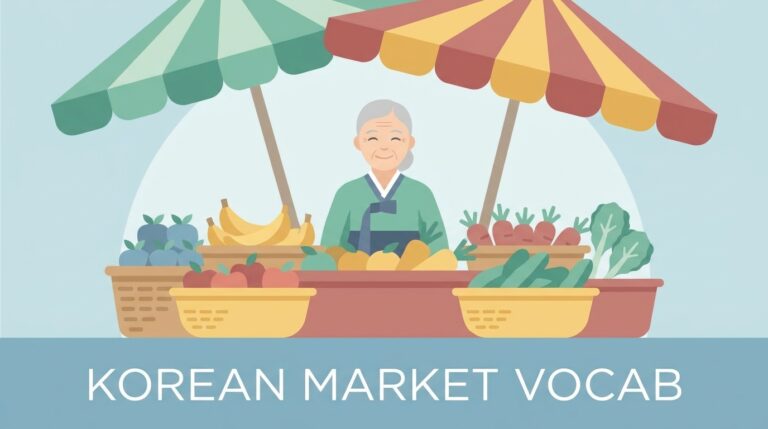
Imagine this: you take a regional express bus out of Seoul, winding through misty green mountain passes to a rural town in Gangwon or Jeolla Province. Suddenly, a sleepy crossroad has exploded into a swirling kaleidoscope of bright parasols, the aroma of sizzling mung bean pancakes (bindaetteok), and elderly vendors passionately calling out their harvest. You have landed right in the heart of an O-il-jang (5-day market) on its designated market day (jangnal). If you’ve watched K-dramas like Our Blues (우리들의 블루스) or Hometown Cha-Cha-Cha (갯마을 차차차), you know this is where the real pulse of Korean life beats—raw, unscripted, and overflowing with human warmth.
Yet for many advanced Korean learners, entering an O-il-jang triggers instant linguistic stage fright. You know how to order an Americano in Gangnam with textbook perfection, but when a quick-talking merchant asks, “아가씨/총각, 뭐 보고 가? 오늘 아침에 캔 거라 아주 실해!” your mind goes blank. Standard polite phrases feel too clinical, while overly aggressive bargaining feels rude. How do you bridge that gap without sounding like an AI reading from a 2012 grammar book? Based on feedback from our C1 learners who dared to step outside Seoul’s department stores, this guide provides the cultural fluency and linguistic nuances to help you navigate Korea’s traditional markets like a savvy local insider.
Phase 2: Core Expressions Deep-Dive
1. 덤 좀 얹어 주세요 (Hangul: 덤 좀 얹어 주세요)
- Pronunciation: [Deom jom eonjeo juseyo] (Tip: ‘Deom’ rhymes with the English word ‘thumb’, articulated softly without popping the ‘d’)
- Meaning: Literally “Please place an extra bonus on top,” used naturally as “Could you toss in a little extra something?”
- K-Culture Moment: In rural variety shows like Three Meals a Day (삼시세끼), cast members charm local vendor grandmothers with this playful phrase rather than asking for monetary discounts.
- Editor’s Insight: In Korean traditional markets, deom (덤) is not merely a freebie; it is the currency of jeong (affection and solidarity). Asking directly for a price cut (“깎아 주세요”) can sometimes feel transactional or dismissive of the farmer’s hard labor. Asking for deom playfully invites the merchant to show off their generosity (insim).
- Situation Spectrum: Casual ✅ | Semi-formal ✅ | Formal 🚫
- 🤔 Think About It: In Western commerce, retail transactions prioritize strict unit pricing and receipts. Why does Korean traditional culture favor giving excess goods (deom) over slashing monetary prices?
2. 장날이라 그런지 확실히 활기가 넘치네요 (Hangul: 장날이라 그런지 확실히 활기가 넘치네요)
- Pronunciation: [Jangnarira geureonji hwaksilhi hwalgiga neomchineyo] (Tip: Link ‘Jang-nal’ as ‘Jang-nal’ with a soft nasal transition like ‘sing-along’)
- Meaning: Literally “Perhaps because it is market day, it is certainly overflowing with vitality.”
- K-Culture Moment: Think of regional travel vlogs or healing dramas where the protagonist remarks upon the contrast between a sleepy town and its electric festival-like market day.
- Editor’s Insight: This is a classic C1 conversational icebreaker. Instead of stating the pedestrian “사람이 많네요” (There are lots of people), using “활기가 넘치다” (to brim with vitality) and attributing it to the jangnal cycle instantly validates the merchant’s pride in their community event.
- Situation Spectrum: Casual ✅ | Semi-formal ✅ | Formal ✅
- 🤔 Think About It: Notice how Korean speakers often use “-라 그런지” (perhaps because…) to frame observations modestly rather than stating assertions bluntly.
3. 물건이 너무 실해서 안 살 수가 없네요 (Hangul: 물건이 너무 실해서 안 살 수가 없네요)
- Pronunciation: [Mulgeoni neomu silhaeseo an sal suga eomneyo] (Tip: ‘Sil’ sounds like ‘silk’ without the ‘k’, ending with the tip of your tongue resting lightly behind your upper front teeth)
- Meaning: Literally “The goods are so solid and fresh that I simply cannot walk away without buying.”
- K-Culture Moment: Commonly heard in foodie documentaries like Heo Young Man’s Food Travel when praising seasonal mountain greens or fresh seafood.
- Editor’s Insight: The adjective silhada (실하다) is high-level market slang. When applied to produce, fruit, or fish, it means substantial, plump, healthy, and premium quality. Using this compliment makes any merchant beam instantly.
- Situation Spectrum: Casual ✅ | Semi-formal ✅ | Formal ⚠️
- 🤔 Think About It: How does complimenting the vendor’s discerning eye establish an egalitarian, warm relationship before any financial exchange occurs?
Phase 3: 교과서 한국어 vs 진짜 한국어
Situation 1: Inquiring about adding extra produce
- 📖 교과서 한국어: 가격을 깎아 주실 수 있습니까? (Gagyogeul kkakka jusil su itseumnikka? – Can you reduce the price?)
- 🗣️ 진짜 한국어: 사장님, 단골 할 테니까 덤 조금만 챙겨주세요~ (Sajangnim, dangol hal tenikka deom jogeumman chaenggyeojuseyo~ – Boss, I promise to be your regular! Throw in a little extra love, will you?)
- 💡 왜 다를까?: Traditional market merchants take pride in reasonable pricing. Promising future loyalty (단골) combined with a polite request for deom appeals to mutual affection rather than haggling down their honest margins.
Situation 2: Expressing admiration for the lively atmosphere
- 📖 교과서 한국어: 시장에 사람이 아주 많고 복잡합니다. (Sijange sarami aju manko bokjaphamnida. – The market has very many people and is crowded.)
- 🗣️ 진짜 한국어: 역시 장날에 오니까 사람 냄새도 팍팍 나고 구경하는 재미가 쏠쏠하네요! (Yeoksi jangnare onikka saram naemsaedo pakpak nago gugyeonghaneun jaemiga ssolssolhaneyo! – As expected of market day, you really feel that vibrant human warmth, and people-watching here is pure joy!)
- 💡 왜 다를까?: In natural spoken Korean, crowdedness isn’t described as negative congestion (복잡함), but as saram naemsae (the comforting warmth of humanity) paired with idiomatic phrases like jaemiga ssolssolhada (rewardingly fun).
Phase 4: K-Culture 딥다이브 & 비언어적 매너
4-1. 눈치(Nunchi) & Gestures: The Five-Day Market Etiquette
- Two-Handed Cash Exchange: While digital cards work in permanent market stalls, small O-il-jang roadside mats run primarily on cash or quick bank transfers (gyejwa-iche). Hand over crisp banknotes using both hands (or supporting your right forearm with your left hand). This gesture signals deep respect for manual agricultural labor.
- The Eye-Smile Nod (눈웃음 인사): Vendors are often surrounded by loud banter, frying noises, and announcements. Exaggerate your vocal clarity and pair it with an eye-smile and a warm head tilt. Do not touch or squeeze fragile produce like ripe persimmons or strawberries unless invited; ask first with an inquiring gesture: “만져봐도 돼요?” (Manjyeobwado dwaeyo?).
4-2. 문화 코드 분석: The Rhythm of the 5-Day Cycle (O-il-jang)
Unlike modern 7-day Gregorian workweeks, Korea’s traditional market grid operates on a 5-day solar cadence (e.g., markets opening on days ending in 2 and 7, or 4 and 9). Historically, itinerant merchants (bobusang) rotated across five towns in a circle on foot. Even in modern hyper-digital Korea, people travel hours on high-speed KTX trains just to experience the sensory spectacle of an O-il-jang, feasting on seasonal delicacies like freshly pressed perilla oil, wild chives, and kettle-fried traditional chicken (gamasot tongdak).
Phase 5: 실전 롤플레이 시나리오
Setting: Moran Traditional 5-Day Market (모란 5일장). The air smells of freshly toasted sesame seeds and medicinal angelica root. An elderly vendor, Grandma Sun-hee, sits warmly behind baskets of fragrant wild spring greens.
- 할머니 (Grandma): “어이구, 젊은 양반이 나물 볼 줄 아네! 오늘 아침에 갓 뜯어 온 참나물이야!” (Eoigu, jeolmeun yangbani namul bol jul ane! Oneul achime gat tteudeo on chamnamuriya! – Oh my, look at this young person who knows their greens! These wild chamnamul were freshly plucked just this morning!)
🎭 행동 지문: Baskets brimming with dew-dropped green herbs are gently pushed forward. -
당신 (You): “향이 정말 진하네요, 할머니. 오늘 장날이라 그런지 물건들이 다 실해요.” (Hyangi jeongmal jinhaneyo, halmeoni. Oneul jangnarira geureonji mulgeondeuri da silhaeyo. – The aroma is incredibly rich, Grandma. Perhaps because it’s market day, all your produce looks remarkably fresh.)
🎭 행동 지문: Bending down slightly to take in the fragrant scent while making warm eye contact. -
할머니 (Grandma): “말도 어쩜 이렇게 예쁘게 해! 한 바구니에 오천 원인데, 두 바구니 가져가면 만 원에 그냥 싹 줄게.” (Maldo eojjeom ireoke yeoppeuge hae! Han bagunie ocheon woninde, du baguni gajyeogamyeon man wone geunyang ssak julge. – Look at you speaking so charmingly! It’s 5,000 won a basket, but take two and I’ll pack them up for an even 10,000!)
🎭 행동 지문: Chuckling happily and wiping her hands on her floral patterned apron. -
당신 (You): “두 바구니 주세요! 대신 제가 요리 초보니까, 덤으로 쪽파 몇 뿌리만 얹어 주시면 안 돼요?” (Du baguni juseyo! Daesin jega yori chobonikka, deomeuro jjokpa myeot ppuriman eonjeo jusimyeon an dwaeyo? – I’ll take two baskets! But since I’m a novice cook, could you toss in a few scallions as a little bonus?)
🎭 행동 지문: Bringing your hands together playfully in an endearing request. -
할머니 (Grandma): “호호, 아주 똑소리 나는 손님이네! 좋아, 내가 파에다가 깻잎까지 듬뿍 얹어 줄게!” (Hoho, aju ttoksori naneun sonnimine! Joa, naega paedaga kkaennipkkaji deumpuk eonjeo julge! – Haha, what a clever shopper! Deal, I’ll toss in wild perilla leaves on top of the scallions!)
🎭 행동 지문: Grabbing a generous handful of fresh green herbs and stuffing them into the black carrier bag. -
당신 (You): “와, 할머니 인심 정말 최고예요. 단골 예약하고 갑니다! 현금으로 드릴게요.” (Wa, halmeoni insim jeongmal choegoyeyo. Dangol yeyakhago gamnida! Hyeongeumeuro deurilkeyo. – Wow, Grandma, your generosity is unmatched. Consider me a lifelong regular! I’ll pay in cash.)
🎭 행동 지문: Taking out a crisp 10,000-won note and presenting it with both hands. -
할머니 (Grandma): “고마워요! 맛있게 무쳐 먹고 다음 장날에 또 와!” (Gomaweoyo! Masitge muchyeo meokgo daeum jangnare tto wa! – Thank you! Season it well with sesame oil and come back next market day!)
🎭 행동 지문: Tucking the bill safely into her waist pouch and handing over the heavy bag with a broad smile. -
당신 (You): “네, 할머니! 많이 파시고 건강하세요!” (Ne, halmeoni! Mani pasigo geonganghaseyo! – Yes, Grandma! Wishing you brisk sales and great health!)
🎭 행동 지문: Bowing politely at a 30-degree angle while carrying the bag.
🔀 인터랙티브 분기점 (Interactive Choice)
When Grandma offers two baskets of produce for 10,000 won, how should you respond if you only need one basket?
- Option A: “혼자 살아서 다 못 먹어요. 한 바구니만 주시고, 대신 4천 원으로 깎아주세요.” (I live alone and can’t eat it all. Give me one basket, but discount it to 4,000 won.)
- Option B: “혼자 살아서 아쉽지만 한 바구니만 가져갈게요! 대신 할머니 손맛 나게 쪽파 한 줄기만 덤으로 주실 수 있나요?” (I live alone so I can only take one basket, sadly! But could you spare a stalk of scallion as deom to add your homemade touch?)
- Option C: “너무 비싸요. 옆 가게는 삼천 원에 팔던데요.” (That’s way too expensive. The stall next door sells it for 3,000 won.)
Feedback Breakdown:
* Option A [Risk]: Demanding a 20% discount on an already cheap agricultural item while acknowledging you are buying less disrupts the rhythm of warm marketplace rapport.
* Option B [Best]: Empathetic, charming, and honest. Explaining your single-person household (1인 가구) with gentle self-deprecation while appreciating her generosity wins you both respect and extra greens.
* Option C [Bad]: Direct price comparison to competitors is considered bad manners (kyemyeon eopda) in traditional markets, instantly souring the mood.
Phase 6: 10초 감정 섀도잉 드릴
Practice reading these out loud at native speed, pausing strictly at each / mark and embracing the emotional cues:
[😊 기쁘고 활기차게 / Cheerful & Vibrant]
“와, / 오늘 장날이라 그런지 / 물건이 진짜 실하고 좋네요!”
(Wa, / oneul jangnarira geureonji / mulgeoni jinjja silhago jonneyo!)-
[🥺 애교 섞인 정중함 / Endearing & Persuasive]
“사장님, / 제가 단골 할 테니까, / 덤 조금만 / 얹어 주시면 안 돼요~?”
(Sajangnim, / jega dangol hal tenikka, / deom jogeumman / eonjeo jusimyeon an dwaeyo~?) -
[🙏 깊은 감사와 존경 / Deep Gratitude & Warmth]
“할머니 인심 덕분에 / 장날 구경 제대로 하고 갑니다. / 많이 파세요!”
(Halmeoni insim deokbune / jangnal gugyeong jedaero hago gamnida. / Mani paseyo!)
Phase 7: K-Culture Mini Dictionary
- 덤 (Deom) | N. Free bonus addition | The defining soul of Korean market commerce; supplementary items added free of charge out of hospitality.
- 장날 (Jangnal) | N. Official market day | The specific recurring calendar dates (e.g., every 5 days) when regional pop-up bazaars assemble.
- 인심 (Insim) | N. Generosity / Warmhearted benevolence | Literally “human heart-mind”; refers to public hospitality and kindness demonstrated toward neighbors or travelers.
- 에누리 (Enuri) | N. Graceful price trimming / Courteous discount | An archaic yet elegant Korean word for a customary discount made through mutual goodwill rather than stingy haggling.
Phase 8: Survival Kit for Travelers
Top 3 Survival Expressions
- 계좌이체 되나요? (Gyejw-a-iche doenayo? – Do you accept mobile bank transfer?)
Pro Tip: If you run out of cash at a small street stall, almost every vendor has their bank name and account number printed on a board. Use your Korean banking app to send funds instantly. - 이거 오늘 들어온 거예요? (Igeo oneul deureo-on geoyeyo? – Did this come in today?)
Pro Tip: Signals to merchants that you understand agricultural seasonality and appreciate fresh daily stock. - 먹고 갈 수 있나요? (Meokgo gal su innayo? – Can I eat this here?)
Pro Tip: Many five-day market stalls have makeshift plastic stools behind the counter for immediate snacking.
Editor’s Travel Note
- Navigation Guide: Finding regional market dates requires local mapping apps. Download the platform ahead of time via 네이버 지도 앱 다운로드 and search terms like “민속 5일장” (folk five-day market) to view schedules and bus routes.
- Calendar Hack: 5-day markets operate on dates ending in specific digits. For instance, the famous Moran Market runs on days ending in 4 and 9 (4th, 9th, 14th, 19th, 24th, 29th). If a month has 31 days, the market skips the 31st and starts fresh on the next cycle.
Phase 9: 한 발 더 깊이 (Reflective Prompt)
Traditional Korean O-il-jang represents a preservation of cyclical village temporality that industrial modern society almost entirely erased. In modern hypermarkets, every single gram is measured digitally, barcodes dictate prices, and human encounters are reduced to contactless self-checkout beeps. In an O-il-jang, however, transactions remain fundamentally relational rather than mechanical. The phrase “인심 쓰다” (to exercise one’s generous heart) reminds us that exchange is an exchange of human energy, not just legal tender.
💬 Your Turn: How does bargaining or purchasing fresh food in your home country compare to Korea’s deom culture? Share your favorite market memories in the comments below!
Phase 10: FAQ & Avoiding Misconceptions
Q: Can I use credit cards everywhere at a 5-day market?
A: Permanent, brick-and-mortar storefronts within the market boundaries always accept domestic and international credit cards. However, elderly farmers selling wild herbs or produce displayed on street mats (nosang) rarely have card terminals. Always carry 20,000 to 30,000 KRW in cash, or be prepared to use domestic mobile bank transfers (계좌이체).
Q: Is aggressive haggling expected like in Southeast Asian night markets?
A: No. Haggling aggressively (“반값으로 해줘요” – Cut it in half) is considered inappropriate and disrespectful. Korea’s traditional market prices for produce and street food are already razor-thin. Friendly negotiation should focus on asking for a little extra item (덤) or rounding down small change (에누리), never slashing prices drastically.
Q: What is the best time of day to visit an O-il-jang?
A: Arrive between 9:30 AM and 11:30 AM. You will catch the freshest produce displays, witness the lively morning banter, and avoid the overwhelming lunchtime crowds flocking to the food tents for kalguksu (knife-cut noodles) and makgeolli.
🚨 Common Mistakes (흔한 실수 TOP 3)
- Mistake: Shaking or aggressively tapping melons, pumpkins, or seafood to test freshness.
Correct Action: Keep hands at your sides, observe visually, and politely ask: “어떤 게 제일 달아요/좋아요?” (Which one is the sweetest/best?). - Mistake: Using ultra-formal military endings like “~하십니까?” with elderly vendors.
Correct Action: Soften your speech to polite informal style (해요체) blended with respectful honorific markers (e.g., “할머니, 이거 얼마예요?” instead of “이것은 얼마입니까?”). - Mistake: Turning down a food sample directly with a flat “싫어요” (I don’t want it).
Correct Action: Smile gently, place a hand lightly over your chest, and say: “방금 밥을 먹고 와서 배가 너무 불러요, 죄송해요!” (I just ate and am so full, I’m sorry!).
Phase 11: 액션 미션 & 참여 유도
- 🥉 Bronze Mission (Solo Shadowing): Practice pronouncing “단골 할 테니까 덤 좀 챙겨주세요~” 5 times in front of a mirror with a friendly, charming smile.
- 🥈 Silver Mission (Community Challenge): Head to Instagram or Threads, share a photo of your favorite fresh food item, and caption it in Korean using the adjective 실하다 (e.g., “오늘 마트에서 사 온 사과가 참 실하다!”). Tag @DailyHangul.
- 🥇 Gold Mission (Real-World Test): Visit a traditional market (such as Mangwon, Gwangjang, or Moran Market), buy seasonal fruit or street food, and use the phrase “많이 파세요!” (Wishing you many sales!) as your departure greeting.
🎮 K-Culture Mission: Watch Episode 1 of the drama Our Blues (우리들의 블루스). Listen carefully to how the fishmonger characters talk to their regular patrons at the seaside market. Can you spot when someone gives deom?
Phase 12: 인터랙티브 퀴즈 챌린지
Q1. Situational Judgment: You are at a traditional five-day market in Chuncheon. You want to ask the merchant to give you a couple of extra perilla leaves with your mushroom purchase. Which sentence is the most natural and culturally appropriate for a C1 speaker?
A) 사장님, 돈이 부족하니까 그냥 공짜로 더 주세요.
B) 사장님, 오늘 장날이라 물건도 실한데 깻잎 몇 장만 덤으로 얹어주시면 안 돼요?
C) 사장님, 버섯 가격을 50% 깎아주시면 감사하겠습니다.
Q2. Fill-in-the-Blank: Choose the appropriate word that describes produce that is ripe, hearty, and thick:
“오늘 아침에 들여온 무가 속이 꽉 차고 아주 ( _________ ).”
(A) 썰렁하다 (B) 실하다 (C) 심심하다
Q3. True or False: Korea’s 5-day markets open every weekend on Saturday and Sunday without exception.
(True / False)
👉 정답 및 해설 확인하기 (Click to reveal answers & explanations)
- Q1 Answer: B
Explanation: Sentence B compliments the produce using high-level vocabulary (실하다), references the festive market day context (장날), and politely asks for a bonus (덤) using soft negation (-면 안 돼요?). Option A is rude, and Option C is an unrealistic demand. - Q2 Answer: B (실하다)
Explanation: Silhada describes produce, fruit, or physical items that are robust, solid, and top-tier in quality. Sseolleonghada means chilly/awkward, and simsimhada means bland or bored. - Q3 Answer: False
Explanation: Five-day markets (O-il-jang) run strictly according to a 5-day recurring cycle based on fixed dates of the month (e.g., 2nd, 7th, 12th, 17th, 22nd, 27th), regardless of whether those dates land on weekdays or weekends!







