

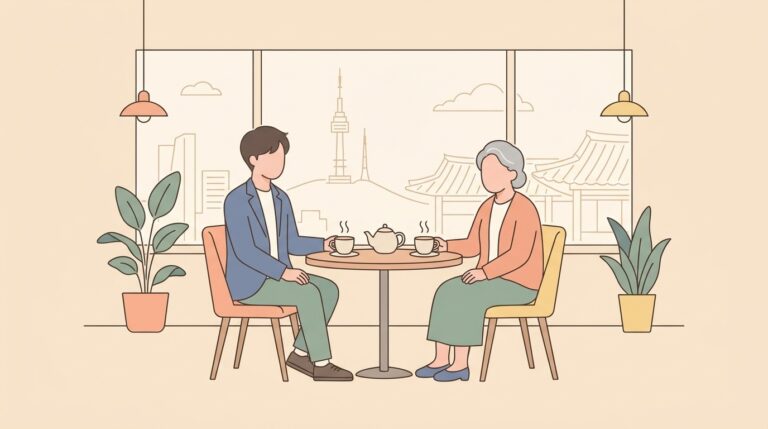
Stop Walking on Eggshells: How to Speak Mindfully Across Generations in Korea
Phase 1: 공감 (Story-Immersive Opening)
안녕하세요! 매일한글 에디터입니다. (Hello! I’m your Daily Hangul editor.)
Picture this: You are seated at a lively hoeshik (after-work dinner) in a bustling barbecue restaurant in Gangnam. The grill is sizzling, glasses are clinking, and suddenly the conversation takes a sharp turn. Your team leader, a dedicated veteran in his 50s, sighs and remarks that today’s youth lack grit because they leave right at 6:00 PM. Across the table, a 26-year-old junior colleague freezes, clenches her chopsticks, and mutters under her breath about toxic overtime culture and work-life balance. The air turns ice-cold. You want to ease the tension, but your tongue feels tied. How do you honor the elder’s lifetime of hard work without invalidating the junior colleague’s boundaries? In Korean, choosing the wrong phrasing can instantly brand you as either an aggressive rebel or an indifferent bystander. As an intermediate (B2) speaker, navigating generational friction is not about memorizing textbook honorific endings—it is about wielding nuanced linguistic cushions and emotional intelligence. Based on hundreds of real coaching sessions with professionals and expats in Korea, this guide provides the exact verbal strategies you need to bridge generational divides with grace, confidence, and warmth.
Phase 2: 핵심 표현 3선 심층 분석 (Core 3 Expressions In-Depth)
1. 말씀하신 뜻은 충분히 이해했습니다 (Malsseumhasin tteuseun chungbunhi ihaehaesseumnida)
- Pronunciation: [Malsseumhasin tteuseun chungbunhi ihaehaesseumnida] (Pronunciation tip: mahl-ssem-ha-sheen ddeut-eun choong-boon-hee ee-hae-hae-sseum-nee-dah – imagine letting your tone descend gently at the end to sound grounded and sincere).
- Meaning: Literal: “I have fully understood the meaning of what you said” vs. Actual Nuance: “I hear your underlying heart and intention loud and clear (which I acknowledge before proposing an alternative).”
- K-Culture Moment: In the hit office drama Misaeng (미생), when a senior manager demands an old-school paper verification process, an empathetic junior uses this phrase to honor the elder’s diligence before introducing a faster digital system.
- Editor’s Insight: Never jump straight into “하지만” (hajiman – but) when talking to a Korean senior. In high-context Korean communication, dismissing someone’s perspective feels like an attack on their status. This phrase cushions the blow by validating their eui-do (intention) first.
- Situation Spectrum: Casual: 🚫 | Semi-formal: ⚠️ | Formal: ✅
- 🤔 Think About It: In many Western corporate cultures, jumping straight to the counter-argument is seen as efficient. Why does Korean culture require verbal validation of the human relationship before discussing the problem?
2. 서로 한 걸음씩 양보하면 어떨까요? (Seoro han georeumssik yangbohamyeon eotteolkkayo?)
- Pronunciation: [Seoro han georeumssik yangbohamyeon eotteolkkayo?] (Pronunciation tip: suh-roh han guh-reum-sheek yahng-boh-ha-myun uh-ddul-kkah-yoh – maintain a rhythmic, soothing cadence like pouring a comforting cup of tea).
- Meaning: Literal: “How about we each yield one step?” vs. Actual Nuance: “Let’s meet in the middle so neither side loses face.”
- K-Culture Moment: In family dramas like My Unfamiliar Family, when parents and adult children clash over wedding customs, a diplomatic mediator uses this phrase to establish mutual balance.
- Editor’s Insight: The verb 양보하다 (yangbohada) means to concede or give way. Pairing it with 서로 (mutually) ensures that neither person feels defeated. The ending ~면 어떨까요? converts an imperative demand into a thoughtful collaborative invitation.
- Situation Spectrum: Casual: ⚠️ (Use casual form: 서로 한 걸음씩 양보하자) | Semi-formal: ✅ | Formal: ✅
- 🤔 Think About It: How does preserving che-myeon (체면, social face) shape the way Korean compromises are framed as mutual acts of grace rather than admissions of error?
3. 세대마다 살아온 환경이 다르니까요 (Sedamada saraon hwangyeongi dareunikkayo)
- Pronunciation: [Sedamada saraon hwangyeongi dareunikkayo] (Pronunciation tip: seh-dae-mah-dah sah-rah-ohn hwahn-gyung-ee dah-reu-nee-kkah-yoh – give a soft, reflective lift on dareu-).
- Meaning: Literal: “Because the environment each generation lived through is different” vs. Actual Nuance: “Neither side is malicious; we simply carry different survival values formed by different historical moments.”
- K-Culture Moment: In nostalgic series like Reply 1988, when older parents scold their children for spending money on cafes while the youth seek modern lifestyles, an observant relative uses this line to dissolve the tension.
- Editor’s Insight: The ending ~니까요 introduces a gentle explanation. It immediately depersonalizes the conflict: the friction is not caused by personal flaws, but by the rapid economic transformation Korea navigated over just a few decades.
- Situation Spectrum: Casual: ⚠️ | Semi-formal: ✅ | Formal: ✅
- 🤔 Think About It: Korea transformed from post-war poverty to an economic and technological powerhouse within 40 years. How does this unprecedented speed of social change make empathetic language so vital today?
Phase 3: 교과서 한국어 vs 진짜 한국어 (Textbook vs. Real Korean)
Situation 1: Expressing Disagreement with a Senior
- 📖 교과서 한국어: “저는 그 의견에 동의하지 않습니다.” (Jeoneun geu uigyeone dong-uihaji anseumnida. – I do not agree with that opinion.)
- 🗣️ 진짜 한국어: “선배님 말씀도 충분히 일리가 있지만, 이번에는 다른 각도로 접근해 보면 어떨까요?” (Seonbaenim malsseumdo chungbunhi illiga itjiman, ibeoneneun dareun gakdoro jeopgeunhae bomyeon eotteolkkayo? – What you said makes complete sense, sunbae-nim, but what if we approached it from a different angle this time?)
- 💡 왜 다를까? Directly declaring non-agreement (동의하지 않습니다) sounds aggressive and confrontational. Culturally fluent B2 speakers validate the elder’s logic (일리가 있다) before proposing an alternative exploratory viewpoint.
Situation 2: Deflecting Intrusive Questions from Inquisitive Elders
- 📖 교과서 한국어: “그것은 제 개인적인 사생활입니다.” (Geugeoseun je gaeinjeogin sasaenghwarimnida. – That is my personal private life.)
- 🗣️ 진짜 한국어: “걱정해 주셔서 정말 감사해요. 제가 신경 써서 잘 준비하고 있으니 편안하게 지켜봐 주세요!” (Geokjeonghae jusyeoseo jeongmal gamsahaeyo. Jega sin-gyeong sseoseo jal junbihago isseuni pyeon-anhage jikyeobwa juseyo! – Thank you so much for your caring concern. I’m preparing everything thoroughly, so please watch over me with ease!)
- 💡 왜 다를까? Flatly stating that something is your “private life” severs interpersonal warmth (jeong). Reframing intrusive questions as well-meaning concern (걱정) diffuses pressure while maintaining your personal boundaries.
Phase 4: K-Culture 딥다이브 & 비언어적 매너 (Deep Dive & Non-Verbal Manners)
4-1. Nunchi & Physical Posture
- The Two-Handed Anchor: When offering a counter-opinion to an elder, keep both hands clasped softly in front of your lower torso or rest them calmly on the table. Never point or gesture with one hand.
- The 70/30 Gaze Rule: Unbroken, fierce eye contact during a debate is interpreted as open defiance. Aim to maintain soft eye contact 70% of the time, and gently drop your gaze toward the elder’s collarbone 30% of the time when verbalizing disagreement.
- Deliberate Nodding: Nodding slowly while an older person speaks indicates respectful listening, not necessarily unconditional agreement.
4-2. Cultural Code Analysis: The Kkondae vs. MZ Paradox
Modern Korea is experiencing a dramatic shift in organizational and social dynamics. While the older generation (Kkondae) values institutional loyalty, shared suffering, and after-hours bonding, the MZ Generation (Millennials and Gen Z) champions autonomy, transparency, and personal boundaries. Progressive Korean organizations are resolving this tension through “Reverse Mentoring” and replacing alcohol-heavy hoeshik with collaborative lunchtime dining or cultural events.
Phase 5: 실전 롤플레이 시나리오 (Real-Life Roleplay Scenario)
Setting: Friday afternoon at a tech venture office in Pangyo.
Characters: Team Leader Park (52, hardworking veteran who values weekend team solidarity) and Alex (29, intermediate foreign marketing manager).
- 박 팀장: “알렉스 씨, 이번 주말에 팀원들 다 같이 북한산 등산 가기로 했는데, 당연히 같이 갈 거지?” (Alex-ssi, ibeon jumare tim-wondeul da gachi Bukhansan deungsan gagiro haenneunde, dang-yeonhi gachi gal geoji? – Alex, we decided to hike Bukhansan together this weekend as a team. Naturally you’re joining, right?)
🎭 [어깨를 툭 치며 호탕하게 웃는다] (Pats Alex on the shoulder with a hearty laugh) - 알렉스: “팀장님, 팀 단합을 아끼시는 말씀하신 뜻은 충분히 이해했습니다.” (Timjangnim, tim danhabeul akkisineun malsseumhasin tteuseun chungbunhi ihaehaesseumnida. – Team Leader, I fully understand your caring intention regarding team unity.)
🎭 [두 손을 모으고 정중하게 고개를 끄덕인다] (Clasps hands respectfully and nods) - 박 팀장: “그렇지? 역시 우리 알렉스 씨는 주말에도 팀을 먼저 생각할 줄 알아!” (Geureotji? Yeoksi uri Alex-ssineun jumaredo timeul meonjeo saeng-gakhal jul ara! – Right? I knew our Alex puts the team first, even on weekends!)
🎭 [흐뭇한 미소를 지으며 기대감을 나타낸다] (Smiles warmly with high expectations) - 알렉스: “하지만 세대마다 주말에 에너지를 재충전하는 방식과 살아온 환경이 다르니까요.” (Hajiman sedamada jumare eneojireul jaechungjeonhaneun bangsikgwa saraon hwangyeongi dareunikkayo. – However, each generation grew up in different environments, and our ways of recharging energy on weekends differ.)
🎭 [차분하고 진중한 눈빛으로 부드럽게 말한다] (Speaks softly with a calm, earnest expression) - 박 팀장: “음… 하긴 요즘 젊은 직원들은 개인적인 휴식을 더 중요하게 여긴다고 하더군.” (Eum… hagin yojeum jeolmeun jig-wondeureun gaeinjeogin hyusigeul deo jung-yohage yeogindago hadeogun. – Hmm… I suppose younger staff members these days value personal rest much more.)
🎭 [턱을 매만지며 생각에 잠긴다] (Rubs his chin in contemplation) - 알렉스: “맞습니다. 그래서 이번에는 서로 한 걸음씩 양보하면 어떨까요?” (Matseumnida. Geuraeseo ibeoneneun seoro han georeumssik yangbohamyeon eotteolkkayo? – Exactly. So, how about we each take a step back and meet in the middle this time?)
🎭 [열린 손짓을 하며 온화하게 미소 짓는다] (Makes an open hand gesture with a gentle smile) - 박 팀장: “한 걸음씩 양보? 구체적으로 어떤 좋은 생각이 있나?” (Han georeumssik yangbo? Guchejeogeuro eotteon joeun saeng-gagi itna? – Meet in the middle? What good idea do you have in mind?)
🎭 [궁금한 표정으로 의자를 당겨 앉는다] (Pulls chair closer with curious interest) - 알렉스: “주말 등산 대신, 다음 주 금요일 점심에 다 함께 맛있는 특식을 먹으러 가는 건 어떠세요?” (Jumal deungsan daesin, daeum ju geum-yoil jeomsime da hamkke masitneun teuksigeul meogeureo ganeun geon eotteoseyo? – Instead of a weekend hike, how about we all go enjoy a delicious special lunch together next Friday?)
🎭 [기분 좋은 표정으로 제안서를 건넨다] (Hands over the proposed team lunch schedule with an inviting smile)
🔀 인터랙티브 분기점 (Interactive Branching Point)
If Team Leader Park hesitates, how should Alex reply?
* Choice A: “주말 근무나 다름없는 일정은 근로기준법상 무리입니다.” (Weekend schedules like this violate fair labor norms.)
* ❌ [Bad]: Citing legal regulations creates cold hostility and permanently damages workplace rapport.
* Choice B: “팀장님께서 팀원들을 아끼시는 마음을 모두 알고 있으니, 맛있는 점심 식사도 뜻깊은 자리가 될 것 같습니다!” (Everyone knows how much you care about the team, Team Leader, so a special lunch will be just as meaningful!)
* ✅ [Best]: Masterful emotional intelligence! Validates his leadership while sealing the practical compromise.
* Choice C: “그럼 저는 개인 사정으로 몸이 아프다고 하겠습니다.” (Then I will just claim I am sick.)
* ⚠️ [Risk]: Avoidance tactic. If colleagues spot you out on the weekend, your trust will evaporate.
Phase 6: 10초 감정 섀도잉 드릴 (10-Second Emotion Shadowing Drill)
- Sentence 1:
[🤝 공감하며 부드럽게]
말씀하신 뜻은 / 충분히 이해했습니다.
(Malsseumhasin tteuseun / chungbunhi ihaehaesseumnida.)
Tip: Pause deliberately at the slash to show genuine reflection. -
Sentence 2:
[💡 차분하고 진솔하게]
세대마다 / 살아온 환경이 / 다르니까요.
(Sedamada / saraon hwangyeongi / dareunikkayo.)
Tip: Let your voice trail down softly on dareunikkayo to avoid sounding argumentative. -
Sentence 3:
[😊 따뜻하게 권유하며]
서로 한 걸음씩 / 양보하면 어떨까요?
(Seoro han georeumssik / yangbohamyeon eotteolkkayo?)
Tip: Lift your pitch lightly at the question mark to create a warm, collaborative tone.
Phase 7: K-Culture 미니 사전 (Key Vocabulary)
- 꼰대 (Kkondae): A condescending senior who forces outdated mindsets and blind obedience onto juniors. Used widely in pop culture and media discussions.
- 세대 갈등 (Sedaegaldeung): Generational conflict. A frequent keyword in news features exploring shifting workplace dynamics, housing, and social values.
- 소통 (Sotong): Mutual, open communication. Often contrasted with bultong (불통, communication gridlock or refusal to listen).
- 워라밸 (Worabal): Work-Life Balance. A Korean portmanteau (Work + Life + Balance) representing modern professionals’ focus on personal wellness.
Phase 8: 여행자를 위한 생존 키트 (Traveler’s Survival Kit)
Survival Phrases TOP 3
- 배려해 주셔서 감사합니다. (Baeryeohae jusyeoseo gamsahamnida. – Thank you for your warm consideration.) Pro Tip: Use this when an older taxi driver or shop owner assists you.
- 제가 한국 예절에 아직 서툴러서 죄송합니다. (Jega hanguk yejeore ajik seotulleoseo joesonghamnida. – I apologize that I am still learning Korean etiquette.) Pro Tip: The ultimate social buffer if an elder looks surprised by a cultural slip.
- 천천히 말씀해 주셔도 괜찮습니다. (Cheoncheonhi malsseumhae jusyeodo gwaenchanseumnida. – It is perfectly fine to speak slowly to me.) Pro Tip: Keeps older speakers from raising their voice when trying to communicate.
Editor’s Travel Note
Navigating Seoul’s multi-generational public transit requires keen situational awareness. When boarding the subway, avoid sitting in designated seats for the elderly and pregnant individuals (노약자석). Use the 네이버 지도 앱 다운로드 resource to find quiet transit routes, and rely on the 카카오 T 앱 다운로드 service for clear, cashless taxi rides without language friction.
Phase 9: “한 발 더 깊이” (One Step Deeper)
Traditional Korean social etiquette stems from reciprocal relational duties rather than arbitrary dominance. When older Koreans offer unsolicited advice or ask personal questions, it often originates from jeong (communal warmth) developed during eras when survival depended on collective cohesion. Modern etiquette does not require abandoning personal autonomy; it simply asks that you wrap boundaries in relational respect. By validating the speaker’s good intentions before stating your own position, you preserve communal harmony while safeguarding your individuality.
💬 Your Turn: Have you ever experienced a generational communication clash while living in Korea or working with Korean colleagues? Share your story in the comments below!
Phase 10: FAQ & 오해 방지 (FAQ & Common Mistakes)
Q: How can I refuse an alcoholic drink offered by a senior colleague without offending them?
A: Never shove the glass away. Receive the cup with both hands, place it gently on the table, and explain: “건강검진(or 약 복용) 때문에 오늘은 술을 마시기 어렵습니다. 대신 물로 건배를 함께해도 되겠습니까?” (Due to a health checkup/medication, I cannot drink alcohol today. May I toast with water instead?) This honors their hospitality while holding your boundary.
Q: Can I use the term 꼰대 (Kkondae) jokingly with an older boss?
A: No. While close friends of the same age might tease each other with this word, using it with someone older or senior in rank is considered extremely disrespectful.
Q: Why do older Koreans ask about my age, marital status, or salary?
A: In Korean culture, these questions help determine proper linguistic registers (jondaenmal) and social context. Rather than an interrogation, it is historically meant as an expression of personal interest.
🚨 흔한 실수 (Common Mistakes)
- Mistake: Flatly saying “틀렸어요” (Teullyeosseoyo – You are wrong). -> Correct Action: Say “생각해 보지 못한 관점입니다” (That is a perspective I had not considered).
- Mistake: Crossing your arms or keeping hands in pockets while listening. -> Correct Action: Keep hands loosely clasped in front of you (gongsu posture).
- Mistake: Abruptly walking away to conclude a tense exchange. -> Correct Action: Offer a warm concluding bridge: “좋은 말씀 나눠 주셔서 감사합니다. 다음에도 이야기 들려주세요!”
Phase 11: 액션 미션 & 참여 유도 (Action Mission)
- Bronze Mission: Stand in front of a mirror and practice saying 말씀하신 뜻은 충분히 이해했습니다 three times with the 70/30 gaze technique.
- Silver Mission: Write down a recent disagreement you experienced and translate your proposed compromise into Korean using 서로 한 걸음씩 양보하면 어떨까요? on your social study feed.
- Gold Mission: Apply this cushion formula during your next interaction with an older colleague, Korean teacher, or language partner.
- 🎮 K-Culture Mission: Watch an episode of an office drama such as Misaeng or Doctor Cha. Identify one scene where a junior negotiates with a senior, and take note of their non-verbal cues.
Phase 12: 인터랙티브 퀴즈 챌린지 (Interactive Quiz Challenge)
1. Situational Judgment
Your senior colleague wants everyone to come in early on Monday morning for an informal chat. How do you respectfully propose an alternative?
A) “월요일 아침 일찍 출근하는 것은 제 계약 조건에 없습니다.”
B) “선배님 말씀하신 뜻은 충분히 이해했습니다. 혹시 월요일 점심시간을 활용해 보는 건 어떨까요?”
C) “왜 항상 월요일에만 그런 제안을 하시는지 모르겠습니다.”
👉 Click here to reveal the answer & explanation!
Correct Answer: B
Explanation: Option B acknowledges the senior colleague’s intent with honorific courtesy (말씀하신 뜻은 충분히 이해했습니다) while offering a practical alternative (점심시간 활용). Option A and Option C are overly abrasive and disregard relational harmony.
2. Fill-in-the-Blank
Fill in the blank to propose a mutual compromise:
“우리 갈등을 해결하기 위해 [ ] 한 걸음씩 양보합시다.”
👉 Click here to reveal the answer & explanation!
Correct Answer: 서로 (Seoro – Mutually / Each other)
Explanation: The word 서로 highlights shared cooperation, ensuring neither side feels dishonored.
3. True or False Cultural Quiz
True or False: Staring directly and unblinkingly into an older colleague’s eyes during a disagreement proves your honesty and sincerity in Korea.
👉 Click here to reveal the answer & explanation!
Correct Answer: False
Explanation: Intense, unbroken eye contact during a disagreement is perceived as aggressive defiance. Use a softened gaze and deliberate, polite nodding.







