

Phase 1: Empathy & Story-Driven Opening
안녕하세요! 매일한글 에디터입니다. (Hello! It is your Daily Hangul editor.)
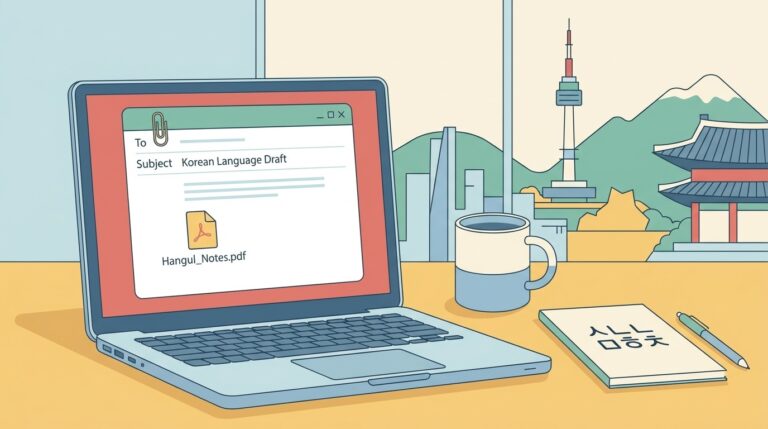
Picture this: You are sitting at your desk, the glow of your monitor lighting up a draft email addressed to your Korean client, partner, or team manager. You have spent hours perfecting a report, attached the finalized PDF, and now your cursor blinks on the body text. You want to say, “Please check the attached file and let me know your thoughts.”
In your native English, that feels straightforward, crisp, and professional. But in Korean, you hesitate. If you translate it word-for-word—“첨부된 파일을 확인하세요”—you might sound like a stern boss ordering an intern around! On the other hand, if you sound overly hesitant, your message might lose its professional authority.
If you have watched K-dramas like Misaeng: Incomplete Life (미생) or Agency (대행사), you know that corporate communication in Korea is an art form. A single misplaced verb ending or an overly casual request can make senior colleagues raise an eyebrow before they even open your attachment.
This guide was developed directly from real feedback shared by intermediate (B2) learners working in or collaborating with Korean companies. Today, we are bridging the gap between “textbook polite” and “corporate boardroom fluent.” By the end of this guide, you will attach files, set gentle deadlines, and request confirmations with effortless poise and confidence!
Phase 2: Core 3 Expressions In-Depth
Here are the three foundational expressions every intermediate professional must have in their toolkit when sending deliverables.
1. 관련 자료를 첨부하여 송부드립니다 (한글)
- Pronunciation: [Gwan-ryeon ja-ryo-reul cheom-bu-ha-yeo song-bu-deu-rim-ni-da] (Sound tip: “song-bu” rhymes with “long view” but with a crisp b sound; “cheom-bu” sounds like “chum-boo”).
- Meaning: Literal: “Attaching related materials, I send them to you.” | Nuance: “Please find the relevant materials attached for your reference.”
- K-Culture Moment: In Misaeng, whenever rookie contractor Jang Geu-rae submits an export brief to Section Chief Oh, this formal Sino-Korean phrase appears in the email preview on screen.
- Editor’s Insight: While everyday Korean uses 보내드립니다 (bonaedeurimnida), professional business writing favors the Sino-Korean verb 송부하다 (songbuhada, 送付 – to send/forward documents). It instantly elevates your register to upper-intermediate polish.
- Situation Spectrum: Casual 🚫 | Semi-formal ⚠️ | Formal ✅
- 🤔 Think About It: Notice how Korean business emails avoid the passive voice (“The file is attached”). Instead, they explicitly acknowledge who is serving whom using humble humble verbs like 드립니다 (deurimnida). How does this change the psychological warmth of the email?
2. 첨부된 파일을 확인해 주시기 바랍니다 (한글)
- Pronunciation: [Cheom-bu-doen pa-i-reul hwa-gin-hae ju-si-gi ba-ram-ni-da] (Sound tip: “hwa-gin” sounds like “hwa-geen”; “baramnida” sounds like “bah-rahm-nee-dah”).
- Meaning: Literal: “I wish that you would check the attached file.” | Nuance: “Kindly review the attached document at your convenience.”
- K-Culture Moment: Seen in executive correspondence between competing marketing directors in Agency when transmitting revised media proposals.
- Editor’s Insight: The ending -기 바랍니다 (-gi baramnida) is the standard business imperative. It tells the recipient what action to take while wrapping the request in polite deference. If you are writing to someone with much higher seniority, you can soften it even further to 확인 부탁드리겠습니다 (hwagin butakdeurigetseumnida).
- Situation Spectrum: Casual 🚫 | Semi-formal ✅ | Formal ✅
- 🤔 Think About It: In English, “Please review” uses an imperative verb. In Korean, you state your personal hope (바라다) that the other person performs the action for you. Which feels more respectful to you?
3. 검토 후 피드백 주시면 감사하겠습니다 (한글)
- Pronunciation: [Geom-to hu pi-deu-baek ju-si-myeon gam-sa-ha-get-seum-ni-da] (Sound tip: “geom-to” sounds like “gum-toe”).
- Meaning: Literal: “If you give feedback after review, I would be thankful.” | Nuance: “I would greatly appreciate your feedback once you have had a chance to review it.”
- K-Culture Moment: The standard closing line from junior strategists in Search: WWW before sending pitch decks to client stakeholders.
- Editor’s Insight: Notice the noun 검토 (geomto, thorough examination/review). It signals respect for the recipient’s analytical expertise. Adding the hypothetical conditional -시-면 감사하겠습니다 (-simyeon gamsahagetseumnida) gives the recipient breathing room, avoiding any appearance of demanding an immediate reply.
- Situation Spectrum: Casual 🚫 | Semi-formal ✅ | Formal ✅
- 🤔 Think About It: How does phrasing a deadline or request as an “if-then gratitude statement” preserve the recipient’s face (체면) in hierarchical work cultures?
Phase 3: Textbook Korean vs Real Korean
Let’s compare the rigid sentences found in older textbooks with what native professionals actually write in modern Korean offices.
Situation 1: Telling the recipient that the files are attached
- 📖 Textbook Korean: 파일 첨부했으니 보세요. (Pail cheombuhaesseuni boseyo. – “I attached the file, so look at it.”)
- 🗣️ Real Korean: 요청하신 기획서 파일을 첨부하여 송부드립니다. (Yocheonghasin gihoekseo paireul cheombuhayeo songbudeurimnida. – “I have attached and forwarded the proposal file you requested.”)
- 💡 Why is it different? Saying 보세요 sounds condescending in business. Real Korean specifies what the document is (요청하신 기획서) and applies the humble action marker 송부드립니다 to establish professional respect.
Situation 2: Asking for a response by a deadline
- 📖 Textbook Korean: 오늘 5시까지 답장 주세요. (Oneul daseot-si-kkaji dapjang juseyo. – “Give me a reply by 5 PM today.”)
- 🗣️ Real Korean: 바쁘시겠지만, 일정상 오늘 17시까지 확인 부탁드리겠습니다. (Bappeusigetjiman, iljeongsang oneul sip-chil-si-kkaji hwagin butakdeurigetseumnida. – “I understand you are busy, but due to our schedule, I would be grateful if you could confirm by 17:00 today.”)
- 💡 Why is it different? Imposing an unbuffered deadline violates workplace harmony (화합). Real professionals always preface strict timelines with empathetic cushions like 바쁘시겠지만 (“I know you are occupied”) and attribute urgency to the project schedule (일정상) rather than their own impatience.
Phase 4: K-Culture Deep Dive & Non-Verbal Manners
4-1. Nunchi (눈치) & Digital Etiquette in Email
Korean business emails require exceptional 눈치 (nunchi—situational awareness and tact). Even though email is written, non-verbal cues translate into layout and formality:
1. Never send a “Ghost Email” (영혼 없는 메일): Never attach a document and leave the email body blank or write just one line. It is considered careless and impolite. Even for a routine update, include a greeting, a brief context sentence, the attachment note, and a warm closing.
2. File Naming Standards: Professional Koreans are meticulous about file organization. Never attach a file named Final_proposal_v2_reallyfinal.pdf. Instead, use the Korean standard bracket system:
[회사명/부서명]_문서제목_날짜_작성자.pdf
(Example: [DailyHangul]_2024사업계획서_240520_Alex.pdf)
3. Formatting Clarity: Use bullet points (- or ※) to list attachments when you send more than two files. It shows that you value the reader’s time.
4-2. Cultural Code Analysis: The Hierarchy of Carbon Copies (CC)
In K-dramas like Misaeng, you often see juniors get reprimanded over email mistakes. A huge part of this is 참조 (chamjo – CC). When you send an email requesting a file review, adding your team lead or the recipient’s co-lead to CC requires a delicate touch. Korean email etiquette dictates that you explicitly mention CC recipients in the body if they need to be kept in the loop:
“(부서장님께는 참조로 공유드렸습니다.)” – (Shared with the department head via CC.)
This prevents anyone from feeling blindsided and maintains clear structural transparency.
Phase 5: Real-World Roleplay Scenario
Setting: You are Alex, an overseas project coordinator working with a tech entertainment studio in Teheran-ro, Gangnam. You need your Korean partner, Team Leader Min-ji Park (박민지 팀장님), to review a contract draft before Friday.
- Character: 박민지 팀장 (Team Leader Park) — Fast-paced, detail-oriented, but deeply appreciative of clear, well-mannered communicators.
박 팀장: 알렉스 님, 지난주에 논의했던 인플루언서 협업 계약서 초안 완성되었나요?
(Alex-nim, jinanju-e non-uihaetdeon inpulleueonseo hyeob-eop gyeyakseo cho-an wanseongdoeeonnayo?)
🎭 [Typing rapidly on her mechanical keyboard, glancing up with an attentive smile]
“Alex, is the draft for the influencer collaboration contract we discussed last week ready?”
Alex: 네, 팀장님! 법무팀 피드백 반영해서 방금 수정 완료했습니다.
(Ne, timjangnim! Beommutim pideubaek banyeonghaeseo banggeum sujeong wanryeohaetseumnida.)
🎭 [Holding a notebook, nodding confidently]
“Yes, Team Leader! We just incorporated the legal team’s feedback and finalized the revisions.”
박 팀장: 좋아요. 메일로 보내주시면 제가 오늘 퇴근 전에 한번 훑어볼게요.
(Joh-ayo. Meil-ro bonaejusimyeon jega oneul toegeun jeone hanbeon hulteobolgeyo.)
🎭 [Adjusting her glasses, clicking back to her inbox]
“Great. Send it over by email and I will scan through it before leaving today.”
Alex: 알겠습니다. 메일 본문에 주요 변경 사항도 정리해서 첨부파일과 함께 보내드리겠습니다.
(Algetseumnida. Meil bonmune juyo byeongyeong sahangdo jeongnihaeseo cheombupailgwa hamkke bonaedeurigetseumnida.)
🎭 [Slight bow of the head before returning to your desk]
“Understood. I will summarize the key changes in the email body and send it along with the attached file.”
박 팀장: 고마워요. 파일 확장자는 PDF랑 워드 둘 다 넣어줄 수 있죠?
(Gomawoyo. Pail hwakjangjaneun PDF-rang Wodeu dul da neo-eojul su itjyo?)
🎭 [Calling out politely across the partition]
“Thank you. Could you include both PDF and Word formats for the file extension?”
Alex: 네, 두 가지 형식 모두 첨부하여 송부드렸습니다. 메일 확인 부탁드립니다!
(Ne, du gaji hyeongsik modu cheombuhayeo songbudeuryeotseumnida. Meil hwagin butakdeurimnida!)
🎭 [Hitting the Send button, turning around with a warm smile]
“Yes, I have attached and sent both formats. Please kindly check your inbox!”
박 팀장: 알렉스 님, 메일 잘 받았습니다. 변경점 정리가 깔끔해서 보기 편하네요.
(Alex-nim, meil jal badatseumnida. Byeongyeongjeom jeongniga kkalkkeumhaeseo bogi pyeonhaneyo.)
🎭 [Opening the attachment, nodding in approval]
“Alex, received it well. The summary of changes is so clean and easy to read.”
Alex: 도움이 되어 기쁩니다. 검토 후 의견 주시면 바로 반영하겠습니다!
(Doumi doe-eo gippeumnida. Geomto hu uigyeon jusimyeon baro banyeonghagetseumnida!)
🎭 [Standing with clasped hands, speaking warmly]
“I am glad it helps. Once you review it and share your thoughts, I will reflect them immediately!”
🔀 Interactive Decision Point
Suppose you accidentally forgot to attach the file before clicking “Send”! What is your next move in the follow-up email?
- Option A: “파일 첨부 깜빡했습니다. 다시 확인하세요.” (Forgot the file. Check again.)
- Outcome: 🚫 Bad. Extremely abrupt. “깜빡했습니다” is too casual for business, and “확인하세요” sounds like an order.
- Option B: “이전 메일에 파일이 누락되어 다시 첨부하여 송부드립니다. 혼선을 드려 대단히 죄송합니다.” (The file was omitted in the previous email, so I am attaching and resending it. I apologize deeply for the confusion.)
- Outcome: ✅ Best. Professional, acknowledges the mistake instantly, uses formal humilific language (누락되어, 송부드립니다), and smooths over friction.
- Option C: “파일 다시 보냅니다.” (Sending the file again.)
- Outcome: ⚠️ Risk. Not offensive, but lacks context and professional polish. Senior partners might perceive it as careless.
Phase 6: 10-Second Emotion Shadowing Drill
Read these sentences aloud, pausing at the slashes (/) and matching the emotional cues.
[👔 정중하고 단정한 프로의 톤 / Formal & Crisp Professional]
요청하신 / 수정 기획안을 / 첨부파일로 / 송부드립니다.
(Yocheonghasin / sujeong gihoeganeul / cheombupailro / songbudeurimnida.)
“I am forwarding / the requested revised proposal / as an attached file.”-
[🙏 조심스럽고 배려심 넘치게 / Considerate & Polite Cushioning]
바쁘신 와중에도 / 확인해 주셔서 / 진심으로 / 감사드립니다.
(Bappeusin wajung-edo / hwaginhae jusyeoseo / jinsim-euro / gamsadeurimnida.)
“Even amid your busy schedule / for checking this / from the bottom of my heart / thank you.” -
[⚡ 기한을 안내하며 정중하게 / Gentle Urgency with Respect]
일정상 / 금일 17시까지 / 회신 주시면 / 업무 진행에 / 큰 도움이 되겠습니다.
(Iljeongsang / geum-il sip-chil-si-kkaji / hoesin jusimyeon / eommu jinhaeng-e / keun doumi doegetseumnida.)
“Due to the timeline / if you reply by 17:00 today / for our project progress / it would be a tremendous help.”
Phase 7: K-Culture Mini Dictionary
- 첨부파일 (Cheombu-pail) | Email Attachment | The universal Korean compound combining Sino-Korean 添附 (cheombu, attachment) and the loanword “file.” Often shortened to 첨부 in spoken office shorthand (“첨부 확인해 주세요”).
- 송부 (Song-bu) | Transmittal / Sending Documents | From 送 (send) and 付 (deliver). Used exclusively for delivering documents, data, contracts, or goods in formal corporate settings.
- 검토 (Geom-to) | Review / Scrutiny | From 檢 (inspect) and 討 (discuss). Means examining a proposal thoroughly before making a decision. You ask clients to do 검토, not just simple 확인.
- 회신 (Hoe-sin) | Reply / Written Response | The formal counterpart to 답장 (dapjang). In business emails, you always ask for a 회신 rather than a 답장.
Phase 8: Survival Kit for Expats & Business Travelers
Top 3 On-the-Spot Expressions
- “파일이 정상적으로 열리는지 확인 부탁드립니다.”
(Pairi jeongsangjeog-euro yeollineunji hwagin butakdeurimnida.)
Pro Tip: Use this when sending complex spreadsheets or heavy design zip files that might get corrupted. - “첨부 파일 용량이 커서 대용량 링크로 공유드립니다.”
(Cheombu pail yongryang-i keoseo daeyongryang ringkeuro gong-yudeurimnida.)
Pro Tip: Naver and Daum mail services automatically convert files over 25MB into temporary cloud download links called 대용량 첨부. - “수정본을 재송부해 드리오니 확인 부탁드리겠습니다.”
(Sujeongboneul jaesongbuhae deurioni hwagin butakdeurigetseumnida.)
Pro Tip: Perfect sentence when you make an update and need to replace a previously sent file without drama.
Editor’s Travel & Expat Note
If you work with Korean enterprises or government agencies (관공서), you will inevitably receive documents ending in .hwp or .hwpx instead of .docx. These are created using Hancom Hangul, South Korea’s proprietary word processor.
* Ensure you download the official 한글과컴퓨터 모바일 뷰어 다운로드 before opening attachments on your phone or tablet.
* When collaborating on local corporate projects, team messaging often happens on KakaoWork; you can find the 카카오워크 데스크톱 및 모바일 앱 다운로드 to synchronize attachments across devices smoothly.
Phase 9: “One Step Deeper” (Critical Thinking)
In Western business communication, conciseness is often equated with efficiency. “Attached is the report. Let me know by 3 PM.” sounds proactive and direct.
However, in Korean linguistic culture, communication is inherently relational. Every verb carries a GPS tracker indicating your relationship to the listener. When requesting a review, direct phrasing creates pressure and disrupts relational equilibrium (기분 and 체면). By inserting layers of polite cushioning—acknowledging that they are busy (바쁘시겠지만), phrasing deadlines around project needs rather than personal demands (일정상), and wrapping the request in gratitude (-면 감사하겠습니다)—you are not wasting words. You are communicating that you respect their time, status, and mental peace.
💬 Your Turn: How does your native language handle urgent requests in emails? Do you prefer direct efficiency, or do you appreciate the emotional buffer built into Korean business honorifics? Share your thoughts in the comments below!
Phase 10: FAQ & Avoiding Misunderstandings
Q: Can I use “확인하세요” if I add a polite smile emoji?
A: No! In Korean business, adding an emoji does not neutralize an imperative command. 확인하세요 (hwaginhaseyo) means “Go check it.” To colleagues or clients, always use 확인 부탁드립니다 (hwagin butakdeurimnida) or 확인해 주시기 바랍니다 (hwaginhae jusigi baramnida).
Q: What is the difference between 보내드립니다 and 송부드립니다?
A: Both mean “I am sending this to you,” but 송부드립니다 is derived from Sino-Korean characters specifically for official documents. Using 송부드립니다 in external B2B emails shows refined professionalism, while 보내드립니다 is completely acceptable for internal daily correspondence.
Q: What should I write in the email subject line when attaching a file?
A: Standard Korean practice uses brackets at the front of the subject line to state the email’s purpose. E.g., [자료송부] 2024 마케팅 전략 기획안 공유의 건 ([Document Transmittal] Sharing the 2024 Marketing Strategy Proposal). This allows the recipient to archive and locate files instantly.
🚨 Common Mistakes Warning Board
- Mistake: Writing “파일 첨부합니다. 보세요.”
- Correct Action: Replace with “관련 파일을 첨부하여 송부드리오니 확인 부탁드립니다.”
- Mistake: Resending a missed attachment with zero apology.
- Correct Action: Say “파일이 누락되어 재송부드립니다. 번거롭게 해드려 죄송합니다.” (The file was omitted so I am resending it. I apologize for the inconvenience.)
- Mistake: Using “수고하세요” as a sign-off in a business email.
- Correct Action: Never tell a client or senior “수고하세요” (which implies labor from a superior down). Use “감사합니다. [Your Name] 드림” instead.
Phase 11: Action Missions & Community Engagement
Put your learning to the test with our 3-tier action challenge:
- 🥉 Bronze Mission (Solo Practice): Open your notes app and draft a standard 4-line email body attaching a quarterly report. Make sure to use 송부드립니다 and 확인 부탁드립니다.
- 🥈 Silver Mission (Social Sharing): Share your favorite Korean business phrase from this guide on Threads or Instagram. Tag us
@DailyHangulwith#KoreanBusinessEmailto get personal feedback from our editorial team! - 🥇 Gold Mission (Real-World Application): The next time you email your Korean tutor, coworker, or language exchange partner with a homework document or recommendation link, format it using today’s bracket subject line and formal attachment formula!
🎮 K-Culture Mission: Watch an episode of a modern office K-drama (like Misaeng or King the Land). Listen for how characters say “I’ll send it over” or “Please review it.” Did they say 전송 (jeonsong), 송부 (songbu), or 보내다 (bonaeda)? Drop your timestamp in the comments!
Phase 12: Interactive Quiz Challenge
Test your mastery of Korean business attachments before hitting “Send” in real life!
Question 1: Situation Judgment
You are emailing an external client with the final quotation sheet. Which sentence is the most professional and polished choice for the body text?
* A) 견적서 첨부했으니 빨리 확인하세요.
* B) 요청하신 견적서 파일을 첨부하여 송부드리오니, 검토 부탁드리겠습니다.
* C) 견적서 보냅니다. 피드백 주세요.
Question 2: Fill-in-the-Blank
Complete the sentence with the correct polite business honorific:
* “바쁘시겠지만, 일정상 금일 퇴근 전까지 회신 [ ] 감사하겠습니다.”
Question 3: True or False
In Korean corporate emails, it is acceptable to just attach a file without any greeting or body text, as long as the file title is descriptive.
* (True / False)
👉 Click here to reveal Answers & Explanations!
Answer 1: B
Explanation: Option B uses elegant business vocabulary (요청하신, 송부드리오니, 검토 부탁드리겠습니다). Option A is unacceptably blunt and commanding, while Option C lacks business honorific cushions.
Answer 2: 주시면 (or 주신다면)
Full Sentence: 바쁘시겠지만, 일정상 금일 퇴근 전까지 회신 주시면 감사하겠습니다.
Explanation: Combining the honorific verb 주시다 with the conditional -면 creates the gold-standard “I would be grateful if you could kindly give me a response” structure.
Answer 3: False
Explanation: Sending an empty email with only an attachment is considered a “ghost email” (영혼 없는 메일) and is seen as cold and unprofessional. Always provide context and a polite greeting!







