

Phase 1: Story Immersion & Empathy
안녕하세요! 매일한글 에디터입니다. (Hello! I’m your Daily Hangul editor.)
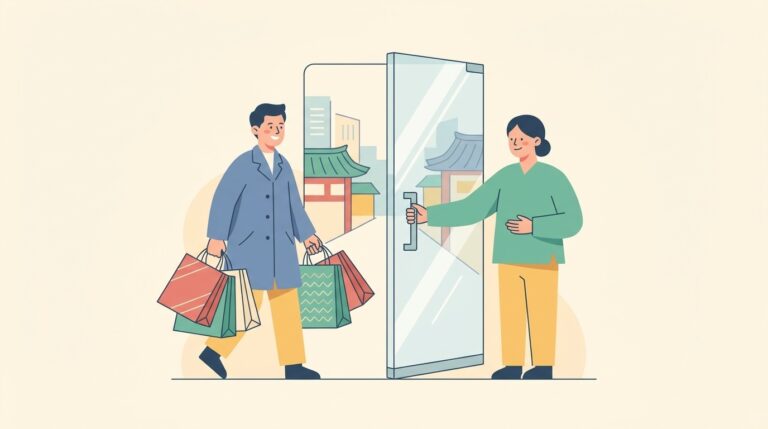
Picture this: You have just walked out of an Olive Young in Hongdae. Your hands are overflowing with shopping bags packed with skincare gems and snacks. You reach the heavy glass door of your guesthouse or apartment building, completely out of breath. Your digital key card is buried somewhere at the bottom of your canvas tote bag, and your fingers are numb. Just as you are about to set everything on the wet pavement, a resident walks toward the door from the inside.
Your eyes meet through the glass. You want to ask them to push the door open or hold it for a second, but your mind goes blank. Do you yell “Open”? That feels rude. Do you just bow repeatedly like a broken bobblehead? Over my past ten years guiding Korean language learners, this exact doorstep panic ranks among the most common, awkward moments beginners face.
Asking for a small favor in Korea—like holding or opening a door—does not require complex grammar. By mastering just a couple of natural phrases and pairing them with the right cultural gestures, you will transform an awkward freeze into a warm, heartwarming interaction. Let’s make sure you never get stuck behind a door in Korea again!
Phase 2: Top 3 Core Expressions Deep-Dive
1. 문 좀 열어주시겠어요? (Mun jom yeoreo-jusigesseoyo?)
- Pronunciation: [Mun jom yeo-reo-ju-si-get-seo-yo] (Think of ‘Mun’ like the English word ‘moon’, and ‘jom’ like ‘chom’ in ‘chomp’.)
- Meaning: Literal: Would you open the door a little for me? | Actual Nuance: “Could you please open the door for me?”
- K-Culture Moment: In office K-dramas like Misaeng, junior interns juggling trays of iced americanos say this softly as they approach conference room doors.
- Editor’s Insight: The secret hero of this sentence is the tiny word 좀 (jom). Literally meaning “a little”, it magically softens your request from a demand to a humble, polite appeal.
- Situation Spectrum: Casual (⚠️) / Semi-formal (✅) / Formal (✅)
- 🤔 Think About It: Why does Korean culture use minimizing words like “a little” (좀) when asking for help? What words do you use in your language to soften a request?
2. 문 좀 잡아주실 수 있으세요? (Mun jom jaba-jusil su isseuseyo?)
- Pronunciation: [Mun jom ja-ba-ju-sil su i-sseu-se-yo] (Sound analogy: ‘ja-ba’ sounds like ‘Java’, ‘su’ like ‘sue’.)
- Meaning: Literal: Can you hold the door for me? | Actual Nuance: “Could you please hold the door for a moment?”
- K-Culture Moment: Commonly heard when running toward an elevator in a bustling Seoul subway station or high-rise officetel.
- Editor’s Insight: 잡다 (japda) means “to hold” or “to catch”. When you see someone about to let a heavy swinging door shut, this phrase saves the day.
- Situation Spectrum: Casual (⚠️) / Semi-formal (✅) / Formal (✅)
- 🤔 Think About It: In English, we often say “Hold the door!” directly. Notice how Korean stacks honorific endings like
-시- (si)to show deep respect to complete strangers.
3. 문 좀 열어주세요! (Mun jom yeoreo-juseyo!)
- Pronunciation: [Mun jom yeo-reo-ju-se-yo] (Crisp and rhythmic: Mun / jom / yeo-reo / ju-se-yo)
- Meaning: Literal: Please open the door a little. | Actual Nuance: “Please open the door!”
- K-Culture Moment: A playful scene in a variety show where cast members are locked outside in a game and plead with the production crew inside.
- Editor’s Insight: This is the most direct polite form. It is shorter, making it perfect when your hands are slipping and you need fast assistance without sounding rude.
- Situation Spectrum: Casual (✅) / Semi-formal (✅) / Formal (⚠️)
- 🤔 Think About It: How does changing the ending from “-주시겠어요?” (asking capability) to “-주세요” (asking action) change the urgency?
Phase 3: Textbook Korean vs. Real-World Korean
Situation 1: Asking someone inside a residential lobby to let you in
- 📖 Textbook Korean: 문을 열어 주십시오. (Mun-eul yeoreo jusipsio.)
- 🗣️ Real-World Korean: 저기요, 죄송한데 문 좀 열어주시겠어요? (Jeogiyo, joesonghande mun jom yeoreojusigesseoyo?)
- 💡 Why is it different? Nobody speaks like a military manual in real life! Dropping the object particle -을 (eul) and adding 저기요 (Excuse me) plus 죄송한데 (Sorry to trouble you, but…) creates an approachable, polite cushion.
Situation 2: Catching an elevator that is closing
- 📖 Textbook Korean: 엘리베이터 문을 닫지 마십시오. (Ellibeiteo mun-eul datji masipsio.)
- 🗣️ Real-World Korean: 잠깐만요! 문 좀 잡아주세요! (Jamkkanmanyo! Mun jom jabajuseyo!)
- 💡 Why is it different? Real Korean prioritizes speed and rhythm during emergencies. “잠깐만요!” (Wait a second!) alerts everyone instantly while maintaining courtesy.
Phase 4: K-Culture Deep Dive & Non-Verbal Manners
4-1. Nunchi (눈치) & Body Language
When asking for a door favor in Korea, your body speaks before your mouth does:
* The Occupied Hands Cue: If your hands are full of bags, slightly tilt or raise one package so the person sees your dilemma. This triggers immediate 눈치 (nunchi)—their situational awareness to help.
* The Head Bow (목례 – Mongnye): Pair your request with a 15-degree nod of the head. Eye contact should be gentle, not an intense stare.
* The Post-Favor Bow: Once the door opens, say “감사합니다! (Gamsahamnida!)” with a crisp head nod. Never just walk through silently, even if they held the door without you asking!
4-2. Cultural Code Analysis: The Digital Lock & Door Culture
Korea is the undisputed capital of 도어락 (digital door locks). From shared officetel entryways (공동현관) to private homes, PIN pads and key fobs are everywhere. Because security is tight, Koreans are mindful about who enters behind them. If you look stranded outside a keypad-locked door, people might hesitate not because they are unkind, but because of safety etiquette. Introducing yourself gently with “저기요, 죄송한데…” reassures them instantly that you are simply an honest resident or traveler in need.
Phase 5: Real-Life Roleplay Scenario
Setting: A drizzly evening outside a modern officetel in Mapo-gu. Raindrops are sliding down the glass doors. You are holding two dripping convenience store bags, while Minjun, a friendly local in an oversized trench coat, stands inside near the sensor.
- You: 🎭 (Making eye contact through the glass with a slight apologetic nod)
저기요! 죄송한데 문 좀 열어주시겠어요?
(Jeogiyo! Joesonghande mun jom yeoreojusigesseoyo?)
“Excuse me! Sorry, but could you please open the door for me?” - Minjun: 🎭 (Noticing your bags and pressing the release button)
아, 네! 잠깐만요. 들어오세요!
(A, ne! Jamkkanmanyo. Deureo-oseyo!)
“Ah, yes! Just a moment. Please come in!” - You: 🎭 (Stepping through quickly so the cold air doesn’t rush in)
감사합니다! 손이 없어서 부탁드렸어요.
(Gamsahamnida! Soni eopseoseo butakdeuryeosseoyo.)
“Thank you so much! My hands were full, so I had to ask.” - Minjun: 🎭 (Smiling warmly and holding the door until you are fully clear)
비 많이 오는데 조심해서 올라가세요!
(Bi mani oneunde josimhaeseo ollagaseyo!)
“It’s raining heavily out there, take care heading up!” - You: 🎭 (Bowing head slightly with a bright smile)
네, 좋은 저녁 보내세요!
(Ne, joeun jeonyeok bonaeseyo!)
“Yes, have a wonderful evening!”
🔀 Interactive Choice Point: What if someone is entering right before you?
- Choice A: Speed-walk in silently right behind their back without saying a word.
- Feedback (Bad): ❌ Creepy! In apartment buildings, following someone closely inside without acknowledgment triggers security concerns.
- Choice B: Say: “저기요, 같이 좀 들어갈게요! 감사합니다!” (Excuse me, I’ll enter with you! Thank you!)
- Feedback (Best): ✅ Perfect! It announces your presence politely, relieves tension, and expresses gratitude.
- Choice C: Shout: “문 닫지 마!” (Don’t close the door!)
- Feedback (Risk): 🚫 Dangerous! That is 반말 (informal speech). Strangers will find this startling and disrespectful.
Phase 6: 10-Second Emotion Shadowing Drill
Practice reading these out loud at native speed using the breath markers (/):
[🥺 Desperately & Apologetically]
저기요… / 죄송한데 / 문 좀 열어주시겠어요?
(Jeogiyo… / joesonghande / mun jom yeoreojusigesseoyo?)-
[🏃 Hurriedly & Energetically]
잠깐만요! / 문 좀 / 잡아주실 수 있으세요?
(Jamkkanmanyo! / mun jom / jabajusil su isseuseyo?) -
[😊 Warmly & Deeply Grateful]
정말 감사합니다! / 복 받으실 거예요!
(Jeongmal gamsahamnida! / Bok badeusil geoyeyo! – Thank you so much! May you receive lots of blessings!)
Phase 7: K-Culture Mini Dictionary
- 도어락 (Doe-o-rak): Digital door lock. Found on 99% of residential doors across South Korea.
- 공동현관 (Gong-dong-hyeon-gwan): The main shared ground-floor entrance of an apartment or officetel.
- 배려 (Bae-ryeo): Consideration and thoughtfulness. Holding the door for people with strollers or parcels is a classic act of baeryeo.
- 저기요 (Jeo-gi-yo): “Excuse me” (literally: “over there”). The quintessential conversation starter when addressing someone whose name you don’t know.
Phase 8: Traveler’s Survival Kit
Survival TOP 3
- 문 좀 열어주세요 (Mun jom yeoreo-juseyo) – “Please open the door.”
Pro Tip: Keep your pitch rising slightly at the end to make it sound extra soft. - 먼저 들어가세요 (Meonjeo deureogaseyo) – “Please go in first.”
Pro Tip: Use this when you want to hold the door open for an elder or someone carrying luggage. - 감사합니다 (Gamsahamnida) – “Thank you.”
Pro Tip: Never forget to say this! Even a quick “감사합니다” leaves a great impression.
Editor’s Travel Note
When navigating Korean residential areas or Airbnbs, digital keypads sometimes require you to swipe your hand over the screen to wake up the digits before entering the code. If your battery runs out on a portable Wi-Fi egg or phone, you can search for nearby cafes using the Naver Map app for mobile navigation. Keep a screenshot of your accommodation address in both Hangul and English handy.
Phase 9: One Step Deeper (Reflection)
In Korean society, the boundary between public and private space is deeply influenced by the concept of 정 (Jeong – affection/bonding) and 공동체 의식 (communal consciousness). Because millions of Koreans live in high-density high-rises, everyday etiquette in elevators and entryways acts as social glue. When you ask for a favor using the softening word 좀, you acknowledge the small imposition and show respect for the other person’s personal space. Language in Korea is never just about exchanging data; it is an exercise in mutual comfort.
💬 Your Turn: Have you ever experienced an awkward door moment when traveling abroad? How would you handle it now using Korean?
Phase 10: FAQ & Common Mistakes
Q: Can I just say “오픈해 주세요 (Open-hae juseyo)”?
A: While Koreans use Konglish often, “오픈 (open)” is usually reserved for store openings (e.g., “가게 오픈”). For doors and windows, always stick to the native verb 열다 (yeolda): “열어주세요 (yeoreo-juseyo)”.
Q: What should I say if someone holds the door open for me?
A: A crisp “감사합니다! (Gamsahamnida!)” or “고맙습니다! (Gomapseumnida!)” along with a friendly nod of the head is the gold standard.
Q: Is it rude to ask an elderly person to open the door?
A: It is not rude if your hands are truly tied, but you should use the most polite form possible: “어르신, 죄송한데 문 좀 부탁드리겠습니다 (Eoreusin, joesonghande mun jom butakdeurigesseumnida)”. If you are physically able, it is better manners to rush ahead and open the door for them instead!
🚨 Common Mistakes Warning Board
- Mistake: Saying “문 열어 (Mun yeoreo)” to strangers.
Correction: That is intimate informal speech. Always add -주세요 or -주시겠어요?. - Mistake: Forgetting the magic word 좀 (jom).
Correction: Without 좀, “문 열어주세요” can sound like a direct demand. Always slip “좀” in the middle! - Mistake: Saying “실례합니다 (Sillyehamnida)” instead of “저기요 (Jeogiyo)”.
Correction: While textbooks teach 실례합니다, locals rarely use it to call someone’s attention on the street. Use “저기요, 죄송한데…” for natural street fluency.
Phase 11: Action Mission & Engagement
- 🥉 Bronze Mission (Solo Practice): Stand in front of a mirror with two books in your hands. Say “문 좀 열어주시겠어요?” three times with a gentle head nod.
- 🥈 Silver Mission (Social Share): Leave a comment below spelling out your favorite survival phrase from today’s guide without checking your notes!
- 🥇 Gold Mission (Real-Life Application): Next time you visit a Korean convenience store, cafe, or watch a live K-Drama, spot how doors and elevators are handled by locals.
- 🎮 K-Culture Mission: Watch an episode of an office drama like King the Land or Business Proposal. Listen closely to see if you catch someone saying “잠깐만요!” at an elevator.
Phase 12: Interactive Quiz Challenge
Test your knowledge with these three quick scenarios:
- Situational Judgment: You are carrying a heavy box. An apartment security guard is standing near the glass door. What is the best phrase to say?
- A) 야! 문 열어!
- B) 저기요, 죄송하지만 문 좀 열어주시겠어요?
- C) 문을 오픈하시오.
- Fill-in-the-Blank: Complete the magic polite cushion:
- “문 ______ 열어주세요.” (Hint: Sounds like ‘chomp’ without the ‘p’)
- True or False Cultural Check: In Korea, it is totally normal to walk through a door someone held for you without saying anything as long as you make eye contact.
- (True / False)
👉 Click here to reveal answers & explanations!
- Answer: B – Option A is rude informal speech, and Option C is an archaic theatrical command. Option B strikes the perfect balance of politeness and natural warmth.
- Answer: 좀 (jom) – Adding 좀 immediately softens requests in daily Korean conversation.
- Answer: False – Non-verbal silence can come across as cold or dismissive. Always offer a quick “감사합니다!” along with a slight head bow!







