

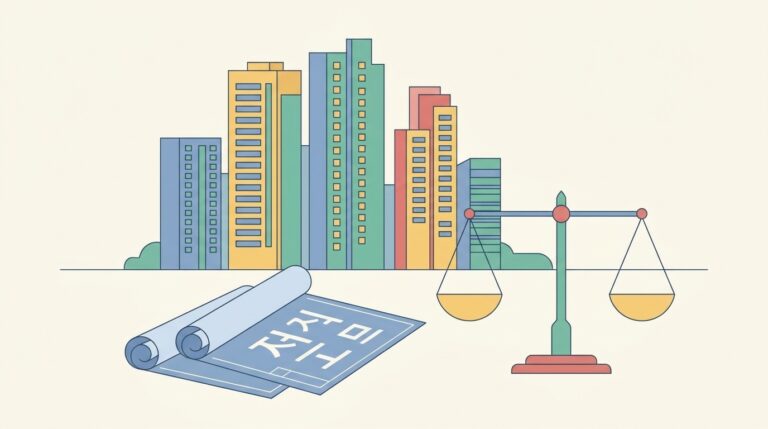
Phase 1: 공감 (Story-Immersive Opening)
안녕하세요! 매일한글 에디터입니다.
Imagine sitting in a warm, buzzing coffee shop near Gangnam Station on a Friday evening. Across from you sits Min-jun, a hardworking 34-year-old developer at a tech firm. He stares intently into his iced Americano, clutching a crumpled notification letter from the Korea Land and Housing Corporation (LH). Two years ago, he felt like he had conquered the world: he had won a slot in the government’s high-profile sajeon cheongyak (사전 청약, pre-subscription system) for a brand-new high-rise apartment in the 3rd New Town (3기 신도시). He celebrated with premium Korean barbecue and received envious congratulations from colleagues who called him a “winner in life.”
Fast forward to today: the official groundbreaking has not even begun, the scheduled date for the bon cheongyak (본 청약, main subscription) has been postponed indefinitely due to soaring raw material costs and archaeological discoveries on site, and market interest rates have doubled. Min-jun is stuck in limbo—unable to buy an existing home for fear of forfeiting his winner status, while watching his estimated acquisition price skyrocket.
For an advanced C2 learner, dissecting the labyrinth of Korean real estate policy is not merely an academic exercise. In South Korea, where the dream of “owning a home” (nae jip maryeon, 내 집 마련) constitutes the single largest benchmark of social maturation and wealth preservation, housing discussions dominate dinner tables, corporate watercoolers, and evening news cycles. Today, based on actual feedback from expatriate professionals navigating Korean corporate life, we bridge the gap between high-level institutional terminology and the raw socio-cultural reality behind the pre-subscription system.
Phase 2: 핵심 표현 3선 심층 분석 (Key Expressions In-Depth)
1. 사전 청약에 당첨되다 (Sajeon cheongyage dangcheomdoeda)
- Pronunciation: [사전 청약에 당첨되다] (Sah-jeon cheong-yah-ge dang-cheom-dwae-da) — sounds like “sah-jeon” (dictionary) blended with “cheong-yak” (petition) and “dang-cheom” (winning a lottery ticket).
- Meaning: Literal: To be selected in the pre-subscription lottery. | Real Nuance: Securing the provisional early-bird right to purchase public housing years before actual construction begins, often celebrated as winning a life-changing golden ticket.
- K-Culture Moment: In modern family dramas like Work Later, Drink Now or My Liberation Notes, when a character reveals they “사전 청약 당첨됐어” (I won a pre-subscription), the entire room gasps in disbelief and immediately asks about the location (입지) and estimated price (추정 분양가).
- Editor’s Insight: The word 당첨 (dangcheom) carries the visceral weight of winning a massive jackpot. Because public housing in Korea is strictly rationed based on points accrued from years of maintaining a subscription account, having dependents, and enduring decades without owning property, “winning” here implies both immense bureaucratic virtue and pure luck.
- Situation Spectrum: Casual ✅ | Semi-formal ✅ | Formal ✅
- 🤔 Think About It: In your home country, is homeownership distributed through a state-sanctioned point-and-lottery system, or is it strictly dictated by open-market capital?
2. 본 청약이 기약 없이 미뤄지다 (Bon cheongyagi giyak eopsi mirwojida)
- Pronunciation: [본 청약이 기약 업시 미뤄지다] (Bon cheong-yah-gi gi-yahk eop-shi mee-rwo-ji-da) — the phrase giyak eopsi rolls smoothly like “without a promised day.”
- Meaning: Literal: The main subscription is postponed without a definite promise. | Real Nuance: To be trapped in administrative purgatory as the finalized contract date is delayed indefinitely due to uncalculated land development bottlenecks.
- K-Culture Moment: Seen across socio-economic documentaries on KBS Sisa Jikgyeok where desperate young parents hold banners in front of municipal halls, exclaiming that their children will graduate elementary school before the promised apartment even lays its foundation.
- Editor’s Insight: Giyak eopda (기약 없다) is a classical, poignant phrase traditionally reserved for lovers separated by war or long journeys. Elevating it into urban real estate discourse highlights the existential dread felt by contract holders who cannot plan their life milestones, marriage, or schooling.
- Situation Spectrum: Casual ✅ | Semi-formal ✅ | Formal ✅
- 🤔 Think About It: How does linguistic usage shift when institutional delay is framed not merely as an administrative lag (yeon-gi), but as a tragic lack of promise (giyak eopsi)?
3. 희망고문에 시달리다 (Huimanggomune sidallida)
- Pronunciation: [희망고문에 시달리다] (Hee-mang-go-mu-ne shi-dal-li-da) — blends huimang (hope) and gomun (torture) with sidallida (to suffer/be plagued).
- Meaning: Literal: To suffer under torture disguised as hope. | Real Nuance: The grueling psychological exhaustion caused by false or dangling promises that keep someone from giving up or moving forward.
- K-Culture Moment: Frequently featured in business dramas like Misaeng or real estate satires where characters endure toxic corporate exploitation or housing delays because walking away means discarding years of invested patience.
- Editor’s Insight: While huimanggomun originated as colloquial pop-culture slang, it has become standard high-register socio-political commentary. Editorial columnists routinely describe the pre-subscription policy as “정부의 희망고문” (the government’s torture through false hope), because pre-winners cannot lease or buy other homes without losing their status.
- Situation Spectrum: Casual ✅ | Semi-formal ✅ | Formal ⚠️ (Preferred in speeches/columns rather than official civil contracts)
- 🤔 Think About It: Does your language have a compound concept pairing “hope” directly with physical or psychological “torture”?
Phase 3: 교과서 한국어 vs 진짜 한국어 (Textbook vs. Real Native Korean)
Situation 1: Describing an Unexpected Construction Delay
- 📖 교과서 한국어 (Textbook):
사전 청약 후 공사 일정이 지연되어 본 청약이 늦어지고 있습니다.
(Sajeon cheongyak hu gongsa iljeongi jiyeondoe-eo bon cheongyagi neujeojigo itseumnida.)
“After the pre-subscription, the construction schedule has been delayed, so the main subscription is late.” - 🗣️ 진짜 한국어 (Real Native C2):
본 청약이 무기한 연기되는 바람에 내 집 마련 계획이 완전히 꼬여버렸어요.
(Bon cheongyagi mugihan yeongidoeneun barame nae jip maryeon gyehoegi wanjeonhi kkoyo-beoryeosseoyo.)
“The main subscription was postponed indefinitely, leaving my homeownership timeline completely in knots.” - 💡 왜 다를까? (Why the difference?):
Native C2 speakers avoid sterile passive terms like jiyeondoe-eo (being delayed) in natural conversation. They utilize expressive dynamic idioms such as Gyehoegi kko-i-da (plans getting tangled/twisted) to convey immediate life disruption.
Situation 2: The Inability to Purchase Another House
- 📖 교과서 한국어 (Textbook):
청약 자격을 유지하기 위해 다른 주택을 구매하지 못하고 있습니다.
(Cheongyak jagyeogeul yujihagi wihae dareun jutaegeul gumahehaji mothago itseumnida.)
“In order to maintain subscription qualification, I cannot purchase another home.” - 🗣️ 진짜 한국어 (Real Native C2):
청약 당첨권 때문에 발이 묶여서 다른 집은 쳐다보지도 못하고 발만 동동 구르고 있어요.
(Cheongyak dangcheomgwon ttaemune bari mukkyeoseo dareun jibeun cheodabojido mothago balman dongdong gureugo isseoyo.)
“My hands are tied because of the pre-allotment status; I can’t even dare look at other houses and can only stomp my feet in frustration.” - 💡 왜 다를까? (Why the difference?):
Idiomatic expressions like bari mukkkida (feet tied / bound to an obligation) and baleul dongdong gureuda (stomping one’s feet anxiously) communicate emotional and financial vulnerability under administrative mandates.
Phase 4: K-Culture 딥다이브 & 비언어적 매너 (Deep Dive & Nuance)
4-1. 눈치 (Nunchi) & Somatic Politeness in Real Estate Conversations
When discussing real estate at work or social gatherings in Korea, extreme emotional calibration (nunchi) is mandatory:
* The Sincerity Sigh (공감의 한숨): If a colleague laments that their bon cheongyak has been delayed, never offer naive optimism like “Well, at least you have a ticket!” Instead, execute a subtle, low-frequency exhalation, tilt your head slightly at a 15-degree angle, and say: “아, 진짜 피가 마르시겠어요…” (You must be anxious to the core).
* Avoiding Capital Arrogance: Even if your own pre-subscription or apartment acquisition yielded substantial capital gains (sise chaik, 시세 차익), downplay it vigorously. Wave your hands dismissively and attribute it to debt: “다 은행 빚이에요. 속 빈 강정이죠.” (It’s all bank debt anyway; an empty gangjeong puff).
4-2. Cultural Code: The Double-Edged Sword of “내 집 마련” (Nae Jip Maryeon)
In contemporary Korean cinema and dramas (e.g., Crash Course in Romance, The Glory, and modern cinema), physical real estate operates as a surrogate for family security and moral worth. The sajeon cheongyak was instituted by the government as an “early psychological sedative” to cool down the panic buying (yeong-kkeul, 영끌) frenzy of younger generations. However, because the pre-subscription locks buyers into the “homeless” (mu-jutaek, 무주택) status for eligibility, any multi-year delay prevents them from building family wealth or moving geographically, turning an architectural dream into a domestic prison.
Phase 5: 실전 롤플레이 시나리오 (Real-Life Roleplay Scenario)
Setting: A quiet lounge at a corporate office in Pangyo.
Characters:
* Min-su (Senior Team Lead): A pragmatic senior colleague who experienced the 2008 financial cycle and applied for pre-subscriptions in the past.
* Alex (You – Advanced Professional): A high-ranking expat director planning permanent settlement in Korea, caught up in the 3rd New Town pre-subscription delays.
Turn 1
민수: 알렉스 님, 요새 안색이 안 좋아 보이시는데 무슨 고민 있으세요?
(Alex-nim, yosae ansaegi an jo-a boisineunde museun gomin isseuseyo?)
“Alex, you look a bit worn out these days. Is something weighing on your mind?”
🎭 행동 지문: 민수가 서류를 정리하며 조심스럽게 건네받은 커피잔을 내려놓는다.
Turn 2
알렉스: 지난번에 말씀드렸던 사전 청약 단지 본 청약 일정이 또 밀렸거든요.
(Jinanbeone malsseumdeuryeotdeon sajeon cheongyak danji bon cheongyak iljeongi tto millyeotgeodeunyo.)
“The main subscription schedule for that pre-subscription complex I mentioned last time got delayed yet again.”
🎭 행동 지문: 스마트폰 화면에 뜬 LH 안내 공문 문자를 보여주며 미간을 찌푸린다.
Turn 3
민수: 아이고… 벌써 두 번째 연기 아니에요? 입주 시기까지 늦어지면 전세 계약도 애매해질 텐데요.
(Aigo… beolsseo du beonjjae yeongi anieyo? Ippju sigikkaji neujeojimyeon jeonse gyeyakdo aemaehaejil tendeyo.)
“Oh no… isn’t this the second postponement already? If move-in is pushed back, your Jeonse renewal will become a nightmare.”
🎭 행동 지문: 턱을 괴고 진심으로 안타까워하며 고개를 절레절레 흔든다.
Turn 4
알렉스: 맞아요. 게다가 공사비 인상 때문에 확정 분양가가 1억 원 가까이 뛸 거라네요. 완전 희망고문이에요.
(Majayo. Gedaga gongsabi insang ttaemune hwakjeong bunyanggaga ireok won gakkai ttwil georaneyo. Wanjeon huimanggomunieyo.)
“Exactly. On top of that, rising construction costs mean the final sale price might jump by nearly 100 million KRW. It’s absolute psychological torture.”
🎭 행동 지문: 깊은 한숨을 내쉬며 고개를 숙인다.
Turn 5
민수: 본 청약 지연으로 사업이 엎어지는 경우도 종종 있어서, 마냥 손 놓고 계시면 안 됩니다.
(Bon cheongyak jiyeoneuro sa-eobi eopeojineun gyeong-udo jongjong isseoseo, manyang son nokko gyesimyeon an doemnida.)
“There are cases where projects fall through entirely due to delayed subscriptions. You shouldn’t just sit on your hands.”
🎭 행동 지문: 알렉스의 어깨를 가볍게 두드리며 목소리를 낮춘다.
Turn 6
알렉스: 차라리 당첨을 포기하고 기존 아파트 매매로 돌아설지 심각하게 고민 중입니다.
(Charari dangcheomeul pogihago gijon apateu maemaero doraseolji simgakhage gomin jung-imnida.)
“I’m seriously contemplating forfeiting my allotment and pivoting to buying an existing resale apartment instead.”
🎭 행동 지문: 다이어리에 적어둔 인근 단지 시세 메모를 펼치며 진지하게 응시한다.
Turn 7
민수: 지금 포기하면 청약 통장 부활 여부랑 페널티 규정을 꼼꼼하게 따져보셔야 해요. 법률 상담 한번 받아보셨어요?
(Jigeum pogihamyeon cheongyak tongjang buhwal yeoburang peneolti gyujeongeul kkomkkomhage ttajyeobosyeoya haeyo. Beobryul sangdam hanbeon badabosyeosseoyo?)
“If you forfeit now, you must double-check penalty regulations and whether your subscription savings account can be restored. Have you sought legal advice?”
🎭 행동 지문: 안경을 고쳐 쓰며 명함 지갑을 매만진다.
Turn 8
알렉스: 네, 내일 부동산 전문 행정사랑 면담 잡았습니다. 더 이상 질질 끌려다닐 순 없으니까요.
(Ne, naeil budongsan jeonmun haengjeongsaran myeondam jabasseumnida. Deo isang jiljil kkeullyeodanil sun eopseunikkayo.)
“Yes, I booked an appointment with a real estate legal consultant tomorrow. I can’t let them drag me around anymore.”
🎭 행동 지문: 단호하게 메모장을 덮으며 결연한 표정을 짓는다.
🔀 인터랙티브 분기점 (Interactive Choice)
At Turn 6, instead of considering forfeiture, what would you say to Min-su to preserve maximum flexibility?
- Option A: “그냥 정부만 믿고 5년이든 10년이든 버텨보려고요.” (I plan to just trust the government and hold out for 5 or 10 years.)
- Option B: “공공분양 취소 가능성과 분양가 상한제 변동 폭을 분석해서 플랜 B를 세워야겠어요.” (I need to establish a Plan B by analyzing the probability of public cancellation and variations in the price cap system.)
- Option C: “담당 공무원 찾아가서 당장 착공 안 하면 고소하겠다고 따지려고요.” (I will march to the municipal office and threaten to sue the civil servants if they don’t break ground immediately.)
Feedback:
* Choice A (Risk): Too passive. In Korean policy shifts, passive long-term waiting often results in severe opportunity costs and inflated purchase prices.
* Choice B (Best): Superb C2-level strategic judgment. It balances institutional acumen with realistic risk hedging.
* Choice C (Bad): Socio-culturally inappropriate. Threatening lawsuits over statutory pre-subscription lags reveals a fundamental misunderstanding of Korean administrative law.
Phase 6: 10초 감정 섀도잉 드릴 (10-Second Shadowing Drill)
Practice reading these cadence-marked sentences with authentic emotion and natural pausing (/).
- [😮💨 답답하고 피폐해진 감정으로]
사전 청약에 당첨됐다고 좋아했는데, / 본 청약이 기약 없이 미뤄지니까 / 피가 바짝바짝 마르네요.
(Sajeon cheongyage dangcheomdwaetdago joahaenneunde, / bon cheongyagi giyak eopsi mirwojinikka / piga batchak-batchak mareuneyo.)
“I rejoiced when I won the pre-subscription, / but since the main subscription has been postponed indefinitely, / my soul is turning completely dry with anxiety.” -
[🧐 냉철하고 이성적인 비판 톤으로]
분양가 상한제가 적용된다 해도 / 공사비 상승분을 사전 당첨자에게 떠넘기는 건 / 명백한 제도적 허점입니다.
(Bunyangga sanghanjega jeok-yongdoenda haedo / gongsabi sangseungbuneul sajeon dangcheomja-ege tteoneomgineun geon / myeongbaekhan jedojeok heojeom-imnida.)
“Even if a price ceiling is applied, / shifting the burden of soaring construction costs onto early winners / is an undeniable systemic loophole.”
Phase 7: K-Culture 미니 사전 (Mini Dictionary)
-
분양가상한제 (Bunyanggag-sanghanje) [Price Ceiling System]
Meaning & Usage: A regulatory mandate capping the sale price of newly constructed public/private apartments to prevent speculative spikes. Crucial in evaluating whether a delayed project will remain affordable upon main subscription. -
무주택자 (Mu-jutaekja) [Non-Homeowner Status / Homeless by Registry]
Meaning & Usage: An individual or household registered without residential property ownership. Retaining this civil status is the indispensable prerequisite for maintaining public subscription eligibility. -
지체상금 (Jiche-sanggeum) [Liquidated Delay Damages]
Meaning & Usage: Contractual penalty compensations owed to prospective buyers when a contractor fails to deliver completion on the agreed calendar date. Often hotly disputed in delayed pre-subscription zones. -
영끌족 (Yeong-kkeul-jok) [Panic-Buyers / “Soul-Borrowers”]
Meaning & Usage: A socio-economic portmanteau (Yeong-hon-kkaji Kkeuleomo-eun) describing young urbanites who accumulated the absolute maximum debt to buy real estate before prices became permanently unattainable.
Phase 8: 여행자 & 체류자를 위한 생존 키트 (Survival Kit)
Practical Housing Consultation Survival Expressions
-
“추정 분양가와 확정 분양가 사이에 차이가 얼마나 발생하나요?”
(Chujeong bunyanggawa hwakjeong bunyangga sa-ie cha-iga eolmana balsaenghanayo?)
Pro Tip: Use this when speaking with LH or SH housing officers to clarify the financial deviation between provisional and finalized unit prices. -
“본 청약 취소 시 청약 통장 효력이 그대로 인정됩니까?”
(Bon cheongyak chwiso si cheongyak tongjang hyoryeogi geudaero injeongdoemnikka?)
Pro Tip: Crucial for safeguarding your accumulated points before walking away from an indefinitely stalled public development. -
“입주 예정일 지연에 따른 보상 규정이 공문에 명시되어 있나요?”
(Ipju yejeong-il jiyeone ttareun bosang gyujeongi gongmune myeongsi-doeeo innayo?)
Pro Tip: High-level bureaucratic question for official written consultations that demands institutional accountability.
Editor’s Travel & Living Note
If you plan to rent, lease, or evaluate residential prospects in Korea, do not rely on standard travel search engines. Install and explore the official real estate apps:
* Monitor official notifications and lottery schedules directly via the 청약홈 앱 다운로드 (Cheongyak Home Official App).
* Track neighborhood price fluctuations, transaction volumes, and school districts using 네이버 부동산 바로가기.
Phase 9: “한 발 더 깊이” (Deep Reflection)
In South Korea, apartment ownership transcends shelter; it embodies one’s civic report card, pension security, and familial fortress. The introduction and subsequent friction surrounding the pre-subscription system demonstrate how administrative paternalism often clashes with turbulent global economic realities. When individuals mortgage their 30s as non-homeowners waiting for a promised state apartment, a multi-year delay is not merely a schedule adjustment—it alters their family planning, life trajectories, and faith in the social compact.
💬 Your Turn: How does your home society balance the government’s desire to cool speculative buying against the real-life unpredictability of commercial construction projects? Share your insights in the comments!
Phase 10: FAQ & 오해 방지 (FAQ & Misconceptions)
Q: Can foreign nationals apply for South Korea’s public pre-subscriptions?
A: In general public housing distributions (gong-gong bun-yang), applicants must be Korean nationals head-of-household (se-dae-ju). However, foreign residents holding permanent residency (F-5) or specific long-term corporate visas may qualify for private subscriptions (min-gan bun-yang) depending on municipality point regulations.
Q: What happens if a pre-subscription winner decides to give up their allotment?
A: While forfeiting a public pre-subscription generally allows the applicant to retain their core savings account (cheongyak tongjang), they are frequently barred from applying to any other pre-subscription programs for a statutory cooling period (often 6 months to 1 year).
Q: Why do construction costs rise between pre-subscription and main subscription?
A: The pre-subscription reveals an estimated price (chujeong bunyangga). The main subscription formalizes the contract based on actual construction procurement costs. If global steel, cement, or labor expenses surge during the intervening years, the finalized price (hwakjeong bunyangga) will rise significantly.
🚨 Common Mistakes Warning Board
- Mistake: Assuming that winning a pre-subscription guarantees an unalterable price.
Correct Action: Always budget a 15–20% financial contingency cushion above the chujeong bunyangga. - Mistake: Purchasing a small studio condo (officetel) while waiting for the main subscription.
Correct Action: Verify housing registry laws; purchasing certain properties invalidates your strict non-homeowner (mu-jutaek) status immediately. - Mistake: Confusing pre-subscription (sajeon cheongyak) with early contract signing (gagyeyak).
Correct Action: Sajeon cheongyak is a formal government allotment mechanism, whereas gagyeyak is an informal private deposit customary in standard private real estate transactions.
Phase 11: 액션 미션 & 참여 유도 (Action Missions)
- Bronze Mission (Self-Practice): Record your voice reading Shadowing Drill #2 with an articulate, assertive analytical intonation.
- Silver Mission (Social Engagement): Summarize the difference between chujeong bunyangga and hwakjeong bunyangga in 2 sentences on your Korean study journal or Instagram story, tagging
#DailyHangul. - Gold Mission (Real-World Fluency): Visit 네이버 부동산 바로가기, select an area designated as a 3rd New Town (e.g., Gyeyang, Wangsuk, or Changneung), and identify the scheduled main subscription dates.
🎮 K-Culture Mission: Watch an episode of a Korean investigative journalism program (such as SBS Curious Story Y or MBC PD Notebook) dealing with urban housing issues. Listen for the terms 기약 없는 연기, 희망고문, and 분양가 인상.
Phase 12: 인터랙티브 퀴즈 챌린지 (Interactive Quiz)
1. Situational Judgment:
Your acquaintance has been waiting 3 years for their public apartment main subscription, which was just delayed by another 18 months. Which expression offers the most natural, empathetic C2 response?
* (A) “축하해요! 이제 곧 집이 생기겠네요!”
* (B) “본 청약이 또 밀리다니, 마냥 희망고문에 시달리는 기분이시겠어요.”
* (C) “공사비가 오르면 건설사에게 무조건 소송을 거세요.”
2. Fill-in-the-Blank:
사전 청약 당시 고지되었던 ( ________ )보다 실제 본 청약 시점의 확정 분양가가 크게 올라 당첨자들의 반발을 사고 있다.
(Fill in the term meaning ‘estimated sale price’.)
3. True or False:
Pre-subscription winners are permitted to purchase any secondary residential property while awaiting the main subscription without losing their winner status.
정답 및 해설 보기 (Click to Reveal Answers & Explanations)
-
정답: (B)
Explanation: Option (A) is completely tone-deaf to the distress of delay. Option (C) is legally naive. Option (B) demonstrates advanced empathy utilizing the cultural concept of huimanggomun. -
정답: 추정 분양가 (Chujeong bunyangga)
Explanation: The provisional price announced during the preliminary stage is the 추정 분양가, contrasted with the finalized 확정 분양가. -
정답: False
Explanation: If a pre-subscription winner purchases a residential property, they forfeit their mu-jutaek (non-homeowner) status and their pre-allotment is immediately cancelled.







