

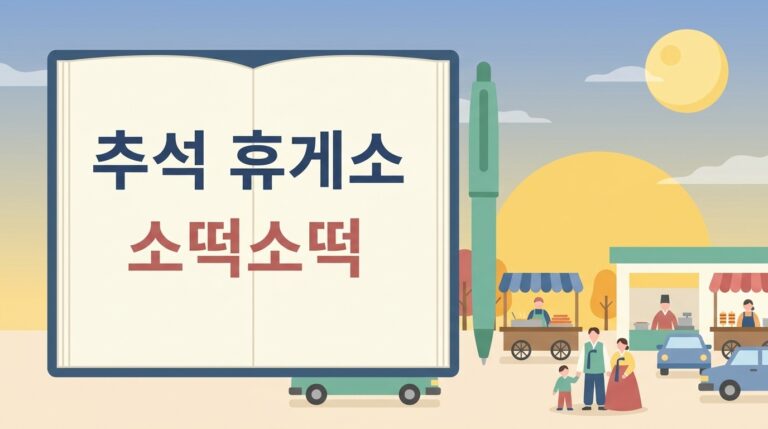
Surviving the Holiday Rush: Master Korea’s Toll Waivers and Rest Stop Food
Phase 1: Empathy (Story-Immersive Opening)
안녕하세요! 매일한글 에디터입니다. If you have ever experienced Chuseok (추석) or Seollal (설날) in South Korea, you already know the awe-inspiring, spine-chilling cultural phenomenon known as Minjok Daedongwon (민족대동원, the Great National Migration). Picture this: you are packed into a car with friends or in-laws on the Gyeongbu Expressway, staring at a crimson sea of taillights that extends past the horizon. It has taken four hours just to cover thirty kilometers. Your stomach is rumbling, your coffee has gone lukewarm, and ahead lies a toll gate.
Here is where modern Korean holiday magic takes over. Instead of scrambling for credit cards or transit passes, you glide straight through because of the government’s nationwide holiday toll exemption policy. Even better? Just two kilometers ahead looms an illuminated sanctuary: the Korean Expressway Rest Area (고속도로 휴게소). Far from the greasy, desolate roadside gas stations found elsewhere, Korean rest stops are multi-story gastronomic theme parks where gourmet regional delicacies, sizzling street food, and frantic holiday travelers collide in a symphony of organized chaos.
Navigating this high-stakes highway ritual requires more than basic conversational skills; it demands native-level cultural intuition, sharp highway etiquette, and the vocabulary to claim your sizzling sotteok-sotteok before the stall sells out. Backed by real feedback from our advanced learners and international professionals living in Seoul, this guide will equip you with high-register C2 Korean expressions and insider survival strategies to conquer the holiday road trip like an authentic local.
Phase 2: Core Expression Deep-Dive
1. 명절 통행료 면제 (Myeongjeol tonghaengnyo myeonje)
- Pronunciation: [Myeong-jeol tong-haeng-nyo myeon-je] (Think: Myung-jol + Tong-hang-nyo like a resonant bell + Myun-jeh rhymes with ‘buffet’)
- Meaning: Literal: “Holiday toll fee exemption” | Actual Nuance: The temporary government decree waiving expressway tolls across South Korea during major holiday periods (Seollal and Chuseok), signaling both financial relief and the official start of holiday traffic jams.
- K-Culture Moment: Seen every holiday season across KBS, SBS, and JTBC news tickers: “설 연휴 고속도로 통행료 전면 면제” (Full expressway toll exemption during Seollal holiday), followed by aerial footage of packed expressways.
- Editor’s Insight: At a C2 level, note the legalistic Sino-Korean terminology: 면제 (免除, exemption). Rather than using conversational phrases like “돈 안 내요” (we don’t pay), native speakers and media strictly utilize 통행료 면제. Note that this applies whether you pass through the blue Hi-Pass (하이패스) lane or the regular cash booth!
- Situation Spectrum:
- Casual: ⚠️ (Sounds overly formal in pure slang; say 통행료 공짜 instead)
- Semi-formal: ✅
- Formal: ✅
- 🤔 Think About It: Does your home country ever lift public infrastructure tariffs for major cultural events, or is public transit strictly commercialized?
2. 휴게소 도장 깨기 (Hyugeso dojang kkaegi)
- Pronunciation: [Hyu-ge-so do-jang kkae-gi] (Think: Hyu-geh-so + Doh-jahng + Kkay-gee like cracking an egg)
- Meaning: Literal: “Rest stop dojo-breaking” | Actual Nuance: Systematically hitting several highway rest stops along a route to conquer and taste the signature regional dish of each location.
- K-Culture Moment: Born out of martial arts films where a fighter travels to rival schools to defeat their masters (“breaking the dojo”), this phrase went viral on variety shows like MBC’s Omniscient Interfering View (전지적 참견 시점) when comedian Lee Young-ja curated her legendary expressway gourmet map.
- Editor’s Insight: 도장 깨기 conveys a determined, recreational mission. If you tell your Korean companions, “오늘 부산 가는 길에 휴게소 도장 깨기 한번 제대로 해보자!”, you establish instant camaraderie and cultural fluency.
- Situation Spectrum:
- Casual: ✅
- Semi-formal: ✅
- Formal: 🚫 (Avoid in boardroom business settings; use 휴게소 특화 매장 탐방 instead)
- 🤔 Think About It: How does humorously applying martial arts metaphors to food hunting reflect Korea’s fast-paced, goal-oriented recreational culture?
3. 귀성길 정체를 뚫고 (Gwiseong-gil jeongche-reul ttulko)
- Pronunciation: [Gwi-seong-gil jeong-che-reul ttul-ko] (Think: Gwee-sung-gil + Jung-cheh-reul + Ttull-koh with an explosive, aspirated ‘k’)
- Meaning: Literal: “Piercing through the hometown-bound congestion” | Actual Nuance: Victoriously overcoming the notorious hours-long highway bottlenecks during the traditional homeward migration.
- K-Culture Moment: Standard dramatic opening line delivered by exhausted but proud drivers on holiday vlog content or family group chats upon safely arriving at their ancestral home (큰집).
- Editor’s Insight: Distinguish between 귀성길 (journey down to the hometown) and 귀경길 (journey back up to the capital/city). Pairing this with the dynamic verb 뚫다 (to pierce/break through) illustrates sheer willpower against unrelenting gridlock.
- Situation Spectrum:
- Casual: ✅
- Semi-formal: ✅
- Formal: ✅
- 🤔 Think About It: Why does Korean language maintain distinct lexical pairs for moving away from versus returning to the capital during holidays?
Phase 3: Textbook Korean vs. Real Korean
Scenario 1: Passing the expressway tollgate during Chuseok
- 📖 교과서 한국어 (Textbook Korean):
- “이번 명절 연휴 기간에는 고속도로 통행료를 지불하지 않아도 됩니다.” (Ibeon myeongjeol yeonhyu giganneneun gosokdoro tonghaengnyoreul jibullhaji anado doemnida.) — During this holiday period, you do not have to pay the highway toll fee.
- 🗣️ 진짜 한국어 (Real Native Korean):
- “이번 연휴는 통행료 면제라 그냥 하이패스든 일반 차로든 멈추지 말고 지나가면 돼.” (Ibeon yeonhyuneun tonghaengnyo myeonjera geunyang ha-i-paeseudeun ilban charodeun meomchuji malgo jinagamyeon dwae.) — Tolls are waived this break, so whether it is Hi-Pass or the regular lane, just roll right through without stopping.
- 💡 왜 다를까? (Cultural/Linguistic Context):
- While textbooks use clinical textbook verbs like 지불하다, natives focus on driving flow and lane choice (하이패스든 일반 차로든), emphasizing safety and speed.
Scenario 2: Selecting snacks at a crowded rest area
- 📖 교과서 한국어 (Textbook Korean):
- “이 휴게소에서 가장 유명한 간식을 주문해서 먹어봅시다.” (I hyugesoeseo gajang yumyeonghan gansigeul jumunhaeseo meogeobopsida.) — Let us order and eat the most famous snack at this rest stop.
- 🗣️ 진짜 한국어 (Real Native Korean):
- “여기선 이영자 추천 소떡소떡이랑 갓 구운 호두과자가 국룰인 거 알지? 키오스크로 후딱 주문하고 올게!” (Yeogiseon I Yeong-ja chucheon sotteok-sotteok-irang gat guun hodu-gwajaga gungnurin geo alji? Kioskeuro huttak jumunhago olge!) — You know Lee Young-ja’s sotteok-sotteok and freshly baked walnut cakes are the unwritten law here, right? I will dash over to the kiosk and order quick!
- 💡 왜 다를까? (Cultural/Linguistic Context):
- Modern natives use cultural touchstones like 이영자 픽 (Lee Young-ja’s pick) and the socio-cultural slang 국룰 (Gungnul: “national rule” / universally acknowledged standard) to express consensus enthusiasm.
Phase 4: K-Culture Deep-Dive & Non-Verbal Manners
4-1. 눈치 (Nunchi) & Highway Rest Area Protocol
When pull into a highway service area during a holiday rush, survival requires razor-sharp nunchi (social spatial awareness):
* The Hazard Lights Truce (비상깜빡이): Parking spaces are intensely contested. When you spot a reversing vehicle, immediately turn on your hazard lights (비상등) to claim the spot from three cars back. Failing to do so causes immediate vehicular friction.
* The Two-Pronged Food Strike: Do not look for a table after buying food. One person must stand strategically near diners finishing their last spoonful of gukbap (국밥), giving a polite, anticipatory gaze, while the other runs to the self-order kiosk.
* Return Tray Etiquette (퇴식구): Always separate wooden chopsticks, napkins, and liquid residue into distinct disposal bins at the return window (퇴식구). Leaving a messy tray during the holiday rush attracts disapproving stares from staff and fellow travelers.
4-2. Cultural Code: The Gourmet Evolution of the “Hyugeso”
Traditionally, rest areas were functional utilitarian pit stops for fuel and restrooms. However, Korea’s expressway network—managed primarily by Korea Expressway Corporation—has transformed them into competitive gastronomic havens. Each rest area boasts regional specialties using local agriculture: Deokpyeong Rest Area is renowned for its beef and radish soup (소고기국밥), Hoengseong Rest Area serves Hanwoo beef steak skewers, and Geumgang Rest Area offers panoramic riverside views alongside freshwater fish soup (도리뱅뱅이). This transition reflects the Korean philosophy that the journey itself is an extension of culinary celebration rather than merely dead travel time.
Phase 5: Real-World Roleplay Scenario
Setting: It is 2:00 PM on the day before Chuseok. You are riding shotgun in your Korean colleague Min-woo’s sedan on the Yeongdong Expressway, crawling at 15 km/h. Hunger is setting in as the green highway sign for Deokpyeong Eco-Service Area approaches.
- 민우 (Min-woo): “벌써 세 시간째 기어가는 중이네. 슬슬 허리도 쑤시고 배도 고픈데, 다음 휴게소 들렀다 갈까?”
(Beolsseo se siganjjae gieoganeun jung-ine. Seulseul heorido ssusigo baedo gopeunde, daeum hyugeso deulleotda galkka?)
🎭 Tapping the steering wheel with a weary sigh while glancing at the road signs.
“We’ve been crawling for three hours already. My back’s getting stiff and I’m starving—shall we drop by the next rest stop?” -
나 (You): “완전 찬성이에요! 마침 저기 덕평 휴게소 표지판 보이는데, 거기가 소고기국밥 맛집으로 소문난 곳이잖아요.”
(Wanjeon chanseong-ieyo! Machim jeogi Deokpyeong hyugeso pyojipan boineunde, geogiga sogogi-gukbap matjipeuro somunnan gosi-janayo.)
🎭 Checking your smartphone navigation and pointing toward the exit ramp excitedly.
“Count me in! I just saw the sign for Deokpyeong Rest Stop—that’s the famous spot known for its beef radish soup, right?” -
민우 (Min-woo): “오, 고급 정보까지 꿰고 있네! 근데 명절이라 톨게이트 빠져나갈 때 요금 정산하느라 줄 길게 늘어서진 않겠지?”
(O, gogeup jeongbokkaji kkwego inne! Geunde myeongjeorira tolge-iteu ppajyeonagal ttae yogeum jeongsanhaneura jul gilge neureoseojin anketji?)
🎭 Looking slightly concerned at the merging lanes near the toll booth.
“Oh, look at you with the insider intel! But with the holiday traffic, won’t there be a huge bottleneck at the toll plaza to settle fees?” -
나 (You): “걱정 마세요. 이번 연휴 내내 고속도로 통행료 면제라 하이패스 단말기 없어도 그냥 서행 통과하면 돼요.”
(Geokjeong maseyo. Ibeon yeonhyu naenae gosokdoro tonghaengnyo myeonjera ha-i-paeseu danmalgi eopseodo geunyang seohaeng tonggwahamyeon dwaeyo.)
🎭 Speaking reassuringly with a confident smile.
“No worries at all. Tolls are waived throughout this holiday break, so even without a Hi-Pass terminal, we can just roll through slowly.” -
민우 (Min-woo): “나이스! 그럼 내가 비상깜빡이 켜고 어떻게든 주차 자리 잡아볼 테니까, 자네가 먼저 내려서 자리 선점할래?”
(Na-iseu! Geureom naega bisang-kkambbaegi kyeogo eotteokedeun jucha jari jababol tenikka, jane-ga meonjeo naeryeoseo jari seonjeomhallae?)
🎭 Flicking on the hazard lights and craning his neck toward the crowded parking rows.
“Nice! Then I’ll throw on the hazard lights and hunt down a parking space somehow—could you jump out first and scout a table?” -
나 (You): “맡겨만 주세요! 푸드코트 안쪽에 자리 잡고, 키오스크로 국밥이랑 소떡소떡 먼저 발권해 둘게요.”
(Matgyeoman juseyo! Pudeukoteu anjjoge jari japgo, kioskeuro gukbap-irang sotteok-sotteok meonjeo balgwonhae dulgeyo.)
🎭 Unbuckling seatbelt smoothly, preparing to disembark as the car halts safely.
“Leave it to me! I’ll secure a spot inside the food court and punch in orders for the soup and sotteok-sotteok at the kiosk.” -
민우 (Min-woo): “센스 최고다 진짜! 식후 디저트로 갓 튀긴 델리만주랑 호두과자 들어갈 배는 남겨둬야 하는 거 알지?”
(Senseu choegoda jinjja! Sikhu dijeoteuro gat twigin dellimanju-rang hodu-gwaja deureogal baeneun namgyeodwoya haneun geo alji?)
🎭 Chuckling, parking cleanly within the painted lines.
“Your situational sense is unmatched! You know we have to save room for freshly baked Deli-manjoo and walnut cakes for dessert, right?” -
나 (You): “당연하죠! 귀성길 정체를 뚫으려면 그 정도 당 충전은 필수적인 생존 전략이니까요.”
(Dang-yeonhajyo! Gwiseong-gil jeongche-reul ttulleomyeon geu jeongdo dang chungjeoneun pilsujeogin saengjon jeollyang-inikkayo.)
🎭 Nodding resolutely while closing the car door smoothly.
“Naturally! When fighting through holiday homecoming traffic, that level of sugar replenishment is an absolute survival strategy.”
🔀 Interactive Choice Point
You step inside the packed food court. All tables are full, and several people are hovering. How do you handle the situation?
- Option A (The Direct Confrontation): Approach a seated family who are halfway through their meal and ask bluntly: “다 드셨으면 비켜주실 수 있나요?” (Could you leave if you are finished?)
- Outcome (Bad): Extremely rude (무례함). Breaks social harmony; the family will feel pressured and offended. Rest stop tables are open territory, but overt hovering or demanding causes confrontation.
- Option B (The Nunchi Anticipation – BEST): Identify an elderly couple putting their spoons down and stacking napkins. Stand a respectful two paces away, make brief, pleasant eye contact, and politely say: “혹시 식사 다 끝나셨을까요?” (Might you be finishing up your meal?)
- Outcome (Best): Demonstrates immaculate manners and spatial awareness. The diners will almost always nod warmly, wipe the table with a tissue, and hand the spot over graciously.
- Option C (The Territorial Claim): Drop your designer bag on an empty table while the current occupant is walking to get water, then yell across the room to Min-woo.
- Outcome (Risk): While reserving tables with bags is common in Korea due to high public safety, taking a table while someone is temporarily fetching water or napkins will lead to severe embarrassment and heated arguments.
Phase 6: 10-Second Emotion Shadowing Drill
Train your intonation and rhythm. The / marks a micro-pause where you regroup breath and pitch.
[🚗 안도하며 안심시키는 톤 - Relieved and Reassuring]
“이번 연휴는 / 통행료 전면 면제니까 / 요금소에서 멈추지 말고 / 그냥 서행 통과하세요.”
(Ibeon yeonhyuneun / tonghaengnyo jeonmyeon myeonjenikka / yogeumso-eseo meomchuji malgo / geunyang seohaeng tonggwahaseyo.)-
[🤤 군침을 삼키며 흥분된 목소리 - Mouth-watering and Excited]
“소떡소떡은 / 소시지랑 떡을 / 한 번에 같이 베어 물어야 / 진정한 맛을 느낄 수 있어요!”
(Sotteok-sotteok-eun / sosijirang tteog-eul / han beone gachi beeo mureoya / jinjeonghan maseul neukkil su isseoyo!) -
[😤 정체 도로 속 비장하고 결연한 태도 - Determined and Resolute]
“아무리 귀성길 정체가 심해도 / 휴게소 도장 깨기만 성공하면 / 버틸 수 있습니다.”
(Amuri gwiseong-gil jeongchega simhaedo / hyugeso dojang kkaegiman seonggonghamyeon / beotil su itseumnida.)
Phase 7: K-Culture Mini Dictionary
- 귀성길 vs. 귀경길 (Gwiseong-gil vs. Gwigyeong-gil)
- Meaning: Hometown-bound route vs. Capital-return route.
- Usage: Essential for understanding highway traffic reports. 귀성 denotes traveling from major metropolitan hubs to ancestral provinces before holidays; 귀경 designates the mass return traffic heading back into Seoul and Gyeonggi province at the conclusion of the break.
- 하이패스 (Hi-pass / Ha-i-paeseu)
- Meaning: South Korea’s electronic toll collection system.
- Usage: Blue-painted pavement lanes indicating automatic sensor toll gates. Even during holiday waiver periods, drivers should maintain their respective lane (blue for Hi-Pass vehicles, non-colored for regular cash lanes) to avoid sudden, dangerous lane-cutting maneuvers.
- 호두과자 (Hodu-gwaja)
- Meaning: Walnut-shaped cakes filled with sweet red bean paste and walnut chunks.
- Usage: Originating from the city of Cheonan, this is the undisputed king of Korean highway snacks. Asking “호두과자 따끈따끈한 걸로 한 봉지 살까?” (Shall we grab a piping hot bag of walnut cakes?) is a quintessential road-trip initiation.
- 갓길 운행 (Gatgil unhaeng)
- Meaning: Driving on the highway shoulder lane.
- Usage: Highly regulated. Driving on the shoulder is strictly illegal unless automated digital overhead LED displays indicate that the shoulder has temporarily opened as an extra lane (갓길 가변차로 운행 허용) to alleviate holiday congestion.
Phase 8: Traveler’s Survival Kit
Top 3 Survival Phrases
- “통행료 면제 기간 맞죠? 그냥 지나가면 되나요?”
(Tonghaengnyo myeonje gigan matjyo? Geunyang jinagamyeon doenayo?)- Pro Tip: Use this at car rental counters or gas stations when confirming holiday billing rules before embarking.
- “호두과자 갓 구운 걸로 주실 수 있나요?”
(Hodu-gwaja gat guun geollo jusil su innayo?)- Pro Tip: The crispiness of the shell drops significantly after cooling down. Asking politely for fresh-baked pieces elevates your snacking experience tenfold.
- “주차 자리가 없어서 그런데, 비상등 켜고 뒤에서 잠시 기다려도 될까요?”
(Jucha jariga eopseoseo geureonde, bisangdeung kyeogo dwieseo jamsi gidaryeodo doelkkayo?)- Pro Tip: In ultra-congested rest stop parking lots, clearing intent with parking attendants (주차 관리원) avoids unnecessary conflict.
Editor’s Travel Note
- Essential App Setup: Download the official Korea Expressway Corporation Roadplus traffic service app or set your navigation destination via Naver Map navigation route tracker. Both apps natively calculate real-time toll waiver applications and update expected bottleneck release windows.
- EV Charging Alert: If operating an Electric Vehicle (전기차), holiday rest stop chargers experience queues averaging 45–90 minutes. Charge to 80% at urban fast chargers before entering highway interchanges.
Phase 9: A Step Deeper (한 발 더 깊이)
Why do millions of modern Koreans voluntarily subject themselves to fifteen-hour highway gridlocks year after year? Western observers often analyze this sheer pilgrimage through the lens of individual convenience, asking why families do not simply stagger visits. The answer lies in the deep-seated cultural construct of Gohyang (고향, spiritual ancestral roots) and the collective ritual of Jeong (정). Enduring the arduous journey together is viewed not as a logistical failure, but as a shared communal sacrifice that honors one’s lineage and bonds families through communal hardship and celebration. The holiday expressway, flanked by neon rest areas and free-flowing toll gates, is modern Korea’s contemporary pilgrimage trail.
💬 Your Turn: What traditional journeys or road-trip rituals exist in your culture that mirror the Korean expressway exodus? Share your story in the comments below!
Phase 10: FAQ & Avoiding Misunderstandings
Q: If I do not have a Hi-Pass transponder in my rental car, will I be penalized if I accidentally pass through a blue Hi-Pass lane during the toll exemption period?
A: No, you will not receive a fine. During the nationwide exemption period, cameras log all vehicles as exempt (0 KRW). However, for safe traffic flow and to avoid panic braking, it is best to maintain your course in the non-Hi-Pass lanes (현금/일반 차로) without stopping.
Q: Do all highway rest areas operate 24 hours during Seollal and Chuseok?
A: Convenience stores, restrooms, and automated snack kiosks remain open 24/7. However, specialized brand restaurants, sit-down food court kitchens, and regional specialty stalls often wind down orders between 9:00 PM and 10:00 PM. If arriving late at night, plan on convenience store items or light street snacks.
Q: Are private expressways (민자고속도로) also toll-free during holidays?
A: In general, yes. The central government coordinates with private highway operators to ensure uniform toll waivers across major connecting routes nationwide. However, local municipal toll tunnels or regional bypasses within specific cities (e.g., certain urban tunnels in Busan or Daegu) may occasionally maintain independent local policies.
🚨 Common Mistakes Warning Board
- Mistake: Abruptly stopping inside the toll booth because the toll barrier is open but the digital screen flashes red.
- Correct Action: Maintain a cautious driving speed (30–50 km/h) and continue through smoothly without slamming the brakes. The red signal is a standard transponder warning, not an infringement flag during waivers.
- Mistake: Eating the sausage and rice cake sequentially on a sotteok-sotteok skewer.
- Correct Action: Never eat them separately! Bite both the sausage and the chewy cylinder rice cake simultaneously in one bite (갈비 뜯듯 한 입에). The textural balance of crispy-chewy rice and salty-savory meat is the core culinary thesis of the dish.
- Mistake: Leaving trash on food court tables assuming cleaning staff will collect it.
- Correct Action: Rest areas in Korea operate strictly on a self-service basis (셀프서비스). Always return used crockery to the 퇴식구 and deposit plastics and food scraps into designated recycling bins.
Phase 11: Action Missions
- 🥉 Bronze Mission (Solo Practice): Practice ordering at home using the shadowing sentences from Phase 6. Record your voice emphasizing natural pauses at the
/marks. - 🥈 Silver Mission (Community Sharing): Leave a comment below utilizing the word 국룰 (unwritten national rule) or 도장 깨기 (dojo breaking) in a complete Korean sentence about your favorite road snack.
- 🥇 Gold Mission (Real-World Execution): On your next trip across Korea, navigate through an expressway rest stop kiosk, order 소떡소떡 or 호두과자, and successfully clear your tray at the 퇴식구 without speaking a word of English!
- 🎮 K-Culture Mission: Watch an episode of MBC’s Omniscient Interfering View featuring Lee Young-ja’s highway tour. Write down three regional highway snacks she introduces!
Phase 12: Interactive Quiz Challenge
1. Situational Judgment Quiz
You are approaching a highway toll gate during Chuseok. You drive a rental car without a Hi-Pass device. Traffic is moving at 40 km/h. What is the most appropriate action?
* A) Slam on the brakes and wait for a toll booth attendant to hand you a paper ticket.
* B) Panic and cross three solid white lines to get into the cash lane.
* C) Maintain your current lane at safe speed, decelerate appropriately, and roll through without stopping.
2. Fill-in-the-Blank Quiz
Complete the natural Korean sentence expressing holiday travel resilience:
“아무리 꽉 막히는 (________)이라도 맛있는 휴게소 간식만 있으면 힘내서 갈 수 있어!”
(Hint: The word for the journey bound toward ancestral hometowns.)
3. True or False Cultural Quiz
- Statement: During the holiday toll waiver period, highway rest stops provide all food and beverages free of charge to celebrate national unity.
- (True / False)
👉 Click to reveal answers & in-depth explanations
- Situational Judgment Answer: C
- Explanation: Stopping abruptly (A) or cutting lanes erratically (B) causes serious highway accidents. Because tolls are waived (통행료 면제), you can pass through smoothly without stopping regardless of transponder status.
- Fill-in-the-Blank Answer: 귀성길 (Gwiseong-gil)
- Explanation: 귀성길 refers specifically to the homeward-bound trip toward one’s provincial roots during holidays. (The opposite return route is 귀경길).
- True or False Answer: False
- Explanation: Only the highway infrastructure usage fee (expressway toll / 통행료) is waived by the government. Food, beverages, fuel, and retail items at rest stops remain standard retail purchases!
- Explanation: Only the highway infrastructure usage fee (expressway toll / 통행료) is waived by the government. Food, beverages, fuel, and retail items at rest stops remain standard retail purchases!







