

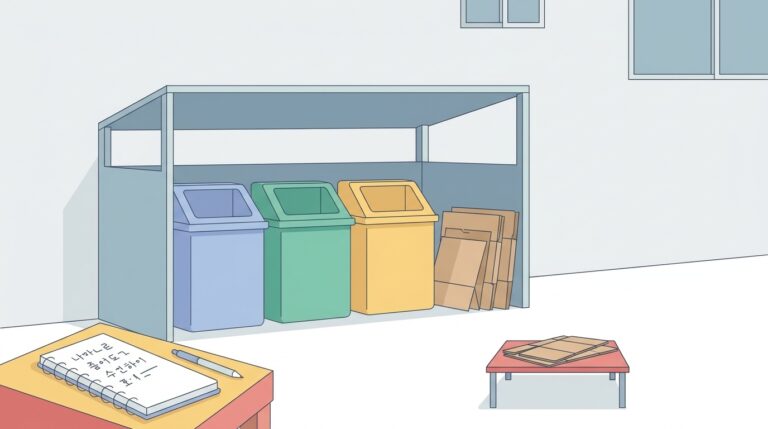
Don’t Get Fined by the Security Guard: The Ultimate Korean Waste Sorting Survival Guide
Phase 1: 공감 (Story-Immersive Opening)
안녕하세요! 매일한글 에디터입니다. (Hello! This is your Daily Hangul editor.)
Picture this: You finally unpack the last box in your cozy new officetel in Mapo-gu. You celebrate your move-in with classic Korean delivery—crispy Banban fried chicken and a cold canned beer. But the next morning, reality hits hard. In front of you sits a chaotic mountain of cardboard boxes, greasy plastic trays, chicken bones, and bubble wrap. Confidently, you carry the garbage bag down to the designated collection area, only to be stopped in your tracks by the eagle-eyed gaze of the building’s Gyeongbi Ajeossi (경비 아저씨, security guard/caretaker).
If you’ve watched K-dramas like Because This Is My First Life or Hospital Playlist, you know that household chore negotiations—especially taking out the trash—are practically a rite of passage. In South Korea, recycling isn’t merely a polite suggestion; it is a legally enforced civic duty governed by the strict Jongryangje (volume-based waste fee) system. Dumping trash in the wrong bag or putting recycling out on the wrong day can cost you fines up to 100,000 KRW—not to mention a lecture from your neighbors!
As someone who has guided hundreds of expats and exchange students through the labyrinth of Korean apartment regulations, I know how intimidating this can feel at intermediate (B2) Korean. But don’t worry! By the end of this guide, you will master the exact conversational nuances and cultural unwritten rules needed to navigate waste disposal like a seasoned Seoulite.
Phase 2: 핵심 표현 3선 심층 분석 (3 Core Expressions)
1. 이거 일반 쓰레기예요, 아니면 재활용이에요? (Igeo ilban sseuregi-yeyo, animyeon jaehwal-yong-ieyo?)
- Pronunciation: ee-guh eel-bahn sseu-reh-gee-yeh-yo, ah-nee-myeon jeh-hwahl-yong-ee-yeh-yo? (Rhymes gently with English “eagle” for il, and the “eu” in sseu sounds like the ‘u’ in ‘put’ but with lips spread flat like a smile).
- Meaning: Literal: “Is this general waste, or is it recycling?” | Real Nuance: “Could you clarify which bin this tricky item belongs to?”
- K-Culture Moment: You’ll see this scene in almost every Korean variety show featuring roommates (like I Live Alone), where someone hesitates holding an unwashed plastic container before getting scolded.
- Editor’s Insight: Korean separates trash into extremely specific streams. Even within plastics, clear bottles (tumyeong pet) are segregated from colored or sauce-stained containers. Use this question when you encounter borderline items like dirty pizza paper or broken mirrors.
- Situation Spectrum: Casual: ✅ | Semi-formal: ✅ | Formal: ⚠️ (In highly formal settings, say: “이 물품은 일반 쓰레기로 분류됩니까?”)
- 🤔 Think About It: In many Western countries, sorting happens downstream at sorting facilities. In Korea, the citizen is the frontline sorting agent. How does this shared civic responsibility alter your relationship with daily waste?
2. 비닐 라벨 떼고 버려야 돼요? (Binil rabel ttego beoryeoya dwaeyo?)
- Pronunciation: bee-neel rah-bel tteh-goh buh-ryuh-yah dweh-yo? (The double consonant tt [ㄸ] is a tense ‘t’ sound produced by tightening your vocal cords without exhaling air, like the ‘t’ in ‘stop’).
- Meaning: Literal: “Do I have to peel off the plastic label and discard it?” | Real Nuance: “Is it mandatory to strip the outer plastic film first for this to be accepted as recyclable?”
- K-Culture Moment: In modern K-dramas, you’ll notice Korean eco-conscious characters habitually stripping labels off mineral water bottles before crushing them with their foot. Major beverage brands even sell “label-free” drinks nowadays.
- Editor’s Insight: The answer is almost always yes. Transparent PET bottles (tumyeong pet-byeong) must be thoroughly rinsed, stripped of exterior plastic film, and crushed flat. Leaving the adhesive label on can cause an entire batch of plastics to be rejected.
- Situation Spectrum: Casual: ✅ | Semi-formal: ✅ | Formal: ✅
- 🤔 Think About It: Korean regulations emphasize “purity of material.” Notice how the verb tte-da (떼다, to detach/peel) carries an active obligation of care on the consumer’s part.
3. 음식물 쓰레기봉투 어디서 파나요? (Eumsikmul sseuregibongtu eodiseo panayo?)
- Pronunciation: eum-sheek-mool sseu-reh-gee-bong-too uh-dee-suh pah-nah-yo? (Note the smooth liaison: panayo sounds like ‘pah-nah-yo’, soft and inquiring).
- Meaning: Literal: “Where do you sell food waste bags?” | Real Nuance: “Could you tell me where I can purchase the district-specific biodegradable food garbage bags?”
- K-Culture Moment: When foreign exchange students first arrive at their off-campus studio apartments (one-room), asking the clerk at the neighborhood GS25 or CU this question is their genuine trial by fire!
- Editor’s Insight: Jongryangje bags are strictly district-coded (gu, 구). A bag bought in Gangnam-gu cannot be used in Mapo-gu! Always buy them at your closest local convenience store or supermarket, and specify the liter size (e.g., il-liteo 1L, i-liteo 2L).
- Situation Spectrum: Casual: ⚠️ | Semi-formal: ✅ | Formal: ✅
- 🤔 Think About It: Why does Korea monetize waste bags instead of rolling trash fees into property taxes? This pay-as-you-throw policy makes consumers directly conscious of how much food they discard.
Phase 3: 교과서 한국어 vs 진짜 한국어 (Textbook vs. Real Korean)
Situation 1: Inquiring about disposal days and times
- 📖 교과서 한국어: 쓰레기 배출 시간은 언제입니까? (Sseuregi baechul siganeun eonje-imnikka? / “When is the waste discharge time?”)
- 🗣️ 진짜 한국어: 쓰레기 언제 내놓으면 돼요? (Sseuregi eonje naenoh-eumyeon dwaeyo? / “When should I put out the trash?”)
- 💡 왜 다를까?: In real spoken Korean, natives rarely use technical administrative terms like baechul (배출, discharge/emission) in daily conversation. Instead, they use the intuitive compound verb nae-noh-da (내놓다, to put out/set outside), paired with the natural conversational ending -myeon dwaeyo (면 돼요, is it okay to/should I).
Situation 2: Clarifying ambiguous items like dirty takeout containers
- 📖 교과서 한국어: 오염된 용기는 분리수거 대상이 아닙니다. (O-yeom-doen yong-gineun bunrisugeo daesang-i animnida. / “Contaminated containers are not subjects of sorted recycling.”)
- 🗣️ 진짜 한국어: 양념 묻은 건 물로 헹궈서 버리거나, 안 지워지면 그냥 일쓰에 넣으세요. (Yangnyeom mudeun geon mullo heng-gwoseo beori-geona, an ji-wo-ji-myeon geunyang il-sseu-e neoheuseyo. / “Rinse out food sauces with water before tossing, or if it won’t wash off, just toss it into general waste.”)
- 💡 왜 다를까?: Real life requires practical alternatives. Koreans routinely use snappy abbreviations like 일쓰 (il-sseu, short for 일반 쓰레기 / general waste) and 음쓰 (eum-sseu, short for 음식물 쓰레기 / food waste). The verb heng-guda (헹구다, to rinse with water) is a core B2 vocabulary word every resident must know.
Phase 4: K-Culture 딥다이브 & 비언어적 매너 (Culture & Manners)
4-1. 눈치 (Nunchi) & Non-Verbal Etiquette
- The Flat-Box Ritual: Leaving a cardboard delivery box unflattened at the recycling station is considered a serious breach of etiquette (no-manner). Always remove packing tape, pull off mailing invoices displaying your personal info, and flatten the box completely before stacking.
- The Finger Pinch Delivery: Food waste (eum-sseu) bins can smell strong, especially during humid Korean summers. When approaching the communal yellow food-waste receptacle, hold your designated prepaid bag or RFID card with purpose. If the security guard (Gyeongbi Ajeossi) is supervising nearby, a polite 15-degree head bow combined with a respectful greeting (“수고하십니다!” / “Thank you for your hard work!”) will instantly win you neighborhood goodwill.
4-2. 문화 코드 분석 (K-Food Delivery & The 1995 Revolution)
Korea possesses arguably the world’s most efficient food delivery ecosystem (Baedal Minjok, Coupang Eats). However, this convenience comes with strict collective responsibility. In 1995, South Korea enacted the nationwide Volume-Based Waste Fee System. Prior to this, trash was dumped indiscriminately. Today, every single delivery container must be washed until no chili oil stain remains; otherwise, it is legally classified as ilban sseuregi (general waste). In Korean apartments, proper recycling is the ultimate test of civic maturity.
Phase 5: 실전 롤플레이 시나리오 (Roleplay Scenario)
Setting: Sunday, 8:30 PM. You are standing in the outdoor recycling area behind your officetel holding an empty fried chicken box, chicken bones in a plastic bag, and a takeout coffee cup. Mr. Park, the vigilant 60-something building security manager (Gyeongbi Ajeossi), observes your actions with arms folded.
- Turn 1 (You):
- 한글: 안녕하세요, 아저씨! 분리수거 하러 나왔는데요.
- Romanization: Annyeonghaseyo, ajeossi! Bunrisugeo hareo nawanneundeyo.
- English: Hello, sir! I came down to do my recycling.
🎭 Action:(Bow politely at a 30-degree angle while holding your bags)
- Turn 2 (Mr. Park):
- 한글: 어, 학생! 잠깐만, 그 치킨 뼈 봉투는 뭐야? 음식물 쓰레기통에 넣으려고?
- Romanization: Eo, haksaeng! Jamkkanman, geu chikin ppyeo bongtuneun mwoya? Eumsikmul sseuregitong-e neoheuryeogo?
- English: Oh, student! Hold on, what’s that bag of chicken bones? Are you planning to throw it in the food waste bin?
🎭 Action:(Points at your small transparent plastic bag with a furrowed brow)
- Turn 3 (You):
- 한글: 네, 먹다 남은 음식이라서 음식물 쓰레기인 줄 알았어요.
- Romanization: Ne, meokda nameun eumsigiraseo eumsikmul sseuregi-in jul arasseoyo.
- English: Yes, it’s leftover food, so I assumed it was food waste.
🎭 Action:(Show a puzzled, apologetic expression)
- Turn 4 (Mr. Park):
- 한글: 아니야! 동물이 먹을 수 없는 딱딱한 뼈나 조개껍데기는 일반 쓰레기로 버려야 해.
- Romanization: Aniya! Dongmuri meogeul su eomneun ttakttakhan ppyeona jogae-kkeopdegineun ilban sseuregiro beoryeoya hae.
- English: No, no! Hard bones or clam shells that animals cannot eat must be discarded in general waste.
🎭 Action:(Shakes his head vigorously and taps the side of the blue general waste bin)
- Turn 5 (You):
- 한글: 아, 정말요? 몰랐어요. 그럼 치킨 상자는 종이로 바로 배출하면 될까요?
- Romanization: A, jeongmallyo? Mollasseoyo. Geureom chikin sangjaneun jong-iro baro baechulhamyeon doelkkayo?
- English: Oh, really? I had no idea. Then can I dispose of this chicken box directly as paper?
🎭 Action:(Show genuine curiosity while pointing to the grease mark inside the box)
- Turn 6 (Mr. Park):
- 한글: 기름이나 양념 묻은 종이는 재활용이 안 되니까, 그 부분만 찢어서 일쓰에 버려요.
- Romanization: Gireumina yangnyeom mudeun jong-ineun jaehwalyong-i an doenikka, geu bubunman jjijeoseo il-sseu-e beoryeoyo.
- English: Paper contaminated with oil or sauce can’t be recycled, so tear off that part and toss it into general waste.
🎭 Action:(Demonstrates a tearing gesture with his hands, smiling gently now)
- Turn 7 (You):
- 한글: 알려주셔서 감사합니다, 아저씨! 다음부터는 꼭 신경 쓸게요.
- Romanization: Allyeojusyeoseo gamsahamnida, ajeossi! Daeumbuteoneun kkok singyeong sseulgeyo.
- English: Thank you for letting me know, sir! I will definitely pay close attention from now on.
🎭 Action:(Carefully separate the greasy paper and bow again appreciatively)
- Turn 8 (Mr. Park):
- 한글: 그래요, 처음엔 다 헷갈리지. 잘 분리해서 저기 노란 통에 둬요.
- Romanization: Geuraeyo, cheo-eumen da hetgalliji. Jal bunrihaeseo jeogi noran tong-e dwoyo.
- English: Sure, everyone gets confused at first. Sort it properly and place it over in that yellow bin.
🎭 Action:(Nods with a warm, approving smile)
🔀 인터랙티브 분기점 (Interactive Choice)
You finish sorting, but notice your plastic takeout iced-coffee cup still contains half-melted ice and a plastic straw inside. What do you do?
- Choice A: Throw the entire plastic cup with ice and straw into the “Plastic” bin since it is predominantly made of plastic.
- ❌ Bad: A major faux pas! Leftover liquids contaminate recyclables, and straws are too small to be sorted mechanically (they belong in general waste). The guard may call you back immediately.
- Choice B: Pour the liquid and ice down the drain/sink in your room, throw the straw into ilban sseuregi (일반 쓰레기), rinse the cup clean, and drop it into the clear plastic bin.
- 🏆 Best: Perfect native score! Liquid drained, unrecyclable straw discarded as general trash, clean container recycled. You have earned 100% community approval.
- Choice C: Throw the whole thing into the black general waste bag (ilban sseuregi) to avoid the hassle of sorting.
- ⚠️ Risk: While throwing contaminated items in general waste is technically permitted, throwing away large quantities of recyclable plastic cups in standard bags wastes expensive bag volume and can trigger inspections if transparent bags reveal high recyclable content.
Phase 6: 10초 감정 섀도잉 드릴 (10-Second Emotional Shadowing Drill)
Read aloud focusing on natural pauses marked with / and mimic the indicated emotional tone:
[😊 Inquiring & Highly Polite]- 한글: 저기요, 아저씨! / 이거 투명 페트병인데 / 라벨 떼고 / 여기 넣으면 돼요? (Jeogiyo, ajeossi! / Igeo tumyeong pet-byeong-inde / rabel ttego / yeogi neoheumyeon dwaeyo?)
- English: Excuse me, sir! This is a clear plastic bottle; if I peel the label off, do I put it here?
[😅 Flustered & Truly Apologetic]- 한글: 죄송해요! / 닭뼈는 / 음식물 쓰레기가 아닌 줄 / 미처 몰랐어요. (Joesonghaeyo! / Dakppyeoneun / eumsikmul sseuregiga anin jul / micheo mollasseoyo.)
- English: I’m so sorry! I didn’t realize that chicken bones aren’t classified as food waste.
[🫡 Confident & Cordial]- 한글: 상자 테이프 다 떼고 / 납작하게 접어서 / 깔끔하게 정리해 뒀습니다! (Sangja te-i-peu da ttego / napjakhage jeobeoseo / kkalkkeumhage jeongrihae dwossseumnida!)
- English: I removed all the tape, folded the box flat, and organized it neatly!
Phase 7: K-Culture 미니 사전 (Key Terminology)
- 종량제 봉투 (Jongryangje bongtu)
- Translation: Government-standard prepaid volume-based garbage bag.
- Usage: These colored bags (usually white/pink for general waste, yellow/blue for food waste depending on the municipality) are sold at convenience store counters. Disposing of trash in standard grocery plastic bags is illegal.
- 일쓰 (Il-sseu) / 음쓰 (Eum-sseu)
- Translation: General Waste / Food Waste (Slang contractions).
- Usage: Widely used in texting, flatmate group chats, and student forums. Example: “오늘 일쓰 버리는 날이야, 음쓰는 내가 버릴게!” (Today is general waste day; I’ll take out the food waste!).
- 대형폐기물 스티커 (Daehyeong pyegimul seutikeo)
- Translation: Bulky waste disposal sticker.
- Usage: Used when discarding furniture, luggage, mattress pads, or appliances. You purchase this sticker from your local community service center (Jumin Center) or print it online via the district office website before placing the item on the curb.
- 투명 페트병 (Tumyeong pet-byeong)
- Translation: Clear plastic PET bottle.
- Usage: Separated into its own dedicated category across Korea. Must be rinsed clean, squashed flat, capped, and discarded without adhesive labels to be recycled into high-grade textile fibers.
Phase 8: 여행자를 위한 생존 키트 (Traveler & Expat Survival Kit)
서바이벌 표현 TOP 3
- 종량제 봉투 10리터짜리 두 장만 주세요.
- Romanization: Jongryangje bongtu sip-liteo-jjari du jangman juseyo.
- Pro Tip: Use this at any convenience store checkout. 10L is ideal for single-person households (one-room).
- 배달 용기 씻어서 분리수거함에 넣으시면 돼요.
- Romanization: Baedal yonggi ssiseoseo bunrisugeoham-e neoheusimyeon dwaeyo.
- Pro Tip: A key phrase heard from guesthouse hosts or officetel managers meaning “Rinse your delivery containers before sorting.”
- 이거 버리려면 스티커 사서 붙여야 하나요?
- Romanization: Igeo beoriryeomyeon seutikeo saseo buchyeoya hanayo?
- Pro Tip: Ask this when getting rid of broken chairs, electric fans, or large suitcases.
Editor’s Travel Note
- Essential App Download: Before moving into Korean housing, make sure to get the 환경부 내 손안의 분리배출 공식 앱 다운로드 (Ministry of Environment Official Waste Sorting Guide App). It lets you search any item (e.g., umbrella, mirror, pizza box) to see exactly how to separate it.
- Local Schedule Verification: Check your district’s disposal hours via the 서울시 자치구별 쓰레기 배출 요일 안내. In most Seoul districts, you may only place bags outside between 6:00 PM and 10:00 PM on designated days (e.g., Sun/Tue/Thu).
Phase 9: “한 발 더 깊이” (Cultural Reflection)
In South Korea, waste sorting is far more than an ecological protocol—it is an unspoken testament to the country’s Uri (우리, collective “we”) culture and high-density urban living. Because millions of residents share vertical apartment buildings, one person’s carelessness with odor or unseparated trash directly impacts dozens of neighbors. Respecting waste disposal rules signifies that you acknowledge and honor the collective living space. It is social harmony manifested in physical hygiene.
💬 Your Turn: How does waste sorting in Korea compare to your home country? Have you ever had a confusing encounter with a security guard or recycling bin? Share your story in the comments below!
Phase 10: FAQ & 오해 방지 (FAQ Schema)
Q: Are eggshells, onion peels, and chicken bones considered food waste?
A: No! The golden rule of Korean food waste (eum-sseu) is: “Can livestock eat this?” Animal feed is processed from food waste. Therefore, eggshells, onion/garlic skins, nutshells, fruit pits (peach, avocado), tea bags, and hard bones are all 일반 쓰레기 (General Waste).
Q: Can I put waste in a 종량제 봉투 purchased from another district?
A: No. Each district (gu) contracts different sanitation companies funded by their specific bag sales. If you move to another district, you can exchange your leftover unused bags at the local community center (Jumin Center) for voucher stickers that validate them in your new area.
Q: What should I do if a greasy plastic container won’t get clean after washing?
A: If stubborn red chili oil stains remain after rinsing with dish soap or warm water, the item can no longer be recycled as clean plastic. It must be discarded into the standard general waste bag (ilban sseuregi).
🚨 흔한 실수 (Common Mistakes) TOP 3
- Throwing delivery chopsticks & sauce packets in recycling: Used wooden chopsticks and plastic squeeze packets with condiment residue belong in General Waste.
- Tossing clear bottles with wrap labels attached: The exterior printed vinyl film must be peeled off and discarded into 비닐류 (Vinyl/Film), while the bottle goes into 투명 페트병.
- Discarding electronics in standard bins: Small electronics (hairdryers, phone chargers, toasters) must be deposited into the dedicated 소형 가전 수거함 (small home appliances bin) usually situated near apartment management offices.
Phase 11: 액션 미션 & 참여 유도 (Action Missions)
- 🥉 Bronze Level (Solo Practice): Check your kitchen trash right now. Separate all plastic drink bottles, peel off their vinyl labels, compress them flat, and recap them.
- 🥈 Silver Level (Language in Action): Visit your local neighborhood convenience store and successfully buy waste bags using: “마포구 10리터 종량제 봉투 5장 주세요.” (Please give me five 10-liter Mapo-gu trash bags).
- 🥇 Gold Level (Real-World Master): Take your sorted recycling downstairs and greet your building’s Gyeongbi Ajeossi with a warm: “아저씨, 수고 많으십니다! 분리수거 잘 정리해 두었습니다.” (Thank you for your hard work, sir! I have sorted the recycling neatly).
- 🎮 K-Culture Mission: In the next K-drama or Korean YouTuber vlog you watch, spot where their kitchen recycling bins are kept and notice what color their trash bags are!
Phase 12: 인터랙티브 퀴즈 챌린지 (Interactive Quiz)
Question 1: Situation Judgement
You ordered spicy Tteokbokki. The plastic bowl is stained bright red even after washing it once with water. Where does it go?
* A) Clear Plastic bin (Tumyeong PET)
* B) General Waste bag (Ilban sseuregi)
* C) Food Waste bin (Eumsikmul sseuregi)
Question 2: Fill-in-the-Blank
물병을 버릴 때는 플라스틱 ______을/를 반드시 떼고 버려야 합니다.
(When throwing away a water bottle, you must peel off the plastic ______ before throwing it away.)
Question 3: True or False
Pork ribs and chicken bones should be placed in the yellow food waste (음식물 쓰레기) bag because they are food leftovers. (True / False)
👉 Click here to reveal answers & explanations!
- Answer: B) General Waste bag (Ilban sseuregi)
- Explanation: Once plastic is permanently stained with oil or pigment, it cannot be processed into clean recycled pellets. It must go into general waste.
- Answer: 라벨 (Label)
- Explanation: Removing the vinyl label (rabel ttego) is legally mandated for clear plastic PET bottles.
- Answer: False
- Explanation: Bones cannot be ground down into animal feed, so they are classified as general waste (ilban sseuregi), not food waste!
- Explanation: Bones cannot be ground down into animal feed, so they are classified as general waste (ilban sseuregi), not food waste!







