

Phase 1: 공감 (Story-Immersive Opening)
안녕하세요! 매일한글 에디터입니다.
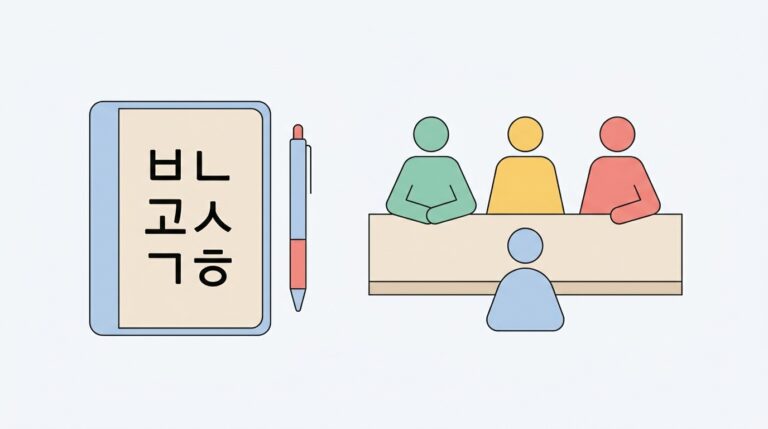
Have you ever watched the tension-drenched scenes in K-dramas like SKY Castle or Crash Course in Romance and felt your heart race alongside the characters? Picture this: a chillingly quiet mock-interview room in Daechi-dong. Three stern-faced professors sit across a mahogany table, evaluating every flicker of your eyes and every syllable you utter. For many advanced Korean learners, stepping from everyday conversational comfort into the high-stakes arena of Korean college entrance exams—specifically the dreaded Nonsul (논술, academic essay exams) and Myeonjeop (면접, oral interviews)—feels like hitting a linguistic concrete wall.
You might already express yourself comfortably at a cafe or debate casual topics with friends, but university admissions require an entirely different cognitive register. Here, speaking in conversational formulas like 제 생각에는… (In my opinion…) makes you sound unpolished, while using overly archaic textbook idioms makes you sound robotic. Korean university professors look for logical coherence, acute analytical discernment, and culturally grounded academic decorum.
Drawing from our decade of experience mentoring non-native applicants who successfully entered Seoul National University, Yonsei, and Korea University, this guide will serve as your strategic playbook. Mastering these C1-level rhetorical expressions and non-verbal nuances will not only elevate your entrance exam scores but also permanently upgrade your intellectual Korean for graduate seminars and corporate boardrooms.
Phase 2: 핵심 표현 3선 심층 분석
1. 견해를 피력하다 (Gyeonhaereul piryeokhada)
- Pronunciation: [Gyeon-hae-reul pi-ryeok-ha-da] (Pronunciation tip: ‘Gyeon’ rhymes with ‘yawn’ preceded by a hard ‘g’, and ‘pi-ryeok’ sounds like ‘pee-ryuck’ with a crisp final k)
- Meaning: Literally “to unfold and reveal one’s viewpoint”; contextually “to articulate or assert a cogent academic stance.”
- K-Culture Moment: In legal or academic K-dramas (such as Law School), you will hear top-tier candidates declare their stance not by saying 제 의견을 말하겠습니다, but by confidently opening with 이 문제에 대한 저의 견해를 피력하고자 합니다.
- Editor’s Insight: 피력하다 (披瀝하다) carries the physical imagery of opening one’s mind and laying it out transparently. In a competitive interview, it signals that your answer is not an impromptu gut feeling, but an analytically synthesized thesis.
- Situation Spectrum:
- Casual: 🚫 (Sounds ridiculously pretentious among friends)
- Semi-formal: ⚠️ (Only appropriate in structured presentations)
- Formal: ✅ (The ultimate gold standard for admissions and debates)
- 🤔 Think About It: In English, you might casually say “I’d like to share my view.” Why does Korean require a distinct Sino-Korean verb like 피력하다 to validate scholarly seriousness?
2. 일맥상통하다 (Ilmaeksangtonghada)
- Pronunciation: [Il-maek-sang-tong-ha-da] (Pronunciation tip: ‘Il-maek’ sounds like ‘eel-meck’, transitioning smoothly into ‘sahng-tong-hah-dah’)
- Meaning: Literally “to connect through the same pulse or vein”; contextually “to be fundamentally aligned with or share the same core rationale.”
- K-Culture Moment: When students in university entrance preparation scenes connect their personal philosophy with the founding motto of a university, the admissions coach nods in approval when they state that their career goal 일맥상통합니다 with the department’s vision.
- Editor’s Insight: This expression demonstrates an advanced ability to synthesize disparate ideas. When comparing two literary texts in Nonsul or connecting a social theory to current events in Myeonjeop, using 일맥상통하다 shows that you perceive macro-level patterns.
- Situation Spectrum:
- Casual: 🚫
- Semi-formal: ⚠️
- Formal: ✅
- 🤔 Think About It: The root 맥 (脈) means ‘pulse’ or ‘bloodline’. How does using physiological metaphors for abstract logic reflect Eastern philosophical traditions?
3. 지양해야 마땅합니다 (Jiyanghaeya mattanghamnida)
- Pronunciation: [Ji-yang-hae-ya mat-ttang-ham-ni-da] (Pronunciation tip: Emphasize the doubled ‘tt’ in ‘mat-ttang’ like the energetic ‘tt’ in ‘attack’)
- Meaning: Literally “it is only natural/proper to refrain from”; contextually “we ought to decisively avoid such an approach.”
- K-Culture Moment: In public speaking or admissions panel scenes, characters address societal issues (e.g., educational inequality, ethical hazards of AI) with this exact concluding remark to sound decisive yet respectful.
- Editor’s Insight: Many foreign learners confuse 지양 (avoiding an undesirable action) with 지향 (aiming toward an aspiration). Saying 지양해야 마땅합니다 allows you to present strong ethical and logical critiques without coming across as aggressive or emotionally defensive.
- Situation Spectrum:
- Casual: 🚫
- Semi-formal: ⚠️
- Formal: ✅
- 🤔 Think About It: Why does Korean rhetoric pair the avoidance verb (지양) with the duty suffix (-마땅하다) rather than a simple command like 하지 말아야 합니다?
Phase 3: 교과서 한국어 vs 진짜 한국어
Situation 1: Presenting a counter-perspective during an interview
- 📖 교과서 한국어: 저는 그 생각에 반대합니다. 왜냐하면 다른 이유가 있기 때문입니다. (Jeoneun geu saenggake bandaehamnida. Waenyahamyeon dareun iyuga itgi ttaemun-imnida. / I disagree with that idea because there is another reason.)
- 🗣️ 진짜 한국어: 교수님께서 지적하신 견해 또한 일리가 있으나, 반대급부로 발생할 사회적 비용을 간과할 수 없다고 사료됩니다. (Gyosunimkkeseo jijeokhasin gyeonhae ttohan illiga eousseuna, bandaogeupburo balsaenghal sahoejeok biyong-eul gang-gwahal su eopdago saryodoemnida. / The point you noted certainly holds merit; however, I deem that the reciprocal social costs cannot be overlooked.)
- 💡 왜 다를까?: Outright rejection (반대합니다) in a Korean academic setting creates instant social friction. Sophisticated speakers cushion counterarguments by acknowledging the interviewer’s premise (일리가 있으나) and softening their conclusion with 사료됩니다 (I deem/estimate).
Situation 2: Synthesizing a conclusion in an academic essay (Nonsul)
- 📖 교과서 한국어: 그래서 정부는 법을 바꾸고 사람들은 조심해야 합니다. (Geuraeseo jeongbuneun beobeul bakkugo saramdeureun josimhaeya hamnida. / Therefore, the government must change laws and people must be careful.)
- 🗣️ 진짜 한국어: 따라서 실효성 있는 제도적 보완책 마련과 더불어, 성숙한 시민의식의 함양이 병행되어야 할 것입니다. (Ttaraseo silhyoseong inneun jedojeok bowanchaek maryeongwa deobureo, seongsookhan siminuisi-gui hamyang-i byeonghaengdoeeoya hal geosimnida. / Accordingly, the establishment of effective institutional remedies must proceed in tandem with the cultivation of mature civic consciousness.)
- 💡 왜 다를까?: Conversational conjunctions like 그래서 diminish academic gravitas in written exams. C1 essays demand macro-level conceptual vocabulary (실효성, 보완책, 함양, 병행) paired with balanced dual-track solutions.
Phase 4: K-Culture 딥다이브 & 비언어적 매너
4-1. 눈치(Nunchi) & Gestures: Mastering the Interview Room
In Korean university interviews, your evaluation begins the millisecond you touch the doorknob. Entering the room requires executing a crisp 15-degree standing bow beside the chair, waiting for the professors to prompt you (앉으세요 / Please take a seat), and sitting with an upright spinal alignment.
* The Posture (공수 자세, Gongsu): Place your hands lightly on your thighs or lightly clasp them together over your lap. Keep your elbows tucked near your ribs—flaring your elbows makes you appear confrontational.
* Gaze Control (시선 처리): Avoid burning an unblinking, direct gaze into a single professor’s eyes, which can be interpreted as defiant. Instead, let your gaze wander gently around the 인중 (philtrum) and 미간 (the space between the eyebrows), softly rotating your gaze across all evaluators when making a multi-point argument.
4-2. Cultural Code Analysis: The Crucible of 입시 (Ipsi)
To understand the gravity of admissions language, you must understand the cultural weight of Ipsi (entrance examination culture). In Korea, getting into a prestigious university is viewed not just as personal achievement, but as an earned social badge for the entire family line. This is why Nonsul (논술) demands absolute objectivity—evaluators grade thousands of identical manuscript papers (원고지) anonymously. One emotional outburst or colloquial lapse (ㅋㅋ, 솔직히, 대박) leads to immediate disqualification. Polished language equals disciplined character.
Phase 5: 실전 롤플레이 시나리오
- Setting: An intimidating interview room at an elite university in Seoul. Professor Park, renowned for rigorous probing questions, glares over his reading glasses.
- Characters:
- 교수님 (Professor Park): Sharp, skeptical, tests applicants under pressure.
- 지원자 (You / Applicant): Composed, analytical, aiming for a Department of Sociology seat.
- 교수님: 🎭 (서류를 넘기며 안경 너머로 날카롭게 응시한다) 지원자의 자기소개서를 보면 기술 발전을 무조건적으로 옹호하고 있어요. 기술 만능주의가 초래할 윤리적 공백은 고려하지 않은 겁니까?
(Seoryureul neomgimyeo an-gyeong neomeoro nalkaropge eungshihanda. Jiwonjaui jagisogaeseoreul bomyeon gisul baljeoneul mujogeonjeogeuro onghohago isseoyo. Gisul manneungjuuiga choraehal yunrijeok gongbaegeun goryeohaji aneun geomnikka?)
🎭 (Flipping through the papers, glaring sharply over his glasses) Looking at your personal statement, you seem unconditionally in favor of technological progress. Did you fail to consider the ethical void technological determinism might induce? -
지원자: 🎭 (허리를 곧게 펴고 두 손을 모은 채 차분한 눈빛으로) 지적해 주신 바와 같이, 기술의 무분별한 도입이 인간성 상실을 야기할 수 있다는 점에 깊이 공감합니다.
(Jijeokhae jusin bawa gachi, gisurui mubunbyeolhan doibi inganseong sangsireul yagihal su itdaneun jeome gipi gomghamhanda.)
🎭 (Straightening back with hands folded, maintaining a calm gaze) As you incisively pointed out, I deeply concur that the indiscreet adoption of technology can cause the loss of humanity. -
교수님: 🎭 (눈썹을 치켜세우며) 그렇다면 본인의 지원 동기와 배치되는 것 아닌가요?
(Geureotdamyeon boninui jiwon donggiwa baechidoeneun geot aningayo?)
🎭 (Raising an eyebrow) Doesn’t that directly contradict your stated motivation for applying? -
지원자: 🎭 (온화하면서도 흔들림 없는 어조로) 결코 배치되지 않습니다. 저는 기술의 맹목적 추종을 지양해야 마땅하다고 보며, 인간 중심적 기술 설계를 모색하고자 합니다.
(Gyeolko baechidoeji anseumnida. Jeoneun gisurui maengmokjeok chujong-eul jiyanghaeya mattanghadago bomyeo, ingan jungsimjeok gisul seolgyereul moseokhagoja hamnida.)
🎭 (In a gentle yet unwavering tone) It does not contradict it at all. I believe it is only proper to avoid the blind veneration of technology, and I seek to pursue human-centric technological design. -
교수님: 🎭 (살짝 턱을 괴며 흥미로운 듯) 인간 중심적 설계라… 그것이 본교 학과의 비전과 어떻게 연결됩니까?
(In-gan jungsimjeok seolgyera… Geugeosi bon-gyo hagwawi bijeongwa eotteoke yeongyeoldoemnikka?)
🎭 (Resting chin on hand with slight intrigue) Human-centric design… How does that connect to our department’s vision? -
지원자: 🎭 (교수진 전체를 부드럽게 번갈아 바라보며) 본교가 지향하는 ‘공공선을 위한 학문’이라는 교육 이념과 저의 문제의식은 일맥상통한다고 확신합니다.
(Bon-gyoga jihyanghaneun ‘gonggongseoneul wihan hangmun’iraneun gyoyuk inyeomgwa jeoui munjedeuisigeun ilmaeksangtonghandago hwaksinhamnida.)
🎭 (Gently shifting gaze across the panel) I am convinced that my critical awareness is in complete alignment with this university’s founding educational ethos of ‘Scholarship for the Common Good.’ -
교수님: 🎭 (미세하게 고개를 끄덕이며 펜을 내려놓는다) 그렇다면 본인이 대학 입학 후 구체적으로 탐구하고자 하는 연구 과제를 간략히 말해 보세요.
(Geureotdamyeon bonini daehak iphak hu guchejeogeuro tamguhagoja haneun yeon-gu gwajereul ganryakhi malhae boseyo.)
🎭 (Subtly nodding and setting down his pen) In that case, briefly tell us the specific research question you intend to explore after matriculation. -
지원자: 🎭 (확신에 찬 미소와 함께) 네, 저는 디지털 소외 계층을 포용하는 정책 모델을 구축하는 데 저의 학문적 견해를 피력하고 발전시키고 싶습니다.
(Ne, jeoneun dijiteol soeoe gyecheung-eul poyonghaneun jeongchaek modereul guchukhaneun de jeoui hangmunjeok gyeonhaereul piryeokhago baljeonsikigo sipseumnida.)
🎭 (With a confident smile) Yes, I wish to articulate and develop my academic perspectives in building policy models that embrace digitally marginalized populations.
🔀 인터랙티브 분기점 (Interactive Branching Point)
If the professor hits you with an unexpected, difficult premise, how should you open your rebuttal?
- Option A: “교수님, 제 서류를 잘못 해석하신 것 같은데요. 저는 그런 뜻으로 쓰지 않았습니다.” (Professor, I think you misinterpreted my dossier. I did not write it with that intention.)
- 🚫 Feedback (Bad): Immediate disqualification risk! It aggressively challenges the evaluator’s reading comprehension. In Korean academic hierarchy, this is perceived as an inexcusable lack of decorum.
- Option B: “네… 뭐, 교수님 말씀도 맞고요. 제가 좀 생각이 짧았던 것 같습니다.” (Well… I mean, you’re right too, professor. I guess I didn’t think thoroughly.)
- ⚠️ Feedback (Risk): While humble, it shows zero academic backbone. You crumble instantly under intellectual stress (압박 면접), signaling a lack of intellectual conviction.
- Option C: “우려하시는 맥락을 충분히 이해하고 있습니다. 다만 제가 강조하고자 했던 본질은…” (I fully understand the context of your concern. However, the core essence I wished to emphasize was…)
- ✅ Feedback (Best): Perfect C1 handling! You cushion the challenge with empathy (우려하시는 맥락을 충분히 이해), then strategically pivot back to your intellectual thesis.
Phase 6: 10초 감정 섀도잉 드릴
Practice reading these sentences aloud, respecting the pauses (/) and capturing the internal emotional nuance indicated in the tags.
[🧐 진중하고 논리정연하게 / Serious and analytical]
“교수님께서 지적하신 바와 같이, / 기술의 무분별한 도입은 / 인간 소외를 초래할 위험이 있습니다.”
(Gyosunimkkeseo jijeokhasin bawa gachi, / gisurui mubunbyeolhan doibeun / ingan soeoereul choraehal wiheomi isseumnida.)-
[💡 확신에 찬 어조로 / Firm and convincing]
“본교의 학문적 지향점과 저의 비전은 / 본질적인 측면에서 / 일맥상통한다고 확신합니다.”
(Bon-gyoui hangmunjeok jihyangjeomgwa jeoui bijeoneun / bonjiljeogin cheungmyeon-eseo / ilmaeksangtonghandago hwaksinhamnida.) -
[⚖️ 차분하지만 단호하게 비판하며 / Calm yet decisively critical]
“단기적인 경제적 효용만을 좇는 정책은 / 현시점에서 / 마땅히 지양해야 할 대상입니다.”
(Dangijeogin gyeongjejeok hyoyongmaneul jonneun jeongchaegeun / hyeonsisjeom-eseo / mattanghi jiyanghaeya hal daesang-imnida.)
Phase 7: K-Culture 미니 사전
-
수시 (Susi) vs 정시 (Jeongsi)
- Translation: Rolling Admissions vs. Regular CSAT Admissions
- Context: Susi evaluates student academic records, comprehensive portfolios, interviews, and Nonsul essays before the national CSAT (Suneung). Jeongsi relies almost purely on the raw score from the national exam.
- 학종 / 학생부종합전형 (Hakjong / Haksaengbu Jonghap Jeonhyeong)
- Translation: Comprehensive High School Student Records Track
- Context: The infamous admissions model depicted in SKY Castle. Evaluators assess three years of extracurriculars, reading logs, teacher remarks, and deep-dive oral interviews.
- 변별력 (Byeonbyeolryeok)
- Translation: Discriminative power / Ability to differentiate high achievers
- Context: Academic jargon used constantly by admissions boards: 이번 논술 시험은 변별력이 매우 높았다 (This essay exam had exceptionally high discriminative difficulty).
- 압박 면접 (Apbak Myeonjeop)
- Translation: High-pressure stress interview
- Context: A testing format where professors intentionally challenge your flaws, point out logical fallacies, or simulate skepticism to test emotional stability and situational quick-thinking under duress.
Phase 8: 여행자를 위한 생존 키트
If you are visiting a Korean university campus for admissions consultations, open campus tours, or university office inquiries:
- Survival Phrase 1: “입학처 위치가 어디인지 여쭤봐도 되겠습니까?”
(Iphakcheo wichiga eodiinji yeojjwobwado doegesseumnikka?)
Pro Tip: Always use 여쭤보다 (humble form of ‘ask’) rather than 물어보다 when addressing campus staff or security guards. - Survival Phrase 2: “외국인 전형 모집요강 책자를 한 권 수령할 수 있을까요?”
(Oegugin jeonhyeong mojib-yogang chaekjareul han gwon suryeonghal su isseulkkayo?)
Pro Tip: 수령하다 (to formally receive) makes your request sound exceptionally polite and sophisticated at the administration desk. - Survival Phrase 3: “논술 고사장 입실 마감 시간이 몇 시인가요?”
(Nonsul gosajang ipsil magam sigani myeot siingayo?)
Pro Tip: Use 입실 (entering the test room) rather than 들어가는 시간.
Editor’s Campus Travel Note
When navigating university campuses like Seoul National University (Gwanak Campus) or Yonsei University (Sinchon Campus), hills and vast building clusters can make you late. Never rely solely on global apps. Download the 네이버 지도 모바일 앱 공식 다운로드 to check accurate intra-campus shuttle routes. On test days, nearby subway stations (like Line 2 Nakseongdae or Sinchon) get flooded with anxious applicants and parents—plan to arrive at least 50 minutes before 입실 마감.
Phase 9: “한 발 더 깊이” (Reflective Question)
In South Korea’s hyper-competitive entrance examination landscape, rhetorical decorum is not mere politeness—it is a philosophical litmus test. The traditional Confucian emphasis on Yegui (예의, ritual propriety) intertwines with modern meritocratic rigor. When an applicant uses elevated academic grammar like 피력하다 or balanced humility like 사료됩니다, the university views it as evidence of moral discipline and academic readiness. You are proving that you can master the communal conventions of Korean academia while maintaining your critical identity.
💬 Your Turn: In your native country, does an admissions interview value direct, assertive confidence, or does it reward tempered humility and structured cushioning? Share your cultural comparisons in the comments below!
Phase 10: FAQ & 오해 방지
Q: Can I use everyday polite speech (-해요 style) in an academic interview?
A: Absolutely not. In admissions interviews (면접), the formal -하십시오 / -합니다 ending is non-negotiable. Using -해요 style sounds casual, juvenile, and uncommitted. In written essays (논술), use the neutral declarative -다/-는다 ending without any honorifics (존칭 생략).
Q: What is the most dangerous error foreigners make in Korean college essays?
A: The most common failure is writing from an emotional “I” perspective (저는 슬펐습니다 / 제 생각에는). Korean academic essays demand impersonal, analytical agency: ~는 사실을 방증한다 (It demonstrates the fact that…) or ~라는 결론에 도달하게 된다 (One arrives at the conclusion that…).
Q: How do I recover if my mind goes blank during a high-pressure question?
A: Never say 잠깐만요 (Wait a sec) or sit in total silence. Take a breath, look down slightly, and state: “죄송하지만 잠시 생각을 정리한 후 말씀드려도 되겠습니까?” (Pardon me, may I take a brief moment to organize my thoughts before speaking?). Evaluators respect deliberate composure over rushed blabber.
🚨 흔한 실수 (Common Mistakes) 경고판
- Mistake: Confusing 지양 (avoid) with 지향 (aim for).
- Correction: Never say 친환경 정책을 지양해야 합니다 (We must avoid eco-friendly policies). Always ensure 지양 attaches to negative concepts and 지향 to goals.
- Mistake: Peppered conversational fillers like 솔직히 말씀드리면 (To be honest).
- Correction: It suggests you might have been deceptive earlier! Replace it with 솔직히 -> 엄밀히 검토하건대 (Upon rigorous examination).
- Mistake: Ending analytical sentences with subjective conjecture like ~것 같아요.
- Correction: In admissions, ~것 같아요 conveys indecision. Use ~라고 사료됩니다 or ~라고 판단합니다.
Phase 11: 액션 미션 & 참여 유도
- 🥉 Bronze Mission (Solo Shadowing): Record a voice memo of yourself speaking the Phase 5 Applicant lines 2, 4, and 6 using proper 공수 posture in front of a mirror.
- 🥈 Silver Mission (Community Share): Write a short 2-sentence perspective on a modern social issue (e.g., remote work or artificial intelligence) using 지양해야 마땅합니다 and tag
@DailyHangul_Officialon your social feed. - 🥇 Gold Mission (Mock Drill Challenge): Have a Korean language partner fire a rapid 압박 질문 (pressure question) at you, and respond in under 30 seconds utilizing 견해를 피력하고자 합니다 and 일맥상통합니다 without stammering.
🎮 K-Culture Mission: Watch Episode 1 or 2 of Crash Course in Romance or Law School. Write down three instances where students or professors frame academic discussions using the Sino-Korean rhetorical tools covered today.
Phase 12: 인터랙티브 퀴즈 챌린지
1. 상황 판단 퀴즈 (Contextual Judgment)
During a mock interview, the professor asserts: “당신이 제안한 복지 정책은 국가 재정에 심각한 부담을 줍니다.” Which response demonstrates optimal C1 rhetorical maturity?
* (1) 전혀 그렇지 않습니다. 제 계산은 틀리지 않았습니다.
* (2) 재정적 부담에 대한 우려는 충분히 일리가 있으나, 장기적인 사회 안전망 구축 효과를 고려할 필요가 있습니다.
* (3) 아… 제가 경제학 전공이 아니라서 그 부분은 잘 모르겠습니다.
2. 빈칸 채우기 (Fill-in-the-Blank)
이 연구의 궁극적인 목적은 전통적인 윤리관과 현대 사회의 다원주의가 상호 모순되지 않고 (________)할 수 있는 접점을 모색하는 데 있습니다.
* (A) 일맥상통
* (B) 지양
* (C) 방관
3. 문화 진위 퀴즈 (True / False)
- Korean academic essay exams (Nonsul) permit the use of polite colloquial honorifics like -습니다 and -해요 because you are addressing the admissions professors who will grade your test. (True / False)
👉 Click here to reveal the answers and explanations!
- Answer: (2)
- Explanation: Option (2) acknowledges the counter-point gracefully (우려는 충분히 일리가 있으나) before redirecting to the macro-benefit. Option (1) is combative and rude; Option (3) admits defeat and disqualifies you.
- Answer: (A) 일맥상통
- Explanation: The context demands a word that means harmony and mutual philosophical alignment between tradition and modern pluralism.
- Answer: False
- Explanation: Essays (Nonsul) must always be written in the objective, non-honorific declarative literary style (해라체 / -다, -는다). Using -습니다 or -해요 in an academic essay paper breaks basic written conventions and incurs heavy point deductions.
- Explanation: Essays (Nonsul) must always be written in the objective, non-honorific declarative literary style (해라체 / -다, -는다). Using -습니다 or -해요 in an academic essay paper breaks basic written conventions and incurs heavy point deductions.







