

Phase 1: 공감 (Story-Driven Opening)
안녕하세요! 매일한글 에디터입니다. (Hello! I’m your Daily Hangul editor.)
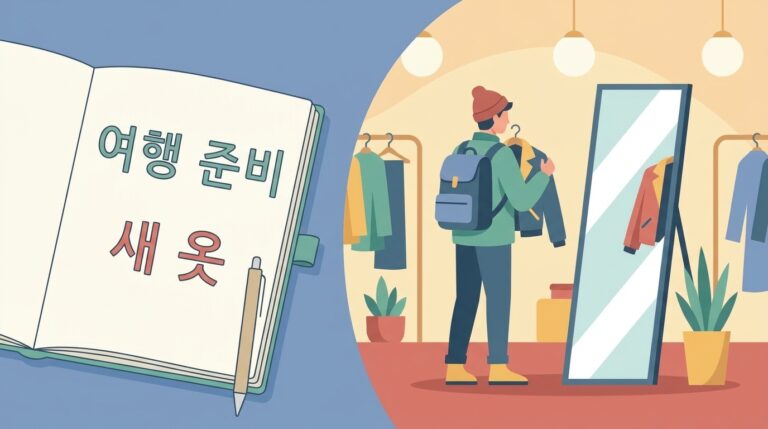
Picture this: You are wandering through the chic, bustling streets of Seongsu-dong or Hongdae. You step into a boutique with rack after rack of sleek, trendy K-fashion. Your eyes lock onto an oversized, effortlessly cool jacket. You slip your arm through the sleeve—it fits wonderfully! But now comes the awkward part: where on earth is the mirror? You stand in the aisle, craning your neck, holding the lapels together, making accidental eye contact with a smiling staff member while freezing up because the words just won’t come out.
Don’t worry, you are not alone! Wandering blindly in a stylish shop happens to almost every beginner traveling in Korea. With just one crisp, polite sentence, you can unlock full confidence, look like a savvy Seoulite, and turn an awkward pause into a smooth shopping trip. This lesson is built on real beginner pain points from our Daily Hangul learners—let’s make sure you never feel lost in front of a clothing rack again!
Phase 2: 핵심 표현 3선 심층 분석 (Top 3 Core Expressions)
1. 거울 어디 있어요? (Geoul eodi isseoyo?)
- Pronunciation: [Geoul eodi isseoyo?] (Sounds like: Guh-wool uh-dee ee-ssuh-yo?)
- Meaning: Literal: “Mirror, where is it?” | Actual Nuance: “Excuse me, where can I find a mirror?”
- K-Culture Moment: Picture standard K-Drama makeover scenes where the lead steps out in a fresh new outfit and turns to the boutique assistant to locate the nearest full-length mirror.
- Editor’s Insight: “어디 있어요?” (Eodi isseoyo?) is your ultimate travel Swiss Army knife. Whenever you need anything—from restrooms to fitting rooms—just put the noun in front of it!
- Situation Spectrum: Casual (⚠️ 거울 어디 있어? – close friends only) / Semi-formal (✅ 거울 어디 있어요? – perfect for retail shopping) / Formal (✅ 거울이 어디에 있습니까? – slightly overly stiff for a trendy clothing store)
- 🤔 Think About It: In English, you start with the question word (“Where is…”), but Korean anchors the noun first (“Mirror, where is it?”). Notice how this immediately tells the listener what you care about most!
2. 입어봐도 돼요? (Ibeobwado dwaeyo?)
- Pronunciation: [I-beo-bwa-do dwae-yo?] (Sounds like: Ee-buh-bwah-doh dweh-yo?)
- Meaning: Literal: “Even if I try wearing it, is it okay?” | Actual Nuance: “May I try this on?”
- K-Culture Moment: In many Korean indie shops, certain knitwear or white shirts cannot be tried on due to makeup marks. Asking this before stepping into a fitting stall displays top-tier etiquette.
- Editor’s Insight: The pattern “-도 돼요?” (-do dwaeyo?) is the gold standard for asking permission. Use it to sound respectful and considerate.
- Situation Spectrum: Casual (⚠️ 입어봐도 돼? – friends) / Semi-formal (✅ 입어봐도 돼요? – standard polite for shops) / Formal (✅ 입어보아도 되겠습니까? – excessively formal)
- 🤔 Think About It: Why does Korean phrase permission as “is it okay even if I do this?” It reflects a cultural mindset prioritizing mutual comfort and harmony.
3. 저한테 어울려요? (Jeohante eoullyeoyo?)
- Pronunciation: [Jeo-han-te eoul-lyeo-yo?] (Sounds like: Juh-hahn-teh uh-wool-lyuh-yo?)
- Meaning: Literal: “Toward me, does it suit?” | Actual Nuance: “Does this look good on me?”
- K-Culture Moment: The classic scene of best friends spinning in front of the fitting mirror while shopping together in Myeongdong.
- Editor’s Insight: The verb “어울리다” (eoullida) means to harmonize or blend nicely. You aren’t just asking if the clothes are pretty; you’re asking if they match your personal vibe!
- Situation Spectrum: Casual (⚠️ 나한테 어울려? – friends) / Semi-formal (✅ 저한테 어울려요? – polite companions or friendly shop owners) / Formal (✅ 저에게 어울립니까? – dramatic script style)
- 🤔 Think About It: In your native tongue, do you ask if clothing “fits” or if it “harmonizes” with you? How does that change the emotional feel of trying on clothes?
Phase 3: 교과서 한국어 vs 진짜 한국어 (Textbook vs. Real Korean)
Situation 1: Asking where the mirror is located
- 📖 교과서 한국어: 거울이 어느 쪽에 위치해 있습니까? (Geouri eoneu jjoge wichihae isseumnikka? / On which side is the mirror situated?)
- 🗣️ 진짜 한국어: 저기요, 거울 어디 있어요? (Jeogiyo, geoul eodi isseoyo? / Excuse me, where is the mirror?)
- 💡 왜 다를까?: Textbooks love heavy Sino-Korean vocabulary like “위치” (location), but real shoppers keep it snappy, natural, and polite using “어디 있어요?”.
Situation 2: Asking if you can try an item on
- 📖 교과서 한국어: 이 의복을 착용해 보아도 됩니까? (I uibogeul chagyonghae boado doemnikka? / May I wear this apparel?)
- 🗣️ 진짜 한국어: 이거 입어봐도 돼요? (Igeo ibeobwado dwaeyo? / Can I try this on?)
- 💡 왜 다를까?: Words like “의복” (apparel) and “착용” (donning/wearing) sound like legal contracts. Everyday Koreans simply say “이거” (this) and “입어보다” (to try wearing).
Phase 4: K-Culture 딥다이브 & 비언어적 매너 (Culture & Body Language)
4-1. 눈치 (Nunchi) & Gestures
When looking for a mirror in a Korean clothing shop, never barge behind curtains unannounced. Make gentle eye contact with the staff, give a slight bow of the head, and use an open hand (palm facing slightly upward) toward the item you are holding. Avoid pointing your index finger directly at people or fitting rooms, as that can seem sharp or confrontational. Also, keep an eye out for “페이스 커버” (face covers)—white disposable non-woven fabric hoods provided in fitting rooms. Placing one over your head before trying on tops protects the merchandise from foundation and lipstick marks!
4-2. Cultural Code Analysis: The Aesthetic Fitting Room
Seoul’s fashion hubs (like Hannam, Seongsu, and Sinsa) treat mirrors as interactive photo booths. Stores often install warm lighting and specially angled full-length mirrors (“전신거울” – jeonsingeoul) to give you the ultimate silhouette. Snapping an “OOTD” (착샷 – fitting shot) in the store mirror is not just allowed; it is actively celebrated in K-fashion retail!
Phase 5: 실전 롤플레이 시나리오 (Interactive Roleplay)
- Setting: “Studio Seongsu”, a minimalist clothing boutique with soft ambient music and warm beige interiors.
- Characters: Minji (the warm, trendy store associate) & You (the stylish shopper).
- Staff (Minji): 어서 오세요! 편하게 보세요. (Eoseo oseyo! Pyeonhage boseyo. / Welcome! Please take your time looking around.)
🎭 Bowing lightly with a welcoming smile. - Learner: 저기요, 이거 입어봐도 돼요? (Jeogiyo, igeo ibeobwado dwaeyo? / Excuse me, can I try this on?)
🎭 Holding up an olive green trench coat. - Staff (Minji): 네, 저쪽 피팅룸 이용하시면 돼요! (Ne, jeojjok pitingrum 이용hasimyeon dwaeyo! / Sure, you can use the fitting room right over there!)
🎭 Directing you with an open-hand gesture. - Learner: 감사합니다! (Gamsahamnida! / Thank you!)
🎭 Nodding politely and stepping into the booth. - Learner: 저기, 거울 어디 있어요? (Jeogi, geoul eodi isseoyo? / Excuse me, where is the mirror?)
🎭 Stepping out wearing the coat and looking around. - Staff (Minji): 피팅룸 바로 오른쪽에 전신거울 있어요! (Pitingrum baro oreunjjoge jeonsingeoul isseoyo! / There is a full-length mirror right to the right of the fitting room!)
🎭 Pointing gently toward the corner. - Learner: 아, 찾았어요! 저한테 어울려요? (A, chajasseoyo! Jeohante eoullyeoyo? / Ah, found it! Does it look good on me?)
🎭 Checking the fit in the mirror and turning around. - Staff (Minji): 완전 찰떡이에요! 진짜 잘 어울리세요. (Wanjeon chaltteogieyo! Jinjja jal eoulliseyo. / It suits you like a dream! It looks truly great on you.)
🎭 Clapping small hands together approvingly.
🔀 인터랙티브 분기점 (Choose Your Move!)
What do you say when you step out of the stall and can’t see your reflection?
* Choice A: “거울 어디 있어요?” (Geoul eodi isseoyo?)
Feedback: [Best Choice] Polite, natural, and directly gives the clerk the exact context to guide you.
* Choice B: “야! 거울 내놔!” (Ya! Geoul naenwa!)
Feedback: [Bad Choice] “Hey! Hand over the mirror!” Super rude! This sounds like a schoolyard bully demanding lunch money.
* Choice C: “거울 보여주세요!” (Geoul boyeojuseyo!)
Feedback: [Risk Choice] Literal meaning: “Show me the mirror!” It makes it sound like you want them to bring a small compact mirror to your face rather than pointing out the standing mirror.
Phase 6: 10초 감정 섀도잉 드릴 (Emotion Shadowing Drill)
Repeat these aloud with the designated intonation and emotional flair!
[😊 Polite & Inquiring]저기요, / 거울 / 어디 있어요? (Jeogiyo, / geoul / eodi isseoyo?)[🤔 Careful & Respectful]이거 / 한번 / 입어봐도 돼요? (Igeo / hanbeon / ibeobwado dwaeyo?)[✨ Bright & Curious]저한테 / 잘 / 어울려요? (Jeohante / jal / eoullyeoyo?)
Phase 7: K-Culture 미니 사전 (Mini Dictionary)
- 거울 (Geoul) | Mirror | A standard mirror. For a full-body mirror, combine it with “whole body” to say 전신거울 (jeonsin-geoul).
- 피팅룸 / 탈의실 (Piting-rum / Tal-ui-sil) | Fitting Room / Changing Room | Modern boutiques in Seoul almost exclusively write and say “피팅룸” (fitting room), while departmental stores might use “탈의실”.
- 페이스 커버 (Pe-i-seu keo-beo) | Face Cover | The essential protective fabric hood found in fitting booths to prevent makeup smudges on new apparel.
- 착샷 (Chak-syat) | Try-on Shot / OOTD Photo | A trendy portmanteau of “착용” (wearing) + “샷” (shot). Often used when uploading mirror selfies to Instagram or showing friends.
Phase 8: 여행자를 위한 생존 키트 (Traveler’s Survival Kit)
Survival Expressions TOP 3
- 거울 어디 있어요? (Geoul eodi isseoyo?) – Where is the mirror?
Pro Tip: Always lead with “저기요” (Jeogiyo – excuse me) to catch the clerk’s ear gently. - 큰 사이즈 있어요? (Keun sa-i-jeu isseoyo?) – Do you have a larger size?
Pro Tip: Korean garments are often tailored slightly slimmer than Western cuts. Don’t hesitate to ask for a size up! - 카드로 결제할게요. (Kadeu-ro gyeoljehalgeyo.) – I’ll pay by card.
Pro Tip: Korea is virtually cashless; card readers are waiting right at the counter.
Editor’s Travel Note
When shopping through trendy alleys in Hongdae or underground malls in Express Bus Terminal, Google Maps often fails to show floor-by-floor layouts. Be sure to check our resource to Download the Naver Map App for iOS and Android to navigate subway exits and shop locations accurately. Also, look for the “Tax Free” logo at the register to claim an instant refund with your passport!
Phase 9: “한 발 더 깊이” (A Step Deeper)
In Korean culture, retail shopping isn’t just a cold, transactional exchange—it is a lively, shared experience of self-expression. When a staff member beams and says “완전 찰떡이에요!” (It fits you like a sweet rice cake!), they are extending warm, communal encouragement. Asking “저한테 어울려요?” invites that friendly interaction, bridging the gap between traveler and local through everyday fashion.
💬 Your Turn: What is your go-to question when shopping in a new country? Have you ever had a funny or confusing moment trying to find a fitting room? Share your story in the comments below!
Phase 10: FAQ & 오해 방지 (FAQ & Common Mistakes)
Q: Can I try on white clothes or knitwear in Korean clothing stores?
A: In many boutique shops, white shirts, thin knits, and light blouses are strictly “No Try-on” items to avoid cosmetic stains. Always point and ask “입어봐도 돼요?” (Ibeobwado dwaeyo?) first.
Q: What should I do with my shoes when entering a fitting room?
A: Look at the floor right before the curtain. If you see a raised wooden platform, a rug, or indoor slippers, take off your outdoor shoes before stepping in.
Q: How do I specify that I need a full-length mirror, not just a small face mirror?
A: Say “전신거울 어디 있어요?” (Jeonsingeoul eodi isseoyo?). “전신” means whole body, making your request unmistakable.
🚨 흔한 실수 (Common Mistakes) 경고판
- Calling the staff “언니” (Eonni) or “오빠” (Oppa) right away
Correct Action: Unless you know the clerk personally, use “저기요” (Jeogiyo – Excuse me) or “사장님” (Sajangnim – Boss/Store owner). It sounds polite and respectful. - Ignoring the Face Cover (페이스 커버)
Correct Action: If you are wearing foundation, sunblock, or lip tint, always slip the disposable pouch over your face before putting on a pullover. - Walking out into the main street while wearing unpurchased clothes
Correct Action: While mirrors are sometimes placed just outside individual fitting stalls, remain within the store boundaries so staff don’t think you’re walking off!
Phase 11: 액션 미션 & 참여 유도 (Action Missions)
- 🥉 Bronze Level: Stand before your own bathroom mirror right now and say “거울 어디 있어요?” 3 times out loud with clear intonation.
- 🥈 Silver Level: Write a comment below answering: “이 옷 어때요?” (How is this outfit?) using one word you learned today!
- 🥇 Gold Level: On your next trip to Korea (or at a local K-fashion popup), ask the clerk “입어봐도 돼요?” before trying on your favorite item.
- 🎮 K-Culture Mission: Watch an episode of a fashion or romance K-Drama and listen for characters complimenting each other with “잘 어울려요!” (It suits you!).
Phase 12: 인터랙티브 퀴즈 챌린지 (Interactive Quiz)
Test your knowledge from today’s unit!
1. Situational Judgment: You find a cute sweater in a boutique and want to ask the clerk if you are allowed to try it on. What should you say?
– (A) 이거 입어봐도 돼요?
– (B) 이거 거울 어디 있어요?
– (C) 이거 얼마예요?
2. Fill-in-the-blank: Fill in the missing word to ask “Where is the mirror?”:
“_______ 어디 있어요?”
3. True or False: In Korean clothing stores, you can always wear your street shoes inside any fitting stall without looking at the floor rules.
– [ ] True
– [ ] False
👉 Click here to reveal the answers and explanations!
-
Answer: (A) 이거 입어봐도 돼요?
Explanation: “이거 입어봐도 돼요?” means “Can I try this on?” (B) asks where the mirror is, and (C) asks how much it costs. -
Answer: 거울 (Geoul)
Explanation: “거울” means mirror, making the complete phrase “거울 어디 있어요?”. -
Answer: False
Explanation: Many Korean boutiques require you to step out of street shoes onto a platform or slipper mat to keep the booth clean!







