

Never Panic in a Korean Cafe: How to Ask for the Restroom Password Like a Local
Phase 1: 공감 (Story Immersion)
안녕하세요! 매일한글 에디터입니다.
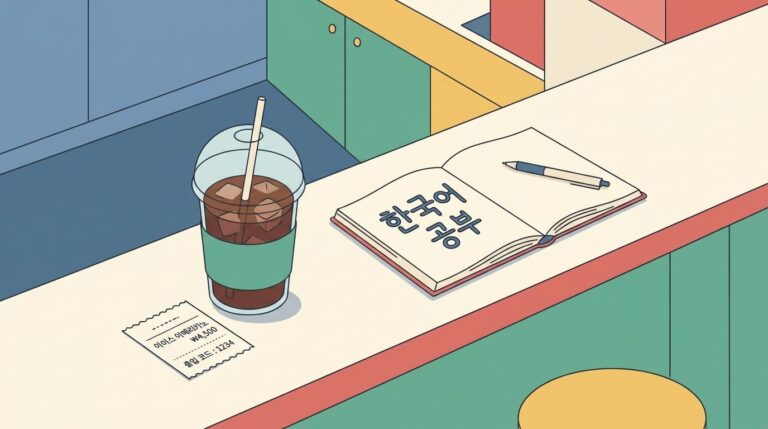
Picture this: You are sitting in a sun-drenched, aesthetically curated cafe in the bustling alleys of Seongsu-dong, Seoul. Soft lo-fi indie music is playing from vintage speakers, and you’ve just happily gulped down half of your giant A-A (Iced Americano). Life feels like an episode of your favorite slice-of-life K-drama.
Then, nature calls. Urgently.
You spot the restroom door tucked away near the back corridor. Relieved, you walk up and reach for the handle—only to find it firmly locked. Right next to the handle sits a glowing, digital keypad (doorlock). Panic creeps in. You didn’t see a physical key anywhere. You frantically look around, wondering if you need to run out into the street or if there’s a secret code everyone else knows.
Take a deep breath! You are not alone. Just last month, Sarah, one of our beginner A1 students from Chicago, shared this exact nightmare: “I stood by the counter for five minutes, rehearsing in my head while holding my bladder, terrified I’d sound rude or embarrass myself in front of the barista.”
In South Korea, almost every modern cafe keeps its restroom locked with a passcode to prevent public overcrowding. Knowing how to ask for this simple 4-digit code in natural Korean will instantly save your trip, spare you awkward sweating at the counter, and make you feel like a true local Seoulite. Let’s conquer this essential survival skill together!
Phase 2: 핵심 표현 3선 심층 분석 (3 Core Expressions)
Here are the three golden phrases you need to navigate any locked bathroom scenario with confidence:
1. 화장실 비밀번호가 뭐예요? (Hwajangsil bimilbeonhoga mwoyeyo?)
- Pronunciation: [Hwa-jang-sil bi-mil-beon-ho-ga mwo-ye-yo?]
- Sound Tip: Think of hwa as “what” without the “t”, jang as “jar” ending in “ng”, and sil like “silk” without the “k”. For bimil, imagine “bee-meal”.
- Meaning: Literal: “What is the restroom secret number?” | Real-world nuance: “Excuse me, what is the bathroom password?” (Polite, natural, and crystal clear).
- K-Culture Moment: In K-Dramas like Hospital Playlist or Business Proposal, you often see characters casually popping back over to the cafe counter asking this exact question while holding their coat.
- Editor’s Insight: 비밀번호 (bimilbeonho) literally means “secret number.” While younger Koreans frequently shorten it to 비번 (bi-beon) in casual speech, using the full word with ~가 뭐예요? (~ga mwoyeyo? / What is…?) is the safest, friendliest standard polite style (해요체) for beginners.
- Situation Spectrum:
- Casual (반말): ⚠️ (Only with close friends: 화장실 비번 뭐야?)
- Semi-formal (해요체): ✅ Perfect for staff and baristas!
- Formal (하십시오체): ⚠️ (Too stiff for a trendy cafe: 비밀번호가 무엇입니까?)
- 🤔 Think About It: In English, we rarely say “secret number” for a keycode—we just say “code” or “door code.” Why do you think Korean uses the word “secret (비밀)” even for a shared public restroom?
2. 영수증에 있어요? (Yeongsujeunge isseoyo?)
- Pronunciation: [Yeong-su-jeung-e is-seo-yo?]
- Sound Tip: Yeong sounds like “young”, su like “soup” without “p”, and jeung like “jungle” without “le”. Isseoyo sounds like “E-saw-yo”.
- Meaning: Literal: “Is it on the receipt?” | Real-world nuance: “Can I find the code printed on my receipt?”
- K-Culture Moment: When a barista hands over a tray with drinks, they frequently point a finger at the paper receipt and say this before you even ask!
- Editor’s Insight: 90% of Seoul cafes print the Wi-Fi password and restroom door code at the very bottom or top of the paper receipt. If the counter is super busy, asking this quick question lets the barista just nod or point without breaking their latte-art rhythm.
- Situation Spectrum:
- Casual: ⚠️ (영수증에 있어?)
- Semi-formal: ✅ Ideal and efficient!
- Formal: ⚠️ (영수증에 있습니까? – overly formal)
- 🤔 Think About It: Why does Korea print passwords on receipts instead of hanging a giant sign on the wall? Think about the balance between customer convenience and building security.
3. 화장실 어디예요? (Hwajangsil eodiyeyo?)
- Pronunciation: [Hwa-jang-sil eo-di-ye-yo?]
- Sound Tip: Eo-di sounds like “uh-dee”. Finish with the melodic, rising ye-yo?
- Meaning: Literal: “Where is the restroom?” | Real-world nuance: “Excuse me, which way is the bathroom?”
- K-Culture Moment: The timeless classic line spoken by every lost tourist, every second character on a blind date in Hongdae, and anyone visiting a multi-story cafe for the first time.
- Editor’s Insight: Even with the password in hand, Korean cafe bathrooms are often hidden in intermediate stairwells or through an exterior side door. Keep this phrase ready in your pocket!
- Situation Spectrum:
- Casual: ⚠️ (화장실 어디야?)
- Semi-formal: ✅ Universal lifesaver!
- Formal: ⚠️ (화장실이 어디입니까?)
- 🤔 Think About It: In your home country, do cafes usually have restrooms inside their own space, or do they share common hallway restrooms with other shops like in Korea?
Phase 3: 교과서 한국어 vs 진짜 한국어 (Textbook vs. Real-Life Korean)
Situation 1: Asking for the door code at the counter
- 📖 교과서 한국어 (Textbook Korean):
- 화장실의 비밀번호를 알려주시겠습니까? (Hwajangsirui bimilbeonhoreul allyeojusigessseumnikka? / Would you please inform me of the restroom’s password?)
- 🗣️ 진짜 한국어 (Real-Life Korean):
- 저기요, 화장실 비번 뭐예요? (Jeogiyo, hwajangsil bibeon mwoyeyo? / Excuse me, what’s the bathroom code?)
- 💡 왜 다를까? (Why is it different?): Textbook phrasing uses heavy, literary grammar. In real life, Koreans value brevity (ppalli-ppalli culture) and abbreviate 비밀번호 to 비번 (bi-beon).
Situation 2: The staff explaining where the code is
- 📖 교과서 한국어 (Textbook Korean):
- 영수증 하단에 암호가 기재되어 있습니다. (Yeongsujeung hadane amhoga gijaedoeeo itseumnida. / The code is inscribed at the bottom of the receipt.)
- 🗣️ 진짜 한국어 (Real-Life Korean):
- 영수증 밑에 적혀 있어요! (Yeongsujeung mite jeokhyeo isseoyo! / It’s written at the bottom of the receipt!)
- 💡 왜 다를까? (Why is it different?): Native staff rarely use Sino-Korean administrative words like 하단 (hadan / bottom) or 암호 (amho / cipher/code) in oral speech. They use everyday words like 밑 (mit / bottom) and 적혀 있다 (to be written down).
Phase 4: K-Culture 딥다이브 & 비언어적 매너 (Deep Dive & Non-Verbal Manners)
4-1. 눈치 (Nunchi) & Body Gestures
- The Two-Handed Receipt Show: If you are holding your receipt and aren’t sure where the digits are, hold it with both hands, lightly point at the paper, and make soft eye contact with a gentle head nod. This shows immense respect without speaking a single complex sentence.
- The Soft “Jeogiyo” Finger Raise: When approaching the counter, don’t yell loudly. Raise your hand slightly to chest level (index finger extended slightly) and say a soft, apologetic 저기요… (Jeogiyo… / Excuse me). This gives the barista a polite visual cue.
- The Asterisk Check: At the electronic keypad door, look closely at the lock instructions! Most Korean commercial door locks require you to press [Asterisk *] + [4 Digits] + [Asterisk *] or [4 Digits] + [Shop/Key icon]. If you just type the 4 numbers and wait, the door won’t unlock!
4-2. Cultural Code: The Secret World of Korean “Sang-ga” (Commercial Buildings)
Why are Korean cafe restrooms locked in the first place? In Korea, high rental costs mean many boutique cafes rent ground-floor space inside shared commercial buildings (상가 / Sang-ga). The restrooms located in the back corridors are shared between multiple shops, clinics, and offices. To keep external pedestrians from using up toilet paper and dirtying the facilities, tenants install shared digital locks and distribute the code strictly to paying customers. It’s a fascinating reflection of shared urban space management!
Phase 5: 실전 롤플레이 시나리오 (Real-Life Roleplay Scenario)
Setting: Cafe Haru, a trendy minimalist coffee shop in Yeonnam-dong. You just finished your beverage and need the restroom before meeting a friend.
Character: Barista Min-su (friendly, wearing a linen apron, steaming milk).
- You: 저기요, 죄송한데요… (Jeogiyo, joesonghandeyo… / Excuse me, I’m sorry to bother you…)
- 🎭 Action: Step up to the pick-up counter, raising one hand slightly with an apologetic smile.
- Min-su: 네, 손님! 필요한 거 있으세요? (Ne, sonnim! Piryohan geo isseuseyo? / Yes, customer! Do you need something?)
- 🎭 Action: Wipes the counter with a cloth and smiles attentively.
- You: 화장실 비밀번호가 뭐예요? (Hwajangsil bimilbeonhoga mwoyeyo? / What is the restroom password?)
- 🎭 Action: Ask clearly with a polite vocal tone.
- Min-su: 아, 영수증 있으세요? (A, yeongsujeung isseuseyo? / Ah, do you have your receipt?)
- 🎭 Action: Points towards your wallet or bag.
- You: 아니요, 버렸어요… (Aniyo, beoryeosseoyo… / No, I threw it away…)
- 🎭 Action: Scratch back of head sheepishly.
- Min-su: 괜찮아요! 일, 이, 삼, 사 별표 누르시면 돼요. (Gwaenchanayo! Il, i, sam, sa byeolpyo nureusimyeon dwaeyo. / That’s okay! Just press 1-2-3-4 and the asterisk button.)
- 🎭 Action: Taps out the numbers on the counter with a finger to demonstrate.
- You: 1, 2, 3, 4 별표요? 화장실 어디예요? (Il, i, sam, sa byeolpyoyo? Hwajangsil eodiyeyo? / 1-2-3-4 asterisk? Where is the restroom?)
- 🎭 Action: Repeat the digits to confirm and look around the cafe.
- Min-su: 나가셔서 오른쪽 계단 밑에 있어요! (Nagasyeoseo oreunjjok gyedan mite isseoyo! / Go outside and it’s right under the stairs on the right!)
- 🎭 Action: Points his open palm toward the glass exit door.
🔀 Interactive Decision Point: What do you say next?
- Option A: 감사합니다! (Gamsahamnida! / Thank you!)
- Option B: 영수증 다시 주세요. (Yeongsujeung dasi juseyo. / Give me the receipt again.)
- Option C: 야, 문 열어줘! (Ya, mun yeoreojwo! / Hey, open the door for me!)
🔍 Click to reveal the Outcome & Feedback
- Choice A: [BEST! 🌟] Perfectly polite! A warm 감사합니다 accompanied by a slight bow leaves the barista with a wonderful impression of international visitors.
- Choice B: [RISK ⚠️] Grammatically fine, but demanding a reprint (dasi juseyo) when he already told you the verbal code might sound slightly demanding and unnecessary.
- Choice C: [BAD 🚫] Extreme faux pas! 야 (Ya) and informal 열어줘 are informal speech used with close childhood friends. Saying this to a barista will cause instant second-hand embarrassment!
Phase 6: 10초 감정 섀도잉 드릴 (10-Second Shadowing Drill)
Practice saying these lines out loud with the emotional markers and rhythm pauses (/):
[😅 Urgently, but maintaining polite manners]- 저기요, / 화장실 비밀번호가 / 뭐예요?
(Jeogiyo, / hwajangsil bimilbeonhoga / mwoyeyo?)
- 저기요, / 화장실 비밀번호가 / 뭐예요?
[🤔 Curious and checking your pocket]- 혹시… / 영수증에 / 적혀 있어요?
(Hoksi… / yeongsujeunge / jeokhyeo isseoyo?)
- 혹시… / 영수증에 / 적혀 있어요?
[😊 Relieved and super grateful]- 아, / 찾았어요! / 감사합니다!
(A, / chajasseoyo! / Gamsahamnida!)
- 아, / 찾았어요! / 감사합니다!
Phase 7: K-Culture 미니 사전 (Mini Dictionary)
- 비번 (Bi-beon)
- Meaning: Short for 비밀번호 (Password/Passcode).
- Usage: Widely used in everyday life: “와이파이 비번 (Wi-Fi password)”, “현관 비번 (Front door code)”.
- 영수증 (Yeong-su-jeung)
- Meaning: Paper receipt.
- Usage: When paying, baristas often ask: “영수증 드릴까요? (Shall I give you the receipt?)” Always say “네, 주세요! (Yes, please!)” to get your door code!
- 도어락 (Do-eo-rak)
- Meaning: Electronic keypad door lock.
- Usage: Korea is virtually keyless. Houses, cafes, and offices all use digital pin pads or RFID tags.
- 휴지 (Hyu-ji)
- Meaning: Toilet paper / tissues.
- Usage: Crucial warning: Many building restrooms do not have toilet paper inside the stalls! Look next to the cafe door for a roll of toilet paper to take with you before leaving.
Phase 8: 여행자를 위한 생존 키트 (Traveler’s Survival Kit)
Top 3 Emergency Expressions:
- 휴지 있어요? (Hyuji isseoyo?)
- Pronunciation: [Hyu-ji is-seo-yo?]
- Pro Tip: If the cafe restroom doesn’t have toilet paper inside, you may need to grab a handful from the counter napkin dispenser or take a roll hanging by the cafe exit.
- 문이 안 열려요! (Muni an yeollyeoyo!)
- Pronunciation: [Mun-i an yeol-lyeo-yo!]
- Pro Tip: If you typed the code and it beeps with a red light, come back and tell the staff this sentence: “The door won’t open!”
- 남녀 공용이에요? (Namnyeo gong-yong-ieyo?)
- Pronunciation: [Nam-nyeo gong-yong-i-e-yo?]
- Pro Tip: Means “Is it unisex?” Many older buildings have single shared restrooms for all genders.
🧭 Editor’s Travel Note:
- Navigation Lifesaver: Google Maps has limited walking navigation in Korea. Make sure to download the Naver Map app on iOS and Android or KakaoMap app for real-time indoor subway station floorplans.
- Public Restroom Backup: If a cafe bathroom has a long line or broken lock, run to the nearest Seoul Metro subway station! Subway restrooms in Korea are universally clean, completely free, and never require a passcode.
Phase 9: “한 발 더 깊이” (Food for Thought)
Korean cafes are not just places to grab coffee; they function as extended living rooms, study lounges, and remote offices in a country with high-density apartment living. Because people linger for hours with laptops and books, cafes must carefully balance open hospitality with boundary security. The humble keypad doorlock represents this delicate line—protecting paying patrons’ safety and hygiene while keeping shared spaces clean.
Language reflects this culture: asking for the 비밀번호 (bimilbeonho) isn’t viewed as an inconvenience, but as a mutual ritual between customer and shopkeeper.
💬 Your Turn: Have you ever encountered a locked bathroom while traveling abroad? How did you handle the situation, and how is it different from your hometown? Let us know in the comments below!
Phase 10: FAQ & 흔한 실수 (FAQ & Common Mistakes)
Q: Why do Koreans put an asterisk (*) before or after the password?
A: Electronic door locks (도어락) use the asterisk key (*) as an “Enter” command. If the code is 1234, typing 1 2 3 4 * signals the lock computer to authenticate the numbers. Some older models require * 1234 * to wake up the sensor pad.
Q: What if the barista didn’t give me a receipt?
A: Simply walk up to the counter and say: “저기요, 영수증 좀 주실 수 있어요?” (Excuse me, could I please have the receipt?) or directly ask the 3 core phrases from Phase 2!
Q: Can I use the cafe restroom before ordering my drink?
A: Culturally, it’s considered impolite (결례) to use private business facilities without placing an order first. Order your drink, grab the receipt, and then head to the restroom with full peace of mind.
🚨 흔한 실수 (Common Mistakes Warning Board)
- Mistake: Throwing away the receipt immediately without looking.
- Correct Action: Keep the receipt at your table until you finish your visit! The Wi-Fi and door codes are almost always printed right there.
- Mistake: Using aggressive informal speech (야! 어디야?).
- Correct Action: Always start with 저기요 (Jeogiyo) and end verbs with polite ~요 (~yo).
- Mistake: Forgetting to grab toilet paper before leaving the shop.
- Correct Action: Glace around the cafe exit door. If you spot a roll of toilet paper sitting on a shelf, that’s your sign that the outside stall has no dispenser!
Phase 11: 액션 미션 & 참여 유도 (Action Missions)
- 🥉 Bronze Mission (Solo Practice): Stand in front of your bathroom mirror. Practice asking “화장실 비밀번호가 뭐예요?” 5 times with natural intonation in under 10 seconds.
- 🥈 Silver Mission (Social Share): Next time you visit a cafe (even outside Korea), check your receipt! Take a photo of your coffee and share your favorite Korean cafe phrase on Instagram or Threads tagging
#DailyHangul. - 🥇 Gold Mission (Real-World Test): On your next trip to Seoul, order an Iced Americano, keep your receipt, and successfully unlock the bathroom doorlock on your very first try!
- 🎮 K-Culture Mission: Watch any episode of the slice-of-life drama Our Blues or My Liberation Notes. Notice how characters interact with store clerks when entering small shops!
Phase 12: 인터랙티브 퀴즈 챌린지 (Interactive Quiz Challenge)
1. Situation Judgment
You just ordered an iced latte at a busy cafe in Myeongdong. You need the bathroom immediately, but three people are waiting in line to order behind you. What is the smartest, most native action?
* A) Cut the line and shout “비번 뭐야?” at the barista.
* B) Check the bottom of your freshly printed paper receipt first.
* C) Try guessing random 4-digit numbers on the keypad lock.
💡 View Answer & Explanation
Correct Answer: B
Explanation: 90% of cafe door codes are printed right at the top or bottom of your receipt! Checking your receipt saves you from waiting in line again and avoids disturbing the busy barista.
2. Fill-in-the-Blank
Complete the sentence to ask where the restroom is:
* “화장실 _________?” (Where is the restroom?)
* Hint: Starts with 어 (eo).
💡 View Answer & Explanation
Correct Answer: 어디예요 (eodiyeyo)
Explanation: 어디 (eodi) means “where”, and ~예요 (yeyo) is the polite ending. Together, 화장실 어디예요? is the universal way to ask for directions inside a building.
3. True or False (Culture Check)
Statement: Korean electronic door locks will automatically open if you simply type the 4 numbers and wait.
* True or False?
💡 View Answer & Explanation
Correct Answer: False
Explanation: Almost all Korean digital locks require you to press the asterisk (*) button or the key icon after typing the numbers to execute the unlock command!







