

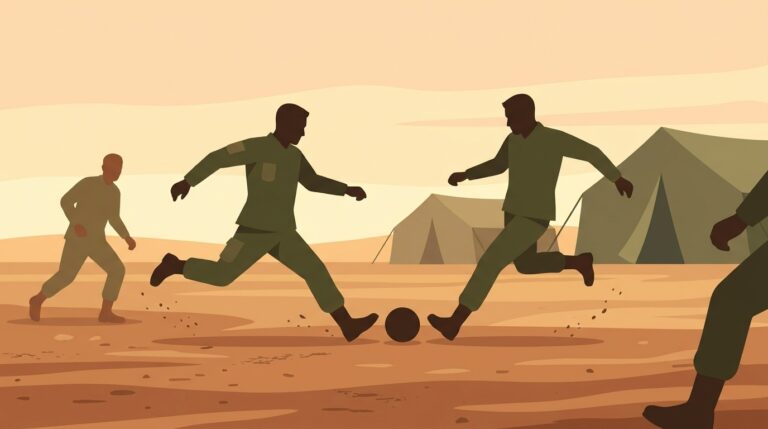
Phase 1: 공감 (Story-Driven Opening)
안녕하세요! 매일한글 에디터입니다.
Imagine this scene: It is a scorching Wednesday afternoon at 3:30 PM on an unpaved, gravel-strewn military sports ground somewhere in Gangwon Province. The dust is flying high, the sun is relentless, and twenty-two men in matching camouflage-trimmed athletic shorts are sprinting as if their lives depended on it. On one side is Captain Kim, barking orders with ferocious intensity; on the other is First Sergeant Park, whose knees creak with every tackle, yet nobody dares to steal the ball from his feet with full force. Welcome to the legendary world of 군대스리가 (Gundaesliga)—the mythical intersection of national defense, cutthroat soccer, and intricate social hierarchy that defines the mandatory military experience in South Korea.
For advanced learners navigating contemporary Korean society, military soccer is far more than just barracks banter. It is the cultural crucible where high-context interpersonal dynamics—known as nunchi (눈치)—are forged under extreme physical duress. If you have ever cringed when someone in a Korean drama groaned, “또 군대에서 축구한 이야기야?” (Not another story about playing soccer in the army!), you were witnessing one of the most culturally loaded running gags in modern Korean communication. Our C2-level international corporate leaders and advanced scholars often share a major pain point: when joining athletic outings or casual drinking sessions (hoesik) with Korean male colleagues, conversations inevitably veer into military memories and athletic euphemisms, leaving even fluent speakers baffled by the subtext.
This masterclass bridges that exact cultural divide. By examining the dialectics of combat physical training (jeontu che-yuk) and competitive sports banter, you will unlock the socio-linguistic subtleties required to thrive in Korea’s most hierarchical yet passion-fueled conversations.
Phase 2: 핵심 표현 3선 심층 분석 (Deep Dive into 3 Core Expressions)
1. 사회에서 공 좀 차다 왔습니다 (Sahoe-eseo gong jom chada watseumnida)
- Pronunciation: [Sah-hwe-eh-seo gong jom cha-da wat-seum-ni-da] (Think of the crisp g in go, followed by a light, clipped ch like cheese).
- Meaning: Literal: “I used to kick the ball a bit back in civilian society.” / Nuanced: A tactical humblebrag signaling elite soccer proficiency while maintaining deferential modesty.
- K-Culture Moment: Featured routinely in military comedies like Blue Tower (푸른거탑) and YouTube comedy skits like Shortbox (숏박스), where a fresh recruit tries to sound modest before completely dismantling the opposing senior officers on the pitch.
- Editor’s Insight: In the Korean armed forces, the outside world is ubiquitously referred to as 사회 (civilian society). Using “공 좀 차다” employs litotes (understatement). Saying you played collegiate or semi-pro soccer directly sounds arrogant; saying you “kicked the ball a bit” prepares your superiors for your talent without threatening their ego.
- Situation Spectrum: Casual: ⚠️ | Semi-formal: ✅ | Formal: ✅
- 🤔 Think About It: Why does Korean collectivism reward understated competence rather than overt self-promotion in athletic arenas?
2. 눈치껏 살살 차라 (Nunchikkeot salsal chara)
- Pronunciation: [Noon-chi-kkeot sal-sal cha-ra] (The double consonants kk and s require sharp glottal tension, like the brisk snap in cat-tail).
- Meaning: Literal: “Kick softly according to your nunchi.” / Nuanced: “Read the room and don’t tackle the commanding officer too aggressively unless you want weekend leave canceled.”
- K-Culture Moment: Seen in hit series like D.P. or entertainment shows like Real Men (진짜 사나이), when a nervous private is warned by his squad leader right before a match against the battalion commander’s team.
- Editor’s Insight: This phrase captures the absolute apex of situational etiquette. If you play too poorly, the officer gets angry because the match is boring; if you play too well and strip the ball, you humiliate your boss. 눈치껏 demands navigating the razor-thin margin between competitive authenticity and hierarchical deference.
- Situation Spectrum: Casual: ✅ | Semi-formal: ⚠️ | Formal: 🚫
- 🤔 Think About It: How do corporate sports days in your home culture navigate matches between senior executives and junior staff?
3. 군대에서 축구한 이야기 (Gundae-eseo chuk-gu-han iyagi)
- Pronunciation: [Goon-dae-eh-seo chook-goo-han ee-yah-gi] (Smooth, flowing cadences; chuk-gu sounds like the brisk chook in chook-rook).
- Meaning: Literal: “Stories of playing soccer in the military.” / Nuanced: The ultimate conversational taboo representing unsolicited, excruciatingly repetitive, and self-aggrandizing chatter.
- K-Culture Moment: The legendary Korean dating meme: “The three things people hate hearing most on blind dates: 1. Military stories, 2. Soccer stories, 3. Stories about playing soccer in the military.”
- Editor’s Insight: At a C2 level, you can use this idiom playfully in professional settings. If a colleague is rambling incessantly about past glory days during a project post-mortem, saying “지금 군대에서 축구한 이야기 하시는 겁니까?” diffuses tension with razor-sharp cultural wit.
- Situation Spectrum: Casual: ✅ | Semi-formal: ✅ | Formal: ⚠️
- 🤔 Think About It: What is the equivalent conversational trope in your native culture that instantly makes listeners glaze over?
Phase 3: 교과서 한국어 vs 진짜 한국어 (Textbook vs. Real-World Korean)
Situation 1: Calling for a pass during a high-stakes match
- 📖 교과서 한국어: 저에게 공을 패스해 주시겠습니까? (Jeo-ege gong-eul paesseu-hae ju-si-get-seumnikka? – “Would you please pass the ball to me?”)
- 🗣️ 진짜 한국어: 여기 비었습니다! 뒤에 사람 붙습니다! (Yeogi bieot-seumnida! Dwie saram bat-seumnida! – “I’m open here! Man on, you’ve got a defender pressing from behind!”)
- 💡 왜 다를까?: Military soccer strips honorific fluff down to brisk, vital tactical shorthand (군더더기 없는 전술 구호). On the dirt field, politeness yields to split-second survival instincts, though military honorific endings (-습니다/ㅂ니다) are miraculously preserved.
Situation 2: Consoling an executive or superior who missed an open goal
- 📖 교과서 한국어: 실망하지 마세요. 다음에는 넣을 수 있습니다. (Silmang-haji maseyo. Daeum-eneun neoheul su itseumnida. – “Do not despair. You can score next time.”)
- 🗣️ 진짜 한국어: 아, 각이 너무 예술이었습니다! 궤적이 살아있네요! (A, gak-i neomu yesul-ieot-seumnida! Gwejeok-i sara-itneyo! – “Ah, the angle was pure art! The trajectory had brilliant life!”)
- 💡 왜 다를까?: Blunt honesty can rupture social harmony (기분 관리). Subordinates transform an executive’s technical blunder into an aesthetic near-miracle through hyperbolic praise.
Phase 4: K-Culture 딥다이브 & 비언어적 매너 (Deep Dive & Non-Verbal Nuance)
4-1. 눈치 (Nunchi) & Gestures on the Dirt Pitch
In 전투 체육 (Combat Physical Training), body language communicates rank as clearly as uniform insignias.
* The Two-Handed Hand-off (두 손 전달): When offering water, an energy drink, or retrieving an out-of-bounds ball for a superior, never toss it or hand it over with one hand. Cup your left hand beneath your right elbow or wrist while extending the object.
* The Self-Effacing Trot: If you accidentally bump into an officer, immediately lower your posture, tuck your elbows inwards, bow your head slightly at a 15-degree angle, and trot backwards two paces while saying, “죄송합니다! 다치지 않으셨습니까?” (Jwesong-hamnida! Dachiji aneusyeot-seumnikka?).
* Celebration Moderation: If your squad scores against the Commander’s team, rejoice with quiet high-fives directed toward your peers while keeping your back partially turned from the officer’s gaze. High-stepping or extravagant dances are cultural suicide.
4-2. Cultural Code Analysis: From Barracks to Boardrooms
Why does Korea obsess over Gundaesliga? In modern Korean society, conscription creates a universal generational baseline for approximately half the population. But more importantly, the corporate ecosystem inherited the behavioral blueprints of the military. When Korean conglomerates hold their annual Che-yuk-dae-hoe (체육대회 – Company Athletic Field Days), the dynamics are 100% modeled on military combat physical training.
Understanding terms like 수비 가담 (tracking back on defense) or 공간 침투 (penetrating open space) gives you conversational currency in post-work drinks (회식), where project delivery is routinely framed using aggressive athletic metaphors rooted in military service memories.
Phase 5: 실전 롤플레이 시나리오 (Interactive Role-Play Scenario)
Setting: It is Wednesday 4:00 PM on the gravel field of the 3rd Infantry Division. The dust is thick. First Sergeant Park (박 상사), a veteran of 18 years known for his ruthless slide tackles, is panting on the sidelines during half-time. You are a newly transferred officer/specialist.
- Turn 1 (First Sergeant Park):
야, 신임 소대장! 아까 전반전에 우리 대대장님한테 다이렉트로 태클 들어간 놈 누구야? 간이 배 밖으로 나왔구만?
(Ya, sinim sodaejang! Akka jeonbanjeon-e uri daedaejang-nim-hante dairekteu-ro taekeul deureogan nom nuguya? Gan-i bae bakkeuro nawakkuman?)
“Hey, Lieutenant! Who was the reckless guy who slide-tackled the Battalion Commander directly in the first half? Has he completely lost his mind?”
🎭 Wiping sweat from his weathered forehead with a rolled-up towel, narrowing his eyes suspiciously. -
Turn 2 (You):
제가 조금 의욕이 앞섰던 것 같습니다. 승부욕을 주체하지 못했습니다.
(Je-ga jogeum uiyok-i apseotdeon geot gatseumnida. Seungbuyok-eul juchehaji mot-haet-seumnida.)
“I believe my ambition got ahead of me, Sergeant. I failed to control my competitive drive.”
🎭 Standing at attention with hands clasped behind back, voice respectful yet firm. -
Turn 3 (First Sergeant Park):
허, 의욕? 군대스리가는 월드컵보다 빡센 곳이야. 대대장님 기분 다운되면 이번 주말 영내 대기인 거 몰라?
(Heo, uiyok? Gundaesliga-neun woldeukeop-boda ppaksen gosiya. Daedaejang-nim gibun daun-doemyeon ibeon jumal yeongnae daegi-in geo molla?)
“Hah, ambition? Gundaesliga is harsher than the World Cup. Don’t you know that if the Commander’s mood drops, the entire company is grounded this weekend?”
🎭 Chucking a slightly dented sports drink can into the bin with a wry smirk. -
Turn 4 (You):
후반전에는 눈치껏 공간만 열어드리고 직접 경합은 피하겠습니다.
(Hubanjeon-eneun nunchikkeot gonggan-man yeoreo-deurigo jikjeop gyeonghap-eun pihaget-seumnida.)
“In the second half, I will read the room, open up space for him, and avoid direct physical contention.”
🎭 Nodding decisively with eyes fixed on the tactics board. -
Turn 5 (First Sergeant Park):
그렇다고 너무 대놓고 티 나게 비켜주면 더 화내신다. 폼은 살려드리면서 막판에 한 골 내어드리는 게 기술이야. 사회에서 공 좀 찼다며?
(Geureotdago neomu daenohgo ti nage bikyeojumyeon deo hwanaesinda. Pom-eun sallyeo-deurimyeonseo makpan-e han gol naeeo-deurineun ge gisuriya. Sahoe-eseo gong jom chatdamyeo?)
“If you step aside too blatantly, he gets even angrier! The real art is making his form look glorious while graciously allowing him a goal at the buzzer. Didn’t you say you kicked the ball a bit back in civilian life?”
🎭 Tapping your shoulder with his knuckles, grinning playfully. -
Turn 6 (You):
대원대 축구동아리 주장이었습니다. 정교한 패스워크로 각을 만들어 드리겠습니다.
(Daewondae chukgu-dong-ari jujang-ieot-seumnida. Jeong-gyohan paeseu-wokeu-ro gak-eul mandeureo deuriget-seumnida.)
“I was captain of my university soccer club. I’ll engineer the precise angles through tactical pass-work.”
🎭 Lowering posture slightly with focused confidence. -
Turn 7 (First Sergeant Park):
좋아! 후반 휘슬 울린다. 우리 중대 명예랑 주말 외박이 네 발끝에 달렸다. 가자!
(Joha! Huban hwiseul ullinda. Uri jungdae myeongye-rang jumal oebak-i ne balkkeut-e dallyeotda. Gaja!)
“Good! The second-half whistle is blowing. Our company’s honor and weekend leave are riding on your toes. Move out!”
🎭 Banging cleats against the dugout post to shake off dried mud, pointing toward midfield. -
Turn 8 (You):
네, 알겠습니다! 승리와 외박 둘 다 쟁취하겠습니다!
(Ne, alget-seumnida! Seungni-wa oebak dul da jaengchwihaget-seumnida!)
“Sir, yes sir! We will secure both victory and our weekend passes!”
🎭 Sprinting onto the pitch with determined energy.
🔀 인라인 인터랙티브 분기점 (Branching Decision)
During the 88th minute of the second half, the Commander receives a loose ball right outside your penalty box. You are the last defender. What do you do?
- Option A: Execute a perfect sliding tackle cleanly touching only the ball, leaving the Commander flat on his back, then initiate a counterattack.
- Option B: Charge in fiercely with loud verbal pressure (“압박! 압박!”), but intentionally mistime your planting foot by 10 centimeters, allowing the Commander to cut inside and blast a spectacular shot into the top corner.
- Option C: Freeze in place, bow politely, and point towards your own empty net inviting him to shoot comfortably.
Feedback:
* Option A (Risk / Dangerous): Technically clean, politically disastrous. You preserved your soccer dignity, but the Battalion Commander will be reviewing your unit’s administrative paperwork with a magnifying glass for the next three weeks.
* Option B (Best Choice): Pure C2-level nunchi mastery! You provided the visceral adrenaline of intense competition while granting your superior the personal glory of a dramatic game-winner. Weekend leave secured.
* Option C (Bad / Unacceptable): Blatant mock-humility. The Commander will perceive this as insulting condescension (조롱), ruining the morale of both squads.
Phase 6: 10초 감정 섀도잉 드릴 (10-Second Emotional Shadowing Drill)
Practice reading these rhythmically with designated breath points (/) and dynamic voice acting:
[🔥 투지 넘치지만 공손하게 / Hungry but Respectfully deferent]
사회에서 공 좀 차다 왔습니다만, / 선배님들 앞에서는 / 아직 한참 멀었습니다!
(Sahoe-eseo gong jom chada watseumnidaman, / seonbaenim-deul ap-eseoneun / ajik hancham meoreot-seumnida!)
“I kicked the ball a bit in civilian life, sir, / but before my seniors / I still have an eternity to learn!”-
[😅 눈치 보며 식은땀 흘리며 / Sweating nervously while reading the room]
나이스 슛이었습니다! / 골대 맞은 건 / 솔직히 바람 때문입니다!
(Naiseu syut-ieot-seumnida! / Goldae majeun geon / soljikhi baram ttaemun-imnida!)
“Sensational shot, sir! / Hitting the crossbar / was honestly just because of a sudden gust of wind!” -
[🤣 능청스럽고 유쾌하게 / Sly, witty, and playfully teasing]
부장님, / 그 이야기는 저번에 하신 / 군대에서 축구한 이야기 레퍼토리 아닙니까?
(Bujang-nim, / geu iyagi-neun jeobeon-e hasin / gundae-eseo chuk-gu-han iyagi repeatori animnikka?)
“Director, / isn’t that story identical to / your legendary military soccer repertoire from last dinner?”
Phase 7: K-Culture 미니 사전 (Mini Dictionary: 4 Essential Terms)
-
군대스리가 (Gundaesliga)
- Meaning: Portmanteau of 군대 (Military) and 분데스리가 (German Bundesliga).
- Usage: Describes any aggressive, rule-bending amateur soccer match characterized by high stamina, questionable refereeing, and strict military hierarchy.
- 전투 체육 (Jeontu Che-yuk / Combat PT)
- Meaning: Mandatory physical training officially scheduled in military life (usually Wednesday afternoons).
- Usage: Used metaphorically in office settings when a company forces employees into weekend mountain hiking or sports tournaments under the guise of “wellness.”
- 깔깔이 (Kkal-kkal-i)
- Meaning: The quilted, bright-yellow/olive thermal inner jacket issued to soldiers.
- Usage: The holy grail of domestic comfort fashion in Korea. If an adult wears this at home on weekends while watching television, they have reached peak relaxation.
- 말년병장 (Mal-nyeon Byeong-jang)
- Meaning: A sergeant in the final weeks before discharge who does no physical work.
- Usage: Applied to senior corporate employees who have mentally checked out before retirement or job-hopping, wandering aimlessly with hands in their pockets.
Phase 8: 여행자를 위한 생존 키트 (Survival Kit for Travelers)
Top 3 Casual Athletic Phrases:
- 자리 있습니까? 같이 차도 될까요?
(Jari itseumnikka? Gachi chado doelkkayo?)
Pro Tip: Perfect when approaching pickup soccer games on the banks of the Han River. - 패스 기가 막혔습니다!
(Paesseu giga mak-hyeot-seumnida!)
Pro Tip: Use this to praise any teammate’s pass; it instantly creates rapport. - 오늘 몸이 좀 무겁네요.
(Oneul mom-i jom mugeomneyo.)
Pro Tip: The universal, face-saving excuse when your touches are clumsy.
Editor’s Travel Note: Field Trips & Real Pitches
If you want to witness real-life amateur Gundaesliga energy in Seoul, take the subway to Ichon Hangang Park or Nangok Sports Park on a Saturday morning. You will see teams wearing vintage camouflage thermal liners (깔깔이) warming up. If you wish to join or reserve athletic fields yourself, check real-time field availability via the Seoul Public Service Reservation Portal or navigate to municipal sports complexes using the Naver Map Application.
Phase 9: “한 발 더 깊이” (Cultural Insights Essay)
In Western sporting traditions, games are ostensibly designed to level social divides—the pitch is a democratic vacuum where athletic competence temporarily overrules worldly pedigree. In Korea, however, competitive sports like military soccer function not as a reprieve from hierarchy, but as its live-fire dramatization. 군대스리가 is an intricate behavioral dance where physical prowess, deferential etiquette, group harmony, and masculine bonding collide on gravel grounds. To master this sphere of the Korean language is to understand that what looks like soccer is actually an ongoing negotiation of respect, emotional intelligence, and collective solidarity.
💬 Your Turn: Has your home culture ever combined sports with organizational rank? Have you ever had to let a boss win? Tell us your funniest sports dilemma in the comments below!
Phase 10: FAQ & 오해 방지 (FAQ & Misconceptions)
Q: Is talking about military service completely off-limits with Korean friends?
A: Not at all! It is only taboo if it turns into a self-centered monologue (자랑질) or if you bring it up on romantic blind dates (소개팅). Among close friends or at company sports events, sharing funny, self-deprecating military mishaps is one of the quickest ways to build deep camaraderie.
Q: Can female learners use these expressions?
A: Absolutely! Using idioms like “그건 군대에서 축구한 이야기 수준이다” (That’s as boring as an army soccer story) demonstrates top-tier native fluency and humor, regardless of your gender or background.
Q: Why do Koreans call their military soccer matches “Gundaesliga” instead of “Army Cup”?
A: The term was popularized in the late 1990s as a humorous tribute to the German Bundesliga, famous for its physical, high-stamina, aggressive style of play, which mirrors the rough, relentless energy of Korean conscripts running on gravel.
🚨 흔한 실수 (Common Mistakes Alert)
- Mistake 1: Translating “You played badly” literally as “못 찼습니다” to a superior.
- Correct Action: Soften it to “오늘 그라운드 컨디션이 조금 아쉬웠습니다” (The pitch conditions were a bit challenging today).
- Mistake 2: Using high-level sports slang (싸커, 슈팅) during formal introductions.
- Correct Action: Anchor your skills humbly: “학창 시절에 취미로 축구를 조금 했습니다”.
- Mistake 3: High-fiving a Korean senior manager with only one hand after a goal.
- Correct Action: Always brace your right forearm with your left hand when high-fiving superiors.
Phase 11: 액션 미션 & 참여 유도 (Action Missions)
- 🥉 Bronze Mission (Self Practice): Record yourself saying “사회에서 공 좀 차다 왔습니다만, 아직 배울 점이 많습니다” with the proper self-effacing cadence.
- 🥈 Silver Mission (Social Sharing): Comment on a YouTube short featuring military soccer with: “이것이 바로 진정한 군대스리가의 품격인가요?” (Is this truly the grandeur of Gundaesliga?).
- 🥇 Gold Mission (Real Life Application): At your next company outing or team-building dinner, if someone boasts about their past athletic exploits, playfully ask: “지금 혹시 군대에서 축구한 이야기 하시는 겁니까?”
- 🎮 K-Culture Mission: Watch Episode 1 of the military sitcom Blue Tower (푸른거탑) and spot three instances of soldiers running across the field while monitoring their commanding officer’s facial expressions.
Phase 12: 인터랙티브 퀴즈 챌린지 (Interactive Quiz Challenge)
- Situational Judgment: Your executive misses an open goal during the company athletic day. Which response shows supreme C2-level sociolinguistic finesse?
- A) “부장님, 너무 못 차시네요!” (Director, you kick so poorly!)
- B) “아, 슈팅 궤적과 임팩트가 예술이었는데 골대가 좁았습니다!” (Ah, the shot trajectory and impact were pure art; the goal was simply too narrow!)
- C) “다시는 축구하지 마십시오.” (Please never play soccer again.)
- Fill-in-the-Blank: Complete this legendary self-deprecating quote about civilian skills:
- “저 ________에서 공 좀 차다 왔습니다.”
- True / False: In genuine Gundaesliga, junior soldiers are expected to tackle the Battalion Commander at full speed without any restraint to show high warrior spirit.
- (True / False)
👉 Click to view answers and explanations!
- Answer: B | Explaining away a superior’s misfire by blaming physics, weather, or goal dimensions is peak Korean athletic etiquette.
- Answer: 사회 (Civilian society) | In military parlance, the pre-service outside world is always called 사회.
- Answer: False | Doing so is the quickest way to end up on perimeter guard duty during Saturday night. Nuanced restraint (눈치껏 경기 조절) is the supreme virtue.







