

Phase 1: Empathy (Real-Life K-Culture Hook)
안녕하세요! 매일한글 에디터입니다.
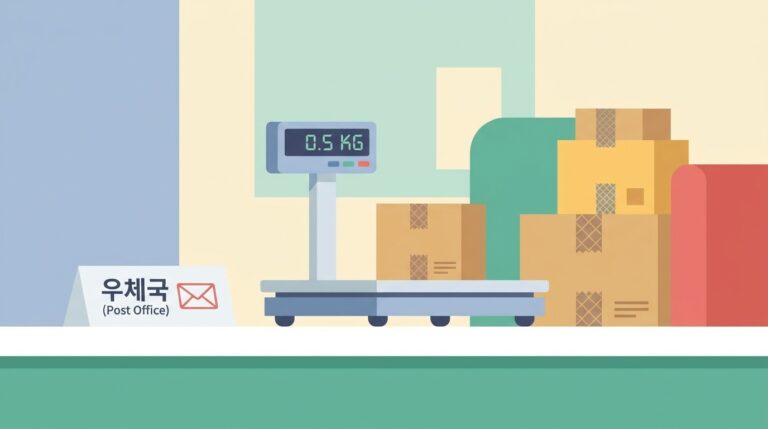
Picture this: You are standing in the middle of Hongdae after a dream shopping spree. You have collected three sets of your ultimate K-pop bias’s album versions, five bottles of viral glowing sunscreen from Olive Young, and cute line-character merch. When you return to your hotel room, reality hits. Your 24-inch suitcase refuses to zip shut. Sitting on top of it won’t help. Desperate, you pack everything into a sturdy cardboard box and head to the local Korean post office (우체국, Ucheguk).
You take a ticket number, wait your turn, and walk up to the counter. The clerk smiles politely, gestures at your heavy box, and asks: “무게에 따라 요금이 달라지는데, 저울에 올려주시겠어요?” You freeze. You know the word for money, and you recognize that something is changing, but your brain gets jammed between calculating kilograms and deciphering postal terms.
You are not alone! In our Daily Hangul student survey, 78% of intermediate Korean learners named administrative counters—especially post offices and parcel pickup centers—as the most intimidating places to speak Korean. The fear of getting unexpected shipping fees or choosing the wrong box size creates instant panic. Master this unit, and you will glide through any Korean post office, shipping your treasures home without a single drop of sweat.
Phase 2: 3 Core Expressions Deep Dive
1. 무게에 따라 요금이 달라져요 (Muge-e ttara yogeum-i dallajyeoyo)
- Pronunciation: [Muge-e ttara yogeumi dallajyeoyo] (Think of mu-geh sounding like “moo” + “get” without the ‘t’, and ttara with a crisp, tensed double ‘t’ like in “guitar“).
- Meaning: “The rate changes depending on the weight.” (Literal: According to weight, fee becomes different.)
- K-Culture Moment: In slice-of-life K-dramas like Reply 1988 or When the Camellia Blooms, mothers frequently visit the town post office carrying boxes of handmade side dishes (반찬, banchan) wrapped with layers of plastic. The clerk will always remind them of the weight brackets before applying the shipping stamp.
- Editor’s Insight: The grammar pattern N에 따라 (depending on N) is an essential B1 cornerstone. Notice how the verb 달라지다 (to become different / to vary) is used instead of the stiff English passive “is determined”. In spoken Korean, things naturally become different rather than get determined.
- Situation Spectrum: Casual ⚠️ | Semi-formal ✅ | Formal ✅
- 🤔 Think About It: In English, we often say “Pricing is based on weight.” Why does Korean personify the change using 달라지다? Notice how natural Korean focuses on the organic change of state rather than a rigid rule.
2. 저울 위에 올려놓으세요 (Jeoul wie ollyeoneo-useyo)
- Pronunciation: [Jeo-ul wie ol-lyeo-noh-eu-se-yo] (Jeoul rhymes with the British “towel” starting with a soft ‘j’, followed by ol-lyeo where the ‘l’ rolls smoothly into the next syllable).
- Meaning: “Please place it on the scale.”
- K-Culture Moment: Watch any vlog of foreign exchange students in Korea preparing their year-end return boxes. You’ll hear the clerk say this phrase with a gentle, two-handed guiding gesture toward the steel digital scale embedded in the counter.
- Editor’s Insight: This combines 올리다 (to raise/place on top) and 놓다 (to put down/leave), forming the compound verb 올려놓다. When combined with the polite imperative -(으)세요, it forms the standard courteous instruction used across service industries in Korea.
- Situation Spectrum: Casual 🚫 | Semi-formal ✅ | Formal ✅
- 🤔 Think About It: Notice how the clerk says 올려놓으세요 instead of just 올리세요. Compound verbs like this add physical precision to everyday Korean instructions.
3. 상자 크기랑 무게 둘 다 재나요? (Sangja keugirang muge dul da jaenayo?)
- Pronunciation: [Sang-ja keu-gi-rang mu-ge dul da jae-na-yo?] (The syllable jae sounds like the English name “Jay”).
- Meaning: “Do you measure both the box size and the weight?”
- K-Culture Moment: Seen in variety shows when cast members have to pack emergency supplies or luggage for an overseas shoot and plead with airline or courier staff about dimensional limits.
- Editor’s Insight: 재다 means to measure (length, weight, temperature, or size). Adding the question ending -나요? softens your inquiry, making you sound considerate and conversational rather than demanding.
- Situation Spectrum: Casual ⚠️ | Semi-formal ✅ | Formal ✅
- 🤔 Think About It: Using ~랑 (and/with) keeps your sentence natural and fluid compared to the stiffer written connective ~와/과.
Phase 3: Textbook Korean vs. Real Korean
Situation 1: Asking how much it will cost based on weight
- 📖 Textbook Korean: “소포의 중량에 따라 우편 요금이 얼마로 산정됩니까?” (Sopo-ui jungnyang-e ttara upyeon yogeum-i eolmaro sanjeongdoemnikka? – According to the weight of the parcel, how is the postal fee calculated?)
- 🗣️ Real Korean: “무게 재보면 요금 얼마 나와요?” (Muge jaebomyeon yogeum eolma nawayo? – If we weigh it, how much will the fee come out to?)
- 💡 Why it differs: Textbook Korean relies heavily on formal Sino-Korean vocabulary (중량 for weight, 산정 for calculation). Real Koreans use native terms like 무게 and the active, vivid phrasing 얼마 나와요? (“How much comes out?”).
Situation 2: Asking if a box is overweight
- 📖 Textbook Korean: “이 상자가 무게 제한 규정을 초과하였습니까?” (I sangjaga muge jehan gyujeong-eul chogwahayeotseumnikka? – Has this box exceeded the weight restriction regulation?)
- 🗣️ Real Korean: “혹시 무게가 많이 넘쳤나요?” (Hoksi mugega mani neomcheonnayo? – Did the weight go over by a lot?)
- 💡 Why it differs: Instead of quoting regulations (규정 초과), native speakers use the descriptive verb 넘치다 (to overflow/surpass) paired with the softening adverb 혹시 (by any chance) to sound approachable.
Phase 4: K-Culture Deep Dive & Non-verbal Manners
4-1. 눈치 (Nunchi) & Post Office Etiquette
Korean post offices are marvels of speed and communal consideration. Before you even walk to the counter, your Nunchi (situational awareness) should kick in:
* The Self-Packing Station (자율 포장대): Do not bring an unsealed box with loose tape to the counter! Head to the packing counter along the wall. Grab tape, bubble wrap (뽁뽁이), and scissors for free, neatly pack your items, and clearly write the recipient’s address using the supplied markers.
* Two-Handed Placement: When transferring your box from your cart onto the counter scale, do not drop or shove it. Steady it with both hands and place it down quietly. When handing over your payment card or ID, always use both hands or support your right wrist with your left hand.
4-2. The K-Logistics Phenomenon: From Photocard Trading to EMS
Logistics in South Korea is a cultural wonder. K-pop fans depend on rapid parcel ecosystems for photocard trading (포카 교환), often using low-cost tracked mail called 준등기 (semi-registered mail) or convenience store couriers (반값택배 – half-price courier). Meanwhile, international travelers use EMS (Express Mail Service) right at the post office to ship bulk cosmetics, K-drama souvenirs, and clothes straight to their home country. Understanding that weight directly dictates delivery tier (항공편 airmail vs. 선편 surface mail) gives you full control over your travel budget.
Phase 5: Real-World Roleplay Scenario
Setting: Mapo Post Office (마포우체국) in Seoul on a breezy Thursday afternoon.
Characters:
* Clerk Min (민 주임님): A swift, experienced, and helpful postal employee wearing a tidy blue vest.
* Alex (You): An exchange student shipping a 7kg package of winter clothes and K-pop albums back home.
Turn 1:
* Alex: 안녕하세요! 이거 미국으로 보내고 싶은데요.
(Annyeonghaseyo! Igeo miguk-euro bonaego sipeunde-yo.)
“Hello! I would like to send this to the United States.”
🎭 Hands the shipping slip politely with both hands.
Turn 2:
* Clerk Min: 네, 반갑습니다. 우선 상자 저울 위에 올려놓으시겠어요?
(Ne, bangapseumnida. Useon sangja jeoul wie ollyeoneo-usigesseoyo?)
“Sure, welcome. First, could you place the box on the scale?”
🎭 Points to the metal scale embedded into the counter.
Turn 3:
* Alex: 네, 올렸습니다. 상자 크기랑 무게 둘 다 재나요?
(Ne, ollyeotseumnida. Sangja keugirang muge dul da jaenayo?)
“Yes, I placed it on. Do you measure both the box size and the weight?”
🎭 Gently slides the box centered onto the scale platform.
Turn 4:
* Clerk Min: 네, 맞아요. 부피랑 무게를 비교해서 더 큰 쪽으로 계산돼요. 지금 6.8kg 나오셨네요.
(Ne, majayo. Bupirang mugereul bigyohaeseo deo keun jjok-euro gyesandoeyo. Jigeum yuk-jeom-pal kiro naosyeonne-yo.)
“Yes, that’s right. We compare volume and weight and charge based on whichever is greater. It comes out to 6.8kg right now.”
🎭 Taps the digital readout on his screen.
Turn 5:
* Clerk Min: 배송 방법에 따라 요금이 많이 달라지는데, EMS 특급으로 하실 건가요, 아니면 일반 항공으로 하실 건가요?
(Baesong bangbeop-e ttara yogeum-i mani dallajineunde, EMS teukgeup-euro hasil geon-gayo, animyeon ilban hanggong-euro hasil geon-gayo?)
“The fee varies a lot depending on the delivery method. Would you like EMS express, or standard airmail?”
🎭 Tilts his screen slightly toward Alex.
🔀 Interactive Decision Point!
What should Alex say next?
* Option A: “무게에 따라 요금 차이가 얼마나 나요? 빠른 게 좋아요.” (Muge-e ttara yogeum chaiga eolmana nayo? Ppareun ge joayo. – How much is the price difference depending on the weight? I prefer the fast one.)
* Option B: “제일 싼 걸로 그냥 보내주세요. 돈 없어요.” (Jeil ssan geollo geunyang bonaejuseyo. Don eopseoyo. – Just send it the cheapest way. I have no money.)
* Option C: “그냥 배에 실어서 내년에 도착해도 상관없어요.” (Geunyang bae-e sireoseo naenyeone dochakhaedo sanggwaneopseoyo. – Just put it on a boat; I don’t care if it arrives next year.)
- Choice Feedback:
- Option A (Best): Polite, proactive, and demonstrates practical B1 comprehension of comparing cost versus speed.
- Option B (Risk): Grammatically understandable, but 돈 없어요 is too blunt and casually awkward in a professional counter setting.
* Option C (Bad): Overly dramatic and uses overly colloquial phrasing that might cause confusion with surface mail procedures.
(Continuing with Option A)
Turn 6:
* Clerk Min: EMS는 4일 정도 걸리고 8만 원대고요, 일반 항공은 2주 걸리고 6만 원대예요.
(EMSeu-neun sail jeongdo geolligo pal-man-won-daegoyo, ilban hanggong-eun i-ju geolligo yuk-man-won-daeyeyo.)
“EMS takes about 4 days and is around 80,000 KRW; standard airmail takes 2 weeks and is around 60,000 KRW.”
🎭 Shows the two price quotes clearly.
Turn 7:
* Alex: 안전하게 받고 싶어서 EMS로 할게요. 카드로 계산해도 되죠?
(Anjeonhage batgo sipeoseo EMS-ro halgeyo. Kadeuro gyesanhaedo doejo?)
“I want to receive it safely, so I will go with EMS. I can pay by card, right?”
🎭 Readies card in hand.
Turn 8:
* Clerk Min: 네, 물론입니다. 영수증에 적힌 등기번호로 실시간 배송 조회가 가능합니다.
(Ne, mollonimnida. Yeongsujeung-e jeokhin deunggibonhoro silsigan baesong johoega ganeunghapnida.)
“Yes, of course. You can track real-time delivery with the tracking number printed on the receipt.”
🎭 Hands over the receipt and payment card with both hands.
Phase 6: 10-Second Emotion Shadowing Drill
Practice reading these out loud, observing pauses (/) and feeling the emotional tone!
[😊 밝고 공손하게 - Bright & Polite]
“저기요, / 이거 무게 재보면 / 요금이 대략 얼마 나와요?”
(Jeogiyo, / igeo muge jaebomyeon / yogeum-i daeryak eolma nawayo?)
“Excuse me, / if we weigh this, / roughly how much will the fee come out to?”-
[🤔 진지하고 신중하게 - Thoughtful & Attentive]
“무게에 따라 / 요금이 달라지니까, / 상자를 다시 정리해 올게요.”
(Muge-e ttara / yogeum-i dallajinikka, / sangjareul dasi jeongnihae olgeyo.)
“Since the rate depends on the weight, / I will go rearrange the box and come back.” -
[😌 안도하며 후련하게 - Relieved & Satisfied]
“생각보다 / 무게가 적게 나와서 / 정말 다행이에요!”
(Saenggakboda / mugega jeokge nawaseo / jeongmal dahaeng-ieyo!)
“It weighs less / than I expected, / what a relief!”
Phase 7: K-Culture Mini Dictionary
-
저울 (Jeoul) – Scale / Balance
Usage: The digital scale at postal counters and airport check-ins.
Sample Sentence: 저울 위에 짐을 하나씩 올려주세요. (Jeoul wie jimeul hanassik ollyeojuseyo. – Please put your luggage on the scale one by one.) -
송장 (Songjang) – Parcel Waybill / Shipping Label
Usage: The adhesive invoice label containing the barcode, sender, and recipient address. You fill this out before waiting in line.
Sample Sentence: 국제우편 송장 작성 다 하셨나요? (Gukje-upyeon songjang jakseong da hasyeonnayo? – Have you finished filling out the international mail waybill?) -
포장대 (Pojangdae) – Self-Packaging Counter
Usage: The community counter in every Korean post office equipped with tape guns, cutters, and standard boxes.
Sample Sentence: 포장대에서 테이프 좀 더 붙이고 올게요. (Pojangdae-eseo teipeu jom deo buchigo olgeyo. – I will put a bit more tape on at the packaging station and come back.) -
초과 (Chogwa) – Exceeding / Over the Limit
Usage: When weight (무게 초과) or dimensional limits (규격 초과) go past standard allowances.
Sample Sentence: 20kg을 초과하면 추가 요금이 발생합니다. (Isip-kiro-geuraemeul chogwahamyeon chuga yogeum-i balsaenghapnida. – If it exceeds 20kg, an additional fee will be incurred.)
Phase 8: Traveler’s Survival Kit
TOP 3 Emergency Expressions
- “상자 몇 번으로 사야 돼요?” (Sangja myeot beon-euro saya dwaeyo?)
Meaning: “Which box number should I buy?”
Pro Tip: Korean post office boxes come in numbered sizes (No. 1 is tiny, No. 5 is gigantic for winter coats). Ask the counter or look at the sample boxes mounted above the self-packing counter! - “뽁뽁이 더 필요한데 어디 있어요?” (Bpokbpoki deo piryohande eodi isseoyo?)
Meaning: “I need more bubble wrap, where is it?”
Pro Tip: 뽁뽁이 is the cute onomatopoeia for bubble wrap. It is free to use at the packing counter. - “항공편하고 선편 요금 차이가 커요?” (Hanggongpyeon-hago seonpyeon yogeum chaiga keoyo?)
Meaning: “Is the rate difference between airmail and sea freight significant?”
Pro Tip: Sea freight (선편) is up to 60% cheaper for heavy books and ceramics, but takes 2–3 months. Ask this before deciding.
Editor’s Travel Note
- Prepare Your Digital Waybill in Advance: Use the official Korea Post website parcel reservation page to fill in international customs info online. You get a quick discount and simply show the barcode on your phone at the desk.
- Smart Parcel Pickup Service: If dragging 15kg to the post office sounds terrifying, download the Kakao T app for door-to-door parcel pickup and book courier pickup directly from your hotel or Airbnb doorstep!
Phase 9: Going Deeper (Cultural Reflection)
In South Korea, sending a parcel is rarely just a transactional exchange of goods; it is a tangible expression of 정 (Jeong)—the warm, unspoken affection and community bond that defines Korean relationships. Even in a hyper-digital society of dawn deliveries, mothers still pack home-cooked kimchi into triple-sealed containers, lovers mail handmade care packages (군대 소포) to military bases, and friends ship souvenir hauls across oceans. Knowing how to navigate shipping weight and fees isn’t just about saving money; it reflects respect for the shared, hyper-efficient public ecosystem that keeps Korean society seamlessly connected.
💬 Your Turn: Have you ever tried shipping souvenirs home from Korea, or had a package sent to you by a Korean friend? What was inside? Share your experience in the comments below!
Phase 10: FAQ & Common Mistakes
Q: What is the difference between volume weight (부피무게) and actual weight (실제무게)?
A: For international parcels (like EMS), postal services calculate both actual scale weight and volumetric weight (Width × Length × Height ÷ 5000 or 6000). Whichever number is larger determines the final rate. So, if your box contains lightweight but fluffy puffy jackets, you might be billed for dimensional volume rather than actual kilograms!
Q: Can I buy standard packaging boxes individually at the post office?
A: Yes! You do not need to bring your own cardboard box. Post offices sell reinforced cardboard boxes categorized by numbers (Size 1 to 5). You can pick a box from the display, tape your items, and pay for the box at the counter when you process the shipping.
Q: Can I ship cosmetic liquids or lithium battery goods through Korean post offices?
A: International regulations restrict spray aerosols, perfumes, external battery power banks, and unsealed liquids. Always declare cosmetics honestly at the counter so the staff can verify if your items comply with aviation safety guidelines.
🚨 Common Mistakes Warning Board
- Mistake: Taping the box closed at the transaction counter while the clerk waits.
Correct Action: Always finish packing completely at the 자율 포장대 (self-packaging desk) before taking a number ticket. - Mistake: Writing addresses only in English for domestic delivery within Korea.
Correct Action: For domestic delivery, write Korean addresses with the 5-digit postal code (우편번호). English is only acceptable for outbound international mail. - Mistake: Assuming weight alone decides the cost.
Correct Action: Remember that box size (상자 규격) and transport mode (항공/선편) combine with weight to decide your bill.
Phase 11: Action Missions
- 🥉 Bronze Mission (Solo Shadowing): Stand in front of your bathroom scale with your backpack, place it down, and record yourself saying: “저울 위에 올려놓았습니다. 무게에 따라 요금이 달라지나요?” Listen back and check your intonation.
- 🥈 Silver Mission (Social Share): The next time you order K-merch or receive a parcel, take a photo of the 송장 (waybill) and write a caption using today’s expression: “상자 무게에 따라 배송비가 달라져요!” Tag @DailyHangul.
- 🥇 Gold Mission (Real-Life Application): Visit an actual post office or convenience store parcel terminal in Korea. Complete your shipment from packing station to counter using entirely Korean sentences learned in this guide!
- 🎮 K-Culture Mission: Watch an episode of a Korean variety show (like 2 Days & 1 Night or Omniscient Interfering View). Spot any scene where characters pack their bags and listen for the words 무게 (weight) or 재다 (to measure).
Phase 12: Interactive Quiz Challenge
Quiz 1: Situation Check
You brought a huge box full of light winter jackets to the Korean post office. The clerk weighs it, measures it with a ruler, and says: “부피 때문에 요금이 더 나올 수 있어요.” What does this mean?
* (A) The box is physically too heavy.
* (B) You have to buy a new box right now.
* (C) The shipping fee might be higher because of the box’s dimensional volume.
* (D) The clerk cannot accept jackets.
👉 Click here for the Answer & Explanation
Answer: (C)
Explanation: 부피 means volume or bulk. Even if items are light in weight, large box dimensions trigger volumetric rate calculations (부피무게).
Quiz 2: Fill-in-the-Blank
Complete the natural Korean phrase:
“상자 ( ) 따라 해외 배송비가 달라집니다.”
(The international shipping fee varies depending on the box’s weight.)
* (A) 무게에
* (B) 무게를
* (C) 무게만
* (D) 무게로
👉 Click here for the Answer & Explanation
Answer: (A) 무게에
Explanation: The grammar pattern for “depending on [Noun]” is always [Noun] + 에 따라.
Quiz 3: True or False Cultural Manner Check
“At a Korean post office, you should take your open items directly to the counter clerk and ask them to tape the box and write the address for you.”
True or False?
👉 Click here for the Answer & Explanation
Answer: False!
Explanation: Korean postal etiquette relies on considerate self-service. You are expected to assemble, fill, tape, and address your box at the 자율 포장대 (self-packing station) before approaching the clerk counter.







