

Phase 1: Empathy (스토리 몰입형 오프닝)
안녕하세요! 매일한글 에디터입니다.
Picture this: It is 11:58 PM. You are sitting at your desk with your heart racing because your favorite K-pop group just dropped limited-edition concert merch, or your favorite K-drama actor’s signature skincare item is having a flash sale on a Korean shopping app. You furiously add the items to your cart, click 주문하기 (Order), and then—bam! A blank form pops up demanding your 배송지 입력 (Entering Delivery Address).
Suddenly, your mind freezes. The screen asks for 우편번호 (postal code), 도로명 주소 (road name address), 상세주소 (detailed address), and 배송 메모 (delivery note). You turn to Google Translate, but it translates your room number into bizarre nonsense. You panic: What if my package gets delivered to the wrong building? What if the courier calls me in rapid-fire Korean?
Take a deep breath! You are definitely not alone. Over my ten years of coaching international residents and K-culture lovers, navigating the Korean delivery system is hands down one of the top hurdles learners face. Korean addresses follow a unique ‘big-to-small’ hierarchy that is completely opposite to Western conventions. Once you master the core patterns and handy phrases in this guide, you will be able to order anything—from midnight tteokbokki to official merch—confidently, accurately, and without a drop of sweat. Let’s conquer it together!
Phase 2: 핵심 표현 3선 심층 분석 (Core Expressions)
1. 배송지 입력해 주세요 (Baesongji ipryeokhae juseyo)
- Pronunciation: [Bae-song-ji ip-ryeok-hae ju-se-yo] (Think of ‘bae’ as in ‘bagel’, ‘song’ like singing a song, ‘ji’ like ‘jeep’, ‘ip-ryeok’ like ‘eep-ryuk’, and ‘juseyo’ like ‘juice-say-yo’)
- Meaning: “Please enter the delivery address.”
- K-Culture Moment: You will see this on system pop-up modals across major Korean platforms like Coupang, Weverse Shop, Olive Young, and Market Kurly when your saved address book is empty.
- Editor’s Insight: 배송지 (Baesongji) combines 배송 (delivery) and 지 (location/site). When Korean apps say 입력해 주세요, it is a polite request commonly used in user interfaces and customer care. At the A2 level, understanding this lets you immediately recognize what the form field wants from you.
- Situation Spectrum:
- Casual (반말): 🚫 배송지 입력해 (Too blunt for customer interactions)
- Semi-formal (해요체): ✅ 배송지 입력해 주세요 (Standard, polite, user-friendly)
- Formal (하십시오체): ✅ 배송지를 입력해 주십시오 (Frequently found in corporate checkout notices)
- 🤔 Think About It: In many Western countries, websites ask for “Shipping Address” or “Billing Address” separately. In Korea, the term 배송지 almost always defaults directly to physical doorstep delivery. Why do you think Korea’s e-commerce is so heavily optimized around the doorstep?
2. 문 앞에 놓아주세요 (Mun ape noajuseyo)
- Pronunciation: [Mun a-pe no-a-ju-se-yo] (Pronounce ‘mun’ like ‘moon’, ‘ape’ sounds like ‘ah-peh’, ‘noa’ like ‘Noah’, ‘juseyo’ like ‘juice-say-yo’)
- Meaning: Direct: “Please put it in front of the door.” / Real Nuance: “Please leave it at my doorstep.”
- K-Culture Moment: Seen as the #1 preset option in the delivery instructions dropdown (배송 요청사항) across all Korean e-commerce apps.
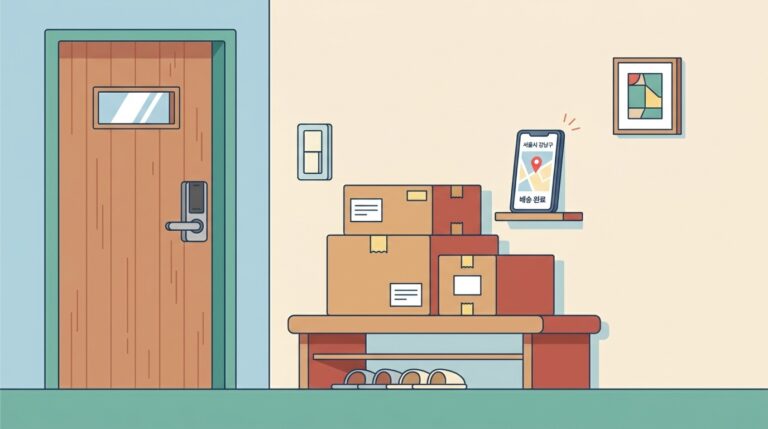
- Editor’s Insight: Korea has a remarkably safe and normalized “doorstep delivery” culture (비대면 배송 or contactless delivery). Couriers rarely ring and wait for you to open the door; they drop the box, take a quick verification photo, and text you. Writing 문 앞에 놓아주세요 guarantees a hassle-free drop.
- Situation Spectrum:
- Casual (반말): ⚠️ 문 앞에 둬 (Only for close family members)
- Semi-formal (해요체): ✅ 문 앞에 놓아주세요 (Perfect for app notes and text messages)
- Formal (하십시오체): ✅ 문 앞에 놓아주시기 바랍니다 (Very formal automated courier text)
- 🤔 Think About It: In your home country, is it safe to leave a parcel sitting in front of your front door for hours? What social conditions allow Koreans to leave high-value electronics outside their door without fear?
3. 상세주소를 확인해 주세요 (Sangsejusoreul hwaginhae juseyo)
- Pronunciation: [Sang-se-ju-so-reul hwa-gin-hae ju-se-yo] (Pronounce ‘sang-se’ like ‘song-seh’, ‘juso’ like ‘joo-so’, ‘hwagin’ like ‘hwa-geen’)
- Meaning: Direct: “Please check the detailed address.” / Real Nuance: “Please make sure your apartment building and unit number are entered.”
- K-Culture Moment: When your delivery is delayed or when an address lookup fails on an app, customer support will text this exact alert to prevent misdelivery.
- Editor’s Insight: A Korean address consists of two halves: the base road name address (기본주소/도로명 주소) and the detailed unit information (상세주소). Foreign names or overseas cards often glitch when entering the 상세주소. If you get an error message, look for this sentence!
- Situation Spectrum:
- Casual (반말): 🚫 상세주소 확인해
- Semi-formal (해요체): ✅ 상세주소를 확인해 주세요 (Friendly CS rep or automated bot message)
- Formal (하십시오체): ✅ 상세주소를 확인해 주시기 바랍니다 (Formal system alert)
- 🤔 Think About It: Western addresses start small (Apt 4B, 123 Main St, New York). Korean addresses start big (Seoul, Gangnam-gu, Teheran-ro 152, 101-dong 402-ho). How does moving from macro to micro reflect the collective worldview in Korean culture?
Phase 3: 교과서 한국어 vs 진짜 한국어 (Textbook vs. Real-Life Korean)
Situation 1: Leaving delivery instructions for the courier
- 📖 교과서 한국어 (Textbook Korean):
> 택배 물건을 현관문 앞에 배송해 주십시오. (Taekbae mulgeoneul hyeongwanmun ape baesonghae jusipsio.)
> “Please deliver the parcel cargo in front of the entrance door.” - 🗣️ 진짜 한국어 (Real-Life Korean):
> 문 앞 배송 부탁드려요! (Mun ap baesong butakdeuryeoyo!)
> “Doorstep delivery, please!” - 💡 왜 다를까? (Why is it different?): Textbook Korean uses heavy vocabulary like 현관문 and stiff grammar like -십시오. In real life, Koreans value brevity and warmth. Courier memo boxes have character limits, so snappy phrases ending in 부탁드려요 (please/I request) are universally preferred.
Situation 2: Specifying your apartment building and door number
- 📖 교과서 한국어 (Textbook Korean):
> 거주하시는 건물의 동 번호와 호실 번호를 상세하게 기재하십시오. (Geojuhasineun geonmurui dong beonhowa hosil beonhoreul sangsehage gijaehasipsio.)
> “Accurately record the building division number and room unit number where you reside.” - 🗣️ 진짜 한국어 (Real-Life Korean):
> 동·호수 정확히 적어주세요. (Dong-hosu jeonghwak-hi jeogeojuseyo.)
> “Please write down your building and unit number accurately.” - 💡 왜 다를까? (Why is it different?): Most Koreans live in apartment complexes (아파트) or multi-family villas. The compound word 동·호수 (Dong-hosu) represents both the building (동) and the room (호). It is natural, concise, and standard across all shopping forms.
Phase 4: K-Culture 딥다이브 & 비언어적 매너 (Deep Dive & Etiquette)
4-1. 눈치 (Nunchi) & Courteous Delivery Communication
In South Korea, delivery couriers (택배 기사님) are true everyday heroes. They operate under intense schedules, delivering hundreds of boxes every day. Having good 눈치 (nunchi – social awareness) means making their job as smooth as possible:
* The Passcode Rule: If your building has an automated security gate downstairs (공동현관), always include the keypad passcode in the delivery notes. The standard format is: 공동현관 비번: #1234* (Common door password: #1234*).
* Warm Confirmation: When the courier sends a photo of your delivered package, you do not need to call back. A quick text reply saying “감사합니다, 기사님! (Thank you, courier driver!)” shows immense respect and warmth without disrupting their driving route.
4-2. Cultural Code: The Dawn of “Ppalli-Ppalli” (빨리빨리) & Rocket Delivery
Korea’s e-commerce is legendary for its speed, driven by the national concept of 빨리빨리 (hurry, hurry). Platforms like Coupang offer 로켓배송 (Rocket Delivery), and Market Kurly pioneered 새벽배송 (Dawn Delivery), where groceries ordered at 11:00 PM arrive outside your front door by 7:00 AM the next morning!
You will often see this lifestyle portrayed in modern K-dramas (like in Crash Landing on You when characters marvel at South Korean door-to-door convenience, or in slice-of-life series like Hospital Playlist where busy doctors survive on dawn-delivered meal kits). Understanding how to type your address correctly is your ticket to experiencing this futuristic daily luxury!
Phase 5: 실전 롤플레이 시나리오 (Real-Life Roleplay Scenario)
Setting: You just ordered a rare K-pop autographed photobook, but you receive a text message from the delivery courier, Mr. Park (박 기사님), who is currently standing at the entrance of your studio apartment building.
- Turn 1 (Mr. Park): 안녕하세요, 택배기사입니다. 주소에 동·호수가 안 적혀 있어요. (Annyeonghaseyo, taekbaegisaimnida. Jusoe dong-hosuga an jeokhyeo isseoyo.)
🎭 [Calling over the phone with street noise in the background] “Hello, this is the courier driver. Your building and unit number aren’t written on the address.” - Turn 2 (You): 아, 죄송합니다! 제가 깜빡했어요. (A, joesonghamnida! Jega kkamppakhaesseoyo.)
🎭 [Apologetic and polite tone] “Oh, I am sorry! I completely forgot.” - Turn 3 (Mr. Park): 몇 호로 가져다 드릴까요? (Myeot horo gajyeoda deurilkkayo?)
🎭 [Speaking quickly and checking the package barcode] “Which room number should I bring it to?” - Turn 4 (You): 3층 302호예요. (Sam-cheung sam-baek-i-hoyeyo.)
🎭 [Speaking clearly and calmly] “It’s the 3rd floor, unit 302.” - Turn 5 (Mr. Park): 1층 공동현관 비밀번호는 어떻게 되나요? (Il-cheung gongdong-hyeongwan bimilbeonhoneun eotteoke doenayo?)
🎭 [Pressing the lobby keypad] “What is the password for the 1st floor common entrance?” - Turn 6 (You): 샵(#), 일이삼사(#1234), 별표() 눌러주세요. (Syap, il-i-sam-sa, byeolpyo nulleojuseyo.)
🎭 *[Explaining keystrokes step-by-step] “Please press Sharp (#), 1-2-3-4, then Star (*).” - Turn 7 (Mr. Park): 네, 확인했습니다. 문 앞에 둘게요! (Ne, hwaginhaessumnida. Mun ape dulgeyo!)
🎭 [Keypad beeps open in the background] “Okay, verified. I’ll leave it in front of the door!” - Turn 8 (You): 네! 정말 감사합니다, 기사님! (Ne! Jeongmal gamsahamnida, gisanim!)
🎭 [Relieved and bowing with gratitude] “Yes! Thank you so very much, driver!”
🔀 인터랙티브 분기점 (Interactive Choice)
Imagine Mr. Park says he can’t access your building floor because the elevator is broken. What do you text back?
- Option A: 그냥 경비실에 맡겨주세요. (Geunyang gyeongbisire matgyeojuseyo. / Just leave it at the security office, please.)
- Feedback (Best! ⭐): Polite, considerate of his busy schedule, and practical. Couriers love this quick alternative.
- Option B: 왜 안 올라와요? 빨리 갖다 줘. (Wae an ollawayo? Ppal-li gatda jwo. / Why aren’t you coming up? Bring it quickly.)
- Feedback (Bad! ❌): Extremely rude, uses informal 반말, and disregards normal Korean delivery courtesy.
- Option C: 내일 다시 오세요. (Naeil dasi oseyo. / Come back again tomorrow.)
- Feedback (Risk! ⚠️): Grammatically fine, but couriers work on daily quotas. Asking them to return creates extra logistics headaches and may delay your parcel for days.
Phase 6: 10초 감정 섀도잉 드릴 (Shadowing Drill)
Practice reading these out loud! Follow the emotional tone tag and pause briefly at each slash (/).
[😊 정중하고 친절하게 / Polite and friendly]- 문 앞에 / 놓아주세요. (Mun ape / noajuseyo.)
- “Please / leave it at the door.”
[📦 똑 부러지고 명확하게 / Crisp and informative]- 공동현관 비밀번호는 / 샵 일-이-삼-사 별표 / 예요. (Gongdong-hyeongwan bimilbeonhoneun / syap il-i-sam-sa byeolpyo / yeyo.)
- “The common entrance password / is #1234 / .”*
[🙏 감사와 존경을 담아 / Grateful and appreciative]- 부재 시 / 경비실에 / 맡겨주세요. (Bujae si / gyeongbisire / matgyeojuseyo.)
- “If I am not home / at the security office / please leave it.”
Phase 7: K-Culture 미니 사전 (Mini Dictionary)
- 택배 (Taekbae) | Courier parcel / Package delivery
The lifeline of modern Korea. Used in everyday phrases like 택배 왔어요! (The package has arrived!). - 도로명 주소 (Doromyeong Juso) | Road Name Address
Korea’s modern address standard introduced in 2014, structured as[Road Name] + [Building Number](e.g., 테헤란로 152). - 공동현관 비밀번호 (Gongdong-hyeongwan bimilbeonho) | Main Lobby Keypad Passcode
The code required to buzz into Korean multi-unit villa or apartment complexes. - 부재 시 (Bujae si) | In case of absence / When not home
A formal conditional phrase frequently used on delivery slips (e.g., 부재 시 문 앞 = Leave at door if absent).
Phase 8: 여행자를 위한 생존 키트 (Traveler’s Survival Kit)
Top 3 Survival Phrases
- 호텔 프런트에 맡겨주세요. (Hotel peuronteue matgyeojuseyo.)
- “Please leave it at the hotel front desk.”
- Pro Tip: Perfect when you stay at a hotel and order items online. Always check with hotel reception first!
- 배송 메모는 어디에 써요? (Baesong memoneun eodie sseoyo?)
- “Where do I write the delivery note?”
- Pro Tip: Use this when asking a bilingual friend or staff member to help you navigate a confusing checkout page.
- 택배 보관함에 넣어주세요. (Taekbae bogwanhame neoeojuseyo.)
- “Please put it inside the parcel delivery locker.”
- Pro Tip: Many subway stations and modern officetels have yellow smart parcel lockers (무인택배함).
Editor’s Travel Note
- When converting your foreign address or hotel address into standard Korean script, don’t use web machine translators! Instead, use the bilingual address search bar on 네이버 지도 앱 다운로드 (Naver Map App Download). It displays both the official English and Korean Road Name Address simultaneously.
- In Korea, zip codes (우편번호) are strictly 5 digits. If your shopping cart gives an error, verify that you didn’t accidentally include an old 6-digit postal code.
Phase 9: “한 발 더 깊이” (Cultural Reflection)
Have you ever seen viral social media videos where travelers leave laptops on café tables in Seoul, or where piles of luxury boxes sit untouched outside apartment doors for days? This phenomenon highlights Korea’s deep communal trust and safety network, reinforced by neighborhood CCTV and collective accountability. While petty bike theft remains a running joke among locals, tampering with another person’s parcel (택배) is viewed with immense societal taboo and carries strict legal penalties. When you type your address and request doorstep drop-off, you are participating in a quiet social contract of mutual trust.
💬 Your Turn: Does your neighborhood or country allow package deliveries right outside the door, or do you have to pick them up from a depot? Share your delivery experiences in the comments below!
Phase 10: FAQ & 오해 방지 (Structured FAQ)
Q: What is the difference between ‘지번 주소’ and ‘도로명 주소’ on Korean forms?
A: 지번 주소 (Jibeon juso) is the old lot-number address system based on land parcels (e.g., 역삼동 649-4), while 도로명 주소 (Doromyeong juso) is the updated system based on street names and building numbers (e.g., 강남대로 396). Most modern Korean shopping sites require the 도로명 주소, though typing either into the postal search pop-up will usually find the right destination.
Q: Can I type my delivery address in English on Korean shopping sites?
A: Generally, no. Domestic couriers (CJ대한통운, 롯데택배, 로젠택배) and local automated sorting facilities operate in Korean Hangeul. Writing your address in Roman letters can cause automated sorting rejections or misdirection. Always copy and paste the Korean Hangeul version of your address into the fields.
Q: What should I enter in the ‘수령인’ field?
A: 수령인 (Suryeong-in) means “Recipient / Receiver.” Type your full name here. If you are using a Korean phone number or Alien Registration Card (ARC), ensure the name matches your local SIM card registration or building directory if requested.
🚨 흔한 실수 (Common Mistakes TOP 3)
- Mistake: Typing your apartment unit number before the street name.
- Correct Action: In Korea, always go largest to smallest: City/Province → Road Name → Building Number → Dong/Ho (Unit number).
- Mistake: Forgetting the
#or*in your lobby door code.- Correct Action: Always write out the full symbol sequence (e.g.,
#1234*or호수 + 종 + 1234) so the driver doesn’t get trapped outside.
- Correct Action: Always write out the full symbol sequence (e.g.,
- Mistake: Leaving the phone number (연락처) field with an international area code (+1, +44).
- Correct Action: Domestic shopping platforms require standard 11-digit Korean mobile numbers (e.g., 010-XXXX-XXXX) to receive courier arrival texts.
Phase 11: 액션 미션 & 참여 유도 (Action Mission)
3-Step Action Mission
- 🥉 Bronze Level: Open your notes app and write down your home, hotel, or dream Korean accommodation address in the proper Korean Road Name format (
기본주소+상세주소). - 🥈 Silver Level: Practice typing out: 문 앞에 놓아주시고 문자 부탁드립니다. (Please leave it at the door and send me a text message.)
- 🥇 Gold Level: Place a small order on a Korean website (or an app with a Korean interface) and successfully set your delivery memo using one of today’s expressions!
🎮 K-Culture Mission
Next time you watch a modern K-drama or reality show like 나 혼자 산다 (I Live Alone), keep your eyes peeled for the hallway scenes outside apartment doors. Spot the stacks of parcel boxes (택배 상자) and listen for the doorbell ringing with the classic shout: “택배요! (Delivery’s here!)”.
Phase 12: 인터랙티브 퀴즈 챌린지 (Quiz Challenge)
Q1. (Situation Judgment) You live on the 5th floor of an apartment without an elevator, and you want the courier to leave your heavy parcel on the 1st floor with the building guard. Which phrase should you select in the delivery memo?
* A) 문 앞에 놓아주세요. (Mun ape noajuseyo.)
* B) 경비실에 맡겨주세요. (Gyeongbisire matgyeojuseyo.)
* C) 부재 시 연락하지 마세요. (Bujae si yeonrakhaji maseyo.)
Q2. (Fill in the Blank) Complete the sentence meaning “Please enter the detailed address”:
“_______를 입력해 주세요.”
* (Hint: It means the specific building unit/room number!)
Q3. (True or False) In South Korea, postal addresses begin with the apartment unit number first, followed by the city and country.
* True / False
👉 Click here to check the answers and explanations!
- A1: B) 경비실에 맡겨주세요. (Leave it at the security office.) Option A leaves it at your door on the 5th floor, and Option C asks them not to contact you.
- A2: 상세주소 (Sangse-juso). Complete sentence: 상세주소를 입력해 주세요 (Please enter the detailed address).
- A3: False. Korean addresses follow a macro-to-micro structure, starting from the province/city (e.g., 서울특별시) down to the specific room number (e.g., 102호).







