

Phase 1: Empathy & Story Immersion
안녕하세요! 매일한글 에디터입니다.
Imagine this classic K-Drama scene: It is Sunday morning in a cozy Seoul “one-room” (studio apartment). Sunlight streams in through the small window, revealing a mountain of delivery food boxes, clothes tossed across the drying rack, and dust bunnies dancing near the door. Your Korean roommate or host takes a deep breath, ties their hair back, and turns to you with a determined smile, ready to tackle the weekly cleaning routine.
If you have ever lived or stayed in Korea—or even shared an Airbnb with Korean friends—you know that cleaning the room (방 청소) is not just about sweeping dirt; it is a sacred weekend ritual deeply tied to Korea’s ultra-efficient recycling and living culture. For beginner learners, trying to explain that you want to wipe down the desk or asking where the recycling bag goes can feel surprisingly overwhelming.
Do not worry! Based on real classroom feedback and living experience in Seoul, this guide breaks down the essential A2-level Korean cleaning expressions you will actually use every single week. By the end of this lesson, you will be able to tidy up your space confidently and impress any native speaker with your practical house-living Korean!
Phase 2: Core Expressions Deep Dive
1. 방 좀 치워야겠어요 (Bang jom chiwoyagess-eoyo)
- Pronunciation: Bang jom chi-wo-ya-gess-eo-yo (Sounds like “Bahng” + “Jom” like jolly + “Chee-wah-yah-get-saw-yo”)
- Meaning: Literally “I should clean the room a bit,” used naturally as “I really need to tidy up my room.”
- K-Culture Moment: You will hear this frequently in reality variety shows like I Live Alone (나 혼자 산다) when a celebrity stands in the middle of a messy studio and mentally prepares to clean.
- Editor’s Insight: The magic particle here is 좀 (jom), meaning “a little/kind of.” In Korean, adding 좀 softens the statement and makes you sound much more natural rather than blunt.
- Situation Spectrum:
- Casual (to friends/roommates): 방 좀 치워야겠어. (Bang jom chiwoyagesseo.) ✅
- Polite/Standard (daily use): 방 좀 치워야겠어요. (Bang jom chiwoyagess-eoyo.) ✅
- Formal (workplace/announcement): 방을 청소해야 합니다. (Bangeul cheongsohaeya hamnida.) ⚠️
- 🤔 Think About It: In English, we often say “I have to clean my room” as a strict duty. In Korean, ending with -겠어요 (-gess-eoyo) expresses a gentle personal intention or realization. Notice how Korean grammar reflects personal mood!
2. 분리수거 같이 해요 (Bunrisugeo gachi haeyo)
- Pronunciation: Boon-ri-soo-geo gah-chee hae-yo (Tip: “Bun-ri” rolls smoothly off the tongue like bool-li)
- Meaning: Literally “Let’s do separate waste collection together,” meaning “Let’s sort the recycling together.”
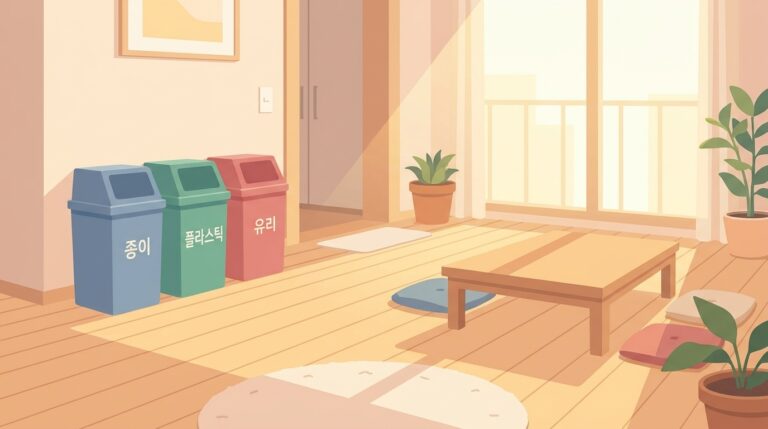
- K-Culture Moment: In almost every Korean university dorm or sharehouse drama, roommates stand side-by-side in front of colorful bins sorting plastic, vinyl, and cans.
- Editor’s Insight: Korea has one of the strictest recycling systems in the world called 분리수거 (bunrisugeo). Saying this phrase turns a chore into a cooperative bonding activity.
- Situation Spectrum:
- Casual: 분리수거 같이 하자. (Bunrisugeo gachi haja.) ✅
- Polite/Standard: 분리수거 같이 해요. (Bunrisugeo gachi haeyo.) ✅
- Formal: 분리수거를 함께 진행합시다. (Bunrisugeoreul hamkke jinhaenghapsida.) 🚫 (Too stiff for home!)
- 🤔 Think About It: Why is 분리수거 a single compound word in Korean while English requires multiple words like “sorting out the recyclables”? It shows how central recycling is to daily Korean society!
3. 먼지가 너무 많아요 (Meonjiga neomu manayo)
- Pronunciation: Mun-jee-gah nuh-moo mahn-ah-yo (Rhymes with “fun-gee”)
- Meaning: Literally “Dust is too plentiful,” meaning “It is so dusty in here.”
- K-Culture Moment: Seen whenever someone opens an old storage box or returns home after a long vacation and begins wiping the shelves with wet wipes (물티슈).
- Editor’s Insight: 너무 (neomu) originally meant negative “too much,” but in everyday modern Korean, it is universally used as “very” or “so.”
- Situation Spectrum:
- Casual: 먼지 진짜 많다! (Meonji jinjja manta!) ✅
- Polite/Standard: 먼지가 너무 많아요. (Meonjiga neomu manayo.) ✅
- Formal: 먼지가 많으니 주의해 주십시오. (Meonjiga maneuni juuirae jusipsio.) ⚠️
- 🤔 Think About It: Does your language treat dust as a countable noun or a general state? In Korean, 먼지 takes the subject marker 가 (ga) just like any everyday object.
Phase 3: Textbook Korean vs. Real Korean
Situation 1: Suggesting a big clean-up
- 📖 교과서 한국어 (Textbook): 방을 대청소합시다. (Bangeul daecheongsohapsida. – Let us clean the room thoroughly.)
- 🗣️ 진짜 한국어 (Real-life): 우리 오늘 방 대청소하자! (Uri oneul bang daecheongsohaja! – Let’s do a big room cleanup today!)
- 💡 왜 다를까?: Textbook endings like -합시다 (-hapsida) sound like a military captain commanding troops. In real daily life, friends and flatmates use the warm informal -자 (-ja) or polite -해요 (-haeyo) with 우리 (uri – we/our).
Situation 2: Asking someone to throw away empty bottles
- 📖 교과서 한국어 (Textbook): 이 병을 쓰레기통에 버리십시오. (I byeongeul sseuregitonge beorisipsio. – Please discard this bottle in the trash can.)
- 🗣️ 진짜 한국어 (Real-life): 이거 분리수거함에 넣어줘. (Igeo bunrisugeohame neoeojwo. – Put this in the recycling bin, please.)
- 💡 왜 다를까?: In Korea, bottles are almost never thrown in a general trash can (쓰레기통). They go into the designated recycling bin (분리수거함), and native speakers speak with the practical -어/아 줘 (-eo/a jwo) pattern.
Phase 4: K-Culture Deep Dive & Non-Verbal Manners
4-1. 눈치 (Nunchi) & Gestures
- Shoe Etiquette while Cleaning: In Korea, you never wear outdoor shoes inside. When scrubbing the balcony (베란다) or bathroom floor (화장실 바닥), Koreans switch into special indoor plastic slippers (욕실화). Walking barefoot onto a wet floor is a cultural faux pas!
- Two-Handed Trash Handover: When handing someone a full trash bag (종량제 봉투), hold it with both hands or hold the top tie gently while looking at the person. It shows care and respect for shared living spaces.
4-2. Cultural Code: The Art of Jongryangje & Delivery Cleanup
In Korean apartment complexes (아파트) and villas, household trash must be bought in standardized municipal bags called 종량제 봉투 (jongryangje bongtu). If you throw food waste in a general bag, you can get fined! Koreans also rinse all delivery plastic containers (배달 용기) thoroughly with water before putting them into recycling. Taking five seconds to rinse a tteokbokki container is the ultimate sign of good room manners.
Phase 5: Real-Life Roleplay Scenario
- Setting: Sunday, 11:00 AM. A bright one-room in Sinchon, Seoul. You and your Korean roommate, Minho (민호), are preparing to clean up after a weekend study party.
- 민호 (Minho): 주말 동안 방이 진짜 더러워졌네요. (Jumal dongan bang-i jinjja deoreowojyeotneyo.)
🎭 [Sighs playfully while looking around the floor littered with snack bags]
“The room got really messy over the weekend.” -
You (학습자): 맞아요. 우리 오늘 방 좀 치워요! (Majayo. Uri oneul bang jom chiwoyo!)
🎭 [Rolls up sleeves enthusiastically with a bright smile]
“Right! Let’s tidy up our room today!” -
민호 (Minho): 좋아요. 제가 먼저 청소기 돌릴게요. (Joayo. Jega meonjeo cheongsogi dollilgeyo.)
🎭 [Plugs in the vacuum cleaner and tests the power switch]
“Great. I will vacuum first.” -
You (학습자): 그럼 저는 책상 먼지 닦을게요. (Geureom jeoneun chaeksang meonji dakkeulgeyo.)
🎭 [Picks up wet wipes and gestures toward the study desk]
“Then I will wipe the dust off the desks.” -
민호 (Minho): 감사합니다! 바닥에 있는 플라스틱병도 모아주실래요? (Gamsahamnida! Badage inneun peullaseutikbyeongdo moajusillaeyo?)
🎭 [Points toward the corner with empty water bottles]
“Thank you! Could you also gather the plastic bottles on the floor?” -
You (학습자): 네, 분리수거 가방에 바로 넣을게요. (Ne, bunrisugeo gabange baro neoeulgeyo.)
🎭 [Nods and quickly collects the bottles into the sorting bag]
“Yes, I will put them right into the recycling bag.” -
민호 (Minho): 청소 끝나면 같이 맛있는 점심 먹어요! (Cheongso kkeutnamyeon gachi masinneun jeomsim meogeoyo!)
🎭 [Gives a thumbs-up happily]
“Let’s eat a delicious lunch together after cleaning!” -
You (학습자): 좋아요! 빨리 끝내요. (Joayo! Ppalli kkeutnaeyo.)
🎭 [Giggles and starts wiping enthusiastically]
“Sounds great! Let’s finish quickly.”
🔀 Interactive Branching Moment
Minho suddenly points to an empty pizza box on the table and asks:
“이 피자 박스는 어디에 버려요? (Where do we throw this pizza box?)”
- Option A: “일반 쓰레기봉투에 버려야 해요. (We should throw it in the general trash bag.)”
- Outcome: [Best Choice! 🌟] Clean paper goes to recycling, but greasy, stained pizza boxes go into general waste (일반 쓰레기). Minho is deeply impressed by your local knowledge!
- Option B: “그냥 밖에 아무 데나 둬요. (Just leave it anywhere outside.)”
- Outcome: [Bad Choice! ❌] Illegal dumping (무단투기) can lead to neighbor complaints and heavy fines. Minho looks startled.
- Option C: “물로 씻어서 플라스틱에 넣어요. (Wash it with water and put it in plastic.)”
- Outcome: [Risk Choice! ⚠️] Paper cannot be recycled as plastic! Minho gently corrects you with a laugh.
Phase 6: 10-Second Emotional Shadowing Drill
Practice reading these lines aloud with the pitch rhythm (/ = brief pause for breath):
[😫 Tired but determined]
방이 / 너무 더러워요. / 오늘 꼭 / 치워야겠어요!
(Bang-i / neomu deoreowoyo. / Oneul kkok / chiwoyagess-eoyo!)
“The room / is so messy. / I definitely / need to clean it today!”-
[😊 Cheerful & Cooperative]
제가 / 청소기 돌릴 테니까, / 분리수거 / 부탁해요!
(Jega / cheongsogi dollil tenikka, / bunrisugeo / butakhaeyo!)
“I will / run the vacuum, / so please handle / the recycling!” -
[✨ Refreshed & Proud]
와, / 방이 진짜 / 깨끗해졌어요!
(Wa, / bang-i jinjja / kkaekkeutaejyeosseoyo!)
“Wow, / the room got / really clean!”
Phase 7: K-Culture Mini Dictionary
- 분리수거 (Bunrisugeo) | Waste Sorting / Recycling
The mandatory system of categorizing trash into paper, plastics, cans, glass, and vinyl before disposal. - 대청소 (Daecheongso) | Deep Cleaning / Spring Cleaning
The big, thorough overhaul where you wipe every corner, wash the bedding, and empty out all trash bins. - 종량제 봉투 (Jongryangje Bongtu) | Government Standard Trash Bag
Color-coded trash bags designated by each city/district (구) in Korea. General waste must strictly go inside these. - 청소기 돌리다 (Cheongsogi Dollida) | To Run the Vacuum Cleaner
Literally “to spin the cleaning machine.” This is the most common Korean idiom for vacuuming the floor.
Phase 8: Traveler’s Survival Kit
TOP 3 Survival Phrases
- 쓰레기 어디에 버려요? (Sseuregi eodie beoryeoyo?)
“Where do I throw this trash?”
👉 Pro Tip: Perfect for Airbnbs or guesthouses when you don’t know the local trash drop location. - 물티슈 좀 있어요? (Mooltisyu jom isseoyo?)
“Do you have some wet wipes?”
👉 Pro Tip: In Korea, wet wipes are used for fast desk cleaning rather than paper towels. - 환기 좀 시킬게요. (Hwangi jom sikilgeyo.)
“I will ventilate (air out) the room a bit.”
👉 Pro Tip: Said right before opening windows wide during room cleaning.
Editor’s Travel Note
When traveling or staying long-term in Korea, download the 네이버 지도 앱 다운로드 (Naver Map App) to find nearby convenience stores (CU, GS25, 7-Eleven). This is where you purchase 종량제 봉투 (trash bags) at the counter. Just say to the clerk: “10리터 쓰레기봉투 한 장 주세요 (10-liter sseuregibongtu han jang juseyo)”!
Phase 9: A Step Deeper (Reflection)
In many Western cultures, cleaning is viewed as a personal chore done inside one’s private bubble. In Korea, however, residential spaces are intimately connected with communal harmony (우리 공동체). How you organize your trash and keep common corridors clean reflects your consideration (배려) for neighbors and roommates. Tidying your room is not merely about hygiene; it is an everyday expression of Korean respect and mindfulness.
💬 Your Turn: How does recycling and room cleaning in your home country compare to Korea’s 분리수거 system? Have you ever had a funny cleaning mix-up while traveling? Let us know in the comments below!
Phase 10: FAQ & Common Mistakes
Q: Can I use any regular plastic grocery bag for general trash in Korea?
A: No! General trash must be discarded in official 종량제 봉투 purchased from convenience stores in your specific district. Ordinary shopping bags will not be picked up by municipal workers.
Q: What is the difference between 청소하다 (cheongsohada) and 치우다 (chiwuda)?
A: 청소하다 refers to the overall act of cleaning (sweeping, mopping, dusting), while 치우다 focuses on organizing, clearing clutter, or putting things away back into their places.
Q: What does “음식물 쓰레기 (Eumsikmul sseuregi)” include?
A: It refers strictly to food waste that animals could theoretically consume. Chicken bones, eggshells, and onion skins belong in 일반 쓰레기 (general waste), not food waste!
🚨 Common Mistakes (흔한 실수) 경고판
- ❌ Mistake 1: Saying “방을 씻어요 (Bangeul ssiseoyo).”
- ✅ Correction: 씻다 is only for washing bodies/dishes. Use 방을 치워요 (Bangeul chiwoyo) or 방을 청소해요 (Bangeul cheongsohaeyo).
- ❌ Mistake 2: Putting delivery chicken bones in the food waste bin.
- ✅ Correction: Hard bones go into the 일반 쓰레기 (general waste) bag.
- ❌ Mistake 3: Forgetting to remove plastic bottle labels.
- ✅ Correction: Peel off clear plastic wrappers (라벨) before crushing the bottle for recycling!
Phase 11: Action Mission & K-Culture Hunt
- 🥉 Bronze Mission (Solo Practice): Stand in your bedroom right now, look around, and say aloud three times: “방 좀 치워야겠어요! (Bang jom chiwoyagess-eoyo!)”
- 🥈 Silver Mission (Social Share): Snap a quick “before & after” photo of your clean workspace and post it on Instagram or Twitter with the caption: “오늘 대청소 완료! ✨ #매일한글 #DailyHangul”
- 🥇 Gold Mission (Real Application): Next time you finish an iced coffee or delivery meal, separate the cup, sleeve, and straw while saying each category out loud in Korean!
- 🎮 K-Culture Mission: Watch an episode of a slice-of-life K-Drama (like Hospital Playlist or Reply 1988) and listen for roommates telling each other “치워! (Chiwo! – Clean up!)”.
Phase 12: Interactive Quiz Challenge
Q1. Fill in the blank:
“바닥이 너무 더러워요. 제가 ________ 돌릴게요.” (The floor is so dirty. I will run the vacuum.)
(1) 분리수거
(2) 청소기
(3) 쓰레기통
Q2. True or False:
In Korea, dirty pizza boxes with grease should be recycled as clean paper. (T/F)
Q3. Situational Judgment:
Your Korean housemate says “먼지가 너무 많아요.” What is the best helpful response?
(A) “제가 걸레로 닦을게요! (I will wipe it with a cloth!)”
(B) “안녕히 가세요. (Goodbye.)”
(C) “축하합니다! (Congratulations!)”
👉 Click here to check the answers & explanations!
- Q1 Answer: (2) 청소기 (청소기 돌리다 = to vacuum).
- Q2 Answer: False (F) (Grease-stained boxes cannot be recycled into paper and must go into the general waste bag).
- Q3 Answer: (A) (“제가 걸레로 닦을게요!” shows great teamwork and answers the dust issue directly!).







