

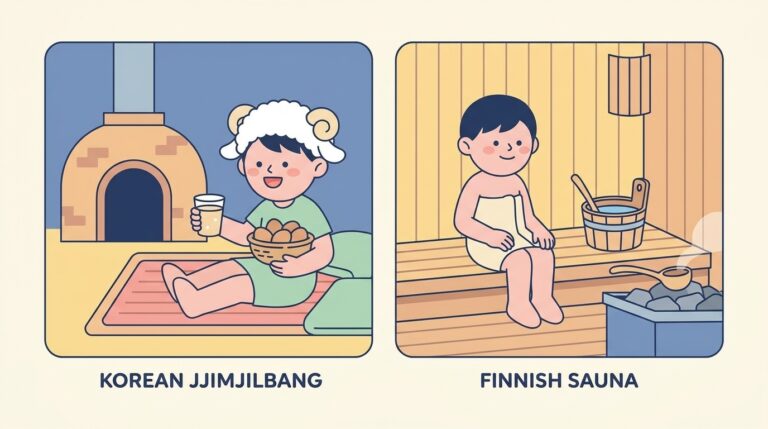
Phase 1: Empathy (Story-Driven Opening)
안녕하세요! 매일한글 에디터입니다. (Hello! I’m your Daily Hangul editor.)
Imagine this: You step into a traditional Finnish sauna. The crisp Scandinavian air outside contrasts with the intense, wood-scented steam (löyly) rising as water splashes onto scorching rocks. You sit quietly in wooden tranquility, sweating out the cold in near-sacred silence.
Now, transport yourself to a bustling Seoul Jjimjilbang (찜질방). You are wearing pastel-colored oversized cotton pajamas, your head is wrapped in a towel folded like cute sheep horns (yangmeori), children are giggling while eating chilled sweet rice punch (sikhye) and baked eggs, and families are sprawled out watching a K-drama on a giant floor-mounted TV. You might wonder: “Wait, is this a sauna, a community living room, or an amusement park? How do I even explain the difference between these two worlds in Korean?”
Many of our intermediate learners tell us they know basic vocabulary like ‘뜨겁다’ (hot) or ‘춥다’ (cold), but when trying to compare cultures with Korean friends, they feel stuck using rigid textbook phrases. In this guide, backed by 10 years of cultural navigating, we will give you the exact conversational tools to naturally compare Korean and Finnish sauna cultures like a savvy local!
Phase 2: Deep Dive into 3 Core Expressions
1. 핀란드 사우나랑 느낌이 완전 달라요.
- Pronunciation: Pinrandeu sau-narang neukkimi wanjeon dallayo. (Sound analogy: Say “Pin-rahn-deu sau-nah-rahng nuh-kkee-mee wahn-jeon dahl-lah-yo”—the double ‘kk’ in neukkim sounds like the sharp ‘k’ in ‘sky’).
- Meaning: Literal: “The feeling is completely different with Finnish sauna.” | Real Nuance: “The vibe here is totally different from a Finnish sauna!”
- K-Culture Moment: Seen in travel variety shows like Welcome, First Time in Korea? when foreign guests experience their very first multi-story mega Jjimjilbang.
- Editor’s Insight: Using ~랑/이랑 (with/compared to) paired with 완전 (wanjeon – completely/totally) makes your intermediate comparison sound effortless and conversational rather than like a dry essay.
- Situation Spectrum:
- Casual (Friends): 핀란드 사우나랑 느낌 완전 달라! (✅)
- Semi-formal (Colleagues/Staff): 핀란드 사우나랑 느낌이 완전 달라요. (✅)
- Formal (Official presentation): 핀란드식 사우나와는 분위기가 사뭇 다릅니다. (⚠️)
- 🤔 Think About It: In English, we often compare features (“The heat is different”), but Koreans frequently compare neukkim (느낌 – vibe/atmosphere/feeling). What does this reveal about Korean sensory-first conversations?
2. 식혜 한 잔 마시면서 땀 뺄래요?
- Pronunciation: Sikhye han jan masimyeonseo ttam ppellaeyo? (Sound analogy: “Seek-hyeh hahn jahn mah-see-myeon-seo ttahm bbael-lae-yo”—ttam sounds like ‘thumb’ with a tense, snappy ‘t’).
- Meaning: Literal: “While drinking a cup of sikhye, shall we pull out sweat?” | Real Nuance: “Shall we sweat it all out while sipping some sweet rice punch?”
- K-Culture Moment: The iconic rom-com trope where leads bond over iced drinks and roasted eggs after surviving the 80°C clay kiln (Hanjeungmak).
- Editor’s Insight: The idiom 땀을 빼다 (ttameul ppaeda – literally ‘to pull out sweat’) means actively detoxing and unwinding in heat. Coupling it with ~(으)면서 (while doing) naturally showcases B1-level grammar.
- Situation Spectrum:
- Casual: 식혜 마시면서 땀 좀 뺄래? (✅)
- Semi-formal: 식혜 한 잔 마시면서 땀 뺄래요? (✅)
- Formal: 식혜를 드시면서 땀을 내시겠습니까? (🚫 – sounds too unnatural for a sauna!)
- 🤔 Think About It: In Finland, cold beer or cider cools down bathers outdoors. In Korea, ice-cold fermented rice drinks (sikhye) balance the internal heat. Why do both cultures pair sweating with specific refreshments?
3. 여기가 훨씬 덜 뜨겁고 아늑해요.
- Pronunciation: Yeogiga hwolssin deol tteugeopgo aneukhaeyo. (Sound analogy: “Yeo-gee-gah hwol-sseen deol tteu-geop-go ah-neuk-hae-yo”—roll the ‘hwol’ smoothly like ‘wholesome’).
- Meaning: Literal: “Here is much less hot and cozy.” | Real Nuance: “It’s way gentler on the heat and much cozier in here.”
- K-Culture Moment: Stepping into an infrared salt room (sogeumbang) or jade room (okbang) after running out of the intense pine-wood dome.
- Editor’s Insight: Combining comparative adverb 훨씬 (much/far more) with 덜 (less) creates refined, nuanced B1 descriptions without sounding overly negative.
- Situation Spectrum:
- Casual: 여기가 훨씬 덜 덥고 아늑해! (✅)
- Semi-formal: 여기가 훨씬 덜 뜨겁고 아늑해요. (✅)
- Formal: 이곳이 비교적 온도가 낮아 쾌적합니다. (⚠️)
- 🤔 Think About It: While Finnish saunas center around instant spikes of steam and dry heat, Korean relaxation rooms emphasize prolonged comfort (aneukham). How does room temperature reflect different concepts of rest?
Phase 3: Textbook Korean vs Real Korean
Situation 1: Suggesting to enter the sauna room to sweat
- 📖 교과서 한국어 (Textbook): “사우나에 들어가서 땀을 흘립시다.” (Sau-na-e deureogaseo ttameul heullipsida. / Let us enter the sauna and shed sweat.)
- 🗣️ 진짜 한국어 (Real-World): “우리 뜨끈하게 땀 좀 뺄까?” (Uri tteukkeunhage ttam jom bbaelkka? / Shall we go sweat it out and get nice and toasty?)
- 💡 왜 다를까? (Why the difference?): Koreans rarely say “shed sweat” (ttameul heullida) casually. Instead, they use evocative sensory adjectives like 뜨끈하다 (tteukkeunhada – comfortably hot/toasty) and dynamic verbs like 땀을 빼다.
Situation 2: Expressing amazement at a hot thermal kiln
- 📖 교과서 한국어 (Textbook): “이 방의 온도가 매우 높아서 신기합니다.” (I bang-ui ondoga maeu nop-aseo singgihamnida. / The temperature of this room is very high, which is fascinating.)
- 🗣️ 진짜 한국어 (Real-World): “우와, 여기 불가마 열기 진짜 장난 아니다!” (Uwa, yeogi bulgama yeolgi jinjja jangnan anida! / Wow, the heat in this fire kiln is no joke!)
- 💡 왜 다를까? (Why the difference?): 장난 아니다 (jangnan anida – literally ‘is not a joke’) is the quintessential intermediate expression to emphasize intense sensations—from scorching kiln heat to mind-blowing flavors.
Phase 4: K-Culture Deep Dive & Non-Verbal Manners
4-1. 눈치 (Nunchi) & Gestures
- No Löyly Splashing: In Finnish saunas, pouring water on hot rocks is standard etiquette. In Korean dry saunas or Bulgama, never throw water on stones or heating elements unless explicitly designed for it. Doing so will draw startled looks!
- The Sheep Head Towel (Yangmeori): Folding your small locker towel into sheep horns is a playful cultural rite of passage. Keep your hands relaxed, and if someone shows you how to fold it, bow your head slightly with a smile (gamsahamnida).
- Voice Level Control: While Jjimjilbang communal halls are social and lively, the dedicated high-temperature clay domes (Hanjeungmak) are quiet zones where people close their eyes and meditate.
4-2. Cultural Code Analysis: The Sauna Spectrum
- K-Travel & Healing: Finnish saunas are rooted in individual communion with nature, wood, and lake dips. In contrast, the Korean Jjimjilbang is an urban refuge. It is a 24-hour sanctuary where friends gossip on heated ondol floors, recharge smartphones, eat seaweed soup (Miyeok-guk), and enjoy foot baths together. It blends bathing, spa therapy, and collective communal hospitality.
Phase 5: Real-World Roleplay Scenario
- Setting: Inside the grand communal hall of a modern traditional Jjimjilbang in Yongsan, Seoul.
- Characters:
- Mika (미카): A Finnish exchange student experiencing a Korean public bath for the first time.
- Minho (민호): Mika’s Korean buddy and seasoned Jjimjilbang master.
[Scene Start: Mika and Minho are walking on the warm heated stone floor in their unisex loungewear.]

1. 미카: 우와, 민호 씨! 여기 진짜 사우나 맞아요? 테마파크 같아요.
   (Uwa, Minho ssi! Yeogi jinjja sauna majayo? Temapakeu gatayo.)
   "Wow, Minho! Is this really a sauna? It looks like a theme park."
   🎭 행동: 눈을 크게 뜨고 넓은 중앙 홀을 둘러본다.

2. 민호: 하하, 맞아요. 핀란드 사우나랑 느낌이 완전 다르죠?
   (Haha, majayo. Pinrandeu sau-narang neukkimi wanjeon dareujo?)
   "Haha, right? The vibe is totally different from a Finnish sauna, isn't it?"
   🎭 행동: 찜질복 바지 주머니에 손을 넣고 웃는다.

3. 미카: 네! 핀란드에서는 조용히 나무 방에서 땀만 빼는데, 여긴 만화책도 있고 식당도 있네요.
   (Ne! Pinrandeueseoneun joyonghi namu bang-eseo ttam-man ppaeneunde, yeogin manhwhachaekdo itgo sikdangdo itneyo.)
   "Yeah! In Finland we quietly just sweat in a wooden room, but here there are comic books and restaurants."
   🎭 행동: 식혜를 마시는 사람들을 가리킨다.

4. 민호: 그렇죠. 먼저 70도 소나무 불가마 가서 땀 좀 뺄래요?
   (Geureochyo. Meonjeo chilsip-do sonamu bulgama gaseo ttam jom bbaellaeyo?)
   "Exactly. Shall we go to the 70°C pine kiln first to sweat it out?"
   🎭 행동: 짚으로 된 가마 입구를 가리킨다.

5. 미카: 70도요? 핀란드 사우나보다 온도는 낮은데… 물을 돌에 부어도 되나요?
   (Chilsip-doyo? Pinrandeu sau-naboda ondoneun najeunde... Mureul dor-e bueodo doenayo?)
   "70 degrees? The temperature is lower than a Finnish sauna... but can we pour water on the stones?"
   🎭 행동: 양동이와 국자를 찾는 듯 손을 움직인다.

6. 민호: 아, 여기선 물을 뿌리면 절대 안 돼요! 그냥 가만히 앉아서 원적외선을 쬐는 거예요.
   (A, yeogiseon mureul ppurimyeon jeoldae an dwaeyo! Geunyang gamanhi anjaseo wonjeogwoeseoneul jtwoeneun geoyeyo.)
   "Ah, you must never spray water here! You just sit still and soak up the infrared heat."
   🎭 행동: 두 손을 저으며 부드럽게 주의를 준다.

7. 미카: 아하, 그렇군요! 여기가 훨씬 덜 뜨겁고 아늑해서 오래 있을 수 있겠어요.
   (Aha, geureokgunyo! Yeogiga hwolssin deol tteugeopgo aneukhaeseo orae isseul su itgesseoyo.)
   "Aha, I see! It is much less hot and cozier here, so I can stay for a long time."
   🎭 행동: 고개를 끄덕이며 안도하는 표정을 짓는다.

8. 민호: 좋아요! 15분만 땀 빼고 나와서 시원한 식혜랑 구운 계란 먹어요.
   (Joayo! Sibobunman ttam bbaego nawaseo siwonhan sikhye-rang guun gyeran meogeoyo.)
   "Great! Let's sweat for just 15 minutes, come out, and grab cool sikhye and baked eggs."
   🎭 행동: 엄지손가락을 들어 올리며 가마 안으로 들어간다.
🔀 Interactive Branching Decision Point
Situation: You step out of the scorching Bulgama drenched in sweat. Mika wipes his forehead and asks what step comes next. What do you reply?
- Option A: “얼음방에 가서 열 좀 식히고 식혜 마시러 가요!” (Let’s go to the ice room to cool down our heat and drink sikhye!)
- Outcome (Best): Perfect natural progression! Alternating between hot rooms and the ice room followed by snacks is authentic Korean spa ritual.
- Option B: “찬물에 바로 뛰어들어야 하니까 탕으로 뛰어가세요!” (You must jump directly into cold water, so run to the wet tub!)
- Outcome (Risk): Entering the wet bath area requires undressing completely again and taking a shower first. Running sweaty into public cold baths violates Korean spa hygiene rules!
- Option C: “사우나 끝났으니까 이제 집에 가요.” (Sauna is finished, so let’s go home now.)
- Outcome (Bad): Leaving without eating baked eggs and lounging on the warm floor misses 80% of the Korean Jjimjilbang experience!
Phase 6: 10-Second Emotional Shadowing Drill
Practicing pausing (marked with /) and matching emotional tones:
[😊 신나고 호기심 가득하게 / Excited & Curious]- “핀란드 사우나랑 / 분위기가 / 완전 달라요!”
- (Pinrandeu sau-narang / bun-wi-giga / wanjeon dallayo!)
[🔥 시원하고 개운하게 / Refreshing & Relieved]- “뜨끈한 불가마에서 / 땀 쫙 빼니까 / 살 것 같아요.”
- (Tteukkeunhan bulgama-eseo / ttam jtwak ppaenikka / sal geot gat-ayo.)
[🤤 기대감 넘치고 다정하게 / Anticipating & Sweet]- “땀 다 뺐으니까 / 시원한 식혜 한 잔 / 마실래요?”
- (Ttam da ppaesseunikka / siwonhan sikhye han jan / masillaeyo?)
Phase 7: K-Culture Mini Dictionary
- 찜질복 (Jjimjilbok)
- Meaning: Spa loungewear (T-shirt and shorts provided at check-in).
- Real-world Usage: The universal uniform of relaxation in Korea. It allows mixed genders to hang out comfortably across open rest halls.
- 양머리 (Yangmeori)
- Meaning: Towel folded into “sheep head/horns”.
- Real-world Usage: A playful staple made famous in classic K-dramas. It keeps your hair off your neck while sweating.
- 한증막 (Hanjeungmak)
- Meaning: Traditional domed kiln built of clay and stone heated with wood fire.
- Real-world Usage: The deepest sweat chamber where locals sit on burlap sacks to absorb far-infrared healing rays.
- 세신사 / 때밀이 (Sesinsa / Ttaemiri)
- Meaning: Professional body scrub master.
- Real-world Usage: In the segregated bathing zone, specialists use textured viscose mitts to scrub off dead skin cells, leaving skin remarkably smooth.
Phase 8: Traveler’s Survival Kit
Survival TOP 3 Phrases
- “식혜랑 구운 계란 세 개 주세요.”
- (Sikhye-rang guun gyeran se gae juseyo.)
- Pro Tip: Pay by tapping your electronic locker key-wristband at the counter; you settle the total bill at checkout.
- “양머리 접는 법 좀 알려주실 수 있나요?”
- (Yangmeori jeomneun beop jom allyeojusil su itnayo?)
- Pro Tip: Ask staff or nearby Korean visitors with this phrase—they will happily demonstrate the three-fold technique.
- “수면실은 몇 층에 있어요?”
- (Sumyeonsil-eun myeot cheung-e isseoyo?)
- Pro Tip: If you plan to sleep overnight on a budget, find the designated quiet sleeping rooms (Sumyeonsil).
Editor’s Travel Note
Before visiting iconic spots like Cimer Spa at Incheon Paradise City or traditional domes around Seoul, install the official 네이버 지도 앱 다운로드 to check live opening hours and customer reviews. Always remember: in Korean bathhouse wet zones, shoes are prohibited at the locker entrance, and soaping up before entering communal hot tubs is mandatory!
Phase 9: One Step Deeper (Reflection)
In Western and Northern European bath traditions, thermal spaces are often quiet personal temples for solitude or silent meditation. In Korea, however, the concept of 정 (Jeong – relational warmth) permeates even communal sweating. The Jjimjilbang acts as a collective living room where physical boundaries dissolve, and shared comfort brings people together regardless of age or status.
💬 Your Turn: How does sauna or bathhouse culture in your home country compare to Korea’s lively social Jjimjilbang or Finland’s serene wooden saunas? Leave a comment in Korean using ~랑 달라요 below!
Phase 10: FAQ & Mistake Prevention
Q: Can I pour water on the hot rocks in a Korean dry sauna like Finnish löyly?
A: No! Korean electric and traditional kiln stones are not designed for water throwing unless explicitly labeled. Pouring water can damage heating elements or create steam burns in closed spaces.
Q: Do I wear clothes in both the bath zone and the sauna lounge?
A: No. The bathing area (Mokyoktang) is strictly gender-segregated and completely nude. The communal sauna lounge (Jjimjilbang) requires wearing the provided cotton loungewear (Jjimjilbok).
Q: Is it rude to stay inside a Jjimjilbang overnight?
A: Not at all! Most Korean Jjimjilbangs operate 24/7 and are legally licensed as low-cost public overnight lodgings equipped with sleeping mats, heated floors, and lockers.
🚨 흔한 실수 (Common Mistakes TOP 3)
- Wearing your locker towel into the hot tub water.
- Correction: Balance the folded towel on top of your head or leave it on the dry rack by the tub side.
- Calling the lounge uniform ‘pajamas’ to the front desk.
- Correction: Ask for 찜질복 (Jjimjilbok), usually included with admission.
- Using formal written language with sauna friends.
- Correction: Instead of saying “온도가 고온입니다”, say naturally: “진짜 뜨끈뜨끈해요!”
Phase 11: Action Missions
- 🥉 Bronze Mission (Solo Drill): Stand in front of a mirror and fold your towel into a sheep head (yangmeori) while saying aloud: “핀란드 사우나랑 느낌이 완전 달라요!”
- 🥈 Silver Mission (Social Challenge): Post a picture of your favorite warm drink or comfort food on Instagram with the caption: “뜨끈하게 땀 빼고 식혜 마시고 싶다!” and tag @DailyHangul.
- 🥇 Gold Mission (Real Interaction): Visit a local Korean bathhouse or Jjimjilbang in your city and order your snacks using the phrase: “식혜 하나랑 구운 계란 주세요!”
- 🎮 K-Culture Mission: Watch an episode of variety show Running Man or K-drama Legend of the Blue Sea featuring a Jjimjilbang scene and identify how many people are wearing the towel sheep horns!
Phase 12: Interactive Quiz Challenge
1. Situational Judgment Quiz
You are inside an authentic Korean charcoal kiln with your friend and feel too hot. Which sentence is the most natural B1-level Korean to suggest moving to a cooler room?
* A) 온도가 높으니 퇴장합시다.
* B) 여기가 너무 뜨거우니까 훨씬 덜 더운 소금방으로 갈래요?
* C) 물을 바위에 뿌려주세요.
🔍 Click to Reveal Answer & Detailed Explanation
Correct Answer: B
* Why: Option B uses the comparative structure 훨씬 덜 (hwolssin deol – much less) and the polite invitation ~갈래요? smoothly. Option A is stiff textbook language, and Option C is dangerous in a Korean kiln!
2. Fill-in-the-Blank Grammar Quiz
Complete the sentence using the grammar pattern for “while doing”:
“우리 시원한 식혜를 __________ 땀을 뺍시다.” (Let’s sweat it out while drinking cool sikhye.)
* Hint: Verb stem is 마시- (drink).
🔍 Click to Reveal Answer & Detailed Explanation
Correct Answer: 마시면서 (masimyeonseo)
* Why: The connective ending ~(으)면서 expresses two concurrent actions happening simultaneously. Since the verb stem mashi- ends in a vowel, we attach -myeonseo.
3. True or False Culture Quiz
Statement: In a Korean Jjimjilbang communal area, men and women wear separate clothes and are not allowed to sit in the same public lounge.
🔍 Click to Reveal Answer & Detailed Explanation
Correct Answer: False (X)
* Why: While the gender-segregated wet bath areas (Tang) are separate, the main communal lounge (Jjimjilbang) is open to all genders and families wearing the shared Jjimjilbok uniform.







