

The Ultimate Guide to Korean Payment Etiquette: Why Tipping Fails and How to Pay Like a Local
Phase 1: Empathy & Storytelling Opening
안녕하세요! 매일한글 에디터입니다. (Hello! This is your Daily Hangul editor.)
Picture this: You have just finished an exquisite meal of charcoal-grilled Hanwoo beef in a vibrant alleyway in Mapo. The banchan was replenished without asking, the service was razor-sharp, and the owner personally demonstrated how to wrap the perfect ssam. Overwhelmed with gratitude and operating on your instinctive dining habits, you leave a crisp 10,000 KRW bill on the table as a tip and walk into the cool Seoul evening air.
Thirty seconds later, you hear frantic footsteps and panting behind you. The restaurant server is running down the sidewalk, holding your cash out with both hands, looking visibly distressed: “손님, 돈 두고 가셨어요!” (Sonnim, don dugo gasyeosseoyo! / Customer, you left your money behind!)
What felt like an act of generosity in New York, London, or Toronto transformed into an awkward moment of confusion in Seoul. Why does tipping not work here? In South Korea, exceptional service is not a discretionary add-on—it is an egalitarian baseline woven directly into the pricing structure and cultural fabric. Today, we will dissect the sociolinguistics of Korean payment culture, master the nuanced expressions for bill-splitting, and empower you to navigate counters with impeccable C2-level cultural dexterity.
Phase 2: Core Expressions in Depth
1. 계산해 주세요 (Gyesanhae juseyo)
- Pronunciation: [Gye-san-hae ju-se-yo] (Think: “Gay-sahn-hae joo-say-yo” with a soft, falling terminal pitch)
- Literal vs. Real Nuance: Literally “Please calculate [the bill],” but functionally means “I am ready to settle the payment.”
- K-Culture Moment: Seen in nearly every K-Drama when a character stands at the counter or calls out to the counter staff while rising from a floor-seated table.
- Editor’s Insight: In Korean commerce, customers rarely say “I want to pay” (내가 돈 낼게요). Instead, they frame the interaction objectively as finalizing the arithmetic: 계산 (calculation). When addressed by the cashier, you will often hear the honorific mirror: 계산 도와드리겠습니다 (Gyesan dowadeurigessumnida / I will assist you with the calculation). This subtle verbal framing preserves mutual dignity.
- Situation Spectrum: Casual ⚠️ | Semi-formal ✅ | Formal ✅
- 🤔 Think About It: Why do you think Korean uses the word “calculation” rather than “payment” when concluding a transaction? How does this soften the bluntness of a monetary exchange compared to your native language?
2. 따로따로 계산해 주실 수 있나요? (Ttarottaro gyesanhae jusil su innayo?)
- Pronunciation: [Tta-ro-tta-ro gye-san-hae ju-sil su in-na-yo?] (Think: Crisp double ‘t’ sounds like “TTA-ro-TTA-ro”)
- Literal vs. Real Nuance: “Could you please calculate [this] separately?” Used when splitting items or paying distinct amounts per person.
- K-Culture Moment: Young professionals after an energetic company lunch (점심 회식) queuing up at a bustling Gangnam cafe counter to pay for their individual cold brews.
- Editor’s Insight: While historical Korean dining favored one person paying the entire tab, contemporary culture embraces 각자 계산 (individual payment). However, asking to split a 12-person bill during peak lunch hour at a small mom-and-pop shop requires refined linguistic politeness. Using the conditional ~ㄹ 수 있나요? softens the operational burden on the staff.
- Situation Spectrum: Casual ✅ | Semi-formal ✅ | Formal ✅
- 🤔 Think About It: In many Western countries, split checks are itemized electronically at the table. In Korea, card terminals sit at the front counter. How does physical space dictate the linguistic politeness required when asking for separate transactions?
3. 맛있게 잘 먹었습니다 (Mas-itge jal meogeossumnida)
- Pronunciation: [Ma-sit-ge jal meo-geot-seum-ni-da] (Smooth liaison: “mah-sheet-gay jahl muh-gut-seum-nee-dah”)
- Literal vs. Real Nuance: “I ate deliciously and well.” Functionally, this is the cultural substitute for a financial tip.
- K-Culture Moment: The warm, satisfying farewell delivered by a regular customer to an elderly Imo (auntie restaurant owner) upon stepping out the doorway in an indie slice-of-life drama.
- Editor’s Insight: Verbal validation is your currency in Korea. Leaving cash on a table can unintentionally imply that the staff is undercompensated or reliant on charity—which can bruise professional pride (체면 / Chaemyeon). Giving a crisp, sincere 맛있게 잘 먹었습니다 with a slight head bow delivers immense emotional value and honors their craftsmanship.
- Situation Spectrum: Casual ⚠️ (needs lower politeness) | Semi-formal ✅ | Formal ✅
- 🤔 Think About It: If social validation replaces financial gratuity, what responsibility does that place on the customer’s tone of voice and physical demeanor?
Phase 3: Textbook Korean vs. Real Native Korean
Situation 1: Splitting the Bill Among Peers
- 📖 Textbook Korean: 우리 각자 돈을 나누어 냅시다. (Uri gakja doneul nanueo naepsida. / Let us divide the money and pay individually.)
- 🗣️ Real Native Korean: 우리 N빵 하자! 내가 일단 긁고 카톡으로 보낼게. (Uri en-ppang haja! Naega ildan geulko katogeuro bonaelge. / Let’s do an N-split! I’ll swipe my card first and send the request via KakaoTalk.)
- 💡 Why is it different? Textbook Korean sounds like a 1980s civic handbook. Modern urban Koreans use the slang N빵 (En-ppang) (dividing by N people) alongside digital payment platforms (KakaoPay, Toss), eliminating counter delays through instant mobile transfers.
Situation 2: Treating Someone to a Meal
- 📖 Textbook Korean: 제가 모든 음식 값을 지불하겠습니다. (Jega modeun eumsik gapseul jiburlhagessumnida. / I will pay the cost of all the food.)
- 🗣️ Real Native Korean: 오늘은 제가 쏠게요. 다음번에 커피 사세요! (Oneureun jega ssolgeyo. Daeumbeone keopi saseyo! / Today is on me! You can grab the coffee next time!)
- 💡 Why is it different? The verb 쏘다 (ssoda)—literally “to shoot”—is the definitive conversational expression for “treating.” Pairing it with an invitation for the other person to buy coffee preserves relational equilibrium (품앗이 spirit of reciprocity).
Phase 4: K-Culture Deep Dive & Non-Verbal Manners
+-------------------------------------------------------------+
|             THE KOREAN PAYMENT ETIQUETTE PROTOCOL           |
+-------------------------------------------------------------+
|  [Eye Contact & Bow] -> [Two-Handed Card Hand-off]         |
|  [Acknowledge Tablet Sign] -> [Verbal Gratitude: 잘 먹었습니다] |
+-------------------------------------------------------------+
4-1. Nunchi (눈치) & Non-Verbal Mechanics
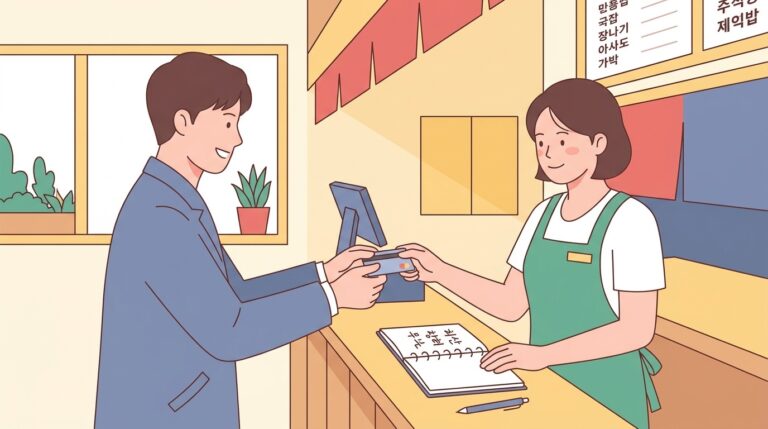
- The Two-Handed Hand-Off (양손 전달): When handing your credit card to the cashier, hold the card with both hands, or support your right elbow/forearm with your left hand. Doing this with one hand, especially flicking the card onto the counter, is perceived as dismissive.
- The Counter Location Awareness: Unlike Western dining where the server brings a billfold to your table, in Korea, you almost always pay at the front register near the entrance. Look for the small acrylic stand with your table number or carry your printed order slip (주문서) up to the counter.
- The POS Screen Signature: Most transactions under 50,000 KRW do not require a signature (무서명 거래). If the tablet prompts you for one, a quick, polite stroke is standard—never scribble disrespectfully.
4-2. Cultural Code: The Counter Struggle (계산대 앞 실랑이)
In Korean dining culture governed by Jeong (정) and Chaemyeon (체면 – saving face), fighting over the bill is an affectionate athletic sport. Two friends or business partners will physically push past each other to reach the card terminal first, shouting “내가 낼게!” (No, I’m paying!). Accepting a split bill immediately among elders or close superiors can sometimes feel transactional. The elegant compromise? If a senior colleague insists on paying the meal, step back politely, bow slightly, and offer: “정말 잘 먹었습니다. 2차는 제가 모시겠습니다!” (Thank you for the wonderful meal. Round two is on me!).
Phase 5: Real-World Roleplay Scenario
Setting: A traditional, bustling Hanok Galbi restaurant in Insadong. You are dining with your Korean colleague, Ji-won. You approach the counter to settle the bill.
Character (NPC): Boss Park (사장님), a charismatic 60-year-old restaurateur who runs a tight, welcoming ship.
[Counter Register Area - Ambient grill sounds and clinking soju glasses]
- Turn 1 (Ji-won): 사장님, 저희 3번 테이블 계산할게요!
(Sajangnim, jeohi sambeon teibeul gyesanhalgeyo!)
“Boss, we’d like to pay for Table 3!”
🎭 Hands over the wooden clipboard order slip with both hands. -
Turn 2 (Boss Park): 네, 3번 테이블 갈비 2인분에 된장찌개 하나, 총 48,000원입니다.
(Ne, sambeon teibeul galbi iinbune doenjangjjigae hana, chong saspalcheon-won-imnida.)
“Yes, Table 3 had 2 orders of Galbi and 1 soybean stew, total is 48,000 KRW.” -
Turn 3 (You): 제가 결제하겠습니다. 여기 카드요.
(Jega gyeoljehagessumnida. Yeogi kadeuyo.)
“I will take care of the payment. Here is my card.”
🎭 Supporting your right arm with your left hand as you offer the card. -
Turn 4 (Ji-won): 아녜요! 이번엔 제가 내려고 했는데…
(Anyeyo! Ibeonen jega naeryeogo haenneunde…)
“No! I was planning to get this one…” -
Turn 5 (You): 지난번에 사주셨잖아요. 오늘은 제가 대접하고 싶습니다.
(Jinanbeone sajusyeotjanayo. Oneureun jega daejeophago sipsumnida.)
“You treated me last time. I really want to treat you today.” -
Turn 6 (Boss Park): 하하, 두 분 보기 좋네! 서명은 생략되고요, 영수증 필요하세요?
(Haha, du bun bogi jonne! Seomyeongeun saengnyakdoegoyo, yeongsujeung piryohaseyo?)
“Haha, you two look great together! No signature needed, do you need the receipt?” -
Turn 7 (You): 영수증은 버려주셔도 됩니다. 너무 맛있게 잘 먹었습니다!
(Yeongsujeungeun beoryeojusyeodo doemnida. Neomu mas-itge jal meogeossumnida!)
“You may discard the receipt. We enjoyed the meal tremendously!”
🎭 Making respectful eye contact with a 15-degree appreciative bow. -
Turn 8 (Boss Park): 고마워요! 또 오세요!
(Gomawoyo! Tto oseyo!)
“Thank you! Come again!”
🔀 Interactive Decision Point
After the transaction is completed, you notice a small tip jar by the door with a couple of foreign coins, but no Korean notes. What do you do?
- Option A: Slip a 10,000 KRW note into the jar to show extra cultural generosity.
- Option B: Bow politely, say “수고하세요!” (Keep up the great work!) to the staff, and exit with Ji-won.
- Option C: Ask the owner why there is no digital tipping option on the card reader.
:::details 🔍 Click here to reveal the situational analysis
* Option A (Risk / Inappropriate): Counter-productive. Tip jars in Korea are gimmicks or tourist residue. Leaving notes can create embarrassment (민망함) for local staff.
* Option B (Best Choice): Impeccable C2 intuition. Leaving a cheerful verbal greeting (“수고하세요! / Have a good rest of your shift!”) respects the dignified service boundary.
* Option C (Bad Choice): Inconsiderate. Suggesting card tipping ignores Korean domestic labour law (Article 11 of the Food Sanitation Act enforces all-inclusive single pricing).
:::
Phase 6: 10-Second Emotional Shadowing Drill
Practice these natural cadence patterns using pause markers (/) and dynamic emotional delivery:
[💳 Polite and Decisive]
저희 / 따로따로 결제할 수 있을까요? / 제 카드로 / 2만 원만 긁어주세요.
(Jeohi / ttarottaro gyeoljehal su isseulkkayo? / Je kadeuro / iman-wonman geulgeojuseyo.)
“Could we / pay separately? / Please charge / 20,000 won to my card.”-
[😊 Warm and Appreciative]
사장님! / 정말 맛있게 잘 먹었습니다. / 다음에 / 또 올게요!
(Sajangnim! / Jeongmal mas-itge jal meogeossumnida. / Daeume / tto olgeyo!)
“Boss! / We ate so wonderfully. / We will / definitely come back!” -
[🤝 Generous and Playful]
오늘은 / 제가 쏘는 날이니까 / 손 하나 까딱하지 마세요!
(Oneureun / jega ssoneun narinikka / son hana kkattakhaji maseyo!)
“Today / is my treat, / so don’t you dare lift a finger!”
Phase 7: K-Culture Mini Dictionary
| Term (Hangul / Romanization) | Precise Translation | Sociolinguistic & Business Context |
|---|---|---|
| 1. 봉사료 (Bongsaryo) | Built-in Service Charge | By South Korean law, all menu prices are strictly VAT (부가가치세) and service inclusive. Tipping is legally and culturally redundant. |
| 2. N빵 (En-ppang) | Equal N-way split | Slang derived from algebraic variable ‘N’ + ‘ppang’ (dividing). Essential among university students and coworkers for splitting shared bar tabs. |
| 3. 쏜다 (Ssonda) | “Shooting” (Treating) | Used proactively: “내가 쏠게!” Signifies social leadership, celebration of a promotion, or returning a heartfelt favor. |
| 4. 영수증 리뷰 (Yeongsujeung Ribyu) | Receipt Verification Review | The lifeblood of Korean local eateries. Instead of tipping, leaving a 5-star Naver Place review with a photo of your receipt supports the business exponentially. |
Phase 8: Traveler’s Survival Kit
Top 3 Survival Phrases
- 카드로 할게요. (Kadeuro halgeyo. / I’ll pay by card.)
Pro Tip: South Korea is an almost 100% cashless society. Even a 1,000 KRW snack at a street kiosk can usually be paid via card or Samsung/Apple Pay. - 영수증은 괜찮아요 / 버려주세요. (Yeongsujeungeun gwaenchanayo / beoryeojuseyo. / I don’t need a receipt / Please toss it.)
Pro Tip: Cashiers will ask “영수증 필요하세요?”. This phrase saves unnecessary thermal paper waste. - 테이블에서 계산하나요? (Teibeureseo gyesanhanayo? / Do we pay at the table?)
Pro Tip: Use this rare check only in high-end hotel fine dining or Western-style tasting menus where table payment is customary.
Editor’s Travel Note
- Avoid carrying stacks of cash for tipping; it serves no purpose and will complicate your transactions.
- Foreign credit cards (Visa/Mastercard) work almost everywhere, but transport and some older market stalls require physical transit cards. Prepare your transport logistics via the 카카오 T 앱 다운로드 for taxis and ensure smooth route navigation through the 네이버 지도 앱 다운로드.
Phase 9: Think Deeper (“한 발 더 깊이”)
Why does tipping feel natural in the West but foreign in Korea? In North America, the gratuity system originated from post-feudal power dynamics and evolved into an economic subsidy for service-industry wages.
Conversely, South Korean dining culture is grounded in traditional communal hospitality (인심 / Insim) and Confucian egalitarianism. Providing side dishes (서비스 / Service) and impeccable attention is an intrinsic social contract, not an audition for a cash reward. When you attempt to tip an individual worker, you unintentionally disrupt this collective dignity, suggesting that professional kindness must be bought. True fluency is recognizing that gratitude in Korea is shared through words, repeat visits, and mutual respect.
💬 Your Turn: Have you ever experienced a culture shock moment involving tipping while traveling in Korea or abroad? Share your story in the comments below!
Phase 10: FAQ & Common Mistakes
Q: What should I do if a restaurant bill already includes a 10% service charge?
A: This only happens at 5-star international hotels or luxury hotel lounges. If it is already printed on the bill, it is processed automatically. You do not add any additional money.
Q: Can I give a small cash tip to taxi drivers if they help with heavy luggage?
A: While drivers do not expect tips, rounding up the spare change from a cash payment (e.g., leaving a 500 KRW coin: “잔돈은 됐습니다”) is acceptable. However, with card payments being standard, simply saying “기사님, 무거운 짐 들어주셔서 정말 감사합니다!” is preferred.
Q: How do Koreans split bills when using credit cards?
A: At casual cafes and restaurants, customers step up to the counter and say: “따로따로 결제할게요 (We will pay separately),” and hand their cards sequentially. In group dinners, one person pays the full amount, and the rest send their exact share instantly via mobile banking apps.
🚨 Common Mistakes Alert Board
- ❌ Mistake 1: Leaving 2,000-5,000 KRW cash on the restaurant table upon leaving.
👉 Correct Action: Leave nothing on the table. Take your order slip to the counter and pay the exact total. - ❌ Mistake 2: Handing your payment card with one limp hand while looking away at your phone.
👉 Correct Action: Hold the card with both hands, make brief respectful eye contact, and say “계산해 주세요”. - ❌ Mistake 3: Loudly interrogating an elderly owner about split billing at a chaotic lunch line.
👉 Correct Action: Nominate one friend to pay the total tab via card, then settle up outside via money transfer apps.
Phase 11: Action Missions
- 🥉 Bronze Mission (Solo Mastery): Practice saying “맛있게 잘 먹었습니다, 수고하세요!” out loud 5 times with a bright, genuine intonation in front of a mirror.
- 🥈 Silver Mission (Social Connection): Share this guide on your social media and explain to your travel buddies why tipping is unnecessary in South Korea!
- 🥇 Gold Mission (Real-world Execution): On your next visit to a Korean restaurant or cafe, hand your payment card over using both hands and deliver the appropriate exit greeting effortlessly.
- 🎮 K-Culture Mission: Watch an episode of a dining-heavy drama (like Let’s Eat or Hospital Playlist) and identify the moment characters pay at the counter. Spot the non-verbal arm support gesture!
Phase 12: Interactive Quiz Challenge
1. Situational Judgment
You are having lunch at a small Kimbap shop in Hongdae during the peak 12:30 PM lunch rush. There is a line of 10 people behind you at the cash register. What is the most culturally considerate payment method?
* A) Have all 4 people in your group pay 3,500 KRW separately with 4 different international credit cards.
* B) Leave a 5,000 KRW tip on the dining table for the dishwashers.
* C) Have one person pay the total bill with a card at the counter, and settle the N-split among yourselves outside.
2. Fill-in-the-Blank
Fill in the missing words to politely decline the paper receipt:
* “영수증은 ________ 됩니다. 맛있게 잘 먹었습니다!”
3. True / False Cultural Check
- Statement: In Korea, tipping 15% is expected at luxury Korean BBQ restaurants where the server cuts the meat for you.
👉 Click here to reveal the Quiz Answers and Explanations!
- Answer: C
Explanation: During the fast-paced Korean lunch rush (점심 피크타임), holding up the register with multiple single-card transactions creates immense friction for the owner and waiting patrons. Paying in lump-sum and settling privately via N빵 demonstrates peak cultural empathy (눈치). - Answer: 버려주셔도 (or 안 주셔도 / 괜찮습니다)
Full Sentence: “영수증은 버려주셔도 됩니다. 맛있게 잘 먹었습니다!” (You can discard the receipt. We ate very well!) - Answer: FALSE
Explanation: Even in premium K-BBQ establishments where dedicated grill-masters prepare your meat, service is included. Exceptional service is rewarded with vocal praise and repeat patronage, not a discretionary cash tip.






