

Phase 1: Empathy (Story-Immersive Opening)
안녕하세요! 매일한글 에디터입니다. (Hello! I’m your Daily Hangul editor.)
Picture this: You are watching a poignant scene in a K-drama like My Mister or Crash Landing on You. After paying solemn respects at a funeral altar, the main character is gently guided by the grieving family to a brightly lit dining hall filled with tables, steaming bowls of red spicy soup, and side dishes. The host warmly insists, “식사 꼭 하고 가세요” (Please make sure you eat before you leave).
If you come from a culture where funeral food is either a quiet reception or completely separate from the service, you might feel a wave of confusion. “Wait, is it respectful to sit down and eat when everyone is mourning? What if I’m not even hungry? What am I supposed to say to the family after finishing?”
You are not alone! Many of our international learners tell us that walking into a Korean funeral dining hall (Jeopgaeksil) is one of the most intimidating yet emotionally rich experiences in Korea. In Korean culture, sitting down to share a meal at a funeral isn’t just about feeding your stomach—it is a profound act of comfort (Wiro) and solidarity. Today, as your 10-year cultural navigator and Korean best friend, I’ll walk you through essential A2-level Korean phrases and foolproof etiquette so you can navigate this meaningful moment with warmth and confidence.
Phase 2: Top 3 Core Expressions for Funeral Dining
1. 식사 꼭 하고 가세요 (Siksa kkok hago gaseyo)
- Pronunciation: [Sik-sa kkok ha-go ga-se-yo] (Sounds like: “Seek-sah cock hah-go gah-say-yo”)
- Meaning: Literal: “Please definitely eat a meal and then go.” | Real Nuance: “Thank you for coming all this way; please let us offer you warmth and hospitality before you leave.”
- K-Culture Moment: In Korean dramas, the chief mourner (Sangju) almost always says this while taking guests’ hands near the dining hall entrance.
- Editor’s Insight: In Korea, asking someone to eat is the ultimate expression of care. The host feels relieved and honored when guests sit down to eat rather than rushing away immediately.
- Situation Spectrum: Casual (⚠️ with close friends you’d say 밥 꼭 먹고 가), Semi-formal (✅), Formal (✅)
- 🤔 Think About It: In your home country, is hospitality offered during times of deep grief, or is mourning kept strictly separate from food service?
2. 조금만 먹고 갈게요 (Jogeumman meokgo galgeyo)
- Pronunciation: [Jo-geum-man meok-go gal-ge-yo] (Sounds like: “Joh-geum-mahn muk-goh gahl-geh-yoh”)
- Meaning: Literal: “I will eat just a little and then leave.” | Real Nuance: “I may be short on time (or not very hungry), but I deeply appreciate your gesture and will gladly share a small meal with you.”
- K-Culture Moment: Said by a visitor who arrives late after work or needs to catch the last subway, reassuring the host that they won’t leave empty-handed.
- Editor’s Insight: This is the magic phrase for when you’re full or in a rush. Even having two spoonfuls of soup or a slice of boiled pork (Suyuk) shows deep respect.
- Situation Spectrum: Casual (⚠️ 조금만 먹고 갈게), Semi-formal (✅), Formal (✅)
- 🤔 Think About It: Why do you think Korean etiquette values the act of sitting at the table over the actual amount of food eaten?
3. 잘 먹고 갑니다 (Jal meokgo gamnida)
- Pronunciation: [Jal meok-go gam-ni-da] (Sounds like: “Jahl muk-goh gahm-nee-dah”)
- Meaning: Literal: “I ate well and am leaving.” | Real Nuance: “Thank you for the warm meal and hospitality during this difficult time. I will be heading out now.”
- K-Culture Moment: Spoken with a subtle 30-degree respectful bow to the family or relatives helping in the kitchen as you step out of the dining room.
- Editor’s Insight: This is the formal closing phrase. Pair it with a calm, gentle facial expression rather than a cheerful grin.
- Situation Spectrum: Casual (🚫 too stiff for best friends), Semi-formal (✅), Formal (✅)
- 🤔 Think About It: Notice how Korean parting words often tie food and departure together (잘 먹고 갑니다). How does your language express departure after hospitality?
Phase 3: Textbook Korean vs. Real Korean
Situation 1: When the family invites you to sit down
- 📖 교과서 한국어 (Textbook): 네, 음식을 먹겠습니다. (Ne, eumsig-eul meokgessseumnida. – “Yes, I will eat food.”)
- 🗣️ 진짜 한국어 (Real-Life): 감사합니다. 조금만 챙겨 먹고 갈게요. (Gamsahamnida. Jogeumman chaenggyeo meokgo galgeyo. – “Thank you. I’ll make sure to have a little bite before I leave.”)
- 💡 왜 다를까? (Why is it different?): The textbook phrase sounds robotic and task-oriented. Adding 챙겨 먹다 (to make sure to eat / look after oneself with food) conveys warm acceptance of their care.
Situation 2: When finishing your meal and saying goodbye
- 📖 교과서 한국어 (Textbook): 이제 집으로 돌아가겠습니다. (Ije jib-euro doragagessseumnida. – “I will return home now.”)
- 🗣️ 진짜 한국어 (Real-Life): 식사 잘 마쳤습니다. 먼저 일어나 볼게요. (Siksa jal machyeossseumnida. Meonjeo ireona bolgeyo. – “The meal was comforting. I’ll take my leave first.”)
- 💡 왜 다를까? (Why is it different?): Announcing you are going “home” feels blunt. Saying 먼저 일어나 볼게요 (“I’ll stand up first / take my leave”) is the gold-standard polite departure in spoken Korean.
Phase 4: K-Culture Deep Dive & Non-Verbal Manners
4-1. 눈치 (Nunchi) & Gestures in the Dining Hall
- No Clinking Glasses (건배 금지!): If you share a drink (soju, beer, or soda) with friends at the funeral table, never say “건배 (Geonbae / Cheers)” and never clink glasses. Simply lift your glass slightly with both hands and sip quietly. Clinking signifies celebratory energy.
- Two Hands for Everything: When receiving side dishes, soup, or drinks from the funeral helpers or friends, always support your wrist or forearm with your other hand.
- Tone Down the Volume: While Korean funeral dining halls can get lively (which is culturally welcomed to bring warmth and dispel heavy grief), avoid loud laughter, shouting, or singing.
4-2. The Secret of 육개장 (Yukgaejang): Why Red Soup?
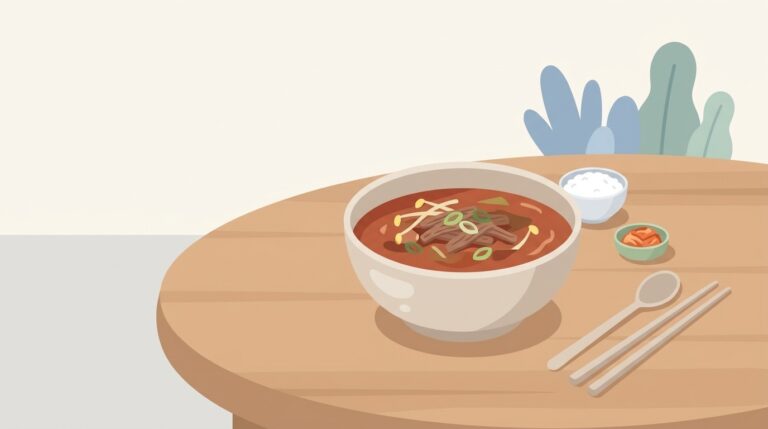
Have you ever wondered why almost every Korean funeral serves 육개장 (Yukgaejang)—a spicy red beef and scallion soup?
1. Spiritual Protection: In traditional Korean folklore, the vibrant red color from chili oil and red pepper flakes is believed to ward off negative spirits (Aek-un) and protect guests as they return home.
2. Practical Comfort: In the past, funerals lasted 3 full days with visitors arriving at all hours of the night. A large, simmering pot of rich spicy soup could be served instantly to warm up weary travelers who came from afar.
Phase 5: Real-Life Roleplay Scenario
Setting: The peaceful basement dining hall (Jeopgaeksil) of Severance Hospital Funeral Hall. Soft murmurs fill the room. Your Korean coworker Minho (the Sangju / chief mourner) walks you toward an open table.
- Turn 1 (Minho): 🎭 (Wiping his tired eyes, giving a grateful slight bow)
와줘서 정말 고마워요. 저기 앉아서 식사 꼭 하고 가세요.
(Wajwoseo jeongmal gomawoyo. Jeogi anjaseo siksa kkok hago gaseyo.)
“Thank you so much for coming. Please take a seat over there and make sure to eat before you go.” -
Turn 2 (You): 🎭 (Placing hands politely in front, speaking softly)
힘드실 텐데 신경 써주셔서 감사해요. 조금만 먹고 갈게요.
(Himdeusil tende singyeong sseojusyeoseo gamsahaeyo. Jogeumman meokgo galgeyo.)
“You must be exhausted, thank you for looking out for me. I’ll have a little bite before leaving.” -
Turn 3 (Helper Auntie): 🎭 (Placing a warm tray with Yukgaejang, rice, and Suyuk)
따뜻할 때 국물 먼저 드세요.
(Ttatteuthal ttae gungmul meonjeo deuseyo.)
“Please have the soup first while it’s nice and warm.” -
Turn 4 (You): 🎭 (Receiving the bowl with both hands and a gentle nod)
감사합니다. 잘 먹겠습니다.
(Gamsahamnida. Jal meokgessseumnida.)
“Thank you very much. I will eat well.” -
Turn 5 (Colleague Jiwon): 🎭 (Pouring water into your cup with both hands)
국물이 조금 칼칼한데 입맛에 맞아요?
(Gungmuri jogeum kalkalhande immase majayo?)
“The soup is a bit spicy, does it suit your taste?” -
Turn 6 (You): 🎭 (Taking a warm sip calmly)
네, 따뜻하고 정말 맛있어요. 마음이 편안해지네요.
(Ne, ttatteuthago jeongmal masisseoyo. Maeumi pyeonanhaejineyo.)
“Yes, it’s warm and delicious. It feels very comforting.” -
Turn 7 (You): 🎭 (Wiping your table space neatly, standing up to greet Minho)
식사 정말 잘 마쳤습니다. 마음 잘 추스르세요.
(Siksa jeongmal jal machyeossseumnida. Maeum jal chuseureuseyo.)
“I finished the meal well. Please take good care of your heart.” -
Turn 8 (Minho): 🎭 (Holding your hand briefly with both hands)
끝까지 자리 지켜줘서 고마워요. 조심히 들어가세요.
(Kkeutkkaji jari jikyeojwoseo gomawoyo. Josimhi deureogaseyo.)
“Thank you for staying with us until the end. Please get home safely.”
🔀 Interactive Choice Point
A colleague sits across from you, pours two small cups of soju, and holds his glass out toward you. What do you do?
- Option A: Cheerfully shout “위하여! (Wihayeo! / To health!)” and clink your glass firmly against his.
- 👉 Feedback (Bad): 🚫 Danger! Never clink glasses or shout cheers at a funeral. It breaks the solemn atmosphere.
- Option B: Receive the glass with two hands, raise it slightly without touching glasses, and drink quietly.
- 👉 Feedback (Best): ✅ Perfect Nunchi! In Korea, drinks at funerals are shared to silently console each other without any toast.
- Option C: Loudly push the drink away and say, “I don’t drink alcohol at sad places.”
- 👉 Feedback (Risk): ⚠️ Awkward! If you don’t drink alcohol, politely accept water or soda instead using two hands: “저는 물로 대신하겠습니다.”
Phase 6: 10-Second Emotion Shadowing Drill
Practice matching your voice tone and pauses (/) to convey heartfelt warmth:
[🥺 차분하고 정중하게 - Calm & Respectful]
힘드실 텐데 / 챙겨주셔서 / 감사합니다.
(Himdeusil tende / chaenggyeojusyeoseo / gamsahamnida.)-
[🙏 조용하고 따뜻하게 - Soft & Reassuring]
식사 / 조금만 먹고 / 일어날게요.
(Siksa / jogeumman meokgo / ireonalgeyo.) -
[🤍 깊은 위로를 담아 - Deep Comfort & Farewell]
식사 잘 마쳤습니다. / 먼저 일어나 보겠습니다.
(Siksa jal machyeossseumnida. / Meonjeo ireona bogessseumnida.)
Phase 7: K-Culture Mini Dictionary
- 육개장 (Yukgaejang): Spicy shredded beef soup served with scallions and ferns; the iconic comforting dish of Korean funerals designed to ward off misfortune.
- 접객실 (Jeopgaeksil): The funeral reception/dining hall attached directly to the memorial room where visitors eat and console the family.
- 상주 (Sangju): The chief mourner (usually the eldest son, daughter, or spouse) who hosts visitors wearing mourning clothes (Sangbok).
- 조의금 / 부의금 (Joeuigeum / Buiuigeum): Condolence money presented in a clean white envelope upon entering the venue before dining.
Phase 8: Traveler’s Survival Kit
Top 3 Survival Phrases
- 식사 잘 먹었습니다. (Siksa jal meok-eossseumnida.)
- Pro Tip: Use this when leaving the table to thank the kitchen helpers and family.
- 물 좀 더 주시겠어요? (Mul jom deo jusigess-eoyo?)
- Pro Tip: If the Yukgaejang is too spicy for your palate, ask for water politely.
- 먼저 가보겠습니다. (Meonjeo gabogessseumnida.)
- Pro Tip: A humble, natural way to announce your quiet departure.
🧭 Editor’s Travel Note
- Cash is Essential: Condolence envelopes are strictly cash-only. Most hospital funeral basements have ATMs, but it is best to prepare crisp bills in advance.
- Transportation: Funerals often run late into the evening. Check your train schedules via Naver Map app navigation or book a late-night ride safely using Kakao T Taxi app for direct pickup.
Phase 9: “A Step Deeper” (Reflective Essay)
In many Western cultures, grief is experienced privately behind closed doors. In Korea, however, a funeral is built upon the tradition of 품앗이 (Pumasi)—communal mutual aid. When tragedy strikes, friends and colleagues gather not only to bow, but to fill the room with warmth, eat together, and ensure the grieving family is never left alone in silence through the dark night. Eating the funeral meal is not an indulgence; it is your active gift of presence and emotional support to the family.
💬 Your Turn: What is the most comforting food in your culture when someone is going through a hard time? Let us know in the comments below!
Phase 10: FAQ & Common Mistakes
Q: Is it rude if I don’t eat anything at a Korean funeral?
A: If you truly cannot eat due to dietary restrictions or a tight schedule, it is acceptable, but politely sitting down for even 5 to 10 minutes over a cup of water or tea is considered far more respectful than leaving immediately after bowing.
Q: Can I take photos of the food or funeral room for memories?
A: Absolutely not. Taking photos or selfies inside the memorial room (Binso) or reception hall (Jeopgaeksil) is strictly taboo and deeply disrespectful to the grieving family.
Q: How long should I stay at the dining table?
A: Around 30 minutes to 1 hour is customary. If you are very close friends with the deceased or the host, staying longer into the evening to keep them company is warmly welcomed.
🚨 Common Mistakes Warning Board
- ❌ Shouting “Cheers” (건배) with drinks ➔ ✅ Sip quietly without touching glasses.
- ❌ Refusing food abruptly with “No thanks, I ate” ➔ ✅ Say “조금만 먹고 갈게요” (I’ll have just a little bite).
- ❌ Laughing or talking at high volume ➔ ✅ Keep conversation warm, moderate, and comforting.
Phase 11: Action Mission & Engagement
- 🥉 Bronze Mission: Say “식사 꼭 하고 가세요” out loud 3 times with a gentle, inviting tone.
- 🥈 Silver Mission: Write a mock dialogue in the comments using “조금만 먹고 갈게요”.
- 🥇 Gold Mission: Next time you watch a K-Drama funeral scene, spot the bowl of Yukgaejang and observe how characters greet each other at the table!
Phase 12: Interactive Quiz Challenge
1. Situation Judgment
You are sitting at a Korean funeral reception table and someone pours you a cup of cider. What should you do?
* A) Clink glasses firmly and yell “건배!”
* B) Hold the cup with two hands, raise it gently without clinking, and sip quietly.
* C) Demand a different beverage loudly.
👉 Click to view Answer & Explanation
Correct Answer: B
Explanation: Never clink glasses or yell toasts (건배) at a funeral. Raising your drink slightly with both hands shows quiet respect and solidarity.
2. Fill in the Blank
Complete the polite departure phrase:
“식사 잘 마쳤습니다. 먼저 ________ 볼게요.” (I finished the meal well. I will take my leave first.)
* A) 놀아 (nora)
* B) 일어나 (ireona)
* C) 달려 (dallyeo)
👉 Click to view Answer & Explanation
Correct Answer: B (일어나)
Explanation: 일어나 볼게요 literally means “I will stand up,” which is the standard, polite way to say you are getting ready to leave a seated table.
3. Cultural True / False
Statement: Eating Yukgaejang at a funeral is considered selfish because you should only focus on mourning without food.
👉 Click to view Answer & Explanation
Correct Answer: False (F)
Explanation: Sharing food is an essential Korean cultural act of comforting the bereaved family and receiving their warm hospitality.







