

Master Korean Banchan Pairing: The Secret Harmony Between Main Dishes and Side Dishes
Phase 1: Empathy (Story-Immersive Opening)
안녕하세요! 매일한글 에디터입니다. (Hello! It’s your Daily Hangul editor.)
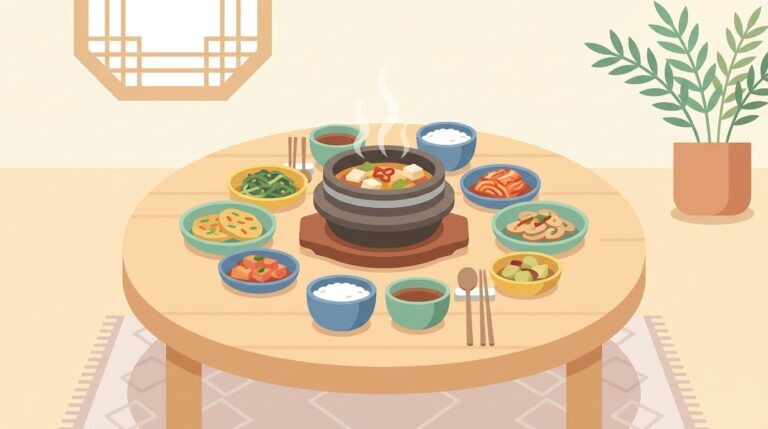
Picture this: You step inside a bustling K-BBQ restaurant in Hapjeong, Seoul. The aroma of sizzling pork belly fills the air, and within seconds, the table is suddenly covered with seven little colorful ceramic bowls: seasoned soybean sprouts, pickled radish (ssammu), aged kimchi, spicy scallion salad (pajeori), steamed egg (gyeran-jjim), and dipping sauces.
You sit there staring at the spread. Do you eat the pickled radish by itself as an appetizer? Should you dump the spicy scallions into the stew? Or do you take a giant bite of raw garlic with a spoonful of rice?
Many intermediate Korean learners tell me: “I know all the names of banchan, but when I sit down at a traditional Korean restaurant, I still feel awkward about how they actually interact with the main course!” In Korean cuisine, side dishes are not just decorative starters or random finger food. They are meticulously designed flavor counterweights that balance oiliness, spice, temperature, and texture. Today, we’re unlocking the art of 메인 요리와 반찬의 조화 (Harmony between main dishes and banchan) so you can dine, converse, and appreciate K-food like a true local gourmet.
Phase 2: Core Expressions Deep Dive (B2 Level)
1. 이건 같이 곁들여 먹어야 제맛이에요.
- Pronunciation: Igeon gachi gyeotdeuryeo meogeoya jemat-ieyo. (Sounds like: ee-geon gah-chee gyut-deul-yeo muh-guh-yah jeh-maht-ee-eh-yo — imagine smoothly sliding the ‘yeo’ sound like saying “get through ya” rapidly)
- Meaning: Literal: “You only get the real taste if you side-eat this together.” ➔ Nuance: “To truly appreciate this dish, you have to pair it with this side dish; that’s where the real magic happens.”
- K-Culture Moment: In food reality shows like Baek Jong-won’s Alley Restaurant, you constantly hear master chefs lecturing guests on how pairing a tangy condiment or specific pickled banchan brings out the savory depth of pork or grilled fish.
- Editor’s Insight: The verb 곁들이다 (to serve alongside / to garnish / to accompany) elevates your Korean instantly from basic beginner speech (같이 먹어요) to refined, gourmet B2 Korean. 제맛 (true/authentic flavor) emphasizes cultural authenticity.
- Situation Spectrum: Casual ✅ | Semi-formal ✅ | Formal ⚠️
- 🤔 Think About It: In Western dining, condiments and sides often sit on the same plate or are ordered separately as full sides. Why does Korean dining center around multiple shared bowls meant to be dynamically combined bite-by-bite?
2. 반찬이 메인 요리랑 궁합이 딱 맞네요.
- Pronunciation: Banchani mein yorirang gunghabi ttak manne-yo. (Sounds like: bahn-chahn-ee may-een yoh-ree-rahng goong-hah-bee dtahk mahn-neh-yoh — make sure to give the ttak a crisp, snappy pop of your tongue)
- Meaning: Literal: “The side dish’s marital compatibility with the main dish fits perfectly.” ➔ Nuance: “These side dishes complement the main dish in absolute culinary harmony!”
- K-Culture Moment: Seen in romantic K-dramas where the lead characters share a meal at a humble pocha or home kitchen, using 궁합 (marital/astrological compatibility) playfully to describe how well their personalities match—just like braised tofu and warm rice.
- Editor’s Insight: Originally a divination term for matchmaking couples based on birth dates, 궁합 (gunghap) is used daily by Koreans to describe flavor synergy. Saying 궁합이 좋다 or 궁합이 딱 맞다 will make any Korean diner smile in deep appreciation of your linguistic fluency.
- Situation Spectrum: Casual ✅ | Semi-formal ✅ | Formal ✅
- 🤔 Think About It: What does it say about a culture when a word originally used for cosmic relationship compatibility (궁합) is commonly used to describe food pairing?
3. 기름진 맛을 싹 잡아줘서 안 물려요.
- Pronunciation: Gireumjin maseul ssak jabajwoseo an mullyeoyo. (Sounds like: gee-reum-jeen mah-seul ssahk jah-bah-jwo-seo ahn mool-lyeo-yoh — pronounce ssak with a clean, sweeping emphasis, like swooshing a broom)
- Meaning: Literal: “It completely catches the oily taste, so I don’t get bitten/tired of it.” ➔ Nuance: “It cuts through the greasiness so perfectly that you never get sick of eating it.”
- K-Culture Moment: Essential vocabulary on famous Korean Mukbang channels! Creators will eat pounds of pork belly (samgyeopsal) or fried chicken, pause to crunch into a piece of pickled garlic or radish, and sigh happily, noting how the acidity resets their palate.
- Editor’s Insight: The verb 물리다 (to become sick/cloyed of a taste or activity) combined with 잡아주다 (to capture/balance out a heavy flavor) is the ultimate native expression for culinary balance.
- Situation Spectrum: Casual ✅ | Semi-formal ✅ | Formal ⚠️
- 🤔 Think About It: How does the concept of ‘palate fatigue’ (물림) shape the side dishes present in your own home cuisine compared to Korean banchan?
Phase 3: Textbook Korean vs. Real Native Korean
Situation 1: Explaining that a side dish balances the heavy flavor of the main meat
- 📖 Textbook Korean: 이 반찬은 고기의 느끼함을 줄여줍니다. (I banchaneun gogi-ui neukkihameul juryeojumnida. – This side dish reduces the greasiness of the meat.)
- 🗣️ Real Native Korean: 이 장아찌가 고기 기름기를 싹 잡아줘서 훨씬 깔끔해요! (I jang-ajjiga gogi gireumgireul ssak jabajwoseo hwolssin kkalkkeumhaeyo! – These pickled vegetables totally cut through the pork fat, making it taste so crisp and clean!)
- 💡 Why the difference? While 느끼함을 줄이다 is grammatically sound, native speakers prefer vivid action verbs like 기름기를 잡다 (catch the oiliness) and sensory adjectives like 깔끔하다 (neat, clean palate finish).
Situation 2: Asking someone how to eat a unique side dish with the stew
- 📖 Textbook Korean: 이 반찬을 찌개와 어떻게 같이 먹습니까? (I banchaneul jjigaewa eotteoke gachi meokseumnikka? – How do you eat this side dish with the stew?)
- 🗣️ Real Native Korean: 이건 찌개 국물에 살짝 적셔 먹는 게 더 맛있죠? (Igeon jjigae gungmure saljjak jeoksyeo meongneun ge deo masitjyo? – It’s much tastier if you lightly dip this into the stew broth, right?)
- 💡 Why the difference? Intermediate learners shine when they ask suggestive questions using ~는 게 더 맛있죠? with culinary verbs like 적시다 (to moisten/dip) rather than generic 어떻게 먹어요? questions.
Phase 4: K-Culture Deep Dive & Non-Verbal Dining Etiquette
    [ Korean Banchan Harmony Chart ]
   +---------------------------------+
   |       MAIN: Sizzling Meat       |
   |  (Rich / Savory / Oily Profile) |
   +----------------+----------------+
                    |
        Balanced by Complementary Banchan
                    |
       +------------+------------+
       |                         |
  [ACIDITY/CRUNCH]         [EARTHY/HERBAL]
  Pickled Radish (쌈무)    Spicy Scallions (파절이)
  Aged Kimchi (익은 김치)   Perilla Leaf (깻잎 장아찌)
4-1. Nunchi & Tabletop Choreography
- The Angle of the Shared Bowl: In Korean restaurants, banchan bowls are placed in the center for everyone to share. If you notice a companion constantly reaching across the table for the eomuk-bokkeum (stir-fried fish cakes), use your Nunchi (quick social intuition) to slide the dish slightly closer to the center between you both using both hands.
- The Double-Hand Pass: When an Imo-nim (restaurant auntie) hands you a freshly refilled side dish, always accept or touch the edge of the plate with both hands as a sign of respect.
- Chopstick Etiquette in Shared Bowls: Avoid rummaging or picking through a side dish plate to find a specific piece. Pick cleanly from the top.
4-2. Cultural Code Analysis: The Science of ‘Dan-Jjan’ and ‘Eol-keon’
Korean gastronomy operates on harmonic polarities: 단짠 (Dan-Jjan: Sweet & Salty) and 얼큰 (Eol-keon: Fiery & Invigorating).
* If the main dish is spicy and hot (like Dak-bokkeum-tang or Kimchi-jjigae), the banchan will intentionally feature cooling, mild textures—such as chilled bean sprout soup (kongnamul-guk), blanched spinach (sigeumchi-namul), or sweet potato mash.
* If the main dish is rich, savory, and fatty (like Samgyeopsal or Galbi), the banchan will offer acidity, pungent fermentation, and crisp textures (pickled perilla leaves, sour kimchi, pungent alliums) to keep your palate lively.
Phase 5: Real-Life Roleplay Scenario
Setting: An authentic Chadol-bagi (thinly sliced beef brisket) restaurant in Euljiro. You are having dinner with your Korean colleague, Min-woo (민우).
[Scene Start]
민우 (Min-woo): [고기를 불판에 올리며 집게를 능숙하게 놀린다] 벌써 다 익었어요! 차돌박이는 빨리 익어서 바로 먹어야 해요.
(Gogireul bulpane ollimyeo jipgereul neungsukhage nollinda. Beolsseo da igeosseoyo! Chadolbagineun ppalli igeoseo baro meogeoya haeyo.)
🎭 Flipping the meat deftly with tongs. “It’s already cooked! Beef brisket cooks in seconds, so you have to eat it immediately.”
You: [젓가락으로 고기 한 점을 집어 들며] 와, 냄새 진짜 좋네요. 그냥 소금에 찍어 먹으면 돼요?
(Wa, naemsae jinjja jonneyo. Geunyang sogume jjigeo meogeomyeon dwaeyo?)
🎭 Lifting a slice of beef with chopsticks. “Wow, the aroma is amazing. Should I just dip it in salt?”
민우 (Min-woo): [미소를 지으며 옆에 있는 갓김치 접시를 가리킨다] 첫 점은 소금도 좋지만, 이 여수 갓김치랑 같이 곁들여 먹어야 제맛이에요.
(Misoreul jieumyeo yeope inneun gatgimchi jeopsireul garikinda. Cheot jeomeun sogumdo jochiman, i Yeosu gatgimchirang gachi gyeotdeuryeo meogeoya jemat-ieyo.)
🎭 Smiling and pointing to the plate of mustard leaf kimchi. “Salt is great for the first bite, but pairing it with this Yeosu mustard leaf kimchi is where the true flavor shines.”
You: [고기에 갓김치를 돌돌 말아 한 입 먹은 후 눈을 크게 뜬다] 오! 갓김치의 톡 쏘는 맛이 기름진 맛을 싹 잡아줘서 전혀 안 물리네요!
(O! Gatgimchi-ui tok ssoneun masi gireumjin maseul ssak jabajwoseo jeonhyeo an mullineyo!)
🎭 Wrapping the kimchi around the meat, taking a bite with wide eyes. “Oh! The pungent kick of the mustard leaf cuts right through the oiliness, so it’s not heavy at all!”
민우 (Min-woo): [뿌듯한 표정으로 고개를 끄덕인다] 맞죠? 이 집은 메인 고기랑 반찬 궁합이 진짜 환상이에요.
(Matjyo? I jibeun mein gogirang banchan gunghabi jinjja hwansang-ieyo.)
🎭 Nodding with satisfaction. “Right? The harmony between the main meat and banchan in this restaurant is truly fantastic.”
You: [빈 반찬 접시를 보며] 갓김치 벌써 다 먹었어요. 이모님께 더 달라고 부탁드려 볼까요?
(Gatgimchi beolsseo da meogeosseoyo. Imonimkke deo dallago butakdeuryeo bolkkayo?)
🎭 Looking down at the empty side plate. “We finished the kimchi already. Shall we ask the auntie for a refill?”
민우 (Min-woo): [손을 들려는 당신을 말리며 미소 짓는다] 아, 저기 ‘추가 반찬은 셀프’라고 적혀 있네요! 제가 가져올게요.
(A, jeogi ‘chuga banchaneun selpeu’rago jeokhyeo inne-yo! Jega gajyeoolgeyo.)
🎭 Gently gesturing toward the back wall with a chuckle. “Ah, it says ‘Self-service for extra side dishes’ right over there! I’ll go grab some.”
You: [일어나며] 아니에요, 제가 다녀올게요! 파절이랑 양파 절임도 더 챙겨올게요.
(Anieyo, jega danyeoolgeyo! Pajeorirang yangpa jeorimdo deo chaenggyeoolgeyo.)
🎭 Standing up proactively. “No way, let me go get it! I’ll bring some more scallion salad and pickled onions too.”
[Scene End]
🔀 Interactive Scenario Branching: Your Turn to Respond!
Imagine the Imo-nim brings a plate of raw fermented skate (hong-eo) or extra-pungent aged radish kimchi (kakkdugi) and places it next to your beef. What would you say?
- Option A: “이건 고기랑 같이 먹으면 기름기를 잡아주는 반찬인가요?” (Is this a side dish that cuts the grease when eaten with meat?)
- 🏆 Result (BEST): Highly natural! Demonstrates food knowledge, contextual curiosity, and cultural etiquette. The Imo-nim will praise your Korean.
- Option B: “이거 너무 냄새가 강해서 못 먹겠어요. 치워주세요.” (This smells too strong; I can’t eat it. Take it away.)
- ❌ Result (BAD): Too blunt and risks offending the restaurant staff. Better to leave it untouched politely if you dislike it.
- Option C: “이 반찬이랑 메인 요리가 서로 어울리지 않는 것 같습니다.” (It seems this side dish and the main dish do not match.)
- ⚠️ Result (RISK): Grammatically correct, but overly formal and presumes the restaurant’s menu pairing is flawed.
Phase 6: 10-Second Emotion Shadowing Drill
Practice these natural rhythm pauses (marked with /) and match the emotion tag!
[😋 입맛을 다시며 깊은 감탄]- “이 묵은지가 / 고기 기름기를 / 싹 잡아줘서 / 끝도 없이 들어가요!”
- (I mugeunjiga / gogi gireumgireul / ssak jabajwoseo / kkeutdo eopsi deureogayo!)
- “This aged kimchi cuts through the meat grease so cleanly that I can eat endlessly!”
[🥢 다정하게 꿀팁을 전수하듯]- “이 나물은 / 밥 위에 얹어서 / 찌개 국물이랑 / 같이 곁들여 드셔보세요.”
- (I namureun / bap wie eonjeoseo / jjigae gungmurirang / gachi gyeotdeuryeo deusyeoboseyo.)
- “Try putting these seasoned greens over your rice and pairing them with a spoonful of stew broth!”
[😍 조화로운 맛에 반한 억양]- “메인 요리도 훌륭한데 / 밑반찬이랑 / 궁합이 진짜 / 예술이네요!”
- (Mein yorido hullyunghande / mitbanchanirang / gunghabi jinjja / yesurineyo!)
- “The main dish is wonderful on its own, but the chemistry with the side dishes is a true work of art!”
Phase 7: K-Culture Mini Dictionary
- 궁합 (Gunghap)
- Translation: Culinary compatibility / Gastronomic harmony.
- Usage: Used to describe foods that enhance each other nutritionally or in flavor (e.g., 삼겹살과 소주, 치킨과 맥주, 생선구이와 와사비 간장).
- 곁들이다 (Gyeotdeurida)
- Translation: To accompany, to serve along with, to garnish.
- Usage: A sophisticated verb used when serving side garnishes, drinks, or complementary side plates alongside the centerpiece dish.
- 물리다 (Mullida)
- Translation: To become cloyed / palate-fatigued.
- Usage: Used when rich, sweet, or overly greasy foods overwhelm your appetite. Countered by sour, spicy, or fermented banchan.
- 입가심 (Ipgasim)
- Translation: Palate cleanser / Post-meal refresher.
- Usage: Refers to light banchan (like chilled dongchimi radish broth) or refreshing beverages (like sikhye or sungnyung) consumed to clean the mouth after a flavorful meal.
Phase 8: Traveler’s Dining Survival Kit
+-------------------------------------------------------------------------+
|                        BANCHAN SURVIVAL PHRASES                         |
+-------------------------------------------------------------------------+
| 1. "이모님, 이 반찬 리필 좀 부탁드려요!"                               |
|    (Imonim, i banchan ripil jom butakdeuryeoyo!)                        |
|    Pro Tip: Raise your hand slightly; 'refill' (리필) is universally    |
|    understood across Korean restaurants!                                |
+-------------------------------------------------------------------------+
| 2. "이 반찬은 셀프바에서 직접 가져오면 되나요?"                         |
|    (I banchaneun selpeuba-eseo jikjeop gajyeoomyeon doenayo?)           |
|    Pro Tip: Look around for a stainless steel refrigerated bar labeled  |
|    '추가 반찬 (Extra Banchan)' or '셀프 코너 (Self Corner)'.            |
+-------------------------------------------------------------------------+
| 3. "이건 매운 메인 요리랑 같이 비벼 먹는 반찬이에요?"                   |
|    (Igeon maeun mein yorirang gachi bibyeo meongneun banchanieyo?)      |
|    Pro Tip: Great for dishes like Nakji-bokkeum (spicy octopus) where   |
|    bean sprouts and seaweed are meant to be mixed directly with rice.   |
+-------------------------------------------------------------------------+
🧳 Editor’s Travel Note
- Navigation & Finding Gourmet Banchan: Check restaurant reviews on the 네이버 지도 앱 다운로드 (Naver Map app download) and search for the keyword ‘밑반찬 맛있는 집’ (restaurants with delicious side dishes). In Korea, any restaurant whose banchan is exceptional is guaranteed to have a phenomenal main dish!
- Payment & Tipping: There is strictly no tipping in South Korea, and banchan refills are almost always free unless specifically marked (such as adding special raw marinated crab or massive meat platters).
Phase 9: “A Step Deeper” (한 발 더 깊이)
In Western dining traditions, dishes are often sequenced sequentially: appetizer, main entrée, dessert. Korean dining, however, is deeply rooted in the philosophy of ‘Han-sang Cha-rim’ (한상차림 – a comprehensive single-table spread).
Every small bowl on the table exists in a dynamic web of relationships. The fiery kick of kimchi, the earthy saltiness of doenjang, the crisp crunch of namul, and the tender richness of the main stew or meat are assembled to create an equilibrium within the diner’s own mouth. Banchan teaches us that Korean gastronomy is participatory: you are the conductor of your own flavor orchestra with every single chopstick motion.
💬 Your Turn: What is your all-time favorite Korean side dish, and which main dish do you love pairing it with? Drop your thoughts in the comments below! (댓글로 여러분이 제일 좋아하는 반찬 조합을 알려주세요!)
Phase 10: FAQ & Common Mistakes
Q: Are all side dishes in Korean restaurants refilled for free?
A: Yes, in 95% of standard Korean restaurants, banchan is unlimited and complimentary! However, expensive specialty sides (like Ganjang Gejang / raw soy-marinated crab, or whole fried fish served as a side) may carry a nominal re-order fee on the menu.
Q: Is it rude to finish all the banchan before the main dish arrives?
A: It is not strictly rude, and nibbling on light banchan like potato salad or acorn jelly (dotorimuk) while waiting is very common! However, save the pickled and spicy condiments to enjoy in harmony with your main dish.
Q: What should I do if a restaurant has a self-bar (셀프바)?
A: Take only what you can eat. Food waste (잔반) is an environmental concern in Korea, so you will often see signs reading “드실 만큼만 적당히 가져가세요” (Please take only as much as you will eat).
+-------------------------------------------------------------------------+
|               🚨 TOP 3 COMMON BANCHAN MISTAKES TO AVOID                |
+-------------------------------------------------------------------------+
| ❌ Mistake 1: Sticking your chopsticks vertically into your rice bowl.   |
|    ✅ Correct Action: Rest them flat across your metal spoon rest or     |
|       the side of your plate. Vertical chopsticks evoke ancestral rites.|
| ----------------------------------------------------------------------- |
| ❌ Mistake 2: Mixing all separate banchan into your main soup bowl       |
|    without knowing if it's meant for it.                                |
|    ✅ Correct Action: Eat a bite of meat/soup, followed by a bite of    |
|       banchan, keeping clean distinct taste profiles.                   |
| ----------------------------------------------------------------------- |
| ❌ Mistake 3: Pouring extra dipping sauce onto the shared banchan plate. |
|    ✅ Correct Action: Use your individual small sauce dish (종지) for    |
|       dipping each piece individually.                                  |
+-------------------------------------------------------------------------+
Phase 11: Action Missions
- 🥉 Bronze Mission (Solo Mastery): Practice saying the sentence “이 반찬이 고기 기름기를 싹 잡아줘서 안 물려요!” aloud 5 times using the shadowing audio rhythm from Phase 6.
- 🥈 Silver Mission (Social Share): Take a photo of your next Korean meal, tag our community
@DailyHangul, and caption the photo describing the 궁합 (Gunghap) of your meal using the phrase “메인 요리랑 반찬 궁합이 딱 맞네요!”. - 🥇 Gold Mission (Real-World Test): Next time you visit a Korean eatery, politely request a refill using the phrase “이모님, 이 반찬 리필 좀 부탁드려요!” or ask if the self-bar is available.
- 🎮 K-Culture Media Hunt: Watch an episode of a Korean variety show (e.g., Delicious Guys / 맛있는 녀석들 or I Live Alone / 나 혼자 산다) and spot at least one moment where a cast member mentions 궁합 or 물리다.
Phase 12: Interactive Quiz Challenge
Question 1: Situation Judgment
You are eating a rich, fatty serving of grilled pork belly (Samgyeopsal). Which of the following banchan provides the best flavor balance according to Korean dining culture?
* (A) Sweet mashed pumpkin
* (B) Pickled radish slices (Ssammu) and spicy scallion salad (Pajeori)
* (C) Heavy mayonnaise macaroni salad
👉 Click to reveal Answer & Explanation
Correct Answer: (B)
Explanation: Fatty, savory pork belly needs crisp acidity and sharpness (기름기를 싹 잡아주는 산미와 매콤함) provided by pickled radish and scallion salad to prevent palate fatigue (물림).
Question 2: Fill in the Blank
Complete the sentence with the natural B2-level verb for culinary pairing:
“이 도토리묵은 양념장에 살짝 ________ 먹어야 제맛이에요.”
(This acorn jelly tastes best when paired/garnished lightly with seasoning sauce.)
* (A) 버려
* (B) 곁들여
* (C) 남겨
👉 Click to reveal Answer & Explanation
Correct Answer: (B) 곁들여 (from 곁들이다)
Explanation: 곁들이다 means to serve along with or pair as a complementary accompaniment. (A means throw away; C means leave behind).
Question 3: Cultural True or False
Statement: In Korean dining culture, 궁합 (Gunghap) only refers to romantic compatibility between engaged couples and is considered inappropriate slang when used to describe food.
👉 Click to reveal Answer & Explanation
Correct Answer: False
Explanation: While 궁합 originated in marriage fortune-telling, it is now an essential, universally accepted term in Korean food culture (음식 궁합) to express harmonious flavor pairings!







