

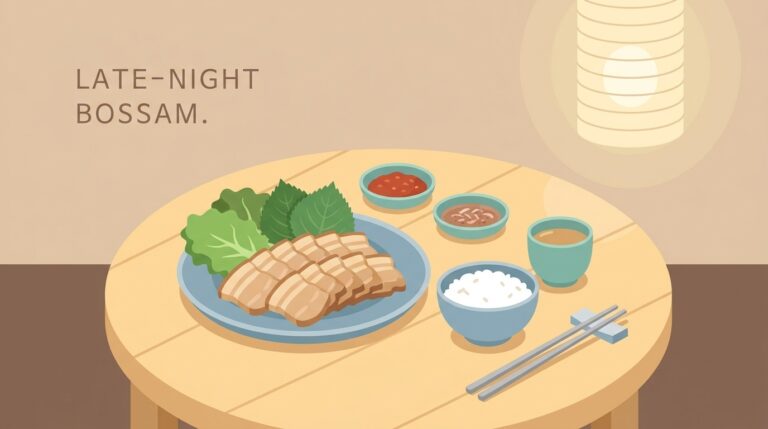
Master Korea’s Midnight Craving: The Ultimate Guide to Ordering Bossam
Phase 1: Empathy (Story Immersion Opening)
안녕하세요! 매일한글 에디터입니다.
Picture this: It’s 11:30 PM in Seoul. The neon signs are glowing, your stomach is rumbling after an exciting day of exploring, and you’re craving something hearty, savory, and uniquely Korean. You walk past bustling restaurants or open a food delivery app, and you see it—보쌈 (Bossam): tender, steaming slices of boiled pork belly wrapped in crisp lettuce with spicy seasoned radish kimchi.
Then, panic sets in. What size should I order? What are all these tiny sauce containers? How do I politely ask for more lettuce wraps without sounding awkward?
Many of our A2 learners tell us they feel intimidated when ordering Bossam because of the specialized dining vocabulary and the rich side-dish etiquette. But don’t worry! By mastering just a few authentic phrases and cultural dining habits, you will order and enjoy Bossam just like a local. This guide is built on real feedback from international learners living in Korea and is tailored specifically for your A2 level.
Phase 2: Deep Dive into 3 Core Expressions
1. 보쌈 소짜 하나 주세요 (Bossam so-jja hana juseyo)
- Pronunciation: Bossam so-jja hana juseyo (Sounds like: boh-ssam so-jah ha-na joo-seh-yo — imagine saying “so” with a snappy “jah” at the end!)
- Meaning: Literal: “Please give one small Bossam” | Actual Nuance: “We’d like a small size Bossam, please.”
- K-Culture Moment: You often hear exhausted office workers in K-dramas collapsing into a 24-hour restaurant booth late at night, calling out this exact phrase to the owner.
- Editor’s Insight: Meat dishes in Korea come in portions labeled 소 (So – Small, for 2 people), 중 (Jung – Medium, for 3 people), and 대 (Dae – Large, for 4+ people). In spoken Korean, Koreans add “-짜 (-jja)” to make it roll off the tongue naturally: 소짜 (so-jja), 중짜 (jung-jja), 대짜 (dae-jja).
- Situation Spectrum: Casual: ⚠️ | Semi-formal: ✅ | Formal: 🚫 (Perfect for ordering at any restaurant!)
- 🤔 Think About It: In Western dining, you usually order individual entrees per person. Why do you think Korean food like Bossam is sized for sharing communally?
2. 상추 더 주실 수 있나요? (Sangchu deo jusil su innayo?)
- Pronunciation: Sangchu deo jusil su innayo? (Sounds like: sahng-choo duh joo-sheel soo een-nah-yo)
- Meaning: Literal: “Can you give more lettuce?” | Actual Nuance: “Could we get a refill on lettuce, please?”
- K-Culture Moment: In food reality shows like Delicious Rendezvous, you’ll see foodies devour their wraps so fast that they constantly ask for more fresh leafy greens.
- Editor’s Insight: Fresh wrap vegetables (쌈채소 – ssam-chaeso) are almost always refillable for free in Korean restaurants! Don’t be shy to ask politely using ~주실 수 있나요? (Could you please give me~?).
- Situation Spectrum: Casual: ⚠️ | Semi-formal: ✅ | Formal: ✅
- 🤔 Think About It: In your home country, do restaurants charge extra for side salad or bread refills? How does free refill culture reflect Korean hospitality (정 – Jeong)?
3. 새우젓에 찍어 드세요 (Saeujeose jji-geo deuseyo)
- Pronunciation: Saeujeose jjigeo deuseyo (Sounds like: seh-oo-juh-seh jee-gaw deh-seh-yo — sae-u sounds like “say-ooh”)
- Meaning: Literal: “Please dip it in salted shrimp and eat” | Actual Nuance: “Try dipping the meat into the salted fermented shrimp sauce!”
- K-Culture Moment: When friendly restaurant owners serve a steaming plate of Bossam, they will kindly advise first-time foreign visitors this golden rule to maximize flavor and aid digestion.
- Editor’s Insight: 새우젓 (Saeujeot) is tiny fermented shrimp. It provides the perfect salty punch and contains enzymes that help digest rich pork belly smoothly.
- Situation Spectrum: Casual: ⚠️ | Semi-formal: ✅ | Formal: ✅
- 🤔 Think About It: Food pairings in Korea often balance nutritional science and traditional medicine. Do you have digestive food pairings in your culture?
Phase 3: Textbook Korean vs Real Korean
Situation 1: Asking for more wrap vegetables
- 📖 교과서 한국어 (Textbook): 채소를 더 주시겠습니까? (Chaeso-reul deo jusigesseumnikka? – “Would you give me more vegetables?”)
- 🗣️ 진짜 한국어 (Real Korean): 사장님, 여기 상추 좀 더 주세요! (Sajangnim, yeogi sangchu jom deo juseyo! – “Boss, could we get a little more lettuce here, please!”)
- 💡 왜 다를까? (Why the difference?): Textbook Korean sounds overly rigid for a casual late-night eatery. Calling the owner 사장님 (Sajangnim) and adding the softener 좀 (jom – a little) creates an approachable and natural vibe.
Situation 2: Asking if a side dish or kimchi is spicy
- 📖 교과서 한국어 (Textbook): 이 음식이 맵습니까? (I eumsigi maepseumnikka? – “Is this food spicy?”)
- 🗣️ 진짜 한국어 (Real Korean): 이거 많이 매워요? (Igeo mani maewoyo? – “Is this very spicy?”)
- 💡 왜 다를까? (Why the difference?): Everyday Korean favors conversational endings like -아요/어요 over formal military-style -ㅂ니까 endings during meals.
Phase 4: K-Culture Deep Dive & Non-Verbal Manners
4-1. 눈치 (Nunchi) & Dining Gestures
- The One-Bite Rule: When making a wrap (쌈 – ssam), fold the lettuce neatly so that the entire piece fits into your mouth in one single bite. Biting a ssam in half causes it to fall apart and is considered messy!
- Two-Hand Etiquette: When the server brings extra sides or when pouring late-night drinks (like cider or soju) for friends, gently support your right forearm with your left hand as a sign of respect.
4-2. Culture Code: The Magic of 야식 (Yasik)
In Korea, 야식 (Yasik) refers to late-night snacks eaten between 9 PM and 2 AM. While fried chicken is popular, 보쌈 (Bossam) is widely regarded as the ultimate “guilt-free” late-night meal because the pork is boiled with aromatics (ginger, garlic, and soybean paste) rather than deep-fried. Paired with tangy buckwheat noodles (막국수 – Makguksu), it is a staple of Korean nightlife.
Phase 5: Real-Life Roleplay Scenario
- Setting: A cozy, lively Bossam alley restaurant in Jongno at 10:30 PM.
- Characters: You (Hungry Traveler) & Auntie Owner (이모님 – Imonim).
- 이모님 (Server): 어서 오세요! 몇 분이세요? (Eoseo oseyo! Myeot bun-iseyo? – “Welcome! How many people?”)
- 🎭 Wipes a clean table and smiles warmly.
- Learner: 두 명이에요! 편한 데 앉을게요. (Du myeong-ieyo! Pyeonhan de anjeulgeyo. – “Two people! We’ll sit at a comfortable spot.”)
- 🎭 Holds up two fingers politely.
- 이모님 (Server): 네! 뭐로 드릴까요? (Ne! Mwo-ro deurilkkayo? – “Sure! What can I get for you?”)
- Learner: 보쌈 소짜 하나 주세요. (Bossam so-jja hana juseyo. – “Please give us one small Bossam.”)
- 🎭 Points to the menu board.
- 이모님 (Server): 막국수도 같이 드릴까? 세트로 먹으면 맛있어! (Makguksudo gachi deurilkka? Seteuro meogeumyeon masisseo! – “Shall I add buckwheat noodles too? It’s delicious as a set!”)
- Learner: 네, 세트로 주세요! (Ne, seteuro juseyo! – “Yes, please give us the set!”)
- 이모님 (Server): 자, 음식 나왔어요. 새우젓에 콕 찍어 드세요! (Ja, eumsik nawasseoyo. Saeujeose kok jjigeo deuseyo! – “Here comes the food. Dip it gently in the salted shrimp!”)
- 🎭 Places the steaming pork, kimchi, and fresh lettuce on the table.
- Learner: 잘 먹겠습니다! 상추 부족하면 더 말씀드릴게요. (Jal meokgetseumnida! Sangchu bujokhamyeon deo malsseumdeurilgeyo. – “Thank you for the meal! We’ll let you know if we need more lettuce.”)
- 🎭 Claps hands together enthusiastically.
🔀 Interactive Choice Moment
You’ve finished all your lettuce, but you still have five thick slices of Bossam pork left. What do you do?
- Option A: Call out softly to the wall: “저기요… (Jeogiyo…)” and wait for someone to notice you.
- Option B: Raise your hand slightly and say with a clear smile: “이모님, 여기 상추 좀 더 주세요! (Imonim, yeogi sangchu jom deo juseyo!)”
- Option C: Stand up, walk into the kitchen, and grab lettuce from the prep counter yourself.
Feedback:
* Option A (Risk): Late-night restaurants can be noisy; you might end up waiting forever!
* Option B (Best): Perfect! Calling the friendly female owner 이모님 (Imonim – Auntie) with a polite request is authentic, effective, and loved by locals.
* Option C (Bad): Never enter the kitchen uninvited. Servers are happy to bring refills to your table.
Phase 6: 10-Second Emotion Shadowing Drill
Repeat after these rhythm markers and emotional tones:
[😋 침 고이며 신나게 / Excited & mouth-watering]- 보쌈 소짜 하나 / 막국수 세트로 / 주세요!
- (Bossam so-jja hana / makguksu seteuro / juseyo!)
[🙏 상냥하고 공손하게 / Polite & friendly]- 이모님, / 상추 조금만 / 더 주실 수 있나요?
- (Imonim, / sangchu jogeumman / deo jusil su innayo?)
[🤤 감탄하며 맛있게 / Savoring the taste]- 우와, / 새우젓에 찍으니까 / 진짜 맛있어요!
- (Uwa, / saeujeose jjigeunikka / jinjja masisseoyo!)
Phase 7: K-Culture Mini Dictionary
- 야식 (Yasik) | Late-night meal/snack | A foundational pillar of Korean food culture driven by 24-hour diners and super-fast delivery services.
- 쌈 (Ssam) | Wrap | The act and dish of wrapping cooked meat, rice, and sauces inside fresh leafy vegetables like lettuce or perilla leaves.
- 새우젓 (Saeujeot) | Salted fermented shrimp | A traditional fermented condiment essential for aiding digestion when eating pork.
- 막국수 (Makguksu) | Chilled buckwheat noodles | Cold, sweet-and-tangy tossed noodles served alongside Bossam to cut through the richness of the meat.
Phase 8: Survival Kit for Travelers
Top 3 Survival Phrases:
- 물 좀 더 주세요 (Mul jom deo juseyo) – Could we have more water, please? (Pro Tip: Many Bossam spots have self-serve water coolers labeled 물은 셀프입니다).
- 덜 맵게 해주세요 (Deol maepge hae-juseyo) – Please make it less spicy. (Pro Tip: Great for ordering mild side sauces or cold noodles).
- 포장해 주세요 (Pojang-hae juseyo) – Please pack the leftovers to go. (Pro Tip: Bossam portions can be generous; taking leftovers to your hotel is very common!).
Editor’s Travel Note:
- Navigation Tip: Find historic Bossam spots by looking up the Jongno 3-ga Bossam Alley on the Naver Map Application on iOS/Android.
- Payment Tip: Tipping is not practiced in Korea. Simply bring your table bill slip to the counter near the exit when you finish eating.
Phase 9: One Step Deeper (“한 발 더 깊이”)
In Korean culture, the act of making a 쌈 (Ssam) is more than just a culinary technique—it is a gesture of affection. Historically, making a generous wrap and feeding it directly to a friend, child, or partner was believed to wrap good fortune (복 – Bok) and love into their life. When you share Bossam at midnight with friends, you aren’t just eating food; you are sharing warmth, camaraderie, and relief after a long day.
💬 Your Turn: What is your country’s ultimate late-night comfort food, and do you have special table manners when sharing it with friends? Share with us below!
Phase 10: FAQ & Common Mistakes
Q: Can one person order Bossam at a restaurant?
A: While Bossam is traditionally a shared dish (starting at size Small / 소짜 for 2 people), many lunch restaurants offer a single-portion set called 보쌈정식 (Bossam Jeongsik). However, late at night, ordering a 소짜 (Small) and taking the leftovers home is standard.
Q: Do I have to pay extra for Bossam Kimchi refills?
A: Standard side dishes and lettuce wraps are usually free, but specially cured 보쌈김치 (Bossam Kimchi) with raw chestnuts or oysters may have a modest additional fee (보쌈김치 추가 – Bossam kimchi chuga). Check the menu or ask the staff!
Q: What is the difference between Bossam (보쌈) and Suyuk (수육)?
A: Both are boiled meats! However, 수육 (Suyuk) refers generally to sliced boiled beef or pork served plain with dipping broth, while 보쌈 (Bossam) specifically pairs boiled pork belly with seasoned Bossam kimchi and fresh wrap vegetables.
🚨 Common Mistakes Warning Board:
- Mistake: Cutting the lettuce wrap in half with your teeth.
- Correct Action: Place modest portions inside the leaf so you can eat the wrap in one neat bite.
- Mistake: Confusing 소짜 (Small) with single-serving.
- Correct Action: Remember that 소짜 (So-jja) usually serves 2 adults generously.
- Mistake: Shouting “Hey!” across the room.
- Correct Action: Press the table call bell (벨) or politely call out “사장님 (Sajangnim)” or “이모님 (Imonim)”.
Phase 11: Action Missions & Engagement
- 🥉 Bronze Mission (Solo Practice): Say “보쌈 소짜 하나 주세요 (Bossam so-jja hana juseyo)” three times out loud with your best confident, friendly tone.
- 🥈 Silver Mission (Social Share): Post a photo of your favorite late-night meal on Instagram/X and write the Korean caption: #야식 #보쌈먹고싶다 (I want to eat Bossam!).
- 🥇 Gold Mission (Real Life Action): Visit a local Korean restaurant or open a food delivery app and order Bossam using the size terms (소/중/대).
🎮 K-Culture Mission: Watch an episode of a Korean drama featuring food (such as Let’s Eat or Weightlifting Fairy Kim Bok-joo) and spot how characters fold their vegetable wraps!
Phase 12: Interactive Quiz Challenge
1. Situational Decision: You are dining with a friend and want to order a medium-sized Bossam. Which phrase should you use?
* A) 보쌈 일인분 주세요 (Bossam il-inbun juseyo)
* B) 보쌈 중짜 하나 주세요 (Bossam jung-jja hana juseyo)
* C) 보쌈 채소 많이 주세요 (Bossam chaeso mani juseyo)
2. Fill in the Blank: When you run out of lettuce wrap greens, you can ask:
* “이모님, ______ 더 주실 수 있나요?”
3. True or False: Eating a wrapped ssam in two or three separate bites is the traditional Korean dining custom.
* (True / False)
🔍 Click here for Answers & Explanations
- Answer: B (보쌈 중짜 하나 주세요) – 중 (Jung) represents Medium size. Adding -짜 makes it natural spoken Korean.
- Answer: 상추 (Sangchu / Lettuce) – The complete sentence is “이모님, 상추 더 주실 수 있나요?”
- Answer: False – Traditional dining etiquette encourages wrapping a bite-sized package to eat in one single mouthful!







