

Phase 1: Empathy & Storytelling Opening
안녕하세요! 매일한글 에디터입니다. (Hello! This is your Daily Hangul editor.)
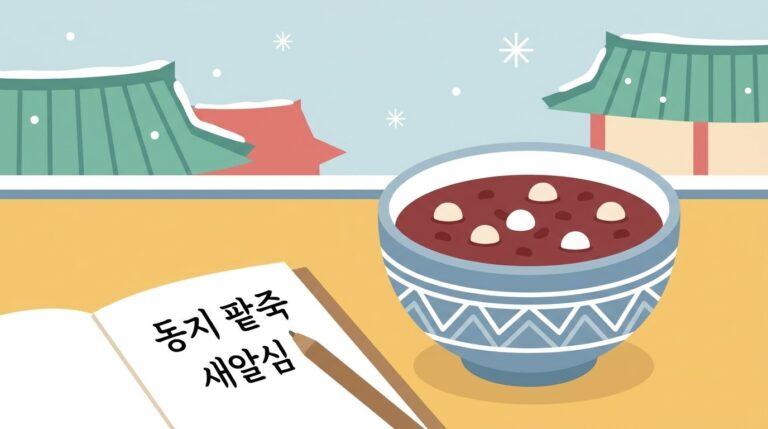
Picture this: It’s late December in Seoul. The sub-zero winter wind cuts through your padded jacket as you step into a bustling alley in Insadong. An earthy, comforting aroma of slow-simmered red beans fills the air. A warm ceramic bowl of ruby-red porridge with floating chewy rice cake balls (새알심 – saeal-sim) arrives at your table. Your Korean friend smiles, offering a profound cultural blessing: “동지 팥죽 드시고 묵은 액운은 훌훌 털어버리세요!” (Eat this Dongji patjuk and shake off all lingering misfortune!)
At a C2 mastery level, engaging with traditional Korean holidays like 동지 (Dongji – Winter Solstice) goes far beyond knowing that Koreans eat red bean porridge. It requires navigating deep-rooted folkloric cosmologies—the interplay of Eum (Yin) and Yang (Yang), ancestral apotropaic rituals (액막이 – warding off misfortune), and nuanced communal idioms that bridge pre-modern animism with contemporary socio-cultural etiquette.
Many advanced Korean learners struggle to express refined seasonal wishes without sounding either excessively archaic or unnaturally clinical. This lesson is curated from years of coaching diplomatic personnel, literary translators, and advanced scholars, equipping you with the linguistic subtlety, idiomatic dexterity, and socio-cultural radar to discuss Dongji customs with genuine native-level sophistication.
Phase 2: In-Depth Breakdown of 3 Core C2 Expressions
1. 액운을 털어내고 만복을 기원하다 (Aeguneul teoleonaego manbogeul giwonhada)
- Pronunciation: [Aeguneul teoleonaego manbogeul giwonhada] (Think of ‘aegun’ as ‘egg-oon’ and ‘teol-eo’ like brushing off dust)
- Meaning: Literal: To shake off ill fortune and pray for myriad blessings. | Nuance: A poetic, elevated seasonal blessing invoking a spiritual and psychological fresh start.
- K-Culture Moment: Used by eloquent anchors during year-end cultural retrospectives or matriarchs serving seasonal banquets in historical K-dramas like Mr. Queen or Under the Queen’s Umbrella.
- Editor’s Insight: 액운 (Aegun) denotes cumulative bad fortune. Pairing it with the dynamic verb 털어내다 (to brush/shake off) conveys intentional mental and ritualistic cleansing.
- Situation Spectrum: Casual: ⚠️ | Semi-formal: ✅ | Formal: ✅
- 🤔 Think About It: How does your native language conceptualize ‘clearing away’ bad luck compared to the Korean kinetic metaphor of physical shaking (털다)?
2. 동지첨치(冬至添齒)라더니 한 살 더 먹는 셈이네요 (Dongjicheomchiradeoni han sal deo meongneun sem-ineyoyo)
- Pronunciation: [Dong-ji-cheom-chi-ra-deo-ni han sal deo meong-neun se-mi-ne-yo] (Dong-jee-chum-chee)
- Meaning: Literal: As the proverb Dongjicheomchi goes, it is as if we are eating one more year of age. | Nuance: A witty, literary nod to the ancient belief that the solar rebirth at solstice marks true chronological aging.
- K-Culture Moment: An erudite guest on a cultural variety show (like The Dictionary of Useless Knowledge) using refined wordplay to bridge modern solar calendars with agrarian folklore.
- Editor’s Insight: 첨치 (添齒) literally means ‘adding teeth’ (a Sino-Korean euphemism for aging). It demonstrates an exquisite command of hanja idioms (사자성어).
- Situation Spectrum: Casual: ⚠️ | Semi-formal: ✅ | Formal: ✅
- 🤔 Think About It: Why did traditional agrarian societies treat astronomical turning points (the longest night) as biological milestones?
3. 붉은 팥의 양기(陽氣)로 음기(陰氣)를 누르다 (Bulgeun pat-ui yang-giro eum-gireul nureuda)
- Pronunciation: [Bul-geun pa-tui yang-gi-ro eum-gi-reul nu-reu-da]
- Meaning: Literal: To suppress Yin energy with the Yang energy of red beans. | Nuance: Explaining the cosmological rationale behind Korean protective culinary practices.
- K-Culture Moment: Protagonists in occult mystery K-dramas (like Revenant or The Guest) explaining why red beans repel baneful spirits (잡귀).
- Editor’s Insight: Red (적색/주홍색) represents peak Yang fire energy (화기/Hwagi), neutralizing ghostly Yin elements. Using cosmological terms elevates your conversational register instantly.
- Situation Spectrum: Casual: ⚠️ | Semi-formal: ✅ | Formal: ✅
- 🤔 Think About It: How do culinary traditions in your culture reflect ancient metaphysical philosophies?
Phase 3: Textbook Korean vs. Real-World C2 Fluency
Situation 1: Offering Dongji Patjuk to a Senior Colleague or In-law
- 📖 교과서 한국어: 동짓날이니까 팥죽 드시고 나쁜 일을 다 잊으세요. (Dongjinnarinikka patjuk deusigo nappeun ireul da ijeuseyo. – Because it is Dongji, eat patjuk and forget bad things.)
- 🗣️ 진짜 한국어: 올 한 해 궂은일은 팥죽 한 그릇으로 말끔히 털어내시고, 동지를 기점으로 길운만 가득하시길 바랍니다. (Ol han hae gujeun-ireun patjuk han geureuseuro malkkeumhi teoleonaesigo, dongjireul gijeomeuro girunman gadeukhasigil baramnida.)
- 💡 왜 다를까?: Textbook formulas rely on simplistic lexical items (나쁜 일). Native C2 discourse leverages evocative native roots (궂은일 – heavy/unpleasant ordeals) and auspicious Sino-Korean concepts (길운 – auspicious fortune; 기점 – turning point).
Situation 2: Explaining Why You Don’t Sprinkle Porridge on Modern Apartments
- 📖 교과서 한국어: 요즘 사람들은 벽에 팥죽을 뿌리지 않아요. 아파트가 더러워져요. (Yojeum saramdeureun byeoge patjugeul ppuriji anayo. Apateuga deoreowojyeoyo.)
- 🗣️ 진짜 한국어: 예전엔 벽사(辟邪)의 의미로 문간에 팥죽을 뿌렸지만, 현대 주거 환경에서는 미관상 온 가족이 나눠 먹는 나눔의 미덕으로 갈음하곤 하죠. (Yejeonen byeoksa-ui uimiro mungane patjugeul ppuryeotjiman, hyeondae jugeo hwangyeongeseoneun migwansang on gajogi nanwo meongneun nanum-ui mideogeuro gareumhagon hajyo.)
- 💡 왜 다를까?: Rather than merely citing messiness, advanced discourse contrasts ancestral talismanic rituals (벽사 – warding off evil) with structural adaptation using refined transitional connectors (~로 갈음하다 – to substitute/replace with).
Phase 4: K-Culture Deep Dive & Non-Verbal Etiquette
4-1. 눈치 (Nunchi) & Spatial Mannerisms during Solstice Gatherings
- The Age-matching Rice Cake Dynamic (새알심 공손 매너): When served ancestral patjuk containing small glutinous rice dumplings (새알심), elder relatives might playfully count how many you eat, referencing the old myth that eating your age in dumplings brings luck. Graciously accept their lighthearted banter (“나이만큼 다 먹으면 배가 너무 부르겠어요!”).
- Gifting Seasonal Confectionery (동지 팥떡 및 팥죽 답례): If receiving homemade patjuk from a neighbor or senior in a traditional community, never return the container completely empty—reciprocate with winter fruits (e.g., 제주 감귤) or warm traditional teas.
4-2. Cultural Code Analysis: The Folklore of Red (적색의 상징성)
In K-dramas such as Revenant (악귀), folk-occult symbolism highlights 팥 (Adzuki red beans) as the premier apotropaic element. Dongji represents the winter solstice with the longest night (극음 – climax of Yin). As the sun’s rebirth begins immediately afterward, eating red bean porridge is not merely a gastronomic choice—it is a seasonal rite of sympathetic magic welcoming the resurgence of Yang energy (일양시생 – 一陽始生).
Phase 5: C2 Role-Play Simulation
- Setting: The cozy traditional dining hall of Hanok guesthouse Rakkojae in Bukchon. Snow falls gently outside the courtyard.
- Characters:
- Master Chef/Hostess Mrs. Park (박 명인): A 60-something culinary artisan preserving royal court recipes.
- You (Advanced Researcher / Cultural Connoisseur): Demonstrating refined conversational etiquette.
- 박 명인: 어서 오세요. 오늘이 마침 밤이 가장 길다는 동짓날이라, 아침부터 가마솥에 붉은 팥을 정성껏 고아 팥죽을 쑤어 두었습니다.
(Eoseo oseyo. Oneuri machim bami gajang gildaneun dongjinnarira, achimbuteo gamasote bulgeun pateul jeongseongkkeot goa patjugeul ssueo dueotseumnida.)
“Welcome. Today happens to be Dongji, the longest night of the year, so I have been carefully simmering red beans in the cauldron since morning to prepare patjuk.” -
You: 🎭 (Taking off gloves, offering a deep respectful bow)
추운 날씨에 가마솥 앞을 지키시느라 노고가 많으셨습니다. 문패 너머로 구수한 팥 향이 그윽하게 배어 나오더군요.
(Chuun nalssie gamasot apeul jikisineura nogoga maneusyeosseumnida. Munpae neomeoro gusu-han pat hyangi geueukhage baeeo naodeogunyo.)
“It must have been arduous tending to the cauldron in this freezing weather. The deep, savory fragrance of red beans wafted delightfully past your doorway.” -
박 명인: 별말씀을요. 예로부터 동지팥죽은 붉은 기운으로 묵은해의 액운을 물리치고 새 기운을 맞는 법이지요. 입맛에 맞으실지 모르겠습니다.
(Byeolmalsseumeullyo. Yeorobuteo dongjipatjugeun bulgeun giuneuro mugeunhae-ui aeguneul mullichigo sae giuneul manneun beobijiyo. Immase majeusilji moreugesseumnida.)
“Don’t mention it. Since antiquity, Dongji patjuk has been a way to repel the old year’s misfortunes with red vibrant energy and welcome renewed vitality. I hope it suits your palate.” -
You: 🎭 (Taking a mindful first spoonful with both hands cupping the side)
단맛에 의존하지 않고 팥 본연의 구수함과 옹심이의 쫄깃한 식감이 완벽하게 어우러지네요. 동지첨치라더니 온전한 보양식을 대접받는 기분입니다.
(Danmase uijonhaji anko pat bon-yeon-ui gusuhamgwa ongsimi-ui jjolgit-han sikgami wanbyeokhage eoureojineyo. Dongjicheomchiradeoni onjeonhan boyangsigeul daejeopbanneun gibunimnida.)
“Without relying on artificial sweetness, the intrinsic savoriness of the red beans and the chewy texture of the rice dumplings harmonize flawlessly. Speaking of Dongjicheomchi, I feel treated to a consummate restorative tonic.” -
박 명인: 하하! 외국인 손님께서 ‘동지첨치’라는 고사성어까지 꿰고 계시다니 탄복했습니다. 새알심은 나이 드신 만큼 드셨습니까?
(Haha! Oeguk-in sonnimkkeseo ‘dongjicheomchi’raneun gosasangeokkaji kkwego gyesidani tanbokhaetseumnida. Saealssimeun nai deusin mankeum deusyeosseumnikka?)
“Haha! I am deeply impressed that an international guest is versed in such traditional idioms. Did you manage to eat as many dumplings as your age?” -
You: 🎭 (Chuckling modestly while waving a hand slightly)
마음 같아서는 청춘으로 되돌아가 딱 스무 개만 골라 먹고 싶었습니다만, 명인님의 솜씨가 워낙 빼어나 그릇을 비우지 않을 수 없었습니다.
(Maeum gat-aseoneun cheongchun-euro doedoraga ttak seumu gaeman golla meokgo sipeosseumnidaman, myeong-innim-ui somssiga wonak bpaeeona geureuseul biuji aneul su eopseosseumnida.)
“In my heart, I wished to return to youth and pick out only twenty, but your culinary mastery was so exceptional that I couldn’t help but finish the whole bowl.” -
박 명인: 참으로 정겨운 화답이십니다. 동지를 기점으로 낮이 차츰 길어지니, 댁내에도 양기 가득한 경사만 깃들길 축원합니다.
(Chameuro jeonggyeoun hwadabisimnida. Dongjireul gijeomeuro naji chacheum gireojini, daengnaeedo yang-gi gadeuk-han gyeongsamang gitdeulgil chuk-wonhamnida.)
“What a heartwarming response. As daylight progressively lengthens from this solstice forward, I pray that only joyous events filled with vital Yang energy grace your household.” -
You: 🎭 (Lowering head gracefully)
따뜻한 환대와 덕담에 감사드립니다. 명인님께서도 올겨울 무탈하시고 가내 평안하시기를 진심으로 기원하겠습니다.
(Ttatteut-han hwandaewa deokdame gamsadeurimnida. Myeong-innimkkeseodo olgyeoul mutalhasigo ganae pyeon-anhasigireul jinsimeuro giwonhagetseumnida.)
“Thank you for your warm hospitality and heartfelt blessings. I sincerely wish you peace, good health, and tranquility throughout the winter.”
🔀 Interactive Branching Moment
Mrs. Park asks you: “혹시 팥죽에 설탕이나 소금 간을 더 곁들이시겠습니까? (Would you prefer additional sugar or salt seasoning for your porridge?)” How do you respond?
- Option A (Best Choice): “명인님의 손맛이 밴 본연의 담백한 풍미가 일품이라 다른 양념 없이 온전히 음미하고 싶습니다.” (Compliments the intrinsic culinary balance—ideal high-context etiquette.)
- Option B (Bad Choice): “너무 싱거우니까 설탕 좀 듬뿍 주세요. 달지 않으면 못 먹겠어요.” (Too bluntly demanding; undermines artisanal effort in traditional settings.)
- Option C (Risk Choice): “전라도식은 설탕이고 경상도식은 소금이라던데, 서울 토박이 방식은 어떤가요?” (Intellectually intriguing, though risks shifting a dining experience into an academic debate.)
Phase 6: 10-Second Emotional Shadowing Drill
Practice these high-level cadence and pause points (/) marked with psychological tone anchors:
[✨ 온화하고 기품 있는 어조]
“동짓날을 맞아 / 묵은해의 액운은 말끔히 씻어내시고, / 다가오는 새해에는 / 만복이 깃드시기를 / 진심으로 축원합니다.”
(Dongjinnareul maja / mugeunhae-ui aeguneun malkkeumhi ssiseonaesigo, / dagao-neun saehae-eneun / manbogi gitdeusigireul / jinsimeuro chuk-wonhamnida.)-
[😄 위트 있고 화기애애하게]
“새알심을 나이만큼 먹다가는 / 오늘 밤 안으로 / 문턱을 넘기도 힘들 만큼 / 배가 부르겠어요!”
(Saealssimeul naimankeum meokdaganeun / oneul bam an-euro / munteogeul neomgido himdeul mankeum / baega bureugesseoyo!)
Phase 7: K-Culture Mini Glossary
- 새알심 (Sae-al-sim) | Bird’s egg rice dumplings | Glutinous rice balls shaped like tiny bird eggs placed inside patjuk; traditionally correlated with longevity and age counting.
- 벽사 (辟邪 – Byeok-sa) | Apotropaic expulsion of evil | The historical and metaphysical act of repelling baneful spirits and negative cosmic energies using talismanic objects or red food.
- 일양시생 (一陽始生 – Il-yang-si-saeng) | The initial rebirth of Yang energy | A philosophical concept celebrating the winter solstice as the pivotal cosmic turning point where daylight begins expanding.
- 애동지 vs. 노동지 (Ae-dong-ji vs. No-dong-ji) | Early Solstice vs. Late Solstice | Lunar-calendar categorization: when Dongji falls in early lunar November (애동지), folk tradition serves red bean rice cakes (팥시루떡) instead of porridge to safeguard young children.
Phase 8: Traveler’s Survival Kit
Survival Expressions TOP 3
- “팥죽에 새알심 많이 넣어 주실 수 있나요?” (Patjuge saealssim mani neoeo jusil su innayo?)
- Pro Tip: Use at traditional markets (like Gwangjang or Mangwon) for extra chewy dumplings.
- “설탕과 소금 중에 어떤 걸 넣어야 별미인가요?” (Seoltanggwa sogeum junge eotteon geol neoeoya byeolmi-ingayo?)
- Pro Tip: Ignites lively regional culinary debates between Jeolla style (sweet) and standard northern style (savory).
- “포장할 때 동치미 국물도 함께 챙겨주세요.” (Pojanghal ttae dongchimi gungmuldo hamkke chaenggyeojuseyo.)
- Pro Tip: Traditional patjuk is eaten alongside chilled radish water kimchi (동치미) to aid digestion.
Editor’s Travel Note
- During Dongji, famous porridge spots like Seoulseo Duljjaero Jalhaneun Jip (서울서 둘째로 잘하는 집) in Samcheong-dong experience lines spanning blocks. Use the Naver Map app download to check live store operating hours and transit routes before departing.
Phase 9: A Step Deeper (Reflection)
Dongji in Korea reflects a profound communal philosophy: survival through collective warmth. In ancient agrarian Korea, winter was an isolating season of scarcity. Gathering to boil massive pots of patjuk, sharing it with neighbors regardless of social hierarchy, and symbolically sweeping out misfortune fostered social cohesion. The ritual was never about fearing the dark, but celebrating the inevitable return of light through collective nourishment.
💬 Your Turn: Does your culture celebrate astronomical turning points like the winter solstice with specific protective foods or rituals? Share your thoughts below!
Phase 10: FAQ & Common Pitfalls
Q: Why do some Korean households serve red bean rice cakes (팥떡) instead of porridge on certain solstices?
A: This occurs during 애동지 (Aedongji)—when Dongji falls before the 10th day of the 11th lunar month. Folk belief held that the guardian child deity (삼신할머니) might be scared away by red porridge, so people steamed red bean rice cakes (팥시루떡) instead.
Q: Is patjuk eaten purely as a dessert or a complete meal?
A: Historically and culturally, traditional patjuk is a substantial savory meal eaten with seasoned side dishes and chilled dongchimi. Modern dessert cafes have introduced sweet variations (단팥죽), but winter solstice patjuk leans savory and rich.
Q: How do I distinguish between 액운 (aegun) and 불운 (burun)?
A: 불운 (Burun) refers generally to bad luck or unfortunate timing in everyday occurrences. 액운 (Aegun) denotes heavier, karmic, or lingering spiritual misfortune that requires deliberate seasonal cleansing or ritual clearance.
🚨 Common Mistakes Warning Board
- ❌ Mistake 1: Calling all red bean dishes 단팥죽 (Danpatjuk). Traditional solstice porridge is often unsweetened (동지팥죽).
- ✔️ Correct Action: Specify “달지 않은 전통 팥죽” if you desire authentic solstice porridge.
- ❌ Mistake 2: Using informal imperative endings when wishing elders well during Dongji (액운 버려요).
- ✔️ Correct Action: Use formal poetic honorifics: “묵은 액운은 털어내시고 평안하시기를 축원합니다.”
- ❌ Mistake 3: Assuming 동지 is merely a solar calendar date.
- ✔️ Correct Action: Understand its interaction with the lunar calendar (애동지/중동지/노동지).
Phase 11: Action Mission & Engagement
- 🥉 Bronze Mission (Solo Practice): Read the Phase 6 shadowing sentences aloud 3 times, focusing on natural pauses at
/marks. - 🥈 Silver Mission (Social Connection): Send a seasonal Korean message to a colleague or language exchange partner: “올 한 해 액운은 다 털어내시고, 동지 팥죽 드시면서 따뜻한 연말 보내세요!”
- 🥇 Gold Mission (Real-life Execution): Visit a traditional Korean porridge house (죽집), order 동지팥죽, and engage the host using the Phase 8 Survival expressions.
- 🎮 K-Culture Mission: Watch a winter scene in a historical drama and spot how ancestral characters discuss 일양시생 (the return of Yang).
Phase 12: Interactive Quiz Challenge
1. [Situational Judgment] Which expression is most stylistically sophisticated when congratulating an executive or elder on Dongji?
* A) 동짓날이니까 팥죽 먹고 힘내라!
* B) 팥죽 드시고 묵은 액운은 말끔히 털어내시며 만복이 깃드시길 기원합니다.
* C) 귀신 쫓아내려고 팥죽 사 왔어요.
2. [Fill in the Blank] 동지에 팥죽을 쑤어 먹으며 나이를 한 살 더 먹는다는 의미의 사자성어는 ( 동지___ )이다.
3. [True / False] In Korean folklore, all years require boiling liquid porridge on Dongji, regardless of whether it falls in early lunar November.
🔍 Click here to reveal the Answers & Explanations!
- Answer: B | Explanation: Option B exhibits C2-level honorific vocabulary (만복, 묵은 액운, 기원합니다), whereas A is impolitely casual and C is unrefined.
- Answer: 첨치 (添齒) | Full phrase: 동지첨치 (Dongjicheomchi).
- Answer: False | Explanation: During 애동지 (Early Solstice), people traditionally prepared steamed red bean rice cakes (팥시루떡) instead of porridge.







