

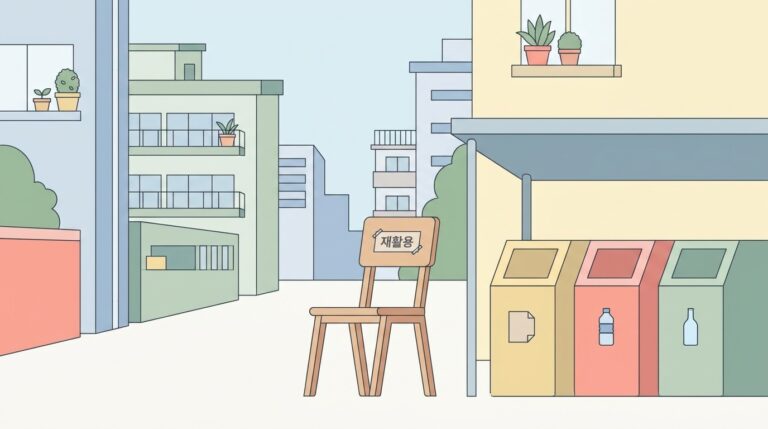
Master Disposing of Bulky Waste in Korea: No Stress, No Fines!
Phase 1: Empathy (Story-Driven Opening)
안녕하세요! (Hello!) I’m your Daily Hangul editor and your Korean bestie! Picture this: You just moved into a charming studio in Hongdae or decided to upgrade your room setup. You’ve got an old broken chair or an oversized mirror that you need to get rid of. In many countries, you might just leave it on the curb with a “Free” sign. But in Korea? If you do that, building managers (관리실 아저씨) or local CCTV cameras will catch it, leading to a hefty fine of up to 1,000,000 KRW for illegal dumping (무단투기)!
Navigating Korea’s rigorous waste separation (분리수거) can feel overwhelming, especially when it comes to oversized bulky waste (대형 폐기물). Many of our learners have told us they felt paralyzed with anxiety at local convenience stores or community centers simply trying to ask for a disposal sticker. Don’t worry! With just three key beginner-friendly sentences, you will confidently clear out large items without stress, language barriers, or awkward misunderstandings.
Phase 2: Core 3 Expressions Breakdown
1. 대형 폐기물 스티커 주세요 (Daehyeong pyegimul seutikeo juseyo)
- Pronunciation: Dae-hyeong pye-gi-mul seu-ti-keo ju-se-yo (Think: “Dae” like day, “Pye” like pie with a soft p, “Sticker please”)
- Meaning: Literal: “Please give me a large-size waste sticker.” / Natural: “I need a bulky waste disposal sticker, please.”
- K-Culture Moment: Seen in relatable K-dramas where characters move into their first tiny “one-room” (원룸) and run to the neighborhood convenience store to buy trash tags.
- Editor’s Insight: Most convenience stores (CU, GS25, 7-Eleven) or your local Community Service Center (주민센터) sell these official stickers. You just tell them what item you have!
- Situation Spectrum: Casual ⚠️ | Semi-formal ✅ | Formal ✅
- 🤔 Think About It: In Korea, waste disposal is paid for by the person who generates it through purchasing designated bags and stickers. How does your country fund public waste management?
2. 이거 버리려면 어떻게 해야 돼요? (Igeo beoriryeomyeon eotteoke haeya dwaeyo?)
- Pronunciation: Ee-geo beo-ri-ryeo-myeon eo-tteo-ke hae-ya dwae-yo?
- Meaning: Literal: “If I want to throw this away, how should I do it?” / Natural: “How should I dispose of this?”
- K-Culture Moment: Asking your building security guard or neighbor politely when you are unsure whether an item counts as general trash or bulky waste.
- Editor’s Insight: Using “~려면 어떻게 해야 돼요?” (How do I do X if I want to…?) is an A2-level power pattern useful in post offices, banks, and subways.
- Situation Spectrum: Casual ⚠️ | Semi-formal ✅ | Formal ✅
- 🤔 Think About It: Koreans appreciate asking upfront rather than making assumptions that might disturb communal cleanliness.
3. 신고 번호 적어둘게요 (Singo beonho jeogeodulgeyo)
- Pronunciation: Shin-go beon-ho jeo-geo-dul-ge-yo
- Meaning: Literal: “I will write down the report number.” / Natural: “I’ll write down the confirmation/report number on the item.”
- K-Culture Moment: When buying disposal permits via mobile apps instead of physical stickers, tenants write the issued number on an A4 paper and tape it to the item.
- Editor’s Insight: If the convenience store is out of physical stickers, you can report online, get a
신고 번호(report number), write it with a marker, and stick it on!- Situation Spectrum: Casual ⚠️ | Semi-formal ✅ | Formal ✅
- 🤔 Think About It: How does digital convenience transform traditional community rules in modern Korea?
Phase 3: Textbook Korean vs. Real Korean
Situation 1: Asking for a disposal sticker at a convenience store
- 📖 Textbook Korean: 대형 폐기물 배출 스티커를 구매하고 싶습니다. (Daehyeong pyegimul baechul seutikeoreul gumaehago sipsumnida. – I desire to purchase a large waste discharge sticker.)
- 🗣️ Real Korean: 의자 버릴 건데 스티커 있어요? (Uija beoril geonde seutikeo isseoyo? – I’m throwing away a chair, do you have stickers for it?)
- 💡 Why the Difference? Textbook Korean uses formal Sino-Korean nouns like 배출 (discharge) and 구매 (purchase). Real Koreans directly name the object (chair, desk) in simple A2 conversational phrasing.
Situation 2: Asking where to place the item
- 📖 Textbook Korean: 폐기물을 어디에 거치해야 합니까? (Pyegimureul eodie geochihaeya hamnikka? – Where must I place the waste?)
- 🗣️ Real Korean: 이거 어디에 내놓으면 돼요? (Igeo eodie naenoh-eumyeon dwaeyo? – Where should I put this out?)
- 💡 Why the Difference? 내놓다 (to put out / place outside) is the natural everyday verb used in residential neighborhoods instead of technical vocabulary.
Phase 4: K-Culture Deep Dive & Non-Verbal Manners
4-1. Nunchi & Polite Gestures
When handing over money or showing a photo of your furniture to a convenience store clerk or security guard:
* Two-Handed Courtesy: Always present your phone photo or credit card using both hands (or holding your right forearm with your left hand).
* Show, Don’t Just Tell: Keep a photo and estimated dimensions (e.g., small single desk vs. large dining table) ready on your phone. It saves time and prevents buying the wrong priced sticker!
4-2. Moving Culture (이사 문화)
In Korea, moving day (이사하는 날) is heavily organized around minimizing neighborhood disruption. Leaving unlabeled bulky waste in common recycling areas (분리수거장) without prior notice can cause friction with neighbors. Doing it the right way showcases good civic etiquette (시민의식).
Phase 5: Real-World Roleplay Scenario
- Setting: A local neighborhood convenience store near your apartment.
- Characters: You (민우 / Alex) & Friendly Store Clerk (편의점 사장님).
- You: 안녕하세요! 저 의자 하나 버리려고 하는데요. (Annyeonghaseyo! Jeo uija hana beoriryeogo haneundeyo. / Hello! I want to throw away a chair.)
🎭 Bows slightly and shows a picture on phone - Clerk: 네, 사무용 의자예요, 식탁 의자예요? (Ne, samuyong uijayeyo, siktak uijayeyo? / Yes, is it an office chair or a dining chair?)
- You: 바퀴 달린 사무용 의자예요. 스티커 얼마예요? (Bakwi dallin samuyong uijayeyo. Seutikeo eolmayeyo? / It’s an office chair with wheels. How much is the sticker?)
- Clerk: 바퀴 있는 건 삼천 원짜리 붙이시면 돼요. (Bakwi inneun geon samcheon-wonjjari buchisimyeon dwaeyo. / For ones with wheels, you can attach a 3,000 KRW one.)
- You: 대형 폐기물 스티커 한 장 주세요. (Daehyeong pyegimul seutikeo han jang juseyo. / Please give me one bulky waste sticker.)
🎭 Hands over credit card with both hands - Clerk: 네, 여기 영수증이랑 스티커요. (Ne, yeogi yeongsujeung-irang seutikeoyo. / Here is your receipt and sticker.)
- You: 이거 오늘 집 앞에 내놓으면 돼요? (Igeo oneul jip ape naenoh-eumyeon dwaeyo? / Can I put this out in front of my house today?)
- Clerk: 네, 스티커 잘 보이게 붙여서 분리수거장에 두세요. (Ne, seutikeo jal bo-ige buchyeoseo bunrisugeojange duseyo. / Yes, stick it where it’s easily visible and leave it at the recycling spot.)
🔀 Interactive Choice:
What should you do if the clerk says they are completely sold out of stickers?
* Option A: Just leave the chair on the street tonight and hope the city takes it.
* Option B: Say: “인터넷으로 신청하고 번호 적어둘게요!” (I will apply online and write down the report number!)
* Option C: Hide the chair inside a standard blue volume-rate trash bag (종량제 봉투).
- Feedback:
- Option A (Risk): ❌ High fine risk! Unlabeled items are marked with violation warnings.
- Option B (Best): ✅ Perfect! You can use local district websites or mobile apps (like ‘Pegi’ / 빼기).
- Option C (Bad): ❌ General trash bags will tear, and sanitation workers will reject collection.
Phase 6: 10-Second Emotion Shadowing Drill
Read aloud with proper emotional immersion and rhythmic pauses (/):
[😊 Polite & Inquiring]저기요 / 의자 버리려는데 / 스티커 얼마예요? (Jeogiyo / uija beoriryeoneunde / seutikeo eolmayeyo?)[🤝 Helpful & Clear]바퀴 달린 의자 / 한 개예요. (Bakwi dallin uija / han gaeyeyo.)[✨ Confident & Relieved]스티커 붙여서 / 오늘 밤에 내놓을게요! (Seutikeo buchyeoseo / oneul bame naenoh-eulgeyo!)
Phase 7: K-Culture Mini Dictionary
- 대형 폐기물 (Daehyeong pyegimul) | Bulky Waste | Items too large for standard trash bags (furniture, mattresses, luggage, large electronics).
- 폐기물 스티커 (Pyegimul seutikeo) | Disposal Sticker Permit | Pre-paid sticker indicating you paid the municipal handling fee.
- 주민센터 (Jumin-senteo) | Community Service Center | The local government branch in each neighborhood where you can register bulky trash and handle official paperwork.
- 무단투기 (Mudan-tugi) | Illegal Dumping | Discarding waste without authorized bags or permits; strictly monitored across Korea.
Phase 8: Survival Kit for Travelers & Expats
Top 3 Survival Expressions
- 이거 스티커 얼마짜리 사야 돼요? (Igeo seutikeo eolmajjari saya dwaeyo? / What value sticker should I buy for this?)
- Pro Tip: Useful when an item is between categories (e.g., small stool vs. large chair).
- 버리는 날짜가 언제예요? (Beorineun naljjaga eongeyeyo? / What day is garbage collection day?)
- Pro Tip: Many districts collect bulky items only on designated weeknights.
- 수거해 주세요. (Sugeohae juseyo. / Please collect this.)
- Pro Tip: Used when calling district sanitation offices for pickup confirmation.
Editor’s Travel & Living Note
If speaking at a counter feels intimidating, download and search for the 공식 대형폐기물 간편배출 앱 ‘빼기’ (Official Waste Pickup App ‘Pegi’). You can snap a photo, pay via card in English/Korean, and simply write the confirmation code on your item with a marker!
Phase 9: “One Step Deeper” (Reflective Thought)
Korea’s waste management system reflects a deep cultural value of communal responsibility (공동체 의식). Keeping shared spaces clean and strictly following disposal procedures shows respect for your neighbors and the sanitation workers (환경미화원). By taking part in this system properly, you transition from being a simple tourist to an integrated member of the local community.
💬 Your Turn: How does recycling large furniture work in your hometown? Drop a comment below and share your experience!
Phase 10: FAQ & Common Mistakes
Q: Can small broken electronics (like hair dryers or toasters) be thrown away for free?
A: Yes! In most Korean apartment complexes and community centers, small home electronics (소형 가전제품) under 1 meter can be placed in designated free electronics drop-off bins without purchasing a sticker.
Q: What if it rains after I attach the sticker to my furniture outside?
A: Tape over the paper sticker with transparent packing tape to prevent it from getting soaked or falling off. If using an app code, write it with an oil-based permanent marker on waterproof paper.
Q: Can I give away usable furniture for free outside instead of paying for a sticker?
A: You cannot simply leave it on the sidewalk. Instead, list it on Korea’s popular second-hand app 당근마켓 (Karrot Market) under the “나눔” (Free Giveaway) tag for rapid pickup!
🚨 Common Mistakes Alert
- Mistake 1: Tossing a suitcase or broken mirror into general recycling bins. -> Action: Suitcases and mirrors require a bulky waste sticker.
- Mistake 2: Putting out the item without sticking the permit on it first. -> Action: Always attach the sticker or write the report number before moving it to the curb.
- Mistake 3: Assuming all convenience stores carry every sticker denomination. -> Action: Small corner stores might run out; visit your local 주민센터 or use the municipal app.
Phase 11: Action Mission & Community Challenge
- 🥉 Bronze Mission: Practice saying “대형 폐기물 스티커 한 장 주세요” out loud 3 times using our shadowing pauses.
- 🥈 Silver Mission: Look up your local district (e.g., Mapo-gu, Gangnam-gu) bulky waste disposal guidelines online.
- 🥇 Gold Mission: Help a friend in Korea or dispose of your own unused bulky item correctly using an official sticker or the mobile app.
- 🎮 K-Culture Mission: Spot a yellow or blue disposal sticker on an item along a Korean street and check its report number!
Phase 12: Interactive Quiz Challenge
1. [Scenario Question] You want to throw away a large study desk in Seoul. What is the most polite and natural way to ask the convenience store clerk?
* A) 책상 버리는데 스티커 있어요? (Chaeksang beorineunde seutikeo isseoyo?)
* B) 책상 버려주세요. (Chaeksang beoryeojuseyo.)
* C) 쓰레기통 어디예요? (Sseuregitong eodiyeyo?)
2. [Fill in the Blank]
“I will apply online and write down the confirmation number.”
= 인터넷으로 신청하고 ____ ____ 적어둘게요.
3. [True / False] In Korea, leaving a large mattress in the alley with a handwritten “Free” sign is legally permitted everywhere.
🔍 Click here to view Answers & Explanations
- Answer: A (Asking “책상 버리는데 스티커 있어요?” is natural and explains your purpose clearly. Option B means “Please throw away my desk for me,” and Option C asks where the trash can is.)
- Answer: 신고 번호 (Singo beonho – Report / Confirmation Number)
- Answer: False (Leaving bulky items on public roads without prior permit registration is considered illegal dumping and subject to fines.)







