

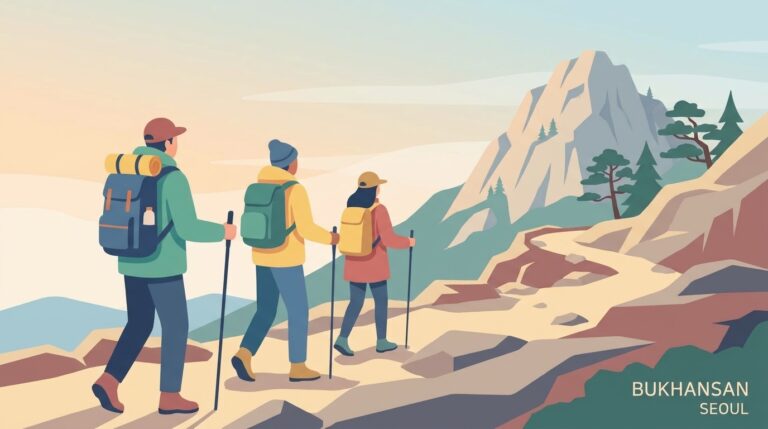
Phase 1: Empathy & Storytelling
안녕하세요! It’s your Korean bestie and Daily Hangul editor! Have you ever seen a K-Drama or a Korean travel vlog where the characters hike up a breathtaking mountain like Bukhansan or Inwangsan, eat delicious gimbap at the peak, and then stumble on the rocky trail on the way down?
Climbing up is exhausting, but hiking veterans in Korea always say: “Going down is when the real hike begins!” Steep granite rocks, loose gravel, and wobbly knees after a long climb can make descending tricky. When a friendly local hiker in vibrant outdoor gear smiles and shares a warm warning, knowing what they are saying—and how to reply politely—makes your mountain trip safe and heartwarming. Today, we’ll master beginner-friendly Korean phrases for watching your step on the way down, proven by real foreign hikers exploring Korea’s beautiful peaks!
Phase 2: Top 3 Core Expressions
1. 조심하세요 (Josimhaseyo)
- Pronunciation: [Jo-sim-ha-se-yo] (Sounds like “Joe-seem-ha-say-yo”)
- Meaning: Literal: “Please do caution” | Nuance: “Please be careful!” or “Watch out!”
- K-Culture Moment: Seen constantly in outdoor variety shows like 2 Days & 1 Night when cast members navigate slippery trails.
- Editor’s Insight: It is the golden standard polite phrase in Korea to show caring concern for someone’s safety.
- Situation Spectrum: Casual ⚠️ | Semi-formal ✅ | Formal ✅
- 🤔 Think About It: In English, we often say “Watch your step!” but Koreans focus on the internal state of care (josim means carefulness/caution).
2. 천천히 가세요 (Cheoncheonhi gaseyo)
- Pronunciation: [Cheon-cheon-hi ga-se-yo] (Sounds like “Chun-chun-hee gah-say-yo”)
- Meaning: Literal: “Go slowly” | Nuance: “Take your time” or “Don’t rush on your way.”
- K-Culture Moment: Often said by kind local elders (ajummas and ajeossis) when they see younger hikers rushing down steep stairs.
- Editor’s Insight: This is both a warm greeting and safety advice on mountain paths.
- Situation Spectrum: Casual ⚠️ | Semi-formal ✅ | Formal ✅
- 🤔 Think About It: Korean daily life is famous for Ppalli-ppalli (Hurry-hurry), but on the descent, slowness is praised as true wisdom!
3. 미끄러워요 (Mikkeureowoyo)
- Pronunciation: [Mi-kkeu-reo-wo-yo] (Sounds like “Mee-kku-ruh-wo-yo”)
- Meaning: Literal: “It is slippery” | Nuance: “Watch out, it’s slippery here!”
- K-Culture Moment: Used when passing fellow hikers near wet rocks, fallen leaves, or icy winter paths.
- Editor’s Insight: A simple, informative warning that saves ankles and builds instant trail camaraderie.
- Situation Spectrum: Casual ⚠️ | Semi-formal ✅ | Formal ✅
- 🤔 Think About It: Notice how adding ~yo at the end instantly turns a raw observation into a polite heads-up to strangers.
Phase 3: Textbook Korean vs. Real Korean
- Situation 1: Telling someone to be careful on steep downhill steps
- 📖 Textbook Korean: 하산할 때 주의하십시오. (Hasanhal ttae ju-ui-hasipp-sio. – “Please exercise caution during descent.”)
- 🗣️ Real Korean: 내려갈 때 조심하세요! (Naeryeogal ttae josimhaseyo! – “Be careful going down!”)
- 💡 Why is it different? The textbook version uses heavy Sino-Korean terms suitable for warning signs, whereas everyday hikers use friendly verbal verbs.
- Situation 2: Warning about a slick rock
- 📖 Textbook Korean: 바위 표면이 미끄러우니 낙상에 유의하세요. (Bawi pyomyeoni mikkeureouni naksange yu-uihaseyo.)
- 🗣️ Real Korean: 여기 미끄러워요! (Yeogi mikkeureowoyo! – “It’s slippery here!”)
- 💡 Why is it different? On the trail, short and punchy phrases ensure instant understanding and quick reflexes.
Phase 4: K-Culture Deep Dive & Non-Verbal Manners
- 4-1. Nunchi & Trail Etiquette (눈치와 매너):
When descending (하산, hasan), hikers going uphill have the right of way because they are more fatigued and have momentum. Step slightly aside to the right, make brief warm eye contact, give a gentle nod, and say: “안녕하세요! (Annyeonghaseyo!)” -
4-2. Mountain Culture (등산 문화):
In Korea, hiking isn’t just exercise; it’s a social ritual! At the summit, people share seasonal fruits like cherry tomatoes or cucumber slices. And at the bottom of the mountain, hikers celebrate a safe descent with crispy Pajeon (green onion pancake) and refreshing chilled Makgeolli (rice wine).
Phase 5: Real-Life Roleplay Scenario
Setting: Bukhansan Mountain trail. You are walking down a rocky slope after enjoying the summit view. An experienced Korean hiker (등산 고수, Deungsan Gosu) with dual trekking poles approaches from above.
- Turn 1 (Hiker Min-su): 조심하세요! 여기 돌이 많이 미끄러워요. (Josimhaseyo! Yeogi dori mani mikkeureowoyo. / 🎭 Pointing gently to the damp granite rock / “Be careful! The rocks here are very slippery.”)
- Turn 2 (You): 아, 감사합니다! 천천히 갈게요. (A, gamsahamnida! Cheoncheonhi galgeyo. / 🎭 Smiling and stepping carefully / “Ah, thank you! I will go slowly.”)
- Turn 3 (Hiker Min-su): 내려갈 때 무릎 안 아파요? (Naeryeogal ttae mureup an apayo? / 🎭 Checking with a friendly, caring gaze / “Do your knees hurt on the way down?”)
- Turn 4 (You): 조금 아파요. 그래도 괜찮아요! (Jogeum apayo. Geuraedo gwaenchanhayo! / 🎭 Lightly tapping your knee with a smile / “A little bit. But I’m okay!”)
- Turn 5 (Hiker Min-su): 천천히 쉬면서 가세요. (Cheoncheonhi swimyeonseo gaseyo. / 🎭 Thumbs up and gesturing toward a rest bench / “Take your time and rest as you go.”)
- Turn 6 (You): 네, 좋은 하루 보내세요! (Ne, joeun haru bonaeseyo! / 🎭 Polite bow with both hands at side / “Yes, have a wonderful day!”)
- Turn 7 (Hiker Min-su): 안전 산행하세요! 파이팅! (Anjeon sanhaenghaseyo! Paiting! / 🎭 Waving energetically / “Have a safe hike! Fighting!”)
- Turn 8 (You): 파이팅! 감사합니다! (Paiting! Gamsahamnida! / 🎭 Waving back warmly / “Fighting! Thank you!”)
🔀 Interactive Choice Point: A steep dirt path is ahead. What do you say to the hiker behind you?
* Choice A: “빨리 가세요!” (Ppalli gaseyo! – Go quickly!)
* 👉 Feedback (Bad): Rushing someone downhill on a trail is dangerous and contrary to Korean hiking courtesy.
* Choice B: “여기 미끄러워요, 조심하세요!” (Yeogi mikkeureowoyo, josimhaseyo! – It’s slippery here, be careful!)
* 👉 Feedback (Best): Perfect! Natural, polite, and warmly protective.
* Choice C: “내려가지 마세요!” (Naeryeogaji maseyo! – Do not go down!)
* 👉 Feedback (Risk): Too dramatic! They might think the trail is officially closed.
Phase 6: 10-Second Emotion Shadowing Drill
- Drill 1 [😊 따뜻하고 친절하게 / Warm & Caring]:
조심하세요 / 천천히 / 가세요! (Jo-sim-ha-se-yo / cheon-cheon-hi / ga-se-yo!) -
Drill 2 [⚠️ 진지하고 명확하게 / Alert & Clear]:
여기 / 바위가 / 미끄러워요! (Yeo-gi / ba-wi-ga / mi-kkeu-reo-wo-yo!) -
Drill 3 [🙏 감사하고 씩씩하게 / Grateful & Cheerful]:
네, / 알려주셔서 / 감사합니다! (Ne, / al-lyeo-ju-syeo-seo / gam-sa-ham-ni-da!)
Phase 7: K-Culture Mini Dictionary
- 하산 (Hasan) – Descent / Descending a mountain | Usage: Essential word for finishing a hike and heading toward the restaurants at the base.
- 등산 스틱 (Deungsan Seutik) – Trekking / Hiking poles | Usage: Highly recommended by locals to protect your knees on steep steps.
- 안전 산행 (Anjeon Sanhaeng) – Safe hiking | Usage: A standard greeting wish among mountain lovers in Korea.
- 파전과 막걸리 (Pajeon-gwa Makgeolli) – Scallion pancake and rice wine | Usage: The undisputed culinary reward waiting at the end of every Korean hiking trail.
Phase 8: Traveler’s Survival Kit
-
Survival Expressions:
- 물 있어요? (Mul isseoyo?) – Do you have water? (Pronunciation: [Mool ee-sseo-yo?])
- 이쪽이 내려가는 길이에요? (Ijjogi naeryeoganeun girieoyo?) – Is this way down? (Pronunciation: [Ee-jjo-gee nae-ryeo-ga-neun gee-ree-eh-yo?])
- 감사합니다! (Gamsahamnida!) – Thank you! (Pronunciation: [Gahm-sah-hahm-nee-dah!])
- Editor’s Travel Note:
Google Maps is not ideal for mountain trails in Korea. Always search trails using the Naver Map app on your phone. Keep a T-money transit card handy, as mountain trailheads connect directly to Seoul subways and local green buses.
Phase 9: A Step Deeper (Reflection)
In Korean culture, the mountain trail acts as a great equalizer. In daily city life, Koreans maintain polite social distance, but the moment they step onto the trail, everyone becomes an extended family member. Calling out “조심하세요 (Josimhaseyo)” to complete strangers is a small glimpse into Korea’s traditional Jeong (정, deep communal affection).
💬 Your Turn: How do hikers greet each other in your home country? Do you warn strangers about slippery paths? Leave a comment below!
Phase 10: FAQ & Common Mistakes
Q: Can I use “조심해 (Josimhae)” instead of “조심하세요 (Josimhaseyo)”?
A: Only with close friends or children! With strangers on the mountain, always use the polite form 조심하세요 (Josimhaseyo) to avoid sounding rude.
Q: What is the most natural reply when someone says “조심하세요” to me?
A: A cheerful “네, 감사합니다! (Ne, gamsahamnida!)” with a light head nod is 100% natural and appreciated.
Q: Does “천천히 가세요” mean I am walking too fast?
A: Not at all! It is a caring idiom meaning “Take your time and stay safe on your journey.”
🚨 Common Mistakes Alert:
- Mistake: Shouting “Stop!” in English when seeing someone slip. -> Correct Action: Shout “조심하세요! (Josimhaseyo!)” or “미끄러워요! (Mikkeureowoyo!)”.
- Mistake: Walking straight down without yielding to uphill hikers. -> Correct Action: Step aside slightly and greet with a nod.
- Mistake: Rushing down rocky steps to catch the bus. -> Correct Action: Take measured steps and say “천천히 가요 (Cheoncheonhi gayo)” to yourself.
Phase 11: Action Mission
- 🥉 Bronze Mission: Practice saying “조심하세요! (Josimhaseyo!)” 5 times in front of the mirror with a friendly smile.
- 🥈 Silver Mission: Post your favorite hiking photo on Instagram with the caption: 내려갈 때 조심하세요! #DailyHangul
- 🥇 Gold Mission: On your next trip to Korea, greet three local hikers with “안녕하세요! 조심하세요!” on your descent!
- 🎮 K-Culture Mission: Watch an episode of a Korean hiking travel show and spot the moment someone warns about slippery steps.
Phase 12: Interactive Quiz Challenge
Q1. What is the most appropriate polite phrase to warn a hiker about slick rocks?
* A) 빨리 가세요 (Ppalli gaseyo)
* B) 미끄러워요, 조심하세요 (Mikkeureowoyo, josimhaseyo)
* C) 밥 먹었어요? (Bap meogeosseoyo?)
Q2. Fill in the blank:
내려갈 때 ______ 가세요. (“Please go slowly on the way down.”)
Q3. [True / False] In Korean hiking etiquette, downhill hikers always have the right of way over uphill hikers.
👉 Click here to check the Answers and Explanations!
- Q1 Answer: B) 미끄러워요, 조심하세요 (It means “It’s slippery, please be careful!”)
- Q2 Answer: 천천히 (Cheoncheonhi) (Means “slowly”)
- Q3 Answer: False (Uphill hikers have the right of way because climbing requires more exertion and momentum!)







