

Phase 1: 공감 (Story-Driven Opening)
안녕하세요! 매일한글 에디터입니다. (Hello! I’m your Daily Hangul editor.)
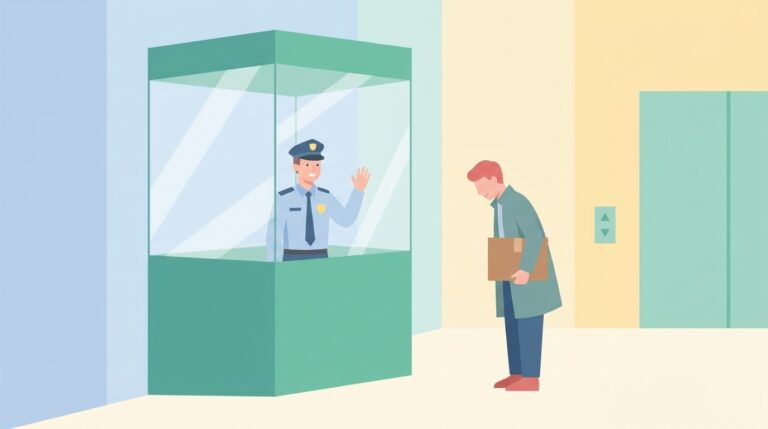
Picture this: You step into the lobby of a Korean apartment building after a long day of exploring Seoul. The automatic sliding door whirs open, and sitting inside the cozy guard booth by the entrance is the Gyeongbi Ajeossi (apartment security guard), wearing his neat uniform and glasses, diligently sorting packages. As you make eye contact, your mind suddenly freezes. Should you say a full formal greeting? Just a nod? What if he asks about your unit number or a parcel?
If you have watched slice-of-life K-dramas like Reply 1988 or My Mister, you know that apartment security guards in Korea are not just security personnel—they are the quiet, protective heart of the neighborhood community. Many international residents and travelers feel awkward or simply rush past with their heads down because textbook Korean never quite taught them the warm, everyday etiquette for these micro-interactions.
Learning how to greet and interact naturally with your building’s security guard will instantly transform you from a detached foreigner into a welcomed, polite neighbor. Based on real feedback from hundreds of our intermediate learners living in Korea, mastering these simple lines and respectful body language opens up genuine smiles, neighborly warmth, and even helpful local tips from your local Ajeossi!
Phase 2: Core Expressions Deep Dive
Let’s break down the 3 most essential expressions you need when passing the security booth.
1. 안녕하세요! 수고 많으십니다. (Annyeonghaseyo! Sugo maneusimnida.)
- Pronunciation: [An-nyeong-ha-se-yo! Soo-go mah-neu-shim-ni-da] (Think of ‘sugo’ like ‘Sue-go’ and ‘man’ like ‘mahn’)
- Meaning: Literal: “Hello! You are doing a lot of hard work.” / Nuance: “Hello! Thank you for your hard work / Keep up the great work!”
- K-Culture Moment: Heard constantly in Korean dramas whenever a polite resident enters the apartment complex lobby on a rainy or freezing evening, acknowledging the guard’s quiet dedication.
- Editor’s Insight: While Sugo-haseyo (수고하세요) is common, saying Sugo maneusimnida (수고 많으십니다) carries deeper warmth and higher respect when addressing someone older than you who is actively working.
- Situation Spectrum: Casual 🚫 | Semi-formal ⚠️ | Formal ✅
- 🤔 Think About It: In your home country, do you verbally acknowledge the effort of service and security workers when walking past, or is a silent smile more customary?
2. 택배 찾아가겠습니다. (Taekbae chajagagesseumnida.)
- Pronunciation: [Taek-bae cha-ja-ga-get-seum-ni-da] (Rhymes with ‘Tech-bay cha-jah-gah-get-seum-nee-da’)
- Meaning: Literal: “I will find and take my parcel.” / Nuance: “I’m here to pick up my package, please.”
- K-Culture Moment: When online shopping packages pile up in the security office (Gyeongbi-sil), residents drop by with a friendly smile to claim their delivery boxes.
- Editor’s Insight: Taekbae refers to doorstep courier packages. Adding -gess-eumnida shows polite intention rather than a blunt command.
- Situation Spectrum: Casual 🚫 | Semi-formal ✅ | Formal ✅
- 🤔 Think About It: Notice how Korean uses the compound verb chaja-gada (find and go) instead of just “taking” or “receiving”. How does this reflect the recipient’s active role?
3. 좋은 하루 보내세요! (Joeun haru bonaeseyo!)
- Pronunciation: [Jo-eun ha-ru bo-nae-se-yo] (Soft ‘J’ sound, ‘Joe-eun hah-roo boh-neh-seh-yoh’)
- Meaning: Literal: “Spend a good day!” / Nuance: “Have a wonderful day!”
- K-Culture Moment: Said cheerfully in morning elevator encounters or when heading out for work as the guard sweeps the front entrance walkway.
- Editor’s Insight: A bright, uplifting closing phrase that leaves a lasting positive impression. Pair it with a gentle bow for maximum warmth.
- Situation Spectrum: Casual ⚠️ | Semi-formal ✅ | Formal ✅
- 🤔 Think About It: “Have a nice day” is universal, but pairing it with an honorific ending (-seyo) bridges casual friendliness with Korean hierarchical politeness.
Phase 3: Textbook Korean vs. Real Korean
Let’s compare robotic textbook lines with what native speakers actually say in an apartment setting.
Situation A: Passing by the guard booth in the morning
- 📖 교과서 한국어 (Textbook): 안녕히 계십시오. 저는 출근합니다. (Annyeonghi gyesipsio. Jeoneun chulgeunhamnida. – “Goodbye. I am going to work.”)
- 🗣️ 진짜 한국어 (Real Korean): 안녕하세요! 다녀오겠습니다~ (Annyeonghaseyo! Danyeo-ogesseumnida~ – “Hello! I’ll be back soon / Have a good day!”)
- 💡 왜 다를까? (Why the difference?): In Korean community culture, leaving your apartment complex feels like leaving a larger home extension. Danyeo-ogesseumnida expresses neighborly connection rather than stiff military-style departure.
Situation B: Noticing the guard working late at night
- 📖 교과서 한국어 (Textbook): 밤늦게까지 일하느라 피곤하시겠습니다. (Bamneutgekkaji ilhaneura pigonhasigesseumnida. – “You must be tired working until late at night.”)
- 🗣️ 진짜 한국어 (Real Korean): 늦은 시간까지 고생 많으세요! (Neujeun sigankkaji gosaeng maneuseyo! – “Thank you so much for your hard work even this late!”)
- 💡 왜 다를까? (Why the difference?): Pointing out tiredness (pigon) can sound slightly awkward. Expressing empathy for their effort (gosaeng maneuseyo) is the standard, natural Korean etiquette.
Phase 4: K-Culture Deep Dive & Non-verbal Manners
4-1. 눈치 (Nunchi) & Body Language
- The 15-to-30 Degree Bow: When passing the security window, make brief, warm eye contact, then bow your upper body about 15 to 30 degrees while saying your greeting. Avoid a rigid 90-degree bow (too stiff) or a simple chin flick (disrespectful to elders).
- Two-Handed Package Acceptance: When picking up a parcel or apartment notice, always use two hands (or support your right elbow with your left hand) to receive it. It shows sincere respect for the guard’s age and role.
4-2. Cultural Code: The Apartment Gyeongbi-won Ecosystem
In Korea, over 60% of people live in high-rise apartments (Apart). Security guards (Gyeongbi Ajeossi) manage waste recycling stations, maintain building safety, accept missed courier deliveries, and clear snow in winter. Korean residents frequently show appreciation on major holidays like Chuseok or Seollal by gifting holiday fruit sets, warm canned coffee (Let’s Be or TOP), or snacks. Building good rapport with your security guard makes your living experience significantly safer and friendlier.
Phase 5: Real Roleplay Scenario
Setting: Lobby entrance of ‘Hangul Dream Apartments’ (한글 드림 아파트). 6:30 PM on a crisp autumn evening.
NPC: Guard Park (박 아저씨), a friendly 65-year-old security guard who knows every resident.
- Resident (You): 🎭 (Approaching the guard booth with a bright smile and light bow)
안녕하세요, 아저씨! 날씨가 많이 쌀쌀하죠?
(Annyeonghaseyo, ajeossi! Nalssiga mani ssalssalhajyo?)
“Hello, Ajeossi! The weather has gotten quite chilly, hasn’t it?” -
Guard Park: 🎭 (Smiles and waves back warmly through the sliding window)
어, 502호 총각/아가씨 왔어요? 오늘 날씨 진짜 춥네. 옷 따뜻하게 입고 다녀요!
(Eo, 502-ho chong-gak/agassi wasseoyo? Oneul nalssi jinjja chumne. Ot ttatteuthage ipgo danyeoyo!)
“Oh, resident from Unit 502 is here? It really is cold today. Make sure to dress warmly!” -
Resident (You): 🎭 (Nodding politely)
네, 감사합니다! 아저씨도 감기 조심하세요. 혹시 502호 택배 온 것 있나요?
(Ne, gamsahamnida! Ajeossido gamgi josimhaseyo. Hoksi 502-ho taekbae on geot innayo?)
“Yes, thank you! Please take care not to catch a cold too. By any chance, is there a delivery for Unit 502?” -
Guard Park: 🎭 (Checking the parcel shelf behind him and holding up a box)
잠깐만요… 아, 여기 큰 상자 하나 와 있어요!
(Jamkkanmanyo… Ah, yeogi keun sangja hana wa isseoyo!)
“Hold on a second… Ah, there is one big box here for you!” -
Resident (You): 🎭 (Receiving the box with both hands and bowing slightly)
아, 맞아요! 무거우셨을 텐데 보관해 주셔서 감사합니다.
(Ah, majayo! Mugeo-usyeosseul tende bogwanhae jusyeoseo gamsahamnida.)
“Ah, that’s right! It must have been heavy, thank you so much for keeping it safe.” -
Guard Park: 🎭 (Patting the box with a reassuring grin)
별말씀을요. 조심히 들고 올라가요. 엘리베이터 바로 잡았어요.
(Byeolmalsseumeullyo. Josimhi deulgo ollagayo. Ellibe-iteo baro jabasseoyo.)
“Don’t mention it. Carry it up safely. I just called the elevator for you.” -
Resident (You): 🎭 (Stepping towards the elevator with gratitude)
감사합니다! 저녁 맛있게 드시고, 수고 많으십니다!
(Gamsahamnida! Jeonyeok mas-itge deusigo, sugo maneusimnida!)
“Thank you! Enjoy your dinner, and keep up the great work!” -
Guard Park: 🎭 (Nodding cheerfully)
네~ 좋은 저녁 보내요!
(Ne~ Joeun jeonyeok bonaeyo!)
“Yes~ Have a wonderful evening!”
🔀 Interactive Choice Point
You see Guard Park struggling to move a heavy recycling cart near the entrance. What do you do and say?
* Option A: Silently walk past with your earphones in because you don’t want to bother him.
* Feedback (Bad): Missing a prime chance for neighborly bonding. Koreans value acknowledging elders when they are performing communal labor.
* Option B: Run over and shout: 야! 내가 해줄게! (Ya! Naega haejulge! – “Hey! I’ll do it!”)
* Feedback (Risk): Using informal banmal (ya, naega) to an elder is socially inappropriate in Korea regardless of your helpful intention.
* Option C: Step forward and say: 아저씨, 제가 조금 도와드릴까요? (Ajeossi, jega jogeum dowadeurilkkayo? – “Ajeossi, shall I help you out a bit?”)
* Feedback (Best): Perfect honorific grammar (jega, -deurilkkayo), respectful tone, and maximum warmth!
Phase 6: 10-Second Emotion Shadowing Drill
Read these aloud, following the rhythm slashes / and matching the indicated mood:
- [😊 Bright & Neighborly]
안녕하세요! / 오늘 날씨가 / 정말 좋네요! / 좋은 하루 보내세요!
(An-nyeong-ha-se-yo! / O-neul nal-ssi-ga / jeong-mal jon-ne-yo! / Jo-eun ha-ru bo-nae-se-yo!) -
[🙏 Grateful & Polite]
택배 맡아주셔서 / 정말 감사합니다! / 수고 많으십니다!
(Taek-bae ma-ta-ju-syeo-seo / jeong-mal gam-sa-ham-ni-da! / Su-go ma-neu-shim-ni-da!) -
[🤝 Warm & Caring on a Cold Night]
날씨가 많이 추운데, / 감기 조심하시고 / 고생 많으세요!
(Nal-ssi-ga ma-ni chu-un-de, / gam-gi jo-sim-ha-si-go / go-saeng ma-neu-se-yo!)
Phase 7: K-Culture Mini Dictionary
- 경비실 (Gyeongbi-sil) | Security Office / Guard Booth
The physical booth situated at the apartment gate or ground-floor lobby where deliveries and complex logistics are handled. - 분리수거 (Bunrisugeo) | Separated Garbage & Recycling
Korea’s meticulous recycling system. Guards often monitor the area; greeting them nicely here will save you from sorting mishaps! - 동 / 호 (Dong / Ho) | Building Number / Unit Number
Essential for mail and identification (e.g., 101동 502호 = Building 101, Unit 502). - 수고하세요 (Sugohaseyo) | Keep up the good work / Goodbye to someone working
Everyday parting remark used when leaving convenience stores, taxis, or apartment booths.
Phase 8: Survival Kit for Travelers & Expats
TOP 3 Survival Lines:
- 안녕하세요, 수고하십니다! (Annyeonghaseyo, sugohasimnida!)
Pro Tip: Use this standard greeting every single time you enter or exit your Airbnb/officetel building. - 택배 찾으러 왔습니다. (Taekbae chajeureo wasseumnida.)
Pro Tip: Show your unit number on your phone screen if your Korean pronunciation feels hesitant. - 감사합니다, 좋은 하루 되세요! (Gamsahamnida, joeun haru doeseyo!)
Pro Tip: Deliver this with a brief two-second head bow as you walk out.
Editor’s Travel Note:
If you are staying in a Korean apartment or officetel, make sure to check the neighborhood recycling schedule via the official Naver Map apartment guide service. When taking out trash, a warm greeting to the guard on duty often turns into a friendly masterclass on which bin your plastic takeout cup belongs in!
Phase 9: Think Deeper (한 발 더 깊이)
In many Western cultures, acknowledging an apartment security guard with a simple head nod or casual “Hey” is standard. However, Korean apartment culture is rooted in a collective neighborhood consciousness (Jeong, 정). Security guards are often retirees dedicating long shifts to the well-being of the building’s families. When you address them with thoughtful honorifics like Sugo 많으십니다, you validate their labor and integrate into the communal harmony of the building.
💬 Your Turn: How do people in your hometown interact with residential staff or building concierges? Share your experience in the comments below!
Phase 10: FAQ & Common Mistakes
Q: Can I call the security guard ‘Ajeossi’ directly?
A: Yes! Calling them 경비 아저씨 (Gyeongbi Ajeossi) or politely 경비 선생님 (Gyeongbi Seonsaengnim) is very natural and affectionate. However, avoid shouting 야 (Ya) or 아저씨 (Ajeossi) abruptly from afar without a greeting.
Q: Is it rude to say ‘Sugo-haseyo’ (수고하세요) to someone older?
A: Traditionally, Sugo implied a superior praising a subordinate’s toil. While widely used today, when speaking to an older guard, Sugo 많으십니다 (Sugo maneusimnida) or 고생 많으십니다 (Gosaeng maneusimnida) is safer and conveys deeper etiquette.
Q: What should I say if the guard helps me with a heavy door or bag?
A: Say 도와주셔서 정말 감사합니다! (Dowajusyeoseo jeongmal gamsahamnida! – “Thank you so much for helping me!”) with two hands slightly clasped.
🚨 Common Mistakes Warning Board
- Mistake: Handing over a package slip or receiving a parcel with only one hand.
Correct Action: Always offer and receive items using both hands. - Mistake: Walking straight past without any eye contact or nod.
Correct Action: Offer a 15-degree nod and a light 안녕하세요. - Mistake: Confusing 안녕히 계세요 (stay well) and 안녕히 가세요 (go well).
Correct Action: Since the guard is staying inside the booth while you leave, say 안녕히 계세요 (Annyeonghi gyeseyo) or 수고하세요 (Sugohaseyo)!
Phase 11: Action Missions
- 🥉 Bronze Mission (Solo Drill): Stand in front of your mirror and practice the 15-degree bow while saying 안녕하세요, 수고 많으십니다! smoothly 5 times.
- 🥈 Silver Mission (SNS & Audio): Record your voice saying 택배 찾아가겠습니다, 감사합니다! and share it with your language partner or study group for intonation check.
- 🥇 Gold Mission (Real-World Challenge): The next time you walk into your residence, guesthouse, or hotel in Korea, look the staff or guard in the eye, bow, and say 좋은 하루 보내세요!.
- 🎮 K-Culture Mission: Watch an episode of a neighborhood K-drama (like Hospital Playlist or Reply 1988) and spot when residents greet building guards or elders with canned coffee.
Phase 12: Interactive Quiz Challenge
1. Situation Judgment: You are picking up a package from your apartment security guard on a hot summer afternoon. Which phrase is the MOST natural and polite to say as you leave?
* A) 잘 있어! (Jal isseo!)
* B) 더운데 수고 많으십니다. 감사합니다! (Deounde sugo maneusimnida. Gamsahamnida!)
* C) 택배 이리 줘. (Taekbae iri jwo.)
2. Fill in the Blank:
“아침 일찍부터 ______ 많으세요! 좋은 하루 보내세요!” (Fill in the word meaning ‘hard work / effort’)
* A) 놀이 (Nori)
* B) 고생 (Gosaeng)
* C) 구경 (Gugyeong)
3. True or False Culture Check:
In Korea, it is considered polite to accept a delivery box from the security guard using only one hand so you can quickly sign the ledger with the other.
* (True / False)
👉 Click to view Answers & Explanations
- Answer: B (Acknowledges the hot weather with empathy and uses formal politeness).
- Answer: B (고생 많으세요 means ‘thank you for your hard work/trouble’).
- Answer: False (Always use both hands when receiving items from an elder in Korea!).







