

Phase 1: Empathy (Story Immersion Opening)
안녕하세요! 매일한글 에디터입니다. (Hello! This is your Daily Hangul editor.)
Picture this: You just walked out of a sleek flagship electronics store in Gangnam or the buzzing aisles of Yongsan Electronics Market. You finally bought that aesthetic K-brand wireless earbuds or a portable vlogging camera you’ve been eyeing for months. You rush back to your hotel or café, unbox it with excitement, press the power button, and… nothing. You charge it, try resetting it, but it’s completely unresponsive—what Koreans call chogi bullyang (dead on arrival).
Panic sets in. You know you need to go back to the store or a local customer service center (AS 센터), but how do you explain the defect without sounding overly aggressive or getting lost in formal dictionary jargon? In Korean tech stores, asking for a brand-new unit requires a specific balance of politeness, clarity, and firm intent. Today’s guide is built on real experiences from our intermediate learners who successfully walked out with a pristine replacement box in under ten minutes. Let’s master the exact phrases that make tech staff instantly understand and resolve your issue!
Phase 2: 3 Key Expressions Deep Dive
1. 새 제품으로 교환해 주세요 (Sae jepumeuro gyohwanhae juseyo)
- Pronunciation: Sae je-poom-eu-ro gyo-hwan-hae joo-seh-yo (Think of “say” + “jepoom” + “gyo-hwan” like “go-hwan”)
- Meaning: “Please exchange this for a new product.” (Direct, polite request for a brand-new replacement rather than a repair)
- K-Culture Moment: Commonly seen in modern K-Dramas when a protagonist calmly insists on their consumer rights after receiving a faulty device.
- Editor’s Insight: In Korean electronics stores, “수리” (suri) means repair, while “교환” (gyohwan) means replacement. If your device broke within the initial return window (usually 7 to 14 days), always specify 새 제품 (brand new product) so they don’t just offer to send it for a week-long repair.
- Situation Spectrum: Casual 🚫 | Semi-formal ✅ | Formal ✅
- 🤔 Think About It: In English, we often say “Can I swap this for a new one?” In Korean, stating the exact desired resolution with “-해 주세요” (-hae juseyo) shows respect while establishing a clear objective.
2. 불량인 것 같아요 (Bullyangin geot gat-ayo)
- Pronunciation: Bool-lyang-in geot gat-ah-yo (“Bool-lyang” rhymes with “cool song”)
- Meaning: “It seems to be defective / faulty.”
- K-Culture Moment: Used frequently at tech counters when describing an unexpected hardware glitch without directly accusing the staff.
- Editor’s Insight: Koreans soften claims using “~것 같아요” (~it seems like). Saying “이거 고장 났어요!” (This is broken!) sounds blunt, whereas “불량인 것 같아요” highlights a manufacturer defect politely and professionally.
- Situation Spectrum: Casual ⚠️ | Semi-formal ✅ | Formal ✅
- 🤔 Think About It: Why does Korean customer etiquette prioritize softened statements like “it seems like” even when a device is clearly broken?
3. 뜯자마자 작동이 안 돼요 (Tteutjamaja jakdong-i an dwaeyo)
- Pronunciation: Tteut-ja-ma-ja jak-dong-ee an dwae-yo (“Tteut” sounds like “t-oot” with a tense start)
- Meaning: “As soon as I unboxed/opened it, it didn’t work.”
- K-Culture Moment: The classic phrase unboxing vloggers use when documenting defective tech.
- Editor’s Insight: The grammar pattern -자마자 (-jamaja) means “as soon as.” Stating that the fault occurred immediately upon unboxing proves that user error or accidental drops were not the cause.
- Situation Spectrum: Casual ⚠️ | Semi-formal ✅ | Formal ✅
- 🤔 Think About It: How does anchoring the timeline of a defect help customer service agents approve instant exchanges under store warranty policies?
Phase 3: Textbook Korean vs Real Korean
Situation 1: Asking for a replacement at the counter
- 📖 교과서 한국어 (Textbook): 이 상품의 하자를 확인하고 새것으로 교체해 주시겠습니까? (I sangpumui hajareul hwaginhago saegeoseuro gyochaehae jusigesseumnikka?)
- 🗣️ 진짜 한국어 (Real-life): 이거 불량인 것 같은데, 새 걸로 바꿔 주실 수 있나요? (Igeo bullyangin geot gateunde, sae geollo bakkwo jusil su innayo?)
- 💡 왜 다를까?: Textbook phrases use stiff Sino-Korean vocabulary like 하자 (defect) and 교체 (replacement). Real native speakers use natural phrasing like 불량 (defective item) and 새 걸로 바꾸다 (swap for a new one).
Situation 2: Explaining that the power does not turn on
- 📖 교과서 한국어 (Textbook): 전원 공급 장치에 문제가 발생하여 기기가 켜지지 않습니다. (Jeonwon gonggeup jangchie munjega balsaenghayeo gigiga kyeojiji anseumnida.)
- 🗣️ 진짜 한국어 (Real-life): 충전해도 아예 전원이 안 켜져요. (Chungjeonhaedo aye jeonwoni an kyeojyeoyo.)
- 💡 왜 다를까?: Adding everyday words like 아예 (not at all / completely) vividly conveys the symptom without needing complex engineering terms.
Phase 4: K-Culture Deep Dive & Non-Verbal Manners
4-1. Nunchi & Polite Gestures at the AS Counter
When approaching a Korean customer service desk:
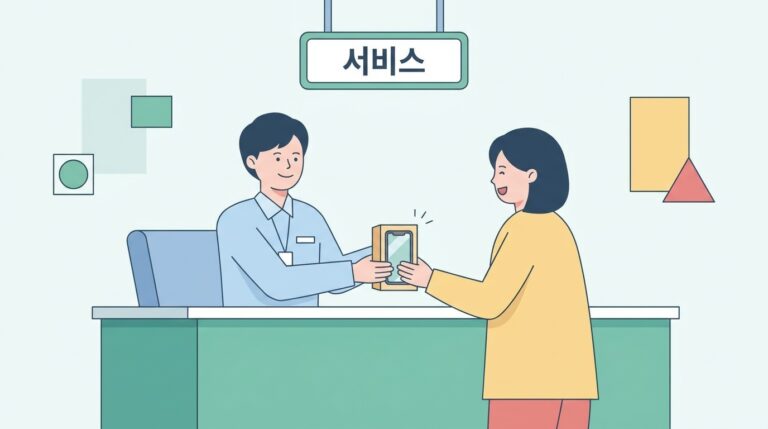
1. Two-Handed Box Presentation: Place the device and its original packaging (including all cables, wrappers, and manuals) on the counter using both hands.
2. Eye Contact & Calm Tone: Korean tech service staff are trained for rapid problem-solving (ppalli-ppalli). Speaking in a composed, courteous tone gets you faster empathy and service than showing visible anger.
3. Receipt Readiness: Keep your physical paper receipt or mobile app purchase barcode on your phone ready to show immediately.
4-2. The “초기 불량 14일” (14-Day Initial Defect) Culture
In South Korea’s fast-paced tech ecosystem, major brands (Samsung, LG, and retail hubs like Electro Mart) strictly operate on a standard 7- to 14-day initial defect policy (초기 불량 규정). If a hardware issue is verified within this window, stores offer a direct one-to-one exchange (1:1 맞교환) rather than repairs. Showing that you understand this policy helps agents fast-track your replacement on the spot.
Phase 5: Real-Life Roleplay Scenario
Setting: You return to the service desk at a large tech retailer in Yongsan with your defective wireless speaker.
Characters:
* 민우 매니저 (Min-woo Manager): Fast, polite, and detail-oriented store technician.
* You: A composed customer seeking a replacement.
- Turn 1 (You): 🎭 Politely placing the speaker box on the desk with both hands
안녕하세요, 어제 여기서 이 스피커를 샀는데요.
(Annyeonghaseyo, eoje yeogiseo i seupikeoreul satneundeyo.)
“Hello, I bought this speaker here yesterday.” -
Turn 2 (민우): 🎭 Bowing slightly and inspecting the receipt
네, 고객님! 어떤 문제가 있으신가요?
(Ne, gogaeknim! Eotteon munjega itsseusingayo?)
“Yes, customer! What kind of issue is there?” -
Turn 3 (You): 🎭 Pointing to the power button
집에 가서 뜯자마자 충전했는데, 아예 전원이 안 켜져요.
(Jibe gaseo tteutjamaja chungjeonhaenneunde, aye jeonwoni an kyeojyeoyo.)
“I charged it right after unboxing it at home, but the power won’t turn on at all.” -
Turn 4 (민우): 🎭 Plugging the device into test cables
아, 그러네요. 기기 초기 불량인 것 같습니다.
(A, geureoneyo. Gigi chogi bullyangin geot gatseumnida.)
“Ah, you are right. It looks like an initial device defect.” -
Turn 5 (You): 🎭 Inquiring with a calm, clear expression
혹시 수리 말고 새 제품으로 교환받을 수 있을까요?
(Hoksi suri malgo sae jepumeuro gyohwanbadeul su isseulkkayo?)
“Could I possibly exchange this for a new product instead of getting it repaired?” -
Turn 6 (민우): 🎭 Checking inventory on his computer screen
네! 구매하신 지 14일 이내라 바로 새 제품으로 교환 가능하십니다.
(Ne! Gumaehasin ji sipsail inaera baro sae jepumeuro gyohwan ganeunghasimnida.)
“Yes! Since it’s within 14 days of purchase, you can get a brand-new replacement immediately.” -
Turn 7 (You): 🎭 Nodding gratefully
감사합니다! 구성품 상자도 여기 다 들어 있어요.
(Gamsahamnida! Guseongpum sangjado yeogi da deureo isseoyo.)
“Thank you! All accessories and the original box are right here inside.” -
Turn 8 (민우): 🎭 Handing over a fresh, sealed box with a new receipt
새 제품으로 준비해 드렸습니다. 매장에서 테스트해 보시겠어요?
(Sae jepumeuro junbihae deuryeotseumnida. Maejang-eseo teseuteuhae bosigesseoyo?)
“Here is your brand-new product. Would you like to test it here in the store?”
🔀 Interactive Branching Choice
If the technician says: “동일한 색상 재고가 없는데 어떡하죠?” (We don’t have stock for the same color, what should we do?)
- Option A: 다른 색상 새 제품으로 교환해 주세요. (Please exchange it for a new one in a different color.)
- Feedback [BEST]: Quick, practical, and gets you a brand-new working device immediately.
- Option B: 그냥 고쳐 주세요. (Just repair it then.)
- Feedback [RISK]: You might have to leave your new gadget for several days or weeks during a short trip.
- Option C: 그럼 이거 그냥 버려 주세요. (Then please just throw this away.)
- Feedback [BAD]: Unrealistic and forfeits your warranty and money!
Phase 6: 10-Second Emotion Shadowing Drill
Practice matching natural cadence and emotional micro-cues:
[🥺 정중하고 답답한 마음으로]
충전했는데 / 아예 전원이 / 안 켜져요.
(Chungjeonhaenneunde / aye jeonwoni / an kyeojyeoyo.)-
[🙂 단호하지만 공손하게]
구매한 지 얼마 안 돼서 / 새 제품으로 / 교환하고 싶어요.
(Gumaeban ji eolma an dwaeseo / sae jepumeuro / gyohwanhago sipeoyo.) -
[😊 안도하며 감사하게]
빠르게 / 새 걸로 바꿔 주셔서 / 감사합니다!
(Ppareuge / sae geollo bakkwo jusyeoseo / gamsahamnida!)
Phase 7: K-Culture Mini Dictionary
- 초기 불량 (Chogi bullyang) | Initial Defect (Dead on Arrival): Hardware failure discovered right after unboxing. Crucial keyword for warranty claims.
- 영수증 (Yeongsujeung) | Receipt / Proof of Purchase: Required documentation for immediate retail exchange in Korea.
- 교환/환불 규정 (Gyohwan/hwanbul gyujeong) | Exchange & Refund Policy: The store’s specific terms regarding timeframe and condition.
- 미개봉 (Migaebong) | Unopened / Factory-Sealed: Refers to items with unbroken security seals.
Phase 8: Traveler’s Survival Kit
Top 3 Survival Expressions
- 한글: 상자랑 구성품 다 있어요.
- Romanization: Sangjarang guseongpum da isseoyo.
- Pro Tip: Say this while presenting the box; proving you kept every cable speeds up full refunds and replacements.
- 한글: 언제쯤 교환 제품을 받을 수 있나요?
- Romanization: Eonjejjeum gyohwan jepumeul badeul su innayo?
- Pro Tip: Use this if the store needs to order stock from another warehouse.
- 한글: 환불로 진행해 주실 수 있나요?
- Romanization: Hwanbullo jinhaenghae jusil su innayo?
- Pro Tip: If a replacement isn’t available, request a complete refund to your payment card.
Editor’s Travel Note
- Navigate seamlessly to official AS centers across Seoul using the 네이버 지도 앱 다운로드 to check real-time wait times and opening hours before visiting.
- If language feels overwhelming in complex hardware disputes, activate voice mode on the 파파고 번역 앱 for real-time bilingual support with Korean technicians.
Phase 9: “한 발 더 깊이” (Reflective Essay)
In South Korea’s high-tech consumer society, the concept of customer service is built on mutual efficiency and mutual respect (상호 존중). While Korean AS centers are renowned worldwide for lightning-fast resolutions, there is a clear social boundary between an informed consumer (스마트 컨슈머) and an unreasonable customer (진상 손님). Expressing device flaws with accurate technical terms while maintaining polite speech (존댓말) creates instant goodwill, prompting Korean service engineers to go the extra mile for you.
💬 Your Turn: Have you ever experienced tech issues while traveling abroad? How would you explain your gadget trouble using today’s Korean phrases? Share your thoughts below!
Phase 10: FAQ & Common Mistakes
Q: Can I get an exchange if I threw away the original plastic wrap and paper box?
A: In Korea, exchanging for a brand-new sealed unit (새 제품 교환) generally requires the complete original packaging and all accessories. If packaging is missing, stores may only offer warranty repair (무상 수리) instead of an instant swap.
Q: What is the typical timeframe to request an exchange for defective electronics?
A: For most major retail chains and service centers in Korea, the initial defect period (초기 불량) is valid within 7 to 14 days of purchase. Always check your receipt date!
Q: Do service centers require my passport for exchange processing?
A: Yes, if you originally purchased the item with duty-free tax refund benefits or paid with an international card, bring your physical passport for administrative verification.
🚨 Common Mistakes Warning Board
- Mistake: Saying “이거 바꿔” (Swap this).
- Correct Action: Use polite honorific forms: “새 걸로 바꿔 주세요” (Please exchange it for a new one).
- Mistake: Forgetting the physical or digital receipt.
- Correct Action: Always retain the paper receipt or take a clear smartphone photo of the barcode immediately upon buying.
- Mistake: Describing the issue as “망가졌어요” (It was ruined/smashed).
- Correct Action: Use “작동이 안 돼요” (It doesn’t operate) or “불량인 것 같아요” to clarify it’s a factory issue, not accidental damage.
Phase 11: Action Missions
- 🥉 Bronze Mission: Stand in front of a mirror and practice saying “새 제품으로 교환해 주세요” three times with steady, polite pronunciation.
- 🥈 Silver Mission: Write a mock dialogue in the comments describing a phone that won’t charge using “-자마자” and “작동이 안 돼요”.
- 🥇 Gold Mission: Next time you visit an electronics store or café in Korea, practice using two-handed etiquette when handing over payment or items.
- 🎮 K-Culture Mission: Watch a tech unboxing video by a Korean creator on YouTube and spot how many times they say 초기 불량 or 새 제품!
Phase 12: Interactive Quiz Challenge
Test your knowledge with these quick checks!
1. Situation Judgment
You bought Bluetooth headphones 3 days ago, and sound only comes out of one side. What is the best phrase to say at the counter?
* (A) 그냥 버려 주세요.
* (B) 초기 불량인 것 같은데, 새 제품으로 교환해 주세요.
* (C) 이거 이미 썼으니까 돈으로 더 주세요.
👉 Click to reveal Answer & Explanation
- Correct Answer: (B)
- Explanation: Stating 초기 불량 (initial defect) and requesting 새 제품으로 교환 (exchange for a new product) is the most natural, polite, and effective approach within the 14-day window.
2. Fill in the Blank
“I tried it as soon as I opened the box.” -> 상자를 뜯(______) 작동해 봤어요.
👉 Click to reveal Answer & Explanation
- Correct Answer: 자마자 (tteut-ja-ma-ja)
- Explanation: The suffix -자마자 conveys “as soon as [action happens]”.
3. True / False Culture Quiz
In Korean electronics stores, you can always exchange an item for a new product after 6 months if it has a small scratch.
👉 Click to reveal Answer & Explanation
- Correct Answer: False
- Explanation: New product exchanges are typically limited to the initial defect period (7–14 days). After that, warranty repairs (AS 수리) apply rather than product swaps.







