

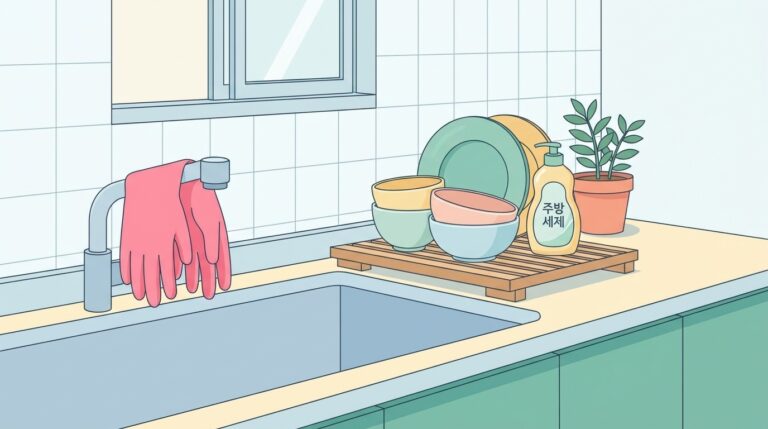
Phase 1: Empathy (Story Immersion Opening)
안녕하세요! 매일한글 에디터입니다. (Hello! I’m your editor from Daily Hangul.) Have you ever watched a cozy scene in a K-Drama like Hospital Playlist or a Korean reality show like Three Meals a Day, where friends finish a delicious feast of Samgyeopsal and Ramyeon, and then someone immediately stands up, rolls up their sleeves, and proudly announces they will do the dishes? In Korea, sharing a meal is an act of deep bonding, but offering to do the dishes—설거지 (seol-geo-ji)—is the ultimate gesture of politeness, gratitude, and warm manners (정, jeong).
If you are living in a shared flat in Seoul, staying at a homestay, or visiting a Korean friend’s home, knowing how to politely offer, “I’ll wash the dishes!” or ask, “Where is the dish soap?” transforms you instantly from an awkward guest into an adorable, thoughtful insider. Based on real questions from our beginner learners at Daily Hangul, we have crafted this practical, bite-sized A1 guide so you can handle Korean kitchen moments with total confidence!
Phase 2: Top 3 Core Expressions Breakdown
1. 제가 설거지할게요! (Je-ga seol-geo-ji-hal-ge-yo!)
- Pronunciation: [Je-ga seol-geo-ji-hal-ge-yo] (Think of ‘seol’ like ‘soul’, ‘geo’ like ‘gull’ without the double l, ‘ji’ like ‘gee’)
- Meaning: Literal: “I will do dishwashing!” | Real Nuance: “Let me do the dishes! / I got the dishes!”
- K-Culture Moment: Seen in almost every variety show where housemates take turns cleaning up after home-cooked meals.
- Editor’s Insight: Using 제가 (je-ga – I/me) emphasizes proactive willingness. It sounds enthusiastic and extremely polite for beginners.
- Situation Spectrum: Casual (⚠️ with friends use 내가 할게), Semi-formal (✅ 제가 할게요), Formal (✅ 제가 하겠습니다)
- 🤔 Think About It: In your culture, is cleaning up after a host prepares food expected, or is it considered stepping into the host’s private kitchen boundaries?
2. 고무장갑 어디 있어요? (Go-mu-jang-gap eo-di i-sseo-yo?)
- Pronunciation: [Go-mu-jang-gap eo-di i-sseo-yo] (Go-moo-jahng-gahp uh-dee ee-ssuh-yo)
- Meaning: Literal: “Rubber gloves, where are they?” | Real Nuance: “Where are the dishwashing gloves?”
- K-Culture Moment: Korean kitchens almost always feature iconic, bright pink rubber gloves resting next to the sink.
- Editor’s Insight: 어디 있어요? (Where is it?) is a magical A1 sentence pattern. Simply place any noun before it!
- Situation Spectrum: Casual (⚠️ 어디 있어?), Semi-formal (✅ 어디 있어요?), Formal (✅ 어디에 있습니까?)
- 🤔 Think About It: Why do Koreans prioritize protecting their hands with thick rubber gloves during kitchen chores?
3. 같이 해요! (Ga-chi hae-yo!)
- Pronunciation: [Ga-chi hae-yo] (Pronounced smoothly like ‘gah-chee hae-yo’)
- Meaning: Literal: “Do together!” | Real Nuance: “Let’s do it together! / I’ll help you!”
- K-Culture Moment: When a host tries to refuse your help out of politeness, you jump in beside them at the sink saying this with a smile.
- Editor’s Insight: 같이 (ga-chi) means ‘together’. Korean society values doing chores collaboratively rather than leaving one person isolated.
- Situation Spectrum: Casual (⚠️ 같이 해), Semi-formal (✅ 같이 해요), Formal (✅ 같이 하시죠)
- 🤔 Think About It: Notice how Korean creates teamwork out of routine chores with just one friendly word!
Phase 3: Textbook Korean vs. Real Korean
Situation 1: Offering to wash dishes
- 📖 Textbook Korean: 저는 식기를 세척하겠습니다. (Jeo-neun sik-gi-reul se-cheok-ha-get-seum-ni-da. – “I shall execute dish sanitization.”)
- 🗣️ Real Korean: 제가 설거지할게요! (Je-ga seol-geo-ji-hal-ge-yo! – “I’ll do the dishes!”)
- 💡 Why is it different? Textbook terms like 식기 세척 (dish washing/sanitization) belong in commercial dish detergent manuals, whereas real humans simply use 설거지 in daily life.
Situation 2: Asking someone to dry or rinse dishes
- 📖 Textbook Korean: 당신은 헹굼을 담당해 주십시오. (Dang-sin-eun heng-gum-eul dam-dang-hae ju-sip-si-o. – “You please assume responsibility for rinsing.”)
- 🗣️ Real Korean: 제가 닦을게요, 물로 헹궈 주세요! (Je-ga da-kkeul-ge-yo, mul-ro heng-gwo ju-se-yo! – “I’ll dry them, please rinse with water!”)
- 💡 Why is it different? Real Korean naturally breaks teamwork into simple action verbs with the soft request ending -해 주세요 (please do).
Phase 4: K-Culture Deep Dive & Non-Verbal Manners
4-1. Nunchi (눈치) & Kitchen Gestures
- The 3-Second Rule: In a Korean household or homestay, when everyone puts their chopsticks down, immediately look around. Standing up first and bringing your own bowl to the sink demonstrates high Nunchi (social intuition).
- The Two-Step Polite Refusal: When you say “제가 설거지할게요!”, the host will almost certainly say, “아니에요, 괜찮아요!” (No, it’s really okay!). Do not immediately sit back down! Offer one more time with a warm smile: “아니에요, 제가 할게요!” (No, really, let me do it!).
4-2. Cultural Code: The Pink Rubber Glove Phenomenon
If you have watched K-Dramas, you must have seen the signature bright pink or coral 고무장갑 (rubber gloves). In Korea, dishwashing is done meticulously with hot water and strong dish soaps (주방세제), so wearing rubber gloves is essential to prevent dry skin (주부습진). Wearing them also shows you know how real Korean kitchens operate!
Phase 5: Real-World Roleplay Scenario
Setting: You just finished a delicious homemade Tteokbokki dinner at your Korean friend Minho’s apartment in Mapo-gu, Seoul.
- Turn 1 (You): 잘 먹었습니다! 정말 맛있었어요. (Jal meo-geot-seum-ni-da! Jeong-mal ma-si-sseo-sseo-yo.) — 🎭 (Puts down chopsticks and gently gathers plates) “Thank you for the meal! It was really delicious.”
- Turn 2 (Minho): 맛있게 먹어줘서 고마워요! 배부르죠? (Ma-si-kke meo-geo-jwo-seo go-ma-wo-yo! Bae-bu-reu-jyo?) — 🎭 (Smiles and leans back happily) “Thanks for enjoying it! Are you full?”
- Turn 3 (You): 네, 배불러요! 이제 제가 설거지할게요. (Ne, bae-bul-leo-yo! I-je je-ga seol-geo-ji-hal-ge-yo.) — 🎭 (Stands up and carries dishes toward the kitchen sink) “Yes, I’m full! Now I will do the dishes.”
- Turn 4 (Minho): 에이, 손님인데 괜찮아요! 그냥 두세요. (E-i, son-nim-in-de gwaen-chan-a-yo! Geu-nyang du-se-yo.) — 🎭 (Waves hands dismissively with a polite smile) “Aey, you are a guest, it’s fine! Just leave them.”
- Turn 5 (You): 아니에요! 같이 해요. 주방세제 어디 있어요? (A-ni-e-yo! Ga-chi hae-yo. Ju-bang-se-je eo-di i-sseo-yo?) — 🎭 (Smiles warmly and rolls up sleeves at the sink) “No way! Let’s do it together. Where is the dish soap?”
- Turn 6 (Minho): 싱크대 오른쪽에 있어요. 고무장갑 끼고 하세요! (Sing-keu-dae o-reun-jjok-e i-sseo-yo. Go-mu-jang-gap kki-go ha-se-yo!) — 🎭 (Hands you the iconic pink rubber gloves) “It’s on the right side of the sink. Put on rubber gloves!”
- Turn 7 (You): 네, 고마워요. 제가 깨끗하게 닦을게요! (Ne, go-ma-wo-yo. Je-ga kkae-kkeut-ha-ge da-kkeul-ge-yo!) — 🎭 (Puts on gloves and turns on warm water) “Yes, thank you. I will wash them squeaky clean!”
- Turn 8 (Minho): 고마워요! 그럼 제가 물기를 닦을게요. (Go-ma-wo-yo! Geu-reom je-ga mul-gi-reul da-kkeul-ge-yo.) — 🎭 (Takes out a clean dish towel ready to dry) “Thank you! Then I will dry the water off.”
🔀 Interactive Branching Point
When Minho says in Turn 4, “손님인데 괜찮아요! 그냥 두세요” (You are a guest, just leave it), what do you reply?
- Option A: “네, 그럼 안 할게요!” (Okay, then I won’t do it!)
- ⚠️ Feedback (Risk): Too blunt! In Korean hospitality, this accepts the initial polite refusal too quickly and can look slightly disinterested.
- Option B: “아니에요, 맛있는 밥 사주셨으니 제가 할게요!” (No, you treated me to great food, so let me do it!)
- 🌟 Feedback (Best Choice): 100 points! Expresses heart-warming gratitude and teamwork. Minho will adore your manners!
- Option C: “돈 드릴게요.” (I will give you money.)
- 🚫 Feedback (Bad): Awkward! Offering money for home hospitality destroys the warm atmosphere of Jeong.
Phase 6: 10-Second Emotion Shadowing Drill
[😊 Friendly & Enthusiastic]제가 / 설거지할게요! (Je-ga / seol-geo-ji-hal-ge-yo!)[🤔 Curious & Polite]주방세제 / 어디 있어요? (Ju-bang-se-je / eo-di i-sseo-yo?)[🤝 Warm & Collaborative]우리 / 같이 해요! (U-ri / ga-chi hae-yo!)
Phase 7: K-Culture Mini Dictionary
- 설거지 (Seol-geo-ji) | Noun: Dishwashing | Daily essential. Used in phrases like 설거지거리 (dishes piled up to wash) or 설거지 당번 (person on dish duty).
- 고무장갑 (Go-mu-jang-gap) | Noun: Rubber Gloves | Iconic thick latex kitchen gloves. A staple in 99% of Korean homes.
- 주방세제 (Ju-bang-se-je) | Noun: Dishwashing Detergent | Soap specially formulated for dishes and kitchen counters.
- 수세미 (Su-se-mi) | Noun: Dish Scrubber / Sponge | Often knitted in bright floral acrylic patterns by Korean mothers and grandmothers!
Phase 8: Survival Kit for Travelers
Top 3 Kitchen Survival Phrases
- 한글: 물 어디서 나와요? | Romanization: Mul eo-di-seo na-wa-yo? | Pro Tip: Useful in Airbnbs or guesthouses when figuring out complex Korean sink mixer faucets.
- 한글: 행주 있어요? | Romanization: Haeng-ju i-sseo-yo? | Pro Tip: Haeng-ju means a small kitchen table cloth used to wipe water spills on dining tables.
- 한글: 다 끝났어요! | Romanization: Da kkeun-na-sseo-yo! | Pro Tip: Say this with a proud smile when you finish all the dishes.
Editor’s Travel Note
When staying in a studio or Airbnb in Korea, proper waste and dish management is crucial. Food scraps must go into designated yellow food waste bags (음식물 쓰레기봉투) before washing dishes. If you need supplies nearby, search for your closest mart using the Naver Map App for iOS and Android.
Phase 9: “One Step Deeper” (Thoughtful Reflection)
In Korean culture, communal meals end with communal care. Housework like 설거지 isn’t viewed merely as a chore, but as a reciprocal return of care (보답, bo-dap). When someone spends hours cooking for you, taking over the sink communicates without words: “I see your effort, and I cherish our relationship.”
💬 Your Turn: In your home country, what is the polite custom after finishing a home-cooked meal with friends or family? Share your experience in the comments below!
Phase 10: FAQ & Common Mistakes
Q: Can I use “설거지해요” directly to an older person?
A: It is better to use honorifics: 제가 설거지하겠습니다 (Je-ga seol-geo-ji-ha-get-seum-ni-da) or ask 도와드릴까요? (Do-wa-deu-ril-kka-yo? – “Shall I help you?”).
Q: What is the difference between 닦다 (dak-da) and 씻다 (ssit-da)?
A: 씻다 means washing with water, while 닦다 means wiping, scrubbing, or drying surfaces with a cloth.
Q: Do young Koreans use dishwashers (식기세척기)?
A: Yes, dishwashers are becoming popular in modern apartments, but hand-washing with rubber gloves remains the standard daily habit in most households.
🚨 Common Mistakes Alert
- Mistake: Saying “제가 청소할게요” (I will clean) when meaning dishes. -> Correct: 청소 refers to vacuuming/room cleaning. Use 설거지 for dishes!
- Mistake: Forgetting the subject particle 제가 and just saying 나 할게 to elders. -> Correct: Always use 제가 할게요 for polite conversational tone.
- Mistake: Pouring food waste directly down the sink drain. -> Correct: Always separate food waste into the sink strainer bin first.
Phase 11: Action Mission & Engagement
- 🥉 Bronze Mission: Stand in front of your mirror and repeat “제가 설거지할게요!” 5 times with a bright smile.
- 🥈 Silver Mission: Write the phrase “고무장갑 어디 있어요?” on a sticky note and place it near your kitchen sink.
- 🥇 Gold Mission: Next time you eat with Korean friends or family, offer to wash the dishes in Korean before anyone asks!
- 🎮 K-Culture Mission: Watch a variety show episode (like Running Man or Jinny’s Kitchen) and spot how cast members negotiate who does the 설거지!
Phase 12: Interactive Quiz Challenge
Q1. Choose the most natural polite expression when offering to wash dishes after dinner:
1) 제가 식기를 소독하겠습니다.
2) 제가 설거지할게요!
3) 너 설거지해.
👉 Click to reveal Answer & Explanation
Correct Answer: 2) 제가 설거지할게요!
Explanation: Option 1 is too rigid and medical-sounding. Option 3 is informal/rude to hosts. Option 2 is the warm, natural, and polite standard!
Q2. Fill in the blank:
“고무장갑 ______ 있어요?” (Where are the rubber gloves?)
1) 누구
2) 언제
3) 어디
👉 Click to reveal Answer & Explanation
Correct Answer: 3) 어디 (Eo-di)
Explanation: 어디 있어요? is the essential question pattern meaning “Where is [noun]?”







