

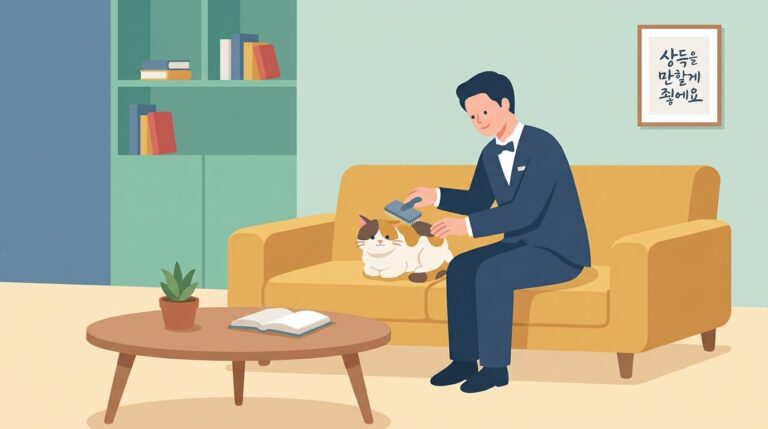
Mastering Advanced Korean Pet Care: Cat Hairball Symptoms and Brushing
Phase 1: Empathy & Immersion
안녕하세요! 매일한글 에디터입니다. (Hello! This is your Daily Hangul editor.)
Picture this: You are relaxing on your sofa in a quiet studio apartment in Mapo-gu after a long day. Suddenly, your beloved feline companion begins making a distressing, rhythmic retching sound—kkek-kkek—hunched over your favorite Korean rug. In sheer panic, you grab your phone to message your local Korean veterinarian or your Korean pet-sitter friend. But how do you articulate subtle clinical nuances in Korean beyond basic textbook phrases? Saying simply “고양이가 아파요” (My cat is sick) won’t convey whether the cat is coughing, dry-heaving, or vomiting hairballs caused by dead fur build-up during shedding season.
Today, we are bridging that exact gap. Drawing from real-life veterinary consult experiences and feedback from our advanced learners living in Korea as dedicated jipsa (cat butler, 집사), this guide equips you with nuanced C2-level expressions, clinical terminologies, and socio-cultural mannerisms to advocate effortlessly for your feline companion in fluent Korean.
Phase 2: Core Expressions Deep Dive
1. 헤어볼을 게워내다 (Heeoboreul geweonaeda)
- Pronunciation: [Hae-uh-bol-eul geh-wo-nae-da] (Think of ge-wo like the English ‘get over’ without the ‘t’)
- Meaning: Literal: “To bring up a hairball.” Nuance: A clinically accurate, native way to describe vomiting/regurgitating ingested fur rather than general sickness.
- K-Culture Moment: Frequently heard on popular Korean pet YouTube channels like CreamHeroes or Haha ha when observing cat grooming behaviors.
- Editor’s Insight: While standard textbooks teach “토하다” (to vomit), native Koreans and veterinary specialists use “게워내다” when stomach contents or hairballs are brought up smoothly through natural physiological expulsion.
- Situation Spectrum: Casual: ✅ | Semi-formal: ✅ | Formal: ✅
- 🤔 Think About It: Why does Korean distinguish between voluntary/involuntary physiological expulsions with verbs like 토하다, 게워내다, and 뱉어내다 compared to English catch-alls?
2. 죽은 털을 솎아내다 (Jugeun teoreul sok-anaeda)
- Pronunciation: [Joo-geun teol-eul sok-ka-nae-da] (Rhymes with English ‘soak out’)
- Meaning: Literal: “To thin out/comb out dead undercoat fur.”
- K-Culture Moment: Featured in high-end Korean pet grooming vlog tutorials during seasonal transition periods (hwanjeolgi).
- Editor’s Insight: The verb “솎아내다” comes from agriculture (thinning out dense seedlings). Using it for feline deshedding highlights precise, high-level language mastery.
- Situation Spectrum: Casual: ✅ | Semi-formal: ✅ | Formal: ✅
- 🤔 Think About It: Notice how Korean borrowing from agricultural terminology reflects meticulous attention to routine domestic care.
3. 사단이 나다 (Sadani nada)
- Pronunciation: [Sa-dan-i na-da]
- Meaning: Literal: “An accident or trouble arises.” Nuance: A situation escalates into a serious problem due to prior negligence (e.g., neglecting daily brushing leading to intestinal blockage).
- K-Culture Moment: Often used by K-Drama protagonists when a small oversight triggers an unexpected crisis at home or work.
- Editor’s Insight: Extremely idiomatic. Saying “빗질을 안 해주면 장폐색으로 사단이 날 수 있어요” shows native-level causality and seriousness.
- Situation Spectrum: Casual: ✅ | Semi-formal: ✅ | Formal: ⚠️
- 🤔 Think About It: How does your native language convey that a trivial slip-up led to a catastrophic health complication?
Phase 3: Textbook Korean vs. Real Native Korean
Scenario 1: Describing Retching and Gagging at the Vet
- 📖 교과서 한국어: 고양이가 배가 아파서 계속 기침하고 토해요. (Goyang-iga baega apaseo gyesok gichimhago tohaeyo. – The cat has a stomachache so it coughs and vomits continuously.)
- 🗣️ 진짜 한국어: 아이가 헛구역질을 심하게 하더니 결국 헤어볼 덩어리를 게워내더라고요. (Ai-ga heot-guyeokjireul simhage hadeoni gyeolguk heeobol deong-eorireul geweonaedeoragoyo. – The little one was dry-heaving severely and eventually brought up a dense clump of hairballs.)
- 💡 왜 다를까?: Native Korean cat parents affectionately refer to their pets as “우리 아이” (our child/little one) and distinguish dry-heaving (heot-guyeokjil) from general coughing.
Scenario 2: Explaining the Necessity of Daily Combing
- 📖 교과서 한국어: 매일 빗으로 고양이 털을 빗어주어야 합니다. (Maeil biseuro goyang-i teoreul biseojueoya hamnida. – You must comb cat fur with a comb every day.)
- 🗣️ 진짜 한국어: 털갈이 철에는 죽은 털을 제때 솎아주지 않으면 헤어볼성 장폐색이 올 수 있어요. (Teol-gari cheoreneun jugeun teoreul jette sok-ajuji aneumyeon heeobol-seong jangpyesaeg-i ol su isseoyo. – During shedding season, if you don’t thin out dead undercoat in time, hairball-induced bowel obstruction can occur.)
- 💡 왜 다를까?: Advanced speech incorporates seasonal conditions (teol-gari cheol) and medical risks (jangpyesaek) rather than basic imperatives.
Phase 4: K-Culture Deep Dive & Non-Verbal Etiquette
4-1. Nunchi & Clinical Manners at Korean Animal Hospitals
In Korean animal clinics (dongmul byeongwon), showing respect involves addressing the veterinary practitioner respectfully as “원장님” (Wonjangnim – Clinic Director) or “선생님” (Seonsaengnim). Maintain polite eye contact while mimicking the exact posture of your cat’s coughing episode with subdued hand gestures. Avoid raising your voice in waiting rooms; pet etiquette in modern Korean high-rises and clinics mandates quiet, calm reassurance toward stressed pets.
4-2. The Cultural Phenomenon of “Jipsa” (집사)
In modern Korea, cat owners do not call themselves “주인” (owners/masters). Instead, they proudly identify as “집사” (butlers who faithfully serve feline royalty). This linguistic shift has spurred massive lifestyle trends—from premium de-shedding slicker brushes (seullikeo beoreosi) to specialized digestive malt paste treats promoted by celebrity pet influencers.
Phase 5: Real-World Roleplay Scenario
Setting: A cozy veterinary clinic in Gangnam. You are consulting with Dr. Park about your 3-year-old Korean Short Hair who has been retching frequently.
- Turn 1 (Doctor Park): 어서 오세요! 우리 냥이 오늘 어디가 불편해서 내원하셨을까요? 🎭 (따뜻하게 진찰실 차트를 확인하며)
(Eoseo oseyo! Uri nyang-i oneul eodiga bulpyeonhaeseo naewonhasyeosseulkkayo? / Welcome! What brings our kitty into the clinic today?) -
Turn 2 (You): 원장님, 아이가 며칠 전부터 사료를 먹고 나면 켁켁거리며 헛구역질을 반복해요. 🎭 (걱정스러운 표정으로 아이의 등을 부드럽게 쓰다듬으며)
(Wonjangnim, ai-ga myeochil jeonbuteo saryoreul meokgo namyeon kkek-kkek-georimyeo heot-guyeokjireul banbokhaeyo. / Doctor, for a few days now, after eating dry food, she keeps coughing and dry-heaving repeatedly.) -
Turn 3 (Doctor Park): 단순 구토인가요, 아니면 털 뭉치 같은 이물질이 섞여 나오나요? 🎭 (청진기를 준비하며)
(Dansun gutoin-gayo, animyeon teol mungchi gateun imuljiri seokkyeo naonayo? / Is it simple vomiting, or are there foreign objects like clumps of hair mixed in?) -
Turn 4 (You): 어제는 손가락 두 마디만 한 빽빽한 헤어볼을 게워냈더라고요. 🎭 (휴대폰으로 찍어둔 구토물 사진을 보여주며)
(Eojeneun songarak du madiman han ppaek-ppaek-han heeoboreul geweonaetdeoragoyo. / Yesterday, she brought up a dense hairball about the size of two finger joints.) -
Turn 5 (Doctor Park): 사진을 보니 털갈이 시즌이라 그루밍하면서 삼킨 죽은 털이 위장에 뭉쳤던 것 같네요. 혹시 평소 빗질 주기는 어떻게 되시나요? 🎭 (사진을 세심히 관찰하며)
(Sajineul boni teol-gari sijeun-ira geuruminghamyeonseo samkin jugeun teori wijang-e mungchyeotdeon geot gatneyo. Hoksi pyeongso bitjil jugineun eotteoke doesinayo? / Looking at the photo, it seems swallowed dead fur during shedding season accumulated in the stomach. How often do you brush her?) -
Turn 6 (You): 일주일에 한두 번 슬리커 브러시로 빗겨줬는데, 털 빠짐 양에 비해 부족했던 것 같아요. 🎭 (반성하는 눈빛으로 고개를 끄덕이며)
(Ilju-ire handu beon seullikeo beoreosiro bitgyeojwotneunde, teol ppajim yang-e bihae bujokhaetdeon geot gatayo. / I brushed her once or twice a week with a slicker brush, but it seems insufficient compared to her shedding volume.) -
Turn 7 (Doctor Park): 맞습니다. 환절기에는 매일 실리콘 브러시나 디쉐딩 툴로 속털까지 꼼꼼히 솎아내 주셔야 장폐색 같은 큰 사단을 막을 수 있습니다. 🎭 (진찰대 위 고양이를 조심스레 안심시키며)
(Matseumnida. Hwanjeolgieneun maeil sil-likon beoreosina disyweding tul-ro sokteolkkaji kkomkkomhi sok-anae jusyeoya jangpyesaek gateun keun sadaneul mageul su itseumnida. / Exactly. During seasonal transitions, you must comb out the undercoat thoroughly every day with a deshedding tool to prevent severe issues like bowel obstruction.) -
Turn 8 (You): 네, 오늘부터 매일 빠짐없이 빗질해주고 처방해 주시는 헤어볼 영양제도 꾸준히 먹이겠습니다! 🎭 (안도하며 감사 인사를 건넨다)
(Ne, oneulbuteo maeil ppajimeopsi bitjilhaejugo cheobanghae jusineun heeobol yeongyangjedo kkujunhi meogigetseumnida! / Understood, I will brush her daily without fail and consistently feed the hairball supplement you prescribe!)
🔀 Interactive Choice Branch
What should you reply if the vet asks whether your cat also shows lethargy or loss of appetite (기력 저하나 식욕 부진)?
* Option A (Best): “사료는 잘 먹는데, 배변 시 털이 섞여 나와 변비 증세가 조금 보여요.” (Accurate clinical description of stools and appetite.)
* Option B (Bad): “고양이가 밥 안 먹고 잠만 자니까 그냥 주사 한 대 놔주세요.” (Disregards diagnosis; overly demanding and unnatural.)
* Option C (Risk): “헤어볼 토하는 건 자연스러운 거니까 약은 안 먹여도 되죠?” (Risky assumption; downplays medical risks of impaction.)
Phase 6: 10-Second Emotional Shadowing Drill
[😟 깊은 걱정과 조심스러움을 담아]
아이가 / 켁켁거리며 / 헛구역질을 하더니 / 결국 헤어볼을 게워냈어요.
(Ai-ga / kkek-kkek-georimyeo / heot-guyeokjireul hadeoni / gyeolguk heeoboreul geweonaesseoyo.)-
[💡 다짐과 프로페셔널한 집사의 톤으로]
털갈이 철에는 / 죽은 털을 제때 솎아줘야 / 장폐색 같은 사단을 / 막을 수 있어요.
(Teol-gari cheoreneun / jugeun teoreul jette sok-ajwoya / jangpyesaek gateun sadaneul / mageul su isseoyo.)
Phase 7: K-Culture Mini Dictionary
- 집사 (Jipsa) | Cat Butler / Pet Parent | Refers to a humble, dedicated cat owner who caters devotedly to their feline companion.
- 환절기 (Hwanjeolgi) | In-between Seasons Period | The rapid seasonal transition window when extreme temperature swings trigger heavy pet shedding.
- 장폐색 (Jangpyesaek) | Intestinal / Bowel Obstruction | A dangerous medical condition where ingested hairballs or foreign objects block digestive tracts.
- 그루밍 (Geuruming) | Self-Grooming | The natural cat habit of licking fur; frequently discussed in context of hairball ingestion prevention.
Phase 8: Traveler & Expat Survival Kit
Survival Expressions TOP 3
- “헤어볼 배출에 좋은 사료나 영양제 추천해 주실 수 있나요?”
(Heeobol baechure joeun saryona yeongyangje chucheonhae jusil su innayo?)
Pro Tip: Use this at pet supermarkets or vet clinics to request hairball relief supplements. - “죽은 털 제거용 실리콘 브러시는 어디에 진열되어 있나요?”
(Jugeun teol jegeoyong sil-likon beoreosineun eodie jinyeoldoeeo innayo?)
Pro Tip: Useful when navigating massive pet supply stores like Molly’s Pet Shop in Korea. - “진료 전에 미리 발톱 깎고 빗질하고 가도 괜찮을까요?”
(Jinryo jeone miri baltop kkakgo bitjilhago gado gwaenchaneulkkayo?)
Pro Tip: Shows great manners when confirming pre-visit protocols with vet receptionists.
Editor’s Travel Note
For effortless veterinary visits and purchasing specialized grooming supplies across Seoul and Busan, explore pet-friendly spots using the Naver Map App Download and Pet Hospital Search. Keep photos of any vomited hairballs or stool anomalies on your phone to show clinic staff directly.
Phase 9: Step Deeper (Reflective Insight)
In Korean society, the semantic shift from identifying as a pet “소유자” (owner) to a humble “집사” (butler) reflects deep relational empathy rooted in contemporary urban living. Just as the Korean language employs honorific levels to establish relational balance among humans, pet-related vocabulary has evolved into affectionate kinship terms. Caring for a pet’s shedding coat is no longer viewed as mere housecleaning, but as a reciprocal duty of care.
💬 Your Turn: How does your native language describe pet ownership? Does it reflect guardianship, ownership, or companionship? Share your thoughts below!
Phase 10: FAQ & Common Mistakes
Q: What is the difference between 토하다 (to vomit) and 게워내다?
A: While “토하다” is the general verb for vomiting, “게워내다” is commonly used when a pet or person smoothly regurgitates swallowed contents (like swallowed fur or unchewed grass) through natural throat contractions.
Q: Can I use “털을 깎다” instead of “털을 빗다” or “솎아내다”?
A: “털을 깎다” means shaving or clipping fur with clippers. If you mean regular brushing to remove dead fur, always use “빗질하다” (to brush) or “죽은 털을 솎아내다” (to comb out undercoat).
Q: How do I say my cat is dry-heaving without bringing anything up?
A: Use the phrase “헛구역질을 하다” (heot-guyeokjireul hada). The prefix “헛-” signifies an action with no tangible outcome (a dry/empty heave).
🚨 Common Mistakes Warning Board
| Mistake | Why it Sounds Unnatural | Correct Action |
|---|---|---|
| 고양이가 머리털을 토해요 | “머리털” refers strictly to human head hair! | Say: “고양이가 헤어볼을 게워내요” |
| 털을 청소기로 빗겨줘요 | Sounds like you are vacuuming the live cat directly! | Say: “브러시로 죽은 털을 솎아줘요” |
| 의사선생, 약 주세요 | Omits proper professional honorifics in a clinical context. | Say: “원장님, 처방 부탁드립니다” |
Phase 11: Action Missions
- 🥉 Bronze Mission (Solo Practice): Read the Shadowing Drill in Phase 6 out loud 5 times, focusing on pausing at the slash marks (
/). - 🥈 Silver Mission (Social Share): Post a photo of your cat (or a favorite cat meme) on your Instagram or Threads with the caption: “환절기 빗질 필수! 죽은 털 솎아내기 완료 🐱✨ #집사의하루 #헤어볼예방”
- 🥇 Gold Mission (Real-life Execution): Visit a local pet boutique or Korean vet and use one of the Phase 8 survival expressions to inquire about grooming brushes or digestive treats.
- 🎮 K-Culture Mission: Watch an episode of a Korean pet rescue documentary (like SBS TV Animal Farm – TV 동물농장) and spot when the hosts use words like 집사 or 털갈이.
Phase 12: Interactive Quiz Challenge
1. Situational Judgment: Your cat keeps hacking dryly without food coming out. What is the most precise way to describe this to the vet receptionist?
* A) 아이가 헛구역질을 켁켁거리며 반복해요.
* B) 아이가 머리털을 많이 먹어서 아파요.
* C) 아이가 침을 계속 뱉어내고 있어요.
2. Fill-in-the-Blank: 털갈이 시즌에는 브러시로 ( ) 털을 꼼꼼히 솎아내야 장폐색을 예방할 수 있습니다.
3. True or False: In modern Korean veterinary culture, referring to your cat as ‘우리 아이’ (our child) is considered overly formal and inappropriate in front of veterinarians.
🔍 Click here to reveal Answers & Detailed Explanations
-
Answer: A
Explanation: ‘헛구역질’ accurately describes dry-heaving, and ‘켁켁거리다’ conveys the choking/hacking onomatopoeia. -
Answer: 죽은 (Jugeun – dead)
Explanation: The standard idiom for deshedding undercoat fur is ‘죽은 털을 솎아내다’. -
Answer: False
Explanation: Calling one’s pet ‘우리 아이’ is the standard, warm, and expected term of affection embraced by both pet owners and veterinarians in Korea.






