

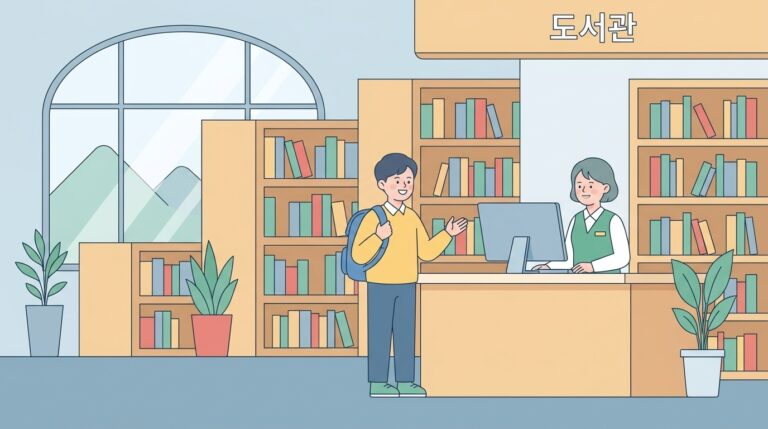
Mastering Korean Libraries: How to Request Books and Explore Korean Literature Like a Local
Phase 1: 공감 (Empathy & Story-Driven Opening)
안녕하세요! 매일한글 에디터입니다.
Picture this: You are standing inside a sunlit public library in Mapo-gu, Seoul. You’ve been captivated by the global surge in Korean literature—perhaps inspired by Han Kang’s poetic prose or Kim Young-ha’s riveting storytelling—and you decide it is finally time to read an authentic Korean novel in its original print. You walk up to the search kiosk (도서 검색대), type in the title, and hit search. But the screen flashes with terms like 대출중 (Checked out), 보존서고 (Closed Stacks), or 상호대차 (Interlibrary Loan).
Your heart races a bit. You want to ask the librarian if you can reserve the copy or put in a request for a new acquisition (희망 도서), but suddenly your mind freezes on how to phrase it politely without sounding like a robotic textbook. At the B2 intermediate level, navigating public institutions like libraries is a major milestone. You aren’t just ordering coffee anymore; you are actively engaging with community spaces and intellectual culture. Based on feedback from hundreds of our learners who felt intimidated at the library counter, this guide gives you the exact phrases, cultural nuances, and conversational confidence to handle book requests and explore Korean literature like a true local.
Phase 2: Core Expressions Deep Dive (핵심 표현 3선)
1. 혹시 이 책 희망 도서로 신청할 수 있을까요? (Hoksi i chaek huimang doseoro sincheonghal su isseulkkayo?)
- Pronunciation: Hok-shee ee chaek hee-mang doh-seo-ro sheen-cheong-hal soo eess-eul-kka-yo? (Sounds like hok-she + hee-mang with a soft rising tone at the end).
- Meaning: Literal: “By any chance, could I apply for this book as a desired book?” | Practical: “Is it possible to submit a purchase request for this book?”
- K-Culture Moment: Seen frequently in slice-of-life K-dramas where university students or neighborhood residents consult community librarians for rare literary works.
- Editor’s Insight: The cushion word 혹시 (by any chance) combined with the indirect ending -ㄹ 수 있을까요? softens the request significantly, showing respect for the librarian’s administrative workload.
- Situation Spectrum: Casual: 🚫 | Semi-formal: ⚠️ | Formal/Polite: ✅
- 🤔 Think About It: Notice how Korean uses soft conditional phrasing when asking public servants for a service, prioritizing harmony over direct transaction.
2. 대출 중인 도서 예약 신청을 걸어두고 싶어요. (Daechul jung-in doseo yeyak sincheong-eul georeodugo sipeoyo.)
- Pronunciation: Dae-chul joong-in doh-seo yeh-yak sheen-cheong-eul geo-reo-doo-go sheep-eo-yo. (Blend jung-in smoothly into doseo).
- Meaning: Literal: “I want to hang a reservation application on the book currently on loan.” | Practical: “I’d like to place a hold/reservation on this checked-out book.”
- K-Culture Moment: When bestsellers like Kim Ji-young, Born 1982 or award-winning poetry collections have a waiting list of 10+ people at local libraries.
- Editor’s Insight: The verb 걸어두다 (literally ‘to hang and keep’) is a vivid colocation used for holds, alerts, and reservations in daily modern Korean.
- Situation Spectrum: Casual: ⚠️ | Semi-formal: ✅ | Formal: ✅
- 🤔 Think About It: Why do you think Korean uses physical action metaphors like 걸다 (to hang) for digital system reservations?
3. 보존서고에 있는 자료를 열람하고 싶은데 어떻게 해야 하나요? (Bojonseogoe inneun jaryoreul yeollamhago sipeunde eotteoke haeya hanayo?)
- Pronunciation: Boh-john-seo-goh-eh ean-neun jah-ryo-reul yeol-lam-hah-goh sheep-eun-deh uh-tteo-keh hae-yah hah-nah-yo?
- Meaning: Literal: “Materials in the preservation stack I want to read, what should I do?” | Practical: “I’d like to view an item kept in the closed stacks. How do I request it?”
- K-Culture Moment: Essential when researching older Korean literary editions, historical journals, or archival poetry books not kept on regular open shelves.
- Editor’s Insight: 열람 (reading/viewing on-site) is distinct from 대출 (borrowing to take home). Closed-stack books are often view-only.
- Situation Spectrum: Casual: 🚫 | Semi-formal: ✅ | Formal: ✅
- 🤔 Think About It: Notice the polite topic-opener -ㄴ데 어떻게 해야 하나요? which politely invites instruction without sounding demanding.
Phase 3: 교과서 한국어 vs 진짜 한국어 (Textbook vs. Real Korean)
Situation 1: Asking if a book can be ordered by the library
- 📖 교과서 한국어 (Textbook): “이 책의 구매를 요청합니다.” (I request the purchase of this book.)
- 🗣️ 진짜 한국어 (Real-life Native): “혹시 이 도서관에 없는 책인데 희망도서 신청 되나요?” (Excuse me, this isn’t in the catalog—can I submit a wish-list book request?)
- 💡 왜 다를까?: Textbook formulas sound like official written directives. Real Korean speakers frame institutional requests with introductory context (없는 책인데…) and ask for procedural possibility (신청 되나요?).
Situation 2: Asking if a returned book is shelved
- 📖 교과서 한국어 (Textbook): “반납된 책이 서가에 있습니까?” (Is the returned book on the shelf?)
- 🗣️ 진짜 한국어 (Real-life Native): “방금 반납된 것 같은데 바로 빌릴 수 있을까요?” (It looks like it was just returned; could I check it out right away?)
- 💡 왜 다를까?: Rather than asking an abstract location question, native speakers explain their situational observation to help the librarian check the return cart instantly.
Phase 4: K-Culture 딥다이브 & 비언어적 매너 (Deep Dive & Etiquette)
4-1. 눈치 (Nunchi) & Library Etiquette
- Subdued Tone: In Korean public libraries, the checkout counter is often right next to general study spaces. Keep your voice in a soft, resonant whisper (속삭임).
- Two-Hand Delivery: Always hand over your physical membership card (도서 대출증) or smartphone barcode with both hands (양손) while maintaining a slight bow.
- Respecting Silent Zones: Notice the distinction between 열람실 (silent study room without typing) and 노트북존 (laptop area). Never type on mechanical keyboards outside designated laptop zones.
4-2. Cultural Code: The K-Literature Boom & District Libraries
Korea’s municipal libraries (구립 도서관) have evolved from quiet cramming spots into vibrant cultural centers featuring curated exhibitions of Korean modern literature, author meet-and-greets (북토크), and independent publishing corners. Participating in book clubs or requesting literature books integrates you directly into the neighborhood’s cultural life.
Phase 5: 실전 롤플레이 시나리오 (Roleplay Scenario)
Setting: Mapo District Public Library, Circulation Desk. Warm lighting, quiet background rustling of pages.
Characters: Alex (B2 Korean Learner) and Min-woo (Friendly Librarian).
- Alex: 안녕하세요, 사서 선생님. 도서 검색을 해봤는데 책이 대출 중이라서요. (Annyeonghaseyo, saseo seonsaengnim. Doseo geomsaeg-eul haebwanneunde chaegi daechul jung-iraseoyo.)
🎭 Hands phone screen showing the book info with both hands. - Min-woo: 아, 한강 작가님의 소설이네요! 네, 지금 관외 대출 중입니다. (A, Han Gang jakganim-ui soseorineyyo! Ne, jigeum gwan-oe daechul jung-imnida.)
🎭 Checks monitor screen and nods warmly. - Alex: 혹시 이 책 예약 신청을 걸어둘 수 있을까요? (Hoksi i chaek yeyak sincheong-eul georeodul su isseulkkayo?)
- Min-woo: 네, 가능합니다. 대출증 바코드 한번 스캔해 주시겠어요? (Ne, ganeunghamnida. Daechuljeung bakodeu hambeon seukaenhae jusigesseoyo?)
- Alex: 여기 있습니다. 그런데 다른 번역본 도서도 희망도서로 신청 가능한가요? (Yeogi itseumnida. Geureonde dareun beon-yeokbon doseodo huimangdoseoro sincheong ganeunghangayo?)
- Min-woo: 물론이죠! 홈페이지나 데스크에서 신청서를 작성해 주시면 검토 후 구입합니다. (Mullonijyo! Hompeijina deseukeueseo sincheongseoreul jakseonghae jusimyeon geomto hu gu-iphamnida.)
- Alex: 안내 감사합니다. 도착하면 문자 알림이 오나요? (Annae gamsahamnida. Dochakhamyeon munja allim-i onayo?)
- Min-woo: 네, 등록하신 연락처로 카카오톡 알림톡을 발송해 드려요. (Ne, deungnokhansin yeollakcheoro Kakaotalk allimtokeul balsonghae deuryeoyo.)
🔀 Interactive Branching Moment
You want to read an archived literary review journal stored in the basement archives right now. What do you say?
* Option A: “저기요, 지하 서고 책 지금 당장 꺼내주세요.” (Hey, bring out the basement book right now.)
* Option B: “보존서고 도서 열람 신청서를 작성하면 오늘 바로 볼 수 있을까요?” (If I fill out the closed-stack viewing form, would I be able to see it today?)
* Option C: “보존서고에 책이 왜 있어요?” (Why is the book in the closed stacks?)
Feedback:
* Option A (Bad): Extremely rude, commanding tone with incorrect honorifics.
* Option B (Best!): Professional, understands the library’s protocol, and asks politely using intermediate connectors.
* Option C (Risk): Sounds confrontational and questions basic library storage rules.
Phase 6: 10초 감정 섀도잉 드릴 (Shadowing Drill)
Repeat these lines aloud with the indicated pause (/) and emotional tone:
[😊 차분하고 정중하게 - Calm & Polite]
“저기요, / 혹시 이 책 / 예약 신청 걸어둘 수 있을까요?”
(Jeogiyo, / hoksi i chaek / yeyak sincheong georeodul su isseulkkayo?)-
[🤔 궁금증을 담아 - Curious & Inquiring]
“이 책은 / 보존서고에 있다고 나오는데, / 열람 신청 어떻게 하나요?”
(I chaeg-eun / bojonseogoe itdago naoneunde, / yeollam sincheong eotteoke hanayo?) -
[🙏 감사하며 밝게 - Grateful & Bright]
“도착하면 / 알림톡으로 연락 부탁드립니다. / 감사합니다!”
(Dochakhamyeon / allimtokeuro yeollak butakdeurimnida. / Gamsahamnida!)
Phase 7: K-Culture 미니 사전 (Mini Dictionary)
- 희망도서 (Huimang-doseo): Desired / Requested Book. A community service in Korean public libraries where patrons can officially request that the library purchase a specific title using its municipal budget.
- 상호대차 (Sangho-daecha): Interlibrary Loan. An ultra-convenient network system in Korea allowing you to borrow books from another library across town and pick them up at your nearest neighborhood branch or subway locker.
- 무인반납함 (Muin-bannap-ham): Automated Book Drop. 24/7 smart return chutes found outside libraries and inside major Korean subway stations for returning books without counter staff.
- 열람실 (Yeollam-sil): General Reading Room. Quiet study areas specifically set aside for focused reading and exam preparation, distinct from open shelf areas (자료실).
Phase 8: 여행자와 거주자를 위한 생존 키트 (Survival Kit)
TOP 3 Survival Phrases
- 대출 연장 되나요? (Daechul yeonjang doenayo?) — Can I extend my loan period? (Pro Tip: Most libraries allow a 7-day one-time online extension if nobody reserved it).
- 책 소독기 어디에 있어요? (Chaek sodokgi eodie isseoyo?) — Where is the UV book sterilizer? (Korea’s public libraries have automated book sanitation machines at the entrance).
- 회원증 재발급 받아야 해요. (Hoewonjeung jaebalgeup badaya haeyo.) — I need to get my library card reissued.
Editor’s Travel & Living Note
If you reside in Seoul, make sure to access the Seoul Metropolitan Library Official Portal to set up your mobile digital library pass. Many districts also offer Smart Libraries (스마트도서관) inside subway transit hubs where you can collect requested books on your evening commute!
Phase 9: “한 발 더 깊이” (Cultural Reflection)
Korean public libraries reflect the society’s deep-rooted reverence for collective education and communal courtesy. Unlike casual Western community libraries where coffee consumption and lively group discussions are often integrated into main halls, Korean libraries maintain distinct spatial boundaries between strict academic focus (열람실) and leisure reading (자료실). Participating in this system means embracing the collective nunchi of quiet consideration.
💬 Your Turn: Which Korean author or literary work are you hoping to check out on your next library visit? Share your dream reading list in the comments below!
Phase 10: FAQ & 흔한 실수 (FAQ & Common Mistakes)
Q: Can foreigners get a public library card in Korea?
A: Yes! Foreign residents holding an Alien Registration Card (ARC / 외국인등록증) or Domestic Residence Certificate can register for a free borrowing card at any municipal district library.
Q: How many books can I request through the 희망도서 program each month?
A: Most municipal libraries allow 2 to 5 wish-list book requests per person per month, provided the books aren’t overly specialized textbooks or luxury art volumes.
Q: What happens if a requested book arrives at the library?
A: You will receive an automated KakaoTalk message (알림톡) or SMS. The library will hold the book exclusively for you at the front desk for 3 to 5 business days.
🚨 Common Mistakes Alert
| Mistake | Why It’s Problematic | Correct Action |
|---|---|---|
| Saying “책 사주세요” (Buy me a book) | Sounds like a personal financial demand | Use “희망 도서 신청할게요” (I’ll request a wish-list book) |
| Confusing 대출 (Borrow) with 열람 (Read on-site) | Staff may think you aren’t checking it out | Specify 관외 대출 (take home) or 관내 열람 (in-library read) |
| Speaking at full volume in 자료실 | Disrupts other patrons | Use lowered whisper tones (속삭임) at the desk |
Phase 11: 액션 미션 (Action Missions)
- 🥉 Bronze Mission: Practice saying the 3 core expressions in the mirror using proper two-handed gestures and whisper pitch.
- 🥈 Silver Mission: Visit a local Korean library website or app and locate the 희망도서 신청 (Wish-list book request) tab.
- 🥇 Gold Mission: Go to a public library counter in Korea, present your member barcode, and successfully place a hold on a checked-out novel in Korean!
- 🎮 K-Culture Mission: Watch an episode of a Korean drama featuring a library scene (like When the Weather Is Fine or Romance Is a Bonus Book) and spot the polite honorific endings used with staff.
Phase 12: 인터랙티브 퀴즈 챌린지 (Quiz Challenge)
1. Situation Challenge: You find a rare poetry collection in the search system, but the location says “보존서고 (Closed Stacks)”. What is the most appropriate action?
* (A) Walk into the private basement archive yourself.
* (B) Ask the librarian: “보존서고 자료 열람 신청서 작성할 수 있나요?”
* (C) Give up and leave.
2. Fill in the Blank:
“대출 중인 도서에 대해 (_______) 신청을 걸어두고 싶어요.”
* (A) 반납 (Return)
* (B) 예약 (Reservation/Hold)
* (C) 결제 (Payment)
3. True or False: In Korea, you can return borrowed library books through automated return drop boxes (무인반납함) even after library hours.
* (A) True
* (B) False
🔍 Click here to reveal the answers & explanations!
- Answer: (B) Closed stacks are restricted to library personnel. You must submit a viewing request at the counter.
- Answer: (B) 예약 — 예약 신청을 걸어두다 is the natural collocation for putting a book on hold.
- Answer: (A) True — Automated chutes (무인반납함) operate 24/7 at library gates and major subway stations.







