

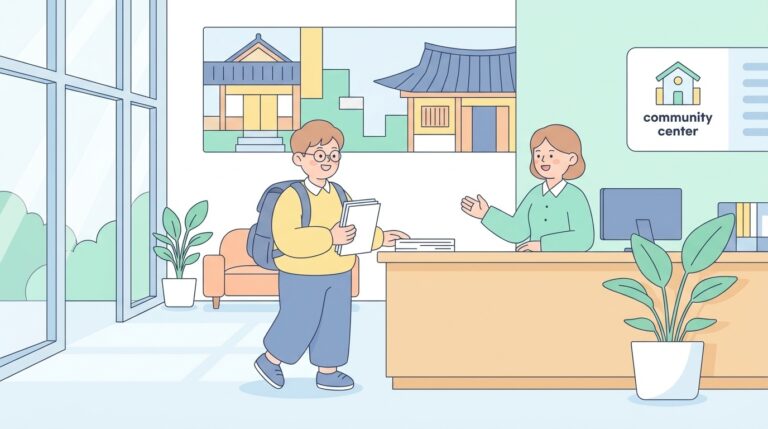
Phase 1: 공감 (Moving In & The Registration Quest)
안녕하세요! 매일한글 에디터입니다.
You just signed your dream rental lease in Seoul, carried heavy boxes up narrow stairs, and finally unpacked your K-pop posters. But before you relax with a celebratory bowl of jjajangmyeon, there is one crucial mission left: registering your move at the local community center (주민센터 / 행정복지센터).
In Korean dramas like Because This Is My First Life or My Liberation Notes, characters casually walk in and out of local government centers clutching brown document envelopes. But for foreign residents, stepping into a busy government office where fast-speaking clerks manage ticking queues can be nerve-wracking. Miss the 14-day legal deadline, and you risk a fine—or worse, your valuable lease deposit (보증금) won’t be fully protected by Korean tenant laws.
Don’t worry! Based on the real experiences of our expat learners, this guide gives you the exact phrases, manners, and steps to complete your address change smoothly in under 10 minutes.
Phase 2: 핵심 표현 3선 심층 분석 (Top 3 Core Expressions)
1. 전입신고 하러 왔어요. (한글)
- Pronunciation: [Jeon-ip-sin-go ha-reo wass-eo-yo] (Sound analogy: Jun-ip-shin-go ha-raw wah-so-yo — pronounce shin-go like “shin” guard + “go”)
- Meaning: “I am here to file a moving-in report.”
- K-Culture Moment: In realistic K-Dramas, whenever someone leaves their hometown to start a fresh life in Seoul, their very first stop after the real estate agency is the community center to say this exact sentence.
- Editor’s Insight: 전입 (Jeon-ip) means “moving in” and 신고 (Sin-go) means “report / notification”. Adding ~하러 왔어요 (~ha-reo wass-eo-yo) (“I came to do…”) is the universal magic key for explaining your purpose at any Korean reception counter.
- Situation Spectrum: Casual ⚠️ | Semi-formal ✅ | Formal ✅
- 🤔 Think About It: In many Western countries, address changes are handled entirely online or via postal services. Why does Korean society emphasize registering locally in person within 14 days?
2. 확정일자도 같이 받을 수 있나요? (한글)
- Pronunciation: [Hwak-jeong-il-ja-do ga-chi ba-deul su in-na-yo?] (Sound analogy: Hwahk-jung-eel-jah-doh gah-chee bah-deul soo een-nah-yo)
- Meaning: “Can I also get the fixed date stamp together with this?”
- K-Culture Moment: Korean webtoons about independent living always show the main character gripping their lease contract tightly, praying their 확정일자 (Hwak-jeong-il-ja) is stamped so their hard-earned Jeonse or Wolse deposit is 100% legally shielded.
- Editor’s Insight: 확정일자 (Fixed Date) is an official legal date stamp placed on your lease contract that grants your deposit priority status against potential landlord bankruptcy. Asking for it alongside your moving-in report is standard practice.
- Situation Spectrum: Casual 🚫 | Semi-formal ✅ | Formal ✅
- 🤔 Think About It: How does your home country safeguard housing deposits, and why does Korea link this protection directly to the municipal date stamp?
3. 신분증하고 계약서 여기 있어요. (한글)
- Pronunciation: [Sin-bun-jeung-ha-go gye-yak-seo yeo-gi iss-eo-yo.] (Sound analogy: Shin-boon-jeung-hah-goh gyeh-yahk-saw yaw-ghee ees-saw-yo)
- Meaning: “Here are my ID and contract.”
- K-Culture Moment: Handing over documents with both hands while slightly bowing is a classic Korean etiquette scene you will spot across administrative and workplace dramas.
- Editor’s Insight: 신분증 refers to your identification card (for foreigners, your Alien Registration Card / Residence Card). ~하고 (~ha-go) means “and”, making this an easy way to present multiple required documents at once.
- Situation Spectrum: Casual ⚠️ | Semi-formal ✅ | Formal ✅
- 🤔 Think About It: Notice how Korean speakers specify the items before saying 여기 있어요 (Here it is). Does your language name the objects first or start with “Here you go”?
Phase 3: 교과서 한국어 vs 진짜 한국어 (Textbook vs. Real Korean)
Situation 1: Stating your visit’s purpose at the counter
- 📖 교과서 한국어: 전입신고서를 제출하고자 방문하였습니다. (I have visited to submit the moving-in registration form.)
- 🗣️ 진짜 한국어: 전입신고 하러 왔어요. (I’m here to report moving in.)
- 💡 왜 다를까?: Written administrative Korean uses stiff literary endings like ~하고자 방문하였습니다. In real life, polite spoken ending ~러 왔어요 sounds much warmer and natural.
Situation 2: Submitting your paperwork
- 📖 교과서 한국어: 저의 외국인등록증과 임대차계약서를 드리겠습니다. (I shall give you my alien registration card and lease agreement.)
- 🗣️ 진짜 한국어: 신분증이랑 계약서 여기 있어요. (Here is my ID and contract.)
- 💡 왜 다를까?: Instead of lengthy legal terms like 임대차계약서 (lease agreement), locals use concise conversational words like 계약서 (contract) and conversational particle (이)랑 or 하고.
Phase 4: K-Culture 딥다이브 & 비언어적 매너
4-1. 눈치 (Nunchi) & Administrative Etiquette
- Grab a Number First (번호표): As soon as you enter a 주민센터 (Community Service Center), do not walk straight to the counter. Look for the ticket kiosk (순번발행기), tap 전입신고 / 민원 (Moving-in / General Civil Petitions), take your number slip, and sit down until your number dings.
- The Two-Hand Rule: When handing your Alien Registration Card and lease contract to the officer, always use both hands (or touch your right forearm with your left hand). It immediately demonstrates respect and sets a friendly, cooperative tone.
4-2. Culture Code: The Korean Community Center Ecosystem
In Korea, your neighborhood 주민센터 (Jumin Center) or 행정복지센터 (Haengjeong Bokji Center) is not just a dull bureaucratic bureau. It is the community heart—often hosting affordable fitness programs, cultural workshops, and even temporary umbrellas to borrow on rainy days. Making a good first impression here anchors your legal identity in your new Korean neighborhood!
Phase 5: 실전 롤플레이 시나리오 (Interactive Roleplay)
Setting: Yeonhui-dong Community Service Center on a crisp Tuesday morning. You hear electronic chimes calling queue numbers. Officer Park sits behind counter #3.
- Chime sound: 띵동! (35번 손님, 3번 창구로 오세요.) (Ding-dong! Customer #35, please come to counter 3.)
- Officer Park: 안녕하세요! 어떤 일로 오셨어요? (Hello! How can I help you today?)
- You: 안녕하세요. 전입신고 하러 왔어요. (Hello. I am here to report moving in.) 🎭 Handing over your number slip with a gentle nod
- Officer Park: 네, 신분증이랑 부동산 계약서 보여주시겠어요? (Sure, could you show me your ID and real estate contract?)
- You: 네, 신분증하고 계약서 여기 있어요. (Yes, here are my ID and contract.) 🎭 Handing documents over with both hands
- Officer Park: 확정일자도 필요하신가요? (Do you also need a fixed date stamp?)
- You: 네, 확정일자도 같이 받을 수 있나요? (Yes, can I receive the fixed date stamp together?)
- Officer Park: 네, 수수료 600원입니다. 여기에 서명해 주세요. (Yes, the processing fee is 600 KRW. Please sign here.)
- You: 감사합니다! 수고하세요. (Thank you! Have a good day.) 🎭 Bowing slightly as you collect stamped documents
🔀 인터랙티브 분기점 (Interactive Decision Point)
When Officer Park asks: “신분증이랑 계약서 원본 가져오셨어요?” (Did you bring the original ID and original contract?), how do you reply?
- Option A: “네, 여기 원본 다 있어요.” (Yes, here are all the originals.)
- 👉 Feedback [BEST]: Perfect! Civil service centers require the physical original contract to place the red ink 확정일자 stamp.
- Option B: “아니요, 사진으로 핸드폰에 있어요.” (No, I have photos on my phone.)
- 👉 Feedback [RISK]: Risky! While some clerks may ask you to email or fax the PDF, many centers strictly require physical hard copies. You might have to print it at a nearby convenience store.
- Option C: “나중에 줄게요.” (I’ll give it to you later.)
- 👉 Feedback [BAD]: Inappropriate! The officer cannot process address registration without verifying documents on the spot, and casual speech (반말) sounds impolite to public officials.
Phase 6: 10초 감정 섀도잉 드릴 (10-Second Emotion Shadowing Drill)
Practice reading these out loud with rhythm pauses (/) and genuine emotion:
[😊 정중하고 명확하게 / Polite & Clear]
“안녕하세요! / 전입신고 / 하러 왔어요.”
(Annyeonghaseyo! / Jeon-ip-sin-go / ha-reo wass-eo-yo.)-
[🤔 확인하듯 차분하게 / Inquiring & Calm]
“혹시 / 확정일자도 / 같이 받을 수 있나요?”
(Hok-si / hwak-jeong-il-ja-do / ga-chi ba-deul su in-na-yo?) -
[🤝 공손하고 감사하게 / Respectful & Grateful]
“네, / 신분증하고 / 계약서 / 여기 있어요!”
(Ne, / sin-bun-jeung-ha-go / gye-yak-seo / yeo-gi iss-eo-yo!)
Phase 7: K-Culture 미니 사전 (Core Keywords)
- 전입신고 (Jeon-ip-sin-go) | Moving-in Notification
- Essential legal registration that officially changes your address in the national register. Must be completed within 14 days of moving.
- 주민센터 (Ju-min-ssen-teo) | Community Service Center
- The municipal local office handling personal civil documents, address changes, recycling bags, and community support.
- 확정일자 (Hwak-jeong-il-ja) | Fixed Date Stamp
- An official legal confirmation proving the date of your tenancy agreement to protect your deposit under Korean Housing Lease Protection Act.
- 신분증 (Sin-bun-jeung) | Identification Card
- For international residents, this refers directly to your Alien Registration Card / Residence Card (외국인등록증).
Phase 8: 여행자를 위한 생존 키트 (Survival Kit & Living Notes)
Top 3 Survival Phrases
- 번호표 어디서 뽑아요? (Beon-ho-pyo eo-di-seo ppo-ba-yo?)
- Pro Tip: Use this if the ticketing kiosk is confusing or tucked behind a pillar.
- 여기 서명하면 되나요? (Yeo-gi seo-myeong-ha-myeon doe-na-yo?)
- Pro Tip: Use when the officer points to an electronic signature pad or document line.
- 처리 다 끝난 건가요? (Cheo-ri da kkeun-nan geon-ga-yo?)
- Pro Tip: Handy when you want to make sure everything is completely processed before leaving.
Editor’s Living Note
- Find your designated neighborhood office quickly through the Naver Map App Navigation. Note that you must visit the specific branch holding jurisdiction over your exact residential block, not just any random center in the city.
- Keep cash or a local transport/debit card ready for small administrative stamps (typically 600–1,000 KRW).
Phase 9: “한 발 더 깊이” (Cultural Insights)
In Korea, the address registration system is woven deeply into communal security and civic order. Because high-density apartment and studio living is standard, up-to-date registry ensures emergency dispatch accuracy, neighborhood voting allocations, and rental market transparency. Registering your new nest isn’t just bureaucratic paperwork—it is an official gesture welcoming you into the local community network.
💬 Your Turn: What is the most memorable or surprising administrative experience you have had in Korea or your home country? Share your stories in the comments below!
Phase 10: FAQ & 오해 방지 (FAQ & Common Mistakes)
Q: Can I register my move at any Community Center in Seoul?
A: No. You must visit the specific 주민센터 (행정복지센터) that governs your exact new administrative district (동). Check your lease contract address carefully on map apps before heading out.
Q: What is the deadline for filing 전입신고 (Jeon-ip-sin-go)?
A: By Korean law, you must submit your moving-in report within 14 days from the moving date stated on your lease agreement. Late filing can lead to civil fines.
Q: Can international students and workers also get 확정일자 (Hwak-jeong-il-ja)?
A: Yes! Foreign nationals registered in Korea have full rights to receive 확정일자 to secure legal priority protection over their rental deposit.
🚨 흔한 실수 (Common Mistakes Warning)
- Mistake 1: Bringing only a digital photo of your lease contract on your smartphone.
- Correct Action: Always bring the original paper lease contract signed by the realtor and landlord.
- Mistake 2: Forgetting physical ID (외국인등록증 or Passport + Visa copy).
- Correct Action: Place your physical Residence Card in your document folder before walking out.
- Mistake 3: Skipping 확정일자 (Fixed Date) to save 600 KRW.
- Correct Action: Always request 확정일자 alongside 전입신고 to secure your housing deposit.
Phase 11: 액션 미션 & 참여 유도 (Action Missions)
- 🥉 Bronze Mission: Read the 3 key sentences out loud in front of a mirror 3 times using the emotion shadowing rhythm.
- 🥈 Silver Mission: Open your notes app and write down:
전입신고 하러 왔어요 + 확정일자도 같이 받을 수 있나요?in pure Hangul without looking. - 🥇 Gold Mission: When visiting your local office, greet the receptionist with “안녕하세요! 전입신고 하러 왔어요” and hand your ID using both hands.
- 🎮 K-Culture Mission: Watch an episode of a slice-of-life K-drama and spot when a character handles real estate documents or visits a public service center.
Phase 12: 인터랙티브 퀴즈 챌린지 (Interactive Quiz)
1. Situational Judgment
You are standing in front of the community center officer. You want to submit your Alien Registration Card and lease agreement politely. What should you say?
* (A) 야, 이거 받아라.
* (B) 신분증하고 계약서 여기 있어요.
* (C) 서류는 집에 있어요.
🔍 Click for Answer & Explanation
Correct Answer: (B)
Explanation: (B) 신분증하고 계약서 여기 있어요 is polite and accurate. (A) uses rude informal speech, and (C) means “The documents are at home” which will prevent registration!
2. Fill-in-the-Blank
Complete the sentence to request a moving-in report:
* “안녕하세요, __________ 하러 왔어요.”
* Hint: Meaning “moving-in notification”.
🔍 Click for Answer & Explanation
Correct Answer: 전입신고 (Jeon-ip-sin-go)
Explanation: 전입신고 means moving-in registration. The full sentence becomes “안녕하세요, 전입신고 하러 왔어요.”
3. True / False Cultural Fact
Question: In Korea, you can visit any community center in any district to file your 전입신고.
* [True / False]
🔍 Click for Answer & Explanation
Correct Answer: False
Explanation: You must report to the designated community center (주민센터 / 행정복지센터) managing your specific residential address.






