

Phase 1: Empathy (Immersive Story Opening)
안녕하세요! 매일한글 (Daily Hangul) Editor here.
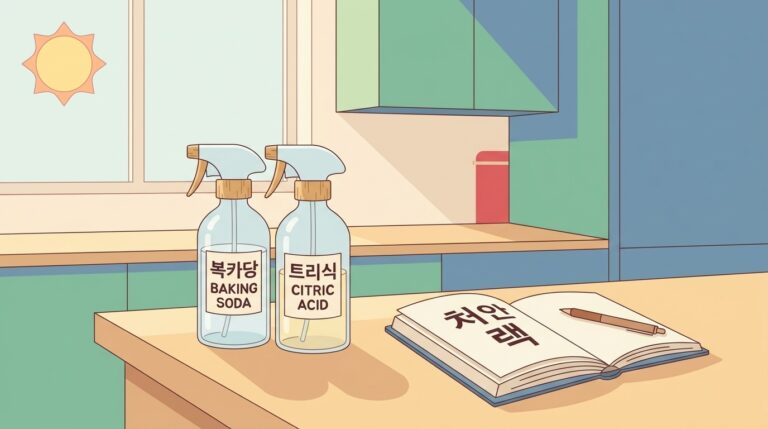
Imagine this familiar scene from your favorite slice-of-life K-Drama: an exhausted protagonist finally moves into a sunny Seoul studio apartment (officetel), only to discover that the previous tenant left stubborn water spots around the sink and accumulated grease behind the induction stove. In Korea, reaching for harsh, suffocating bleach isn’t always the top choice anymore. Instead, Korean lifestyle masters (sal-lim 9-dan, 살림 9단) instinctively reach for natural powerhouses: 베이킹 소다 (Baking Soda) and 구연산 (Citric Acid).
For advanced learners at the C2 level, simply knowing the word ‘to clean’ (청소하다) is nowhere near enough. When living in Korea, interacting with meticulous landlords, or chatting with eco-conscious Korean roommates, discussing cleaning techniques requires sophisticated descriptive verbs, nuanced sensory adjectives, and household life hacks (살림 꿀팁). Our seasoned expat learners often report that once they mastered how to discuss eco-friendly home remedies, their conversations with Korean neighbors shifted from basic small talk to genuine, deep cultural bonding. Let’s elevate your Korean domestic fluency to near-native mastery!
Phase 2: 3 Core Expressions in Depth
1. 찌든 때를 말끔히 불려내다 (Jjideun ttaereul malkkeumhi bullyeonaeda)
- Pronunciation: [Jji-deun ttae-reul mal-kkeum-hi bul-lyeo-nae-da] (Think of jji like a sharp ‘cheese’ without the ‘se’, ttae like the Italian ‘tempo’, and bul-lyeo echoing ‘bull-yuh’).
- Meaning: Literal: To soak and detach ingrained grime cleanly. / Nuance: To effortlessly loosen tough, aged grease or dirt through chemical/physical soaking.
- K-Culture Moment: Seen on variety shows like I Live Alone (나 혼자 산다) when a meticulous celebrity chef demonstrates how sprinkling baking soda on a burnt frying pan lifts grease without scratching.
- Editor’s Insight: 찌들다 implies dirt or stress that has soaked deep over time. Using 불려내다 demonstrates advanced domestic knowledge—softening debris with moisture/powder rather than scrubbing aggressively.
- Situation Spectrum: Casual ✅ | Semi-formal ✅ | Formal ✅
- 🤔 Think About It: In English, we often say ‘scrub out grease,’ emphasizing muscle effort. Why does Korean emphasize 불리다 (softening/expanding with water), reflecting patience and working with natural chemistry?
2. 구연산수를 뿌려서 물때를 싹 잡다 (Guyeonsansureul ppuryeoseo multtaereul ssak japda)
- Pronunciation: [Gu-yeon-san-su-reul ppu-ryeo-seo mul-ttae-reul ssak jap-da] (Sounds like goo-yeon-sahn-soo, while ssak has the crisp snap of a scissors cut ‘ssahk’).
- Meaning: Literal: To spray citric acid water and grab water stains cleanly. / Nuance: To completely eliminate alkaline limescale and mineral deposits in one sweep.
- K-Culture Moment: Featured in Korean interior and home organization YouTube vlogs where bathroom mirrors and electric kettles are restored to showroom shine using diluted citric acid.
- Editor’s Insight: The verb 잡다 (to catch/grab) is idiomatically used in Korean household management to mean neutralizing or conquering a stubborn issue (e.g., 냄새를 잡다, 물때를 잡다).
- Situation Spectrum: Casual ✅ | Semi-formal ✅ | Formal ✅
- 🤔 Think About It: Notice how the sensory adverb 싹 adds an instant sense of thorough, satisfying completion to the action.
3. 화학 세제 없이도 뽀송뽀송하게 마무리되다 (Hwahak seje eopsido bbosong-bbosonghage mamurideoida)
- Pronunciation: [Hwa-hak se-je eop-si-do bbo-song-bbo-song-ha-ge ma-mu-ri-doe-da] (Pronounce bbo-song with a bubbly, lightweight plosive pop).
- Meaning: Literal: To be finished softly/crisp without chemical detergents. / Nuance: Achieving a fresh, completely dry, residue-free cleanliness.
- K-Culture Moment: Typical line spoken on Korean morning lifestyle programs when showcasing zero-waste laundry hacks using baking soda and vinegar.
- Editor’s Insight: 뽀송뽀송하다 is a cherished mimetic word (의태어) describing textiles or surfaces that feel delightfully dry, airy, and fluffy, like sun-dried cotton.
- Situation Spectrum: Casual ✅ | Semi-formal ✅ | Formal ⚠️ (Preferred in spoken reports/conversations over stiff administrative texts)
- 🤔 Think About It: How does Korean use onomatopoeia/mimetic words to convey tactile cleanliness that English often explains through lengthy descriptions?
Phase 3: Textbook Korean vs. Real Korean
Situation 1: Cleaning burnt grease on the stove
- 📖 Textbook Korean: 친환경 세제로 가스레인지의 기름때를 제거해 보세요. (Chinhwan-gyeong sejero gaseureinjieui gireumttaereul jegeohae boseyo. – Please remove grease stains from the gas stove with eco-friendly detergent.)
- 🗣️ 진짜 한국어: 베이킹 소다 반죽 발라두고 10분만 불리면 기름때가 때처럼 솔솔 밀려 나와요. (Beking soda banjuk balladugo sipbunman bullyeomyeon gireumttaega ttaecheoreom solsol millyeo nawayo. – Just apply baking soda paste, let it soak for 10 minutes, and the grease sloughs right off!)
- 💡 Why the Difference? C2 native speakers describe the physical mechanism (반죽 발라두다, 솔솔 밀려 나오다) rather than formal clinical terms like 제거하다.
Situation 2: Deodorizing and descaling the electric kettle
- 📖 Textbook Korean: 전기포트에 구연산을 넣고 끓여서 소독하십시오. (Jeongipoteue guyeonsaneul neoko kkeullyeoseo sodokhasippsio. – Boil citric acid in the electric pot to disinfect it.)
- 🗣️ 진짜 한국어: 포트에 구연산 한 숟갈 넣고 한소끔 끓여내면 쿰쿰한 냄새랑 물때가 온데간데없이 사라져요. (Poteue guyeonsan han sutgal neoko hansokkeum kkeullyeonaemyeon kumkumhan naemsaerang multtaega onde-gande-eopsi sarajyeoyo. – Toss a spoonful of citric acid in the kettle and bring it to a rolling boil; the musty smell and limescale will vanish without a trace!)
- 💡 Why the Difference? Advanced Korean incorporates vivid time-honored cooking/cleaning expressions like 한소끔 끓이다 (bring to a single rolling boil) and sensory descriptors like 쿰쿰하다 (musty).
Phase 4: K-Culture Deep Dive & Non-Verbal Manners
4-1. 눈치 (Nunchi) & Non-Verbal Domestic Manners
When cleaning in shared Korean accommodations (like hasukjib, shared flats, or apartments with thin walls), timing and ventilation are crucial non-verbal etiquette factors:
* 환기 (Ventilation) Gesture: Always prop open the kitchen or veranda windows while cleaning. Opening a window while dusting shows your housemates that you respect shared indoor air quality.
* The Sound of Cleanliness: In Korean culture, excessive aggressive scrubbing sounds can signal frustration. Treating surfaces gently with soaking agents (불리기) indicates patience, sophistication, and domestic wisdom (살림 내공).
4-2. Cultural Code: The Zero-Waste & ‘Sal-lim’ Renaissance
In modern Korea, eco-friendly cleaning isn’t just about utility; it’s a prominent social aesthetic. Influenced by Zero Waste movements in trendy neighborhoods like Seongsu-dong and Mangwon-dong, young Koreans pride themselves on reducing synthetic chemicals. Refill stations (리필 스테이션) offering bulk baking soda, sodium percarbonate (과탄산소다), and citric acid have become cultural hubs for mindful, self-sufficient living.
Phase 5: Real-Life Roleplay Scenario
Setting: You are visiting the home essentials aisle of a large Korean supermarket (E-Mart) with your eco-conscious Korean friend, Minji (민지), who is helping you set up your new apartment.
- 민지 (Minji): 집들이 선물로 뭐 필요한 거 없어? 욕실 청소용 락스는 샀어?
(Jipdeuri seonmullo mwo piryohan geo eopseo? Yoksil cheongsoyong rakseuneun sasseo?)
“Is there anything you need as a housewarming gift? Did you buy bleach for bathroom cleaning?”
🎭 Looking around the chemical detergent shelf with concern. -
You (User): 락스는 냄새가 너무 독해서 머리가 지끈거리더라고. 천연 성분으로 해결하고 싶어.
(Rakseuneun naemsaega neomu dokhaeseo meoriga jikkeungeorideorago. Cheon-yeon seongbuneuro haegyeolhago sipeo.)
“Bleach smells so strong that it gives me a headache. I want to handle it with natural ingredients.”
🎭 Shaking head lightly, pointing towards the eco-friendly corner. -
민지 (Minji): 오, 너 살림 감각 있네! 그러면 베이킹 소다랑 구연산 조합으로 가자.
(O, neo sallim gamgak inne! Geureomyeon be-i-king so-da-rang gu-yeon-san johabeuro gaja.)
“Oh, you’ve got real homemaking intuition! Then let’s go with the baking soda and citric acid combo.”
🎭 Smiling approvingly while picking up two large kraft-paper pouches. -
You (User): 근데 주방 기름때랑 욕실 물때는 산도가 달라서 쓰는 법이 다르지 않아?
(Geunde jubang gireumttaerang yoksil multtaeneun sandoga dallaseo sseuneun beobi dareuji ana?)
“Wait, aren’t kitchen grease and bathroom limescale different pH levels, so they require different methods?”
🎭 Asking with genuine intellectual curiosity. -
민지 (Minji): 정확해! 기름때는 알칼리성인 베이킹 소다로 때를 불려 벗겨내고, 수전의 하얀 물때는 산성인 구연산수로 중화시켜 닦아내면 돼.
(Jeonghwak-hae! Gireumttaeneun alkaliseong-in be-i-king so-da-ro ttaereul bullyeo beotgyeonaego, sujeon-ui hayan multtaeneun sanseong-in guyeonsansuro junghwasikyeo dakkanaemyeon dwae.)
“Spot on! For grease, use alkaline baking soda to soak and peel it off; for white limescale on faucets, neutralize and wipe it with acidic citric acid water.”
🎭 Gesturing clearly with both hands to compare the two methods. -
You (User): 배수구 악취 잡을 땐 둘을 섞어서 거품을 내면 효과 만점이겠다!
(Baesugu akchwi jabeul ttaen dureul seokeoseo geopumeul naemyeon hyogwa manjeom-igetda!)
“When tackling drain odors, mixing the two to produce foaming action must work like a charm!”
🎭 Clapping hands softly in realization. -
민지 (Minji): 맞아, 탄산가스 거품이 배수관 구석구석 묵은 때를 싹 씻어내 주거든. 환기만 딱 신경 쓰면 완벽해.
(Maja, tansan-gaseu geopumi baesugwan guseok-guseok mugeun ttaereul ssak ssiseonae jugeodeun. Hwan-giman ttak sin-gyeong sseumyeon wanbyeok-hae.)
“Exactly! The carbon dioxide bubbles flush out old grime lodged in the pipe crevices. Just ensure proper ventilation, and you’re golden.”
🎭 Nodding with satisfaction. -
You (User): 당장 오늘 저녁에 가서 대청소 한판 뽀송뽀송하게 끝내야겠어.
(Dangjang oneul jeonyeoge gaseo daecheongso hanpan bbosong-bbosonghage kkeunnaeyagetseo.)
“I’m going to head home tonight and finish a thorough, crisp cleaning session right away.”
🎭 Smiling energetically.
🔀 Interactive Decision Fork
How would you conclude your conversation with Minji?
* Choice A (Best – C2 Master): “오늘 특급 살림 비법 전수해 줘서 고마워. 깨끗하게 치워놓고 근사한 저녁 대접할게!” (Thanks for passing down your secret housekeeping hacks today. I’ll clean everything up and treat you to a fabulous dinner!)
* Feedback: Exemplary! Displays deep gratitude and social reciprocity (품앗이/보답 culture).
* Choice B (Risk – Unnatural/Textbook): “친환경 청소 물질들의 화학 반응을 실험해 보게 되어 매우 기쁩니다.” (I am very glad to experiment with the chemical reactions of eco-friendly cleaning substances.)
* Feedback: Grammatically correct, but sounds like an academic laboratory report rather than natural friendly dialogue.
* Choice C (Bad – Rude Nuance): “별거 아니네. 그냥 가루 뿌리면 끝나는 거잖아.” (It’s nothing special. You just sprinkle powder and you’re done.)
* Feedback: Dismissive of Minji’s enthusiastic guidance and diminishes cultural warmth.
Phase 6: 10-Second Emotion Shadowing Drill
Practice matching both the rhythm and the emotional nuances of native Korean speakers:
[✨ Proud & Knowledgeable]
기름때는 / 억지로 문지르지 말고 / 베이킹 소다 반죽으로 / 싹 불려내야 제맛이지!
(Gireumttaeneun / eokjiro munjireuji malgo / be-i-king so-da banjugeuro / ssak bullyeonaeya jemasiji!)-
[💡 Amazed & Delighted]
구연산수 몇 번 칙칙 뿌렸을 뿐인데 / 수전이 거울처럼 반짝반짝해졌어!
(Guyeonsansu myeot beon chik-chik ppuryeosseul ppuninde / sujeoni geoulcheoreom banjjak-banjjakhayeojyeosseo!) -
[😌 Relieved & Satisfied]
독한 락스 냄새 없이도 / 집 안 전체가 / 뽀송뽀송하고 상쾌하네.
(Dokhan rakseunaemsae eopsido / jip an jeonchega / bbosong-bbosonghago sangkwaehane.)
Phase 7: K-Culture Mini Dictionary
- 만능세제 (Man-neung-se-je) | All-purpose homemade cleaner
- Meaning: A popular Korean viral cleaning formula (typically combining baking soda, dish soap, vinegar/citric acid, and water) famous among lifestyle bloggers.
- 묵은 때 (Mug-eun ttae) | Long-standing embedded grime / aged residue
- Meaning: Dust, grease, or dirt that has solidified over months or seasons; often targeted during seasonal spring cleaning (봄맞이 대청소).
- 살림 내공 (Sal-lim nae-gong) | Housekeeping mastery / domestic prowess
- Meaning: Deep, experiential wisdom in managing a spotless, well-organized home with efficiency and minimal waste.
- 환기 필수 (Hwan-gi pil-su) | Ventilation is mandatory
- Meaning: An essential safety rule in Korean households to prevent respiratory irritation whenever combining natural acids with carbonates in enclosed spaces.
Phase 8: Traveler & Expat Survival Kit
Top 3 Domestic Survival Phrases
- 친환경 청소용 가루는 몇 번 코너에 있나요?
(Chinhwan-gyeong cheongsoyong garuneun myeot beon koneoe innayo?)
Pro Tip: Use this at large marts (Homeplus, Lotte Mart) to locate the natural cleaning section instantly. - 싱크대 배수관 소독용으로 구연산 큰 통 하나 추천해 주세요.
(Singkeudae baesugwan sodok-yong-euro guyeonsan keun tong hana chucheonhae juseyo.)
Pro Tip: Hardware and neighborhood Daiso clerks will immediately guide you to high-capacity descalers. - 탄 냄비를 닦으려는데 과탄산소다랑 베이킹 소다 중에 뭐가 더 잘 들어요?
(Tan naembireul dakk-ryeoneunde gwatansansodarang be-i-king so-da junge mwoga deo jal deureoyo?)
Pro Tip: Shows advanced domestic knowledge when consulting local grocery shopkeepers.
Editor’s Travel & Expat Note
To find eco-friendly cleaning bulk stores and local Daiso branches stocking biodegradable tools, check the Naver Map Application search for “친환경 잡화점” or “리필스테이션”. If using delivery apps like Coupang or Kurly, searching for “식용 베이킹소다” (food-grade) versus “청소용 베이킹소다” (cleaning-grade) ensures you get the right particle size for your kitchenware!
Phase 9: “One Step Deeper” (Reflective Cultural Essay)
In traditional Korean thought, cleaning (청소, 淸掃) is not merely the chore of removing physical filth; it is an act of purifying the mind and inviting positive energy (복, good fortune) into the living space. This is why seasonal transitions in Korea are always accompanied by deep cleansing rituals. Choosing natural substances like baking soda and citric acid aligns with the age-old philosophy of Sangsaeng (상생, mutual harmony with nature). By eliminating harsh chemical runoff, Korean households harmonize their personal sanctuary with the broader community environment.
💬 Your Turn: How do people in your home country view natural cleaning hacks compared to store-bought chemical detergents? Share your thoughts and favorite eco-friendly cleaning words in the comments below!
Phase 10: FAQ & Misconception Prevention
Q: Can I mix baking soda and citric acid in boiling water inside a sealed spray bottle?
A: Absolutely not! The rapid reaction between alkaline sodium bicarbonate and citric acid generates high volumes of carbon dioxide gas (탄산가스). Sealing this in an airtight spray container can cause dangerous pressure buildup. Always mix them in an open container and use proper room ventilation.
Q: What is the real difference between 베이킹 소다 (Baking Soda) and 과탄산소다 (Sodium Percarbonate)?
A: While baking soda is mild and perfect for kitchen grease and light descaling, 과탄산소다 is an oxygen-based bleaching agent. It requires warm water (above 50°C) to activate and is exceptionally powerful for yellowed laundry and deep bathroom grout mold.
Q: Does citric acid replace commercial dishwashing rinse aids in Korea?
A: Yes! Many Korean zero-waste households dilute citric acid in water (about 1-2% ratio) and pour it into the dishwasher rinse compartment to prevent hard water spots on glass and stainless steel cookware.
🚨 Common Mistakes Warning Board
- Mistake: Confusing Food-grade (식품첨가물용) with Cleaning-grade (세척용).
- Correct Action: If washing fruits/vegetables or toddler items, ensure the package clearly reads 1종 세척제 or 식품용.
- Mistake: Applying citric acid to natural marble countertops (대리석).
- Correct Action: Never use acidic citric acid (산성) on natural stone or aluminum, as it can corrode and discolor the surface. Use neutral gentle dish soap instead.
- Mistake: Forgetting to rinse after using baking soda paste.
- Correct Action: Baking soda leaves a powdery white residue (하얀 가루 흔적) if not wiped down thoroughly with a damp microfiber cloth.
Phase 11: Action Missions & Community Challenge
- 🥉 Bronze Mission (Solo Practice): Look at your own kitchen sink right now. Say out loud in Korean: “구연산수로 수전의 물때를 말끔히 잡아보자!”
- 🥈 Silver Mission (Social Share): Take a photo of your natural cleaning tools or a before-and-after of your shiny faucet and post it on Instagram/Threads with the hashtag
#매일한글 #친환경살림 #베이킹소다청소. - 🥇 Gold Mission (Real-world Execution): Visit a local Korean mart, Daiso, or convenience store and ask the clerk where the natural descaling agents are located using the phrase: “베이킹 소다랑 구연산 코너가 어디에 있나요?”
- 🎮 K-Culture Mission: Watch an episode of a Korean variety show featuring home organization (such as 신박한 정리 or 나 혼자 산다) and spot at least two moments where natural cleaning hacks are demonstrated!
Phase 12: Interactive Quiz Challenge
1. Situational Judgment:
Your Korean kitchen sink drain has a stubborn, unpleasant smell (배수구 악취). Which combination represents the most authentic Korean eco-friendly cleaning hack?
* A) Pour cold milk mixed with hand sanitizer.
* B) Sprinkle baking soda followed by warm citric acid water to create foaming bubbles.
* C) Spray glass cleaner and seal the drain with plastic wrap.
👉 View Answer & Explanation
Correct Answer: B
Explanation: The chemical reaction between baking soda (alkaline) and citric acid (acidic) produces carbon dioxide foam that loosens organic grime trapped deep within drain pipes without toxic fumes.
2. Fill in the Blanks:
기름때가 심할 때는 억지로 긁지 말고 베이킹 소다를 뿌려 때를 충분히 [ ________ ] 다음에 닦아내세요.
👉 View Answer & Explanation
Correct Answer: 불린 (or 불려낸)
Explanation: The verb 불리다 (to soak and loosen/expand with moisture) is the quintessential Korean verb for pre-treating tough stains and baked-on grease.
3. True or False Cultural Quiz:
True or False: Natural marble (대리석) kitchen islands can be safely sanitized by spraying concentrated citric acid water (구연산수).
👉 View Answer & Explanation
Correct Answer: False (X)
Explanation: Citric acid is corrosive to calcium carbonate in natural marble and can ruin the glossy finish. Baking soda paste or neutral cleaners should be used instead!







