

Phase 1: Empathy & Storytelling Opening
안녕하세요! 매일한글 에디터입니다. (Hello! This is your Daily Hangul editor.)
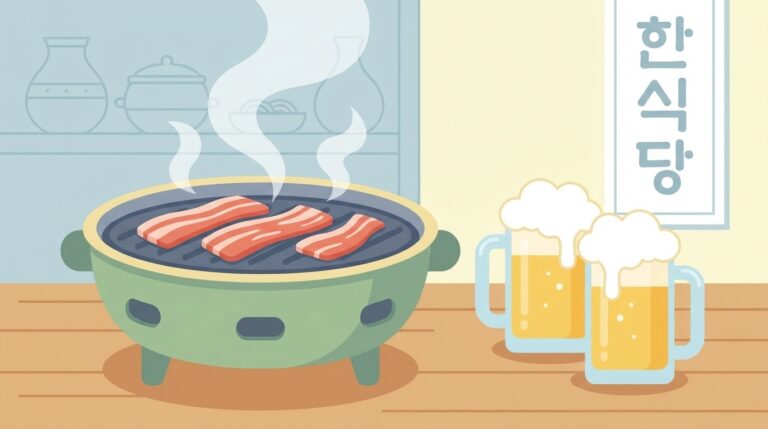
Picture this: You are sitting at a bustling pork belly restaurant in the heart of Seoul after a long workday with your Korean coworkers. Thick slices of pork belly sizzle loudly on the grill, green bottles of soju clink in harmonious toasts, and the table is packed with kimchi, garlic, and leafy wraps. Just when you think your belly is completely full and the night is winding down, your team manager suddenly stands up, smiles widely, and shouts: “자, 2차 갑시다!” (Alright, let’s head to Round 2!)
Before you know it, the entire group is marching down a neon-lit alleyway into a lively Hof (Korean-style pub) for crispy fried chicken, draft beer, and spicy dried squid. If you’ve ever felt overwhelmed by the unwritten social codes of a Korean Hoeshik (company dinner)—like knowing when to grab the grill tongs, how to receive drinks respectfully, or what to say when transitioning from pork belly to pub drinks—you are definitely not alone! This guide is packed with real field-tested tips and natural B1-level expressions to help you navigate a legendary Korean night out with pure confidence and zero awkwardness.
Phase 2: 3 Key Expressions Deep Dive
1. 삼겹살 2인분 더 주세요! (Samgyeopsal i-inbun deo juseyo!)
- Pronunciation: [Sam-gyeop-sal i-in-bun deo ju-se-yo] (Sounds like “Sahm-gyup-sahl ee-een-boon duh joo-seh-yoh”)
- Meaning: Literal: “Please give 2 more servings of pork belly!” | Real Nuance: “We are loving the food, let’s keep the BBQ party going with another order!”
- K-Culture Moment: In K-dramas like Business Proposal or Misaeng, when the team mood reaches its peak and the energetic colleague waves their hand to the server to keep the meat coming.
- Editor’s Insight: In Korea, meat at BBQ restaurants is ordered in inbun (servings per person). Saying “deo juseyo” (more, please) is smooth, polite, and essential for B1 learners.
- Situation Spectrum: Casual ✅ | Semi-formal ✅ | Formal ⚠️
- 🤔 Think About It: In many Western dining settings, each person orders their own separate entrée. How does sharing portions from a central grill reflect Korea’s communal Jeong (정) culture?
2. 2차는 어디로 가요? (I-cha-neun eodi-ro gayo?)
- Pronunciation: [I-cha-neun eo-di-ro ga-yo] (Sounds like “Ee-chah-noon uh-dee-roh gah-yoh?”)
- Meaning: Literal: “Where are we going for Round 2?” | Real Nuance: “What’s the next venue on our night out itinerary?”
- K-Culture Moment: As everyone steps out into the crisp evening air, wrapping up jackets and freshening up, someone excitedly asks this to scout the next spot—usually a Hof, pocha, or karaoke!
- Editor’s Insight: Korean gatherings operate in numbered “rounds” (1차 = 1st round / dinner, 2차 = 2nd round / pub, 3차 = 3rd round / karaoke or snacks). Asking this shows you are engaged with the flow of the night.
- Situation Spectrum: Casual ✅ | Semi-formal ✅ | Formal ⚠️
- 🤔 Think About It: Why does Korean social culture favor changing venues multiple times in one night rather than staying at one bar until closing?
3. 생맥주 500 두 잔 주세요! (Saeng-maek-ju obaek du jan juseyo!)
- Pronunciation: [Saeng-maek-ju o-baek du jan ju-se-yo] (Sounds like “Seng-mek-joo oh-beck doo jahn joo-seh-yoh!”)
- Meaning: Literal: “Please give two 500cc draft beers!” | Real Nuance: “Two standard cold draft beers for our table, please!”
- K-Culture Moment: Walking into a cozy Hof pub, sinking into booth seats, and shouting this immediately as the server places down a bowl of complementary puffed corn snacks.
- Editor’s Insight: In Korean pubs (Hof), draft beer (saengmaekju) is almost universally ordered in 500cc glasses, commonly referred to simply as “obaek” (500).
- Situation Spectrum: Casual ✅ | Semi-formal ✅ | Formal ⚠️
- 🤔 Think About It: Ordering by metric volume (500cc) is standard in Korea. How does your home culture specify beer sizes on tap?
Phase 3: Textbook Korean vs. Real-World Korean
Situation 1: Suggesting to move to the next venue
- 📖 Textbook Korean: 우리 이제 다음 장소로 이동합시다. (Uri ije daeum jangso-ro idong-hapsida. – “Let us now relocate to the subsequent location.”)
- 🗣️ Real-World Korean: 우리 2차 가요! 호프집 어때요? (Uri i-cha gayo! Hopeu-jip eottaeyo? – “Let’s go to Round 2! How about a Hof pub?”)
- 💡 Why is it different?: Korean speakers rarely use formal words like idong-hada (relocate) during casual evening outings; instead, they immediately name the round number (2차) and venue type (호프집).
Situation 2: Proposing a toast at the table
- 📖 Textbook Korean: 모두 함께 건배를 합시다. (Modu hamkke geonbae-reul hapsida. – “Let us all make a toast together.”)
- 🗣️ Real-World Korean: 다 같이 짠해요! (Da gachi jjan-haeyo! – “Let’s all clink glasses!”)
- 💡 Why is it different?: Jjan (짠) is the lively onomatopoeia for clinking glasses together. Turning it into a verb (짠하다) adds instant warmth, energy, and fun to the table.
Phase 4: K-Culture Deep Dive & Non-Verbal Manners
4-1. Nunchi & Table Gestures (The BBQ & Hof Etiquette)
- Two-Hand Pouring & Receiving: When a senior coworker pours alcohol into your glass, hold your glass with both hands (or touch your forearm/wrist with your left hand). When pouring for someone older, hold the bottle with your right hand while lightly supporting your right wrist with your left hand.
- The Head Turn: When taking a sip in front of someone senior in rank or age, gently turn your torso and head slightly away from them while covering your glass lightly with your hand.
- Grill Teamwork: Leaving one person to handle the tongs (jipge) all night makes you look self-centered. Offer to cut the meat or flip the garlic: “제가 구울게요!” (I will grill it!).
4-2. Cultural Code Analysis: The Transition from 1차 to 2차
In Korea, 1차 (Round 1) is focused on filling the stomach with substantial food (like thick Samgyeopsal grilled with garlic and kimchi) and breaking initial barriers. 2차 (Round 2), typically at a Hof (호프집) or craft beer pub, is where conversation deepens over lighter finger food—such as Chimaek (fried chicken & beer), Meoktae (shredded dried pollack with spicy mayo dipping sauce), or fruit platters. Moving locations resets the atmosphere and allows colleagues to switch seats and mingle with different people.
Phase 5: Real-World Roleplay Scenario
- Setting: A buzzing Euljiro Samgyeopsal joint, transitioning to a nostalgic Hof pub nearby. Smoke, laughter, clinking glasses.
- Characters:
- 민수 (Minsu): Your friendly Korean team manager who loves food and lively team outings.
- 유나 (Yuna): You (B1 intermediate Korean learner adjusting to local dining).
민수: 유나 씨, 삼겹살 진짜 잘 먹네요! 고기 1인분 더 시킬까요?
(Yuna-ssi, samgyeopsal jinjja jal meongneyo! Gogi il-inbun deo sikilkkayo?)
[Yuna, you eat pork belly so well! Shall we order one more serving of meat?]
🎭 Smiling warmly while flipping a golden-brown piece of pork belly on the grill.

유나: 네, 팀장님! 여기 삼겹살 너무 맛있어요. 1인분 더 시켜요!
(Ne, timjangnim! Yeogi samgyeopsal neomu masisseoyo. Il-inbun deo sikyeoyo!)
[Yes, Manager! The pork belly here is so delicious. Let's order one more serving!]
🎭 Nodding enthusiastically and holding an empty lettuce wrap leaf.

민수: 좋아요! 저기요~ 여기 삼겹살 1인분 추가해 주세요!
(Joayo! Jeogiyo~ yeogi samgyeopsal il-inbun chugahae juseyo!)
[Great! Excuse me~ please add one more serving of pork belly here!]
🎭 Raising one hand towards the bustling kitchen counter.

유나: 팀장님, 제가 고기 구울게요. 가위랑 집게 주세요!
(Timjangnim, jega gogi gu-ulgeyo. Gawi-rang jipge juseyo!)
[Manager, I will grill the meat. Please give me the scissors and tongs!]
🎭 Reaching out respectfully with two hands to take over the grilling.

민수: 하하, 고마워요. 자, 고기 다 먹었으니 이제 2차 갈까요?
(Haha, gomawoyo. Ja, gogi da meogeosseuni ije i-cha galkkayo?)
[Haha, thank you. Well, now that we've finished the meat, shall we go to Round 2?]
🎭 Wiping his hands with a wet tissue and putting his coat on.

유나: 좋아요! 2차는 어디로 가요?
(Joayo! I-cha-neun eodi-ro gayo?)
[Sounds great! Where are we going for Round 2?]
🎭 Gathering belongings and standing up from the booth table.

민수: 근처 호프집 가서 시원한 생맥주에 먹태 먹읍시다!
(Geuncheo hopeu-jip gaseo siwonhan saengmaekju-e meoktae meogeupsida!)
[Let's go to a nearby Hof pub and have cold draft beer with dried pollack!]
🎭 Pointing cheerfully toward the lively neon-lit pub across the street.

유나: 와, 시원한 생맥주 좋아요! 다 같이 짠해요!
(Wa, siwonhan saengmaekju joayo! Da gachi jjan-haeyo!)
[Wow, cold draft beer sounds wonderful! Let's all clink glasses!]
🎭 Walking into the Hof pub with a bright smile ready for round two.
🔀 Interactive Decision Point
The manager asks how you want to settle the payment at the Hof pub counter during Round 2. What do you do?
* Option A: Say “팀장님, 2차는 제가 낼게요!” (Manager, let me pay for Round 2!) and hand over your card.
* Option B: Just walk outside without saying anything, assuming the senior always pays for every single round without exception.
* Option C: Loudly calculate everyone’s individual exact drink price down to the single won at the cash register in front of everyone.
Feedback:
* Option A (Best 🏆): Superb social etiquette! While seniors often pay, showing genuine willingness to cover the lighter 2nd round (2차) earns tremendous respect and affection.
* Option B (Risk ⚠️): While often acceptable if you are the newest junior, leaving without offering a sincere verbal thank you (“잘 먹었습니다!”) comes across as unappreciative.
* Option C (Bad ❌): Breaking down exact bills down to the penny at the counter creates an awkward, stiff mood in a collective Korean dining setting.
Phase 6: 10-Second Emotional Shadowing Drill
- Drill 1:
[😋 군침 돌며 신나게 / Excited & Mouthwatering]
삼겹살 2인분 / 더 주세요! / 김치도 구워 먹어요!
(Samgyeopsal i-inbun / deo juseyo! / Kimchido guwo meogeoyo!)
“Two more servings of pork belly / please! / Let’s grill the kimchi too!” -
Drill 2:
[🍻 에너지 넘치고 밝게 / Energetic & Lively]
자, 모두 고생하셨습니다 / 다 같이 / 짠해요!
(Ja, modu gosaenghasyeotseumnida / da gachi / jjan-haeyo!)
“Alright, great job everyone / all together / let’s clink!” -
Drill 3:
[🤩 기대감 가득하게 / Eager & Anticipating]
1차 맛있게 먹었으니 / 2차는 / 호프집 가시죠!
(I-cha masitge meogeosseuni / i-cha-neun / hopeu-jip gasijyo!)
“Since Round 1 was delicious / for Round 2 / let’s head to the Hof pub!”
Phase 7: K-Culture Mini Dictionary
- 1차 / 2차 (Il-cha / I-cha): Round 1 / Round 2. Refers to the consecutive phases/venues of a Korean social night out (e.g., BBQ first, then Pub, then Karaoke).
- 치맥 (Chimaek): Chicken + Maekju (Beer). The iconic Korean food pairing of crispy fried or seasoned chicken accompanied by ice-cold draft beer.
- 먹태 (Meoktae): Crisp Dried Pollack. A staple low-calorie, savoury snack served at Korean Hof pubs, dipped in a rich mix of mayonnaise, soy sauce, and diced spicy cheongyang peppers.
- 막내 (Maknae): The youngest/most junior member. In dining contexts, the maknae traditionally distributes water glasses, sets up cutlery over napkins, and helps grill meat.
Phase 8: Survival Kit for Travelers
TOP 3 Survival Phrases
- 불판 좀 갈아주세요. (Bulpan jom gara-juseyo.)
Meaning: “Please change the grill plate.”
Pro Tip: When the pork grease and marinade burn black onto the metal grill, say this to get a fresh, clean hot plate instantly. - 생맥주 500cc 한 잔 더 주세요. (Saeng-maek-ju obaek-cc han jan deo juseyo.)
Meaning: “One more 500cc draft beer, please.”
Pro Tip: Raise your index finger slightly when making eye contact with the server at a loud Hof. - 잘 먹었습니다! (Jal meogeotseumnida!)
Meaning: “I ate very well! (Thank you for the meal!)”
Pro Tip: Always bow slightly and say this to whoever treated the table as you leave the venue.
Editor’s Travel Note
- Navigating Late Nights: If your Hoeshik lasts past midnight when subways stop running, download the Kakao T taxi booking app beforehand to call a cab directly without language barriers.
- Finding Authentic Hofs: Use the Naver Map navigation app and search keywords like “을지로 노가리 골목” (Euljiro Nogari Alley) for the ultimate open-air historic pub atmosphere in Seoul.
Phase 9: “One Step Deeper” (Cultural Reflection)
The Korean Hoeshik (회식) is often misunderstood as merely obligatory corporate drinking, but at its heart, it represents the cultural concept of Jeong (정)—communal bonding and emotional intimacy. Sitting close around a burning fire, flipping meat for one another, and sharing round after round dissolves rigid daytime office hierarchies into warm camaraderie. Understanding this dynamic turns a potentially intimidating night into an authentic cultural bridge.
💬 Your Turn: What is after-work socialization like in your home country? Do people move across multiple venues in numbered rounds like in Korea? Share your stories in the comments below!
Phase 10: FAQ & Common Mistakes
Q: What should I do if I cannot drink alcohol at a Korean Hoeshik?
A: You don’t have to force yourself to drink! Simply say politely: “죄송하지만 제가 술을 잘 못 마셔서, 음료수 마셔도 될까요?” (I am sorry, but I cannot drink alcohol well, may I drink soda/water?). Korean dining partners will gladly order cider or cola for you—the key is participating in the toast (짠) with your soda glass filled!
Q: Who pays the bill at a Korean 1차 and 2차 dinner?
A: Traditionally, the highest-ranking person or host pays for 1차 (dinner). For 2차 (pub), a mid-ranking colleague or another participant often offers to pay, or the group does a relaxed split (N-bbang / 엔빵). Direct separate checks at the counter are rarely done.
Q: Is it rude to leave before Round 2 (2차) starts?
A: It is totally acceptable if you have a valid reason (e.g., long commute, early morning schedule). Just give your polite apologies before the group leaves the first venue: “오늘 정말 즐거웠습니다! 내일 일정이 있어서 저는 1차만 하고 먼저 들어가 보겠습니다.” (I had so much fun today! Because of my schedule tomorrow, I will head home after Round 1.)
🚨 Common Mistakes Warning Board
- ❌ Mistake 1: Pouring your own alcohol glass when it is empty.
👉 Correct Action: In Korea, pour for others first when their cups are low; someone will immediately notice and pour yours in return (수작 문화 / Sujak culture). - ❌ Mistake 2: Sticking chopsticks vertically into a bowl of rice.
👉 Correct Action: Lay chopsticks flat across the side dish dish or table rack. Vertical chopsticks resemble ancestral memorial incense burners (Jesa). - ❌ Mistake 3: Cutting cooked meat right in front of someone’s face.
👉 Correct Action: Angle the scissors and tongs downward toward the grill center to prevent hot pork oil from splashing toward your dining partners.
Phase 11: Action Mission & Engagement
- 🥉 Bronze Tier: Practice shadowing Phase 6’s 3 drill sentences 5 times out loud, mimicking natural intonations.
- 🥈 Silver Tier: Leave a comment below introducing your favorite Korean dish to eat with beer using the formula: “저는 [Dish]에 생맥주 마시는 걸 좋아해요!”
- 🥇 Gold Tier: Visit a local Korean BBQ or pub this weekend, and order meat/drinks using “[Menu] [Number]인분 더 주세요!” without switching to English!
- 🎮 K-Culture Discovery Mission: Watch one episode of an office K-drama (like Misaeng or Gaus Electronics) and spot the exact moment the team moves to 2차!
Phase 12: Interactive Quiz Challenge
1. Situational Judgment: Your team manager pours soju into your glass at the Samgyeopsal dinner. What is the most culturally respectful action?
(A) Grab the glass with one hand and drink while staring straight into their eyes.
(B) Hold the glass with both hands, slightly turn your head away while sipping, and say thank you.
(C) Reject the glass with an aggressive hand wave.
2. Fill-in-the-Blank: Complete the phrase to order 2 draft beers at a Hof pub:
“여기 생맥주 500 ______ 주세요!”
(A) 두 개 (du gae) | (B) 두 잔 (du jan) | (C) 두 명 (du myeong)
3. True or False: In Korean social dining culture, 치맥 (Chimaek) refers to the combination of grilled pork belly and soju.
(True / False)
👉 Click here to reveal the answers and explanations!
- Answer: (B) — Holding your glass with both hands and turning your head slightly away shows proper deference and Korean table manners toward senior peers.
- Answer: (B) 두 잔 (du jan) — Drinks served in glasses and cups use the counter unit 잔 (jan). 개 is for general items, and 명 is for counting people.
- Answer: False — Chimaek (치맥) is Chicken (치킨) + Beer (맥주). The combination of Pork Belly (삼겹살) and Soju (소주) is nicknamed Samso (삼소)!







