

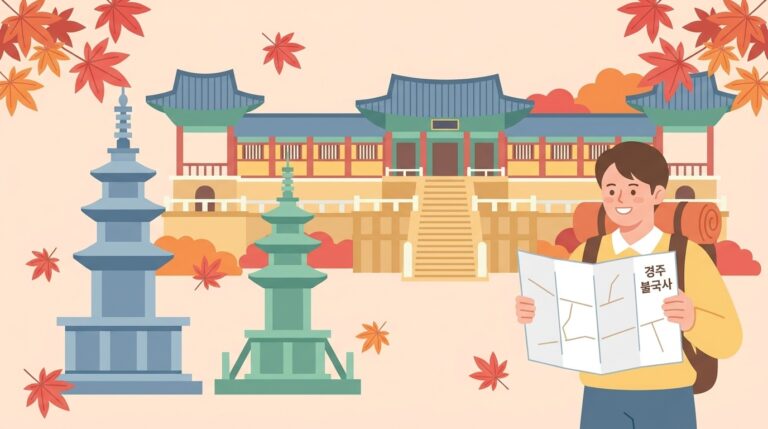
Phase 1: 공감 (Story Opening)
안녕하세요! It’s your Daily Hangul editor and local travel buddy here! Have you ever dreamed of stepping out of the futuristic neon glow of Seoul and traveling straight back in time to an ancient kingdom? If so, Gyeongju (경주)—often called the “museum without walls”—is undoubtedly at the top of your Korean bucket list.
Imagine this: You take the KTX down to Gyeongju, eager to marvel at the architectural genius of Bulguksa Temple (불국사) and the serene, mystical smile of the Buddha in Seokguram Grotto (석굴암). But as soon as you step off the bus at the foot of Tohamsan Mountain, reality sets in. The temple grounds are vast, the transit between Bulguksa and Seokguram is tricky, signs with profound Buddhist vocabulary feel intimidating, and you’re not sure if taking a quick selfie in front of the sacred shrine is considered disrespectful.
Don’t panic! Over the years, countless international learners have told us they felt hesitant to speak at sacred historical sites out of fear of making a cultural faux pas. Today, we’re unpacking natural, polite, and B1-level conversational tools to help you navigate Gyeongju’s UNESCO World Heritage sites with confidence, respect, and local flair.
Phase 2: 핵심 표현 3선 심층 분석 (3 Core Expressions)
1. 불국사 가는 버스 어디서 타요? (Bulguksa ganeun beoseu eodiseo tCurrent?)
- Pronunciation: Bul-guk-sa ga-neun beo-seu eo-di-seo ta-yo? (Sounds like: Bool-gook-sah gah-noon bus uh-dee-saw tah-yo?)
- Meaning: Literal: “Where do I ride the bus going to Bulguksa?” | Nuance: “Where can I catch the bus to Bulguksa?”
- K-Culture Moment: You’ll hear this constantly at Gyeongju Station or the Express Bus Terminal as travelers ask locals for the famous No. 10 or No. 11 circular buses.
- Editor’s Insight: Using the modifier
-는(e.g., 가는 버스 – the bus that goes to…) instantly elevates your Korean from beginner to intermediate smooth flow.- Situation Spectrum: Casual ⚠️ | Semi-formal (Polite -해요) ✅ | Formal (-습니다) ✅
- 🤔 Think About It: In English, we ask “Which bus goes to X?” while in Korean, it’s very natural to specify the location first as the destination (불국사 가는 버스).
2. 문화재 해설 투어 신청할 수 있나요? (Munhwajae haeseol tueo sincheonghal su innayo?)
- Pronunciation: Mun-hwa-jae hae-seol tu-eo sin-cheong-hal su in-na-yo? (Sounds like: Moon-hwah-jeh heh-sawl tour shin-chuhng-hahl soo een-nah-yo?)
- Meaning: Literal: “Is it possible to apply for the cultural heritage commentary tour?” | Nuance: “Can I join the guided cultural heritage tour?”
- K-Culture Moment: Historical sites in Korea provide free/cheap expert guides called 문화관광해설사 (Culture & Tourism Commentators). Asking this at the info booth unlocks stories you’d never find in generic guidebooks!
- Editor’s Insight:
-ㄹ 수 있나요?is the gold standard for polite, gentle requests in intermediate Korean.- Situation Spectrum: Casual 🚫 | Semi-formal ✅ | Formal ✅
- 🤔 Think About It: Why does Korean use 신청하다 (apply/register) rather than simply 참여하다 (join)? It reflects an organized administrative culture where guided slots are managed orderly.
3. 안쪽은 사진 촬영 금지인가요? (Anjjogeun sajin chwaryeong geumji-ingayo?)
- Pronunciation: An-jjo-geun sa-jin chwa-ryeong geum-ji-in-ga-yo? (Sounds like: Ahn-jjo-goon sah-jeen chwah-ryuhng goom-jee-een-gah-yo?)
- Meaning: Literal: “Is inside photo shooting prohibited?” | Nuance: “Is photography prohibited inside?”
- K-Culture Moment: Inside Seokguram Grotto where the main stone Buddha stands, photography is strictly forbidden to preserve the relic and maintain reverence. Asking beforehand shows supreme respect (눈치 / manners).
- Editor’s Insight: Using Sino-Korean nouns like 사진 촬영 (photography/filming) and 금지 (prohibition) sounds much more refined than just saying 사진 안 돼요?.
- Situation Spectrum: Casual ⚠️ | Semi-formal ✅ | Formal ✅
- 🤔 Think About It: Koreans value asking permission cautiously before pulling out a camera in solemn or spiritual spaces.
Phase 3: 교과서 한국어 vs 진짜 한국어 (Textbook vs. Real-World Korean)
Situation 1: Asking how long it takes to get up to Seokguram
- 📖 교과서 한국어: 석굴암까지 몇 분이 소요됩니까? (Seokguram-kkaji myeot buni so-yo-doem-ni-kka?)
- 🗣️ 진짜 한국어: 석굴암까지 가려면 얼마나 걸려요? (Seokguram-kkaji ga-ryeo-myeon eol-ma-na geol-lyeo-yo?)
- 💡 왜 다를까?: The textbook uses overly formal Sino-Korean administrative terms (소요되다), while real travelers naturally use the conditional pattern
-려면(if one intends to go) and the conversational verb 걸리다 (to take time).
Situation 2: Asking if you can purchase entrance tickets
- 📖 교과서 한국어: 입장권을 구매하고자 합니다. (Ip-jang-gwon-eul gu-mae-ha-go-ja ham-ni-da.)
- 🗣️ 진짜 한국어: 성인 두 명 표 주세요. (Seong-in du myeong pyo ju-se-yo.)
- 💡 왜 다를까?: Although 입장권 (admission ticket) is written on signs, native speakers simply say 표 (ticket) and specify the party size (성인 두 명 – two adults) when ordering at the ticket counter.
Phase 4: K-Culture 딥다이브 & 비언어적 매너 (Cultural Deep-Dive & Etiquette)
4-1. 눈치(Nunchi) & Buddhist Temple Manners in Gyeongju
When visiting Bulguksa and Seokguram, physical etiquette speaks as loudly as your Korean:
* Threshold Etiquette (문턱 밟지 않기): When entering temple halls (like Daeungjeon), never step on the wooden door sill (문턱). Always step completely over it. Stepping on it is traditionally believed to bring bad fortune and damages the historic woodwork.
* Hapjang Gesture (합장): When passing a Buddhist monk (스님) or bowing slightly towards the shrine, place your palms together in front of your chest and bow your head gently. This gesture conveys deep mutual respect.
* Tone Down Your Voice: In cave shrines like Seokguram, maintain a whisper. Flash photography or loud gasps disrupt worshippers performing prostrations (배).
4-2. Cultural Code: The Thousand-Year Capital (천년고도 신라)
Gyeongju was the capital of the Silla Kingdom for 992 years. Unlike Seoul’s Joseon-era palaces which feature sharp, colorful royal geometry, Gyeongju’s aesthetic is defined by earthen tumuli (대릉원 고분군), weathered granite pagodas (다보탑과 석가탑), and nature harmony. In K-Dramas like Hwarang (화랑) or historical travel shows, Gyeongju represents the romanticized soul of ancient Korean artistry.
Phase 5: 실전 롤플레이 시나리오 (Interactive Real-Life Roleplay)
Setting: Bulguksa Tourist Information Desk on a breezy autumn morning in Gyeongju.
Characters: You (Traveler) & Min-ji (Friendly Gyeongju Heritage Guide).
- You: 안녕하세요! 불국사 해설 투어 언제 시작해요?
(Annyeonghaseyo! Bulguksa haeseol tueo eonje sijakhaeyo?)
(English: Hello! When does the Bulguksa commentary tour start?)
🎭 [Politely leaning slightly over the counter with an attentive smile] -
Min-ji: 네, 안녕하세요! 정규 해설은 오전 10시랑 오후 1시 30분에 있어요.
(Ne, annyeonghaseyo! Jeong-gyu haeseor-eun ojeon yeol-sirang ohu han-si samsip-bune isseoyo.)
(English: Hi! Regular guided tours are at 10:00 AM and 1:30 PM.)
🎭 [Checking the schedule sheet and pointing to the timetable] -
You: 아, 그렇군요. 지금 바로 신청할 수 있나요?
(A, geureokunyo. Jigeum baro sincheonghal su innayo?)
(English: Ah, I see. Can I sign up for it right now?)
🎭 [Pulling out a pen and showing enthusiasm] -
Min-ji: 그럼요! 성함만 여기에 적어주시면 됩니다. 무료예요.
(Geureomyo! Seonghamman yeogie jeogeo-jusimyeon doemnida. Muryo-yeyo.)
(English: Of course! Just write your name here. It’s free of charge.)
🎭 [Handing over a visitor clipboard with a welcoming gesture] -
You: 감사합니다! 그리고 불국사 보고 석굴암 가려면 어떻게 가요?
(Gamsahamnida! Geurigo Bulguksa bogo Seokguram garyeomyeon eotteoke gayo?)
(English: Thank you! And if I want to go to Seokguram after Bulguksa, how do I get there?)
🎭 [Looking towards the mountain trail map on the wall] -
Min-ji: 매표소 앞 정류장에서 12번 셔틀버스를 타시거나, 등산로로 걸어가실 수 있어요.
(Maepyoso ap jeongnyujang-eseo sip-i-beon syeoteul-beoseureul tasigeona, deungsanro-ro georeogasil su isseoyo.)
(English: You can take shuttle bus No. 12 in front of the ticket office, or hike up the trail.)
🎭 [Handing a small transit leaflet] -
You: 버스로는 얼마나 걸려요?
(Beoseu-roneun eolmana geollyeoyo?)
(English: How long does it take by bus?)
🎭 [Checking your wrist watch] -
Min-ji: 구불구불한 산길이라 한 15분에서 20분 정도 걸려요.
(Gubul-gubulhan san-gir-ira han sip-o-bun-eseo i-sip-bun jeongdo geollyeoyo.)
(English: It’s a winding mountain road, so it takes about 15 to 20 minutes.)
🎭 [Making a gentle winding hand motion]
🔀 인터랙티브 분기점 (Interactive Choice!)
Now you want to ask Min-ji about taking photos inside Seokguram Grotto. How do you ask?
- Option A: “석굴암 안에서 사진 막 찍어도 돼요?” (Seokguram an-eseo sajin mak jjigeodo dwaeyo?)
- Option B: “석굴암 본존불 사진 촬영 가능한가요?” (Seokguram bonjonbul sajin chwaryeong ganeunghangayo?)
- Option C: “사진 찍지 마세요!” (Sajin jjikji maseyo!)
Feedback:
* Option A (Risk): “막 찍다” implies taking photos carelessly or randomly. While understood, it sounds slightly crude for a sacred cultural sanctuary.
* Option B (Best! 🏆): Flawless, respectful, and sophisticated B1 Korean. The guide will be impressed by your etiquette vocabulary (사진 촬영 가능).
* Option C (Bad ❌): This means “Don’t take photos!” which commands the guide not to take photos instead of asking for permission!
Phase 6: 10초 감정 섀도잉 드릴 (Emotion Shadowing Drill)
Practice these lines with the emotional cues and rhythmic pauses indicated by /:
[😊 설레고 호기심 가득하게 / Excited & Inquiring]
“불국사 가는 버스 / 어디서 타요?”
(Bul-guk-sa ga-neun beo-seu / eo-di-seo ta-yo?)-
[🙏 정중하고 조심스럽게 / Respectful & Polite]
“석굴암 안쪽은 / 사진 촬영 금지인가요?”
(Seok-gu-ram an-jjo-geun / sa-jin chwa-ryeong geum-ji-in-ga-yo?) -
[🎒 활기찬 여행자 톤으로 / Energetic Traveler Tone]
“여기서 석굴암까지 / 걸어가면 / 얼마나 걸려요?”
(Yeo-gi-seo Seok-gu-ram-kka-ji / geo-reo-ga-myeon / eol-ma-na geol-lyeo-yo?)
Phase 7: K-Culture 미니 사전 (Mini Dictionary)
- 천년고도 (Cheon-nyeon-go-do) | The Ancient Capital of a Thousand Years
Refers exclusively to Gyeongju. You’ll see this poetic phrase on train banners, travel documentaries, and souvenir postcards. - 문화재 (Mun-hwa-jae) | Cultural Property / Heritage Relic
A term used daily in Korea when discussing historic structures, pagodas, statues, and traditional treasures. - 합장 (Hap-jang) | Clasping Hands (Buddhist Salutation)
The respectful non-verbal gesture of bringing both palms flat against each other before monks or sacred Buddha statues. - 석탑 (Seok-tap) | Stone Pagoda
Refers to iconic stone towers like Bulguksa’s Dabotap (다보탑) and Seokgatap (석가탑), renowned for their 8th-century masonry.
Phase 8: 여행자를 위한 생존 키트 (Traveler’s Survival Kit)
TOP 3 Survival Phrases in Gyeongju:
- 해설 몇 시에 있어요? (Haeseol myeot sie isseoyo? – What time is the tour commentary?)
- 12번 버스 여기서 타나요? (Sip-i-beon beoseu yeogiseo tanayo? – Do I take Bus No. 12 here?)
- 스탬프 투어 용지 있어요? (Seutaempeu tueo yongji isseoyo? – Do you have the Stamp Tour leaflet?)
🗺️ Editor’s Travel Notes:
- Gyeongju Bus Transit: The No. 10 and No. 11 buses operate in opposite loops connecting Gyeongju Station/Terminal, Bomun Lake Resort, and Bulguksa. Download and verify transit schedules via 네이버 지도 앱 다운로드.
- Bulguksa to Seokguram Transit: Don’t walk along the vehicular road! Take the dedicated shuttle bus No. 12 (departs every hour) from Bulguksa parking lot, or hike the lovely 2.2km forest trail (takes approx. 45-50 min).
- Admission: Good news! As of 2023, entrance fees to major temples including Bulguksa and Seokguram are free nationwide for standard entry!
Phase 9: “한 발 더 깊이” (Cultural Insights & Critical Thinking)
In Western classical architecture, monumental structures like cathedrals or Roman arenas were built to impose grandeur over nature. In contrast, the Silla architects designed Bulguksa and Seokguram to blend organically into the ridges of Tohamsan Mountain. The stone terraces (Cheongungyo and Baegungyo bridges) symbolize the transition from the mundane earthly world into Buddha’s paradise.
When Koreans visit Gyeongju, they don’t simply visit a tourist spot; they experience 휴식과 성찰 (relaxation and self-reflection). The respectful vocabulary and quiet etiquette you use there reflect this ancient philosophy of living in harmony with nature and history.
💬 Your Turn: Have you ever visited a spiritual heritage site in your country or in Korea? What is the most memorable etiquette rule you observed? Share your thoughts below!
Phase 10: FAQ & 오해 방지 (FAQ & Common Mistakes)
Q: Can I take photos inside Seokguram Grotto if I turn off the camera flash?
A: No, photography of any kind (including flash-free smartphone photos) is strictly prohibited inside the glass viewing pavilion of Seokguram to protect the fragile granite surface from light and micro-vibrations, and to honor the sacred space.
Q: Do I need to book the Bulguksa cultural tour in advance?
A: For individual travelers and small groups, you don’t need advance booking. Just approach the Cultural Commentary Booth (해설사의 집) near the entrance 5–10 minutes before the scheduled time and write your name.
Q: Are there vegetarian or temple food options near Bulguksa?
A: Yes! The village right beneath Bulguksa is packed with Ssambap (쌈밥 – rice wraps) and traditional Korean mountain vegetable set meals (산채비빔밥), which are great options for vegetarians.
🚨 Common Mistakes Warning Board:
- Calling Seokguram a cave temple casually: Seokguram is not a natural cave; it is an artificially assembled dome of hundreds of granite blocks—an engineering marvel! Referring to it as an architectural grotto (석굴 사원) captures its true essence.
- Stepping on the temple threshold (문턱): Always step over it; stepping directly onto the threshold wooden frame is frowned upon by elderly locals and monks.
- Using plain informal speech (반말) with temple guides: Even if you are friendly, always end your questions with
-요or-ㅂ니다when asking temple staff or commentators.
Phase 11: 액션 미션 & 참여 유도 (Action Missions)
- 🥉 Bronze Mission (Solo Practice): Read Phase 6’s Shadowing sentences out loud 3 times with the exact emotional intonation markers.
- 🥈 Silver Mission (Social Sharing): Post a photo of Gyeongju or your favorite Korean historic site on Instagram/X using the sentence: “다음에 경주 가면 불국사랑 석굴암 꼭 갈 거예요!”.
- 🥇 Gold Mission (Real-Life Action): On your next trip to Korea, head to the Gyeongju Heritage Booth and ask the guide in person: “문화재 해설 투어 신청할 수 있나요?”.
- 🎮 K-Culture Mission: Watch an episode of a Korean travel variety show (like 2 Days & 1 Night or Alssulsinjap) featuring Gyeongju and spot Bulguksa’s Dabotap!
Phase 12: 인터랙티브 퀴즈 챌린지 (Interactive Quiz Challenge)
Q1. Situation Judgment
You arrive at the bus stop in front of Gyeongju Intercity Bus Terminal. Which sentence should you say to confirm if the bus goes to Bulguksa?
* A) 불국사 가고 싶어요 빨리 가요.
* B) 불국사 가는 버스 어디서 타요?
* C) 불국사 버스 언제 옵니까 몰라요.
Q2. Fill-in-the-Blank
“석굴암 안쪽은 사진 촬영 ________인가요?” (Is indoor photo shooting prohibited?)
* A) 시작 (sijak)
* B) 무료 (muryo)
* C) 금지 (geumji)
Q3. True / False Cultural Etiquette
- When entering Buddhist temples in Gyeongju, you should step directly on the wooden threshold (문턱) to show that you have arrived inside firmly. (True / False)
👉 Click here to reveal Answers & Explanations!
- Q1 Answer: B (불국사 가는 버스 어디서 타요? is natural, polite, and clearly conveys your destination).
- Q2 Answer: C (금지 means prohibited/forbidden. So 사진 촬영 금지 means photography prohibited).
- Q3 Answer: False (Never step on the wooden door threshold! Always step cleanly over it as a sign of respect and architectural preservation).







