

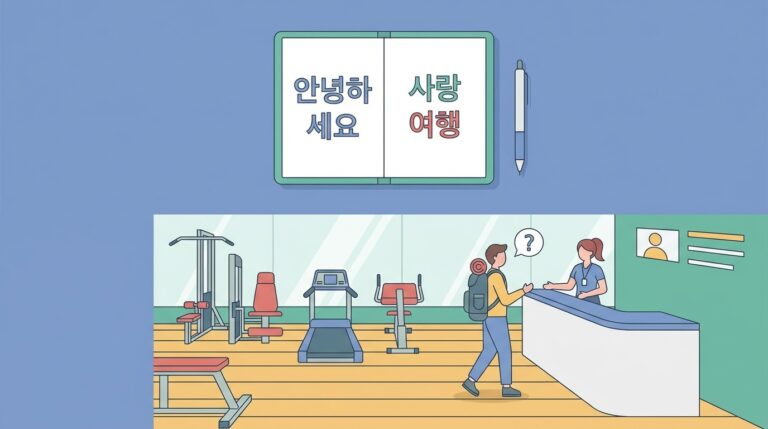
안녕하세요! 매일한글 에디터입니다.
Have you ever walked past a brightly lit Korean fitness center—often buzzing with vibrant K-Pop beats—and wanted to get a quick workout in, but felt paralyzed right at the front desk? Picture this: You’re visiting Seoul, feeling full of delicious K-BBQ and Tteokbokki, and you spot a gym (헬스장, hel-seu-jang). You step inside, only to see racks of identical grey T-shirts, automated touch screens, and a smiling staff member asking you something in lightning-fast Korean.
Panic sets in. Do I need a membership? Where do I put my shoes? How do I ask for a one-day pass?
Take a deep breath! Many of our beginner students tell us that entering a Korean gym feels like stepping onto the set of a K-Drama fitness montage—exciting, yet intimidating without the right survival phrases. In this guide, tailored specifically for A1 beginners, we will equip you with the essential, natural phrases and cultural etiquette to conquer any Korean gym with complete confidence.
Phase 2: Core 3 Expressions for the Gym
1. 일일권 있어요? (Il-il-gwon isseoyo?)
- Pronunciation: Il-il-gwon is-seo-yo? (Sounds like: Eel-eel-gwon ee-suh-yo?)
- Meaning: “Do you have a day pass?” (Literal: One-day ticket exist?)
- K-Culture Moment: Think of travel vloggers dropping by a trendy fitness center in Hongdae or Gangnam for a quick workout session.
- Editor’s Insight: Most Korean gyms focus on 3-to-12-month memberships, but almost all modern gyms offer a 1-day pass (일일권, il-il-gwon). Asking this right at the counter immediately clarifies your intention without complicated grammar.
- Situation Spectrum:
- Casual (Friends): 🚫 일일권 있어? (Too blunt for gym staff)
- Semi-formal (Polite Standard): ✅ 일일권 있어요?
- Formal (Official): ⚠️ 일일 이용권이 있습니까? (A bit stiff for a casual gym)
- 🤔 Think About It: Notice how Korean creates compound words using Sino-Korean roots: Il (Day 1) + Il (Day) + Gwon (Ticket/Pass). How does your language form terms for short-term passes?
2. 이거 어떻게 써요? (Igeo eotteoke sseoyo?)
- Pronunciation: I-geo eo-tteo-ke sseo-yo? (Sounds like: Ee-guh uh-tuh-kay suh-yo?)
- Meaning: “How do I use this?” (Literal: This how use?)
- K-Culture Moment: When a gym member encounters a futuristic Korean weight machine or smart locker system and politely asks a friendly trainer for help.
- Editor’s Insight: Igeo (this) + eotteoke (how) + sseoyo (use). You can simply point at any machine, locker, or water dispenser while saying this phrase!
- Situation Spectrum:
- Casual: 🚫 이거 어떻게 써?
- Semi-formal (Polite Standard): ✅ 이거 어떻게 써요?
- Formal: ⚠️ 이것을 어떻게 사용합니까?
- 🤔 Think About It: In Korean, context carries the subject, so you don’t even need to say “Can you teach me how to use this?” Just saying “How to use this?” politely is 100% natural.
3. 수건 어디에 있어요? (Su-geon eodi-e isseoyo?)
- Pronunciation: Su-geon eo-di-e is-seo-yo? (Sounds like: Soo-guhn uh-dee-ay ee-suh-yo?)
- Meaning: “Where are the towels?”
- K-Culture Moment: Korean gyms almost always provide clean, stacked cotton towels for free near the entrance or locker rooms.
- Editor’s Insight: Su-geon means towel. Swap this single noun with anything else (e.g., Mul for water, Hwajangsil for restroom) and you can find anything in Korea!
- Situation Spectrum:
- Casual: 🚫 수건 어디 있어?
- Semi-formal (Polite Standard): ✅ 수건 어디에 있어요?
- Formal: ⚠️ 수건이 어디에 위치해 있습니까?
- 🤔 Think About It: Why do you think Korean gyms provide free communal gym clothes and towels? It reflects Korea’s seamless “pali-pali” (fast & convenient) after-work culture.
Phase 3: Textbook Korean vs. Real Korean
Situation 1: Asking for a 1-day pass at the counter
- 📖 Textbook Korean: 저는 1일 이용권을 구매하고 싶습니다. (Jeoneun il-il iyong-gwoneul gumaehago sipsumnida. – “I wish to purchase a one-day usage voucher.”)
- 🗣️ Real Korean: 일일권 되나요? (Il-il-gwon doenayo? – “Is a day pass available / can I do a day pass?”)
- 💡 Why is it different? Real Koreans prefer the light auxiliary verb doeda (to work / to be possible) over stiff textbook verbs like gumaehada (to purchase).
Situation 2: Checking if someone is using a machine
- 📖 Textbook Korean: 이 기구를 현재 사용하고 계십니까? (I gigureul hyeonjae sayonghago gyesimnikka? – “Are you currently utilizing this apparatus?”)
- 🗣️ Real Korean: 혹시 쓰고 계세요? (Hoksi sseugo gyeseyo? – “Excuse me, are you using this?”)
- 💡 Why is it different? The soft opener Hoksi (“by any chance / excuse me”) instantly makes your question polite and non-confrontational.
Phase 4: K-Culture Deep Dive & Non-Verbal Manners
4-1. Nunchi & Gym Gestures
- Indoor Shoes Rule: Never wear outdoor sneakers on the gym floor! You must bring a dedicated pair of clean indoor workout shoes (실내 운동화, silnae undonghwa). Look for shoe racks or changing zones near the front desk.
- The Shared Machine Head Nod: If you want to use a machine between someone’s rest sets, make eye contact, offer a slight 15-degree head bow, and ask: “같이 써도 될까요?” (Gachi sseodo doelkkayo? – Can we share?).
4-2. The “O-Un-Wan” Culture
If you browse Korean social media, you will constantly see the hashtag #오운완 (O-un-wan), short for 오늘 운동 완료 (Oneul Undong Wanryo = Workout Completed Today!). Gym mirror selfies showcasing workout outfits are a huge lifestyle trend among Korean 20s and 30s. Don’t forget to snap a mirror selfie and tag it after your workout!
Phase 5: Real-World Roleplay Scenario
Setting: You walk into Power Gym near Gangnam Station. The upbeat music is playing, and Min-ho, a friendly trainer at the front desk, smiles at you.
- Trainer Min-ho: 안녕하세요! 어떻게 오셨어요?
(Annyeonghaseyo! Eotteoke osyeosseoyo?)
🎭 Smiling behind the front desk with a welcoming posture.
“Hello! How can I help you today?” -
You: 안녕하세요! 일일권 있어요?
(Annyeonghaseyo! Il-il-gwon isseoyo?)
🎭 Politely making eye contact with a gentle smile.
“Hello! Do you have a day pass?” -
Trainer Min-ho: 네, 일일권 만 오천 원이에요. 실내 운동화 있으세요?
(Ne, il-il-gwon man o-cheon-won-ieyo. Silnae undonghwa isseuseyo?)
🎭 Pointing to the price screen and looking at your shoes.
“Yes, the day pass is 15,000 KRW. Do you have indoor workout shoes?” -
You: 네, 가방에 있어요.
(Ne, gabang-e isseoyo.)
🎭 Patting your gym bag reassuringly.
“Yes, they are in my bag.” -
Trainer Min-ho: 좋아요. 결제 도와드릴게요. 카드 주세요.
(Joh-ayo. Gyeolje dowadeurilgeyo. Kadeu juseyo.)
🎭 Tapping the card reader terminal.
“Great. I’ll help with payment. Card, please.” -
You: 여기요. 운동복이랑 수건 써도 돼요?
(Yeogiyo. Undongbok-irang sugeon sseodo dwaeyo?)
🎭 Handing over your card with two hands.
“Here you go. May I use the gym clothes and towels?” -
Trainer Min-ho: 네! 저쪽 선반에서 편하게 가져가시면 돼요.
(Ne! Jeojjok seonban-eseo pyeonhage gajyeogasimyeon dwaeyo.)
🎭 Gesturing toward the neatly stacked clothes shelf.
“Yes! You can freely take them from that shelf over there.” -
You: 감사합니다! 열심히 운동할게요.
(Gamsahamnida! Yeolsimhi undonghalgeyo.)
🎭 Giving a light polite bow before heading to the locker room.
“Thank you! I’ll work out hard.”
🔀 Interactive Choice Point
You finish changing and want to ask where the locker room key goes:
* Option A: “열쇠 어디에 둬요?” (Yeolsoe eodie dwoyo?)
* Option B: “야, 사물함 열어줘.” (Ya, samulham yeoreojwo.)
* Option C: “락커 키 그냥 가져가요?” (Rak-keo ki geunyang gajyeogayo?)
- Option A Feedback [Best]: Natural, polite, and perfectly clear!
- Option B Feedback [Bad]: Very rude casual speech (Banmal), do not use with staff.
- Option C Feedback [Risk]: Understandable, but might cause confusion if electronic bands are used.
Phase 6: 10-Second Emotion Shadowing Drill
Read these out loud, observing pauses (/) and emotional cues:
[😊 Bright & Inquiring]안녕하세요! / 일일권 있어요? (Annyeonghaseyo! / Il-il-gwon isseoyo?)[🤔 Polite & Curious]저기요, / 이거 어떻게 써요? (Jeogiyo, / Igeo eotteoke sseoyo?)[💪 Energetic & Proud]오늘 운동 / 끝났어요! (Oneul undong / kkeutnasseoyo!)
Phase 7: K-Culture Mini Dictionary
- 헬스장 (Hel-seu-jang) | Fitness Center / Gym | Derived from “Health” + Jang (place). In Korea, gyms are almost exclusively called Hel-seu-jang.
- 헬스복 (Hel-seu-bok) / 운동복 (Un-dong-bok) | Gym Uniform | Complimentary tops and shorts provided by Korean fitness centers.
- 오운완 (O-un-wan) | Workout of the Day Done | Popular slang acronym used for gym check-in social media posts.
- PT (Pi-ti) | Personal Training | Commonly used acronym in Korea to refer to 1-on-1 fitness coaching.
Phase 8: Survival Kit for Travelers
Top 3 Gym Survival Phrases
- 결제해 주세요. (Gyeolje-hae juseyo.) – “Please charge my card / check me out.” (Pro Tip: Hold your card with both hands as a polite sign of respect.)
- 정수기 어디 있어요? (Jeongsu-gi eodi isseoyo?) – “Where is the water purifier?”
- 샤워실 있어요? (Syawo-sil isseoyo?) – “Is there a shower room?”
Editor’s Travel Note
Before heading to a gym in Seoul, search for nearby spots using 네이버 지도 앱 다운로드. Simply type in 헬스장 to check opening hours and whether they offer 1-day passes (일일권). Remember that Korean gyms require payment via credit card or T-Money at reception—cash is rarely accepted.
Phase 9: A Step Deeper (Think & Reflect)
In many Western gyms, members bring their own towels, wear their street shoes directly inside, and change at home. In contrast, Korean gyms offer a seamless communal infrastructure with free uniforms, disinfected shower facilities, and strict indoor shoe rules. This highlights the Korean cultural emphasis on shared hygiene, order, and consideration for the next user (배려, baeryeo).
💬 Your Turn: Does your home country offer communal gym uniforms, or is everything strictly bring-your-own? Let us know in the comments below!
Phase 10: FAQ & Common Mistakes
Q: Can foreigners sign up for a single day pass without a Korean phone number?
A: Yes! Most gyms will gladly issue a one-day pass with just your credit card or passport name.
Q: Do I have to wear the gym-provided clothes (헬스복)?
A: No, wearing the provided uniform is optional. You can wear your own athletic wear, as long as you have clean indoor shoes.
Q: Is it okay to leave my shoes in the open shoe rack?
A: Yes, Korean fitness centers are generally very secure, but keep your valuables inside the locker with your assigned key or passcode.
🚨 Common Mistakes Warning Board
- Mistake: Stepping onto the gym floor in street sneakers.
👉 Correct Action: Change into dedicated indoor shoes right in the locker room. - Mistake: Forgetting to return used towels to the laundry basket (수건 수거함).
👉 Correct Action: Drop towels into the designated bin on your way out. - Mistake: Leaving heavy weight plates loaded on bars.
👉 Correct Action: Always unload your barbells and dumbbells for the next person.
Phase 11: Action Missions
- 🥉 Bronze Mission (Solo): Stand in front of a mirror and practice saying: “일일권 있어요?” 5 times with confidence.
- 🥈 Silver Mission (Social): Post your workout picture with the Korean hashtag #오운완 on Instagram.
- 🥇 Gold Mission (Real Life): Visit a local Korean gym or simulate a roleplay asking for towel locations in Korean!
- 🎮 K-Culture Mission: Watch an episode of a fitness-themed Korean variety show (like Physical: 100 or Gym Jong Kook) and listen for the words 헬스장 and 운동.
Phase 12: Interactive Quiz Challenge
1. Situational Quiz
You enter a Korean gym and want to know how much a single workout session costs. Which phrase is best?
– (A) 수건 어디 있어요?
– (B) 일일권 얼마예요?
– (C) 운동 끝났어요.
2. Fill-in-the-Blank Quiz
Excuse me, where are the towels?
“저기요, ________ 어디에 있어요?”
– (A) 수건 (Su-geon)
– (B) 신발 (Sin-bal)
– (C) 사탕 (Sa-tang)
3. True / False Culture Quiz
True or False: In Korean gyms, it is completely acceptable to wear muddy outdoor sneakers as long as you wipe them on the floor mat.
👉 Click here to reveal Answers & Explanations
- Answer: (B) 일일권 얼마예요? (Il-il-gwon eolmayeyo? – How much is a day pass?)
- Explanation: Option A asks for towels, and Option C means “workout is finished.”
- Answer: (A) 수건 (Su-geon)
- Explanation: Su-geon means towel. Sin-bal is shoes, and Sa-tang is candy!
- Answer: FALSE
- Explanation: You must bring a dedicated pair of clean indoor sneakers (실내 운동화) to protect gym equipment and maintain hygiene.
- Explanation: You must bring a dedicated pair of clean indoor sneakers (실내 운동화) to protect gym equipment and maintain hygiene.







