

Phase 1: Empathy (Story-driven Intro)
안녕하세요! 매일한글 에디터입니다. (Hello! This is your Daily Hangul editor.)
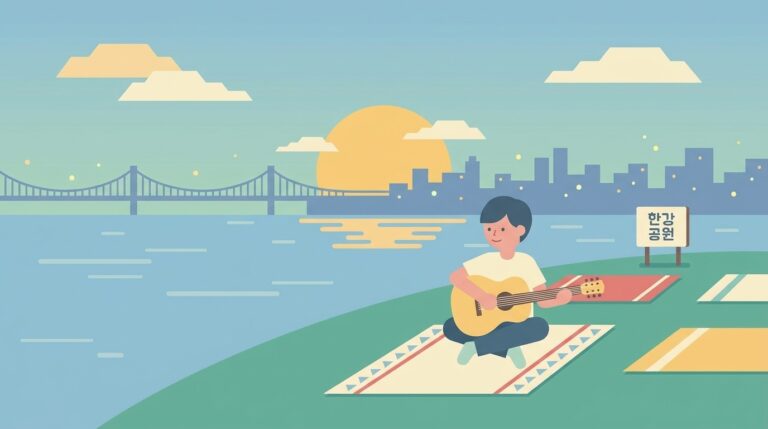
Picture this: It is a gentle, breezy Friday evening at Yeouido Han River Park. You are sitting on a picnic mat, surrounded by twinkling city lights and the mouthwatering scent of crispy fried chicken. Just a few steps away, a talented indie singer strums an acoustic guitar, covering your favorite K-drama soundtrack. A crowd gathers, swaying in unison, clapping to the rhythm, and sharing warm smiles.
You want to cheer them on. You want to shout out a compliment or ask if you can snap a quick video for your Instagram story. But suddenly, your mind goes blank. Should you say ‘감사합니다 (Gamsahamnida)’? Is shouting ‘Good job!’ in English going to sound awkward? What if you use the wrong honorific level and accidentally sound rude to the performer?
Don’t worry at all! Every Korean learner experiences this exact hesitation during their first night out in Seoul. Today, we are breaking down the easiest, most natural A1-level Korean phrases to help you cheer, interact, and soak up the magical Han River busking vibes just like a local. Based on feedback from hundreds of our beginner students, this guide will give you the confidence to speak up and connect effortlessly!
Phase 2: 3 Key Expressions Deep Dive
1. 노래 진짜 좋아요! (Norae jinjja joayo!)
- Pronunciation: [No-rae jin-jja jo-ah-yo] (Sounds like No-ray + jin-jja with a crisp ‘jj’ pop + Joe-ah-yo)
- Meaning: Literal: “Song really is good!” | Natural: “Your singing / This song is amazing!”
- K-Culture Moment: You will hear fans and audience members shout this right after an emotional ballad finishes on shows like Begin Again or street busking scenes in Hongdae and Han River.
- Editor’s Insight: ‘진짜 (Jinjja)’ is Korea’s favorite spice word! Adding it makes your compliment sound 10 times more heartfelt and spontaneous than a robotic dictionary phrase.
- Situation Spectrum: Casual (노래 진짜 좋아!): ⚠️ (Only to peers/younger) | Semi-formal (노래 진짜 좋아요!): ✅ (Perfect for buskers) | Formal (노래가 정말 훌륭합니다): 🚫 (Too stiff for a park setting)
- 🤔 Think About It: In English, we often say “You are an amazing singer!” focusing on the person. In Korean, praising the object (“The song is great!”) naturally honors the performer’s skill with humble warmth.
2. 사진 찍어도 돼요? (Sajin jjigeodo dwaeyo?)
- Pronunciation: [Sa-jin jji-geo-do dwae-yo] (Say Sah-jin + jee-gaw-doe + Dway-yo)
- Meaning: Literal: “Picture if taken, is it okay?” | Natural: “May I take a photo / video?”
- K-Culture Moment: When you want to record an up-and-coming street artist or take a commemorative selfie with them between their sets.
- Editor’s Insight: The ending pattern ‘~도 돼요? (~do dwaeyo?)’ is a magical polite request form in Korean. It immediately shows you have great nunchi (manners and situational awareness).
- Situation Spectrum: Casual (사진 찍어도 돼?): ⚠️ | Semi-formal (사진 찍어도 돼요?): ✅ (Safest & most polite) | Formal (사진 촬영이 가능합니까?): 🚫 (Sounds like a press conference)
- 🤔 Think About It: Asking for permission before recording builds instant trust in public spaces, reflecting Korea’s deep respect for personal privacy and portrait rights.
3. 앵콜! / 한 번 더 해주세요! (Aengkol! / Han beon deohaejuseyo!)
- Pronunciation: [Aeng-kol! / Han-beon-deo-hae-ju-se-yo!]
- Meaning: Literal: “Encore! / One time more please do!” | Natural: “Encore! / Please play one more song!”
- K-Culture Moment: At the end of a busking performance, the crowd claps rhythmically shouting “Aengkol! Aengkol!” until the singer smiles and tunes their guitar for one last track.
- Editor’s Insight: ‘한 번 더 (Han beon deo)’ means ‘one more time’. Adding ‘해주세요 (haejuseyo – please do)’ turns an excited shout into a polite, charming plea that artists cannot resist.
- Situation Spectrum: Casual (한 번 더 해줘!): ⚠️ | Semi-formal (한 번 더 해주세요!): ✅ (Ideal for crowds) | Formal (재공연을 요청합니다): 🚫 (Completely unnatural)
- 🤔 Think About It: How does cheering together as a collective group create a shared bond between complete strangers in public spaces?
Phase 3: Textbook Korean vs. Real Korean
Situation 1: Praising the performance
- 📖 Textbook Korean: 당신의 공연은 매우 아름답습니다. (Dangsin-ui gong-yeon-eun maeu areumdapsumnida. / “Your performance is very beautiful.”)
- 🗣️ Real Korean: 와, 최고예요! (Wa, choegoyeyo! / “Wow, you’re the best!”)
- 💡 Why is it different?: Calling someone ‘당신 (dangsin – you)’ sounds distant or overly dramatic in spoken Korean. Native speakers use short, high-energy exclamations like ‘최고예요 (choegoyeyo – the best)’ paired with a bright thumbs-up.
Situation 2: Dropping a tip into the guitar case
- 📖 Textbook Korean: 저의 팁을 받아주십시오. (Jeoui tib-eul bad-ajusipsio. / “Please accept my tip.”)
- 🗣️ Real Korean: 응원해요! (Eung-wonhaeyo! / “Rooting for you!”)
- 💡 Why is it different?: Korea does not have a formal tipping culture. When you put cash in a busker’s case or buy their sticker merchandise, you are supporting their artistic dream, so a warm “I’m cheering for you!” is much more meaningful.
Phase 4: K-Culture Deep Dive & Non-verbal Manners
4-1. Nunchi & Gestures at Han River Busking
- The Flashlight Wave (플래시 응원): When a busker starts singing a slow ballad as night falls, look around! People will turn on their smartphone flashlights and sway their arms slowly left to right. Joining in shows top-tier nunchi and makes the atmosphere feel like an intimate outdoor concert.
- Subtle Clapping: Keep your claps gentle during the verses so everyone can hear the acoustic sound clearly, then cheer enthusiastically right when the chorus peaks or the song concludes.
4-2. Cultural Code: The Han River ‘Chimaek’ & Busking Vibe
In Korea, Han River Park is the ultimate sanctuary of healing (힐링). People gather in casual groups with picnic mats, eating Chimaek (치맥 – Chicken + Beer) or instant ramen cooked from the park convenience store. Buskers provide the organic soundtrack to this communal unwinding. It is casual, welcoming, and deeply rooted in everyday Korean relaxation.
Phase 5: Real Roleplay Scenario
Setting: Yeouido Han River Park near the floating stage. Minho (an acoustic indie busker) has just finished a sweet cover song, and you are sitting in the front row on a picnic mat.
- You: 🎭 (Clapping enthusiastically with a big smile) 와! 노래 진짜 좋아요! (Wa! Norae jinjja joayo! / “Wow! The song is really great!”)
- Minho (Busker): 🎭 (Bows slightly with a surprised grin) 감사합니다! 즐겁게 듣고 계신가요? (Gamsahamnida! Jeulgeopge deutgo gyesingayo? / “Thank you! Are you enjoying the music?”)
- You: 🎭 (Nodding vigorously) 네! 목소리 정말 멋있어요. (Ne! Moksori jeongmal meosisseoyo. / “Yes! Your voice is really cool.”)
- Minho (Busker): 🎭 (Laughs softly while tuning the guitar) 고마워요. 다음 곡은 신나는 노래예요. (Gomaweoyo. Daeum gog-eun sinnaneun noraeyeyo. / “Thank you. The next song is an upbeat one.”)
- You: 🎭 (Holding up your smartphone politely) 저기요, 영상 찍어도 돼요? (Jeogiyo, yeongsang jjigeodo dwaeyo? / “Excuse me, may I take a video?”)
- Minho (Busker): 🎭 (Points to his Instagram handle on his guitar case) 네, 마음껏 찍으세요! 태그도 해주세요. (Ne, maeumkkeot jjigeuseyo! Taegeudo haejuseyo. / “Yes, feel free to take as much as you like! Please tag me too.”)
- You: 🎭 (Showing a thumbs-up) 네! 인스타 팔로우할게요! (Ne! Inseuta palrouhalgeyo! / “Yes! I will follow you on Instagram!”)
- Minho (Busker): 🎭 (Beams warmly) 감사합니다! 같이 즐겨요! (Gamsahamnida! Gachi jeulgyeoyo! / “Thank you! Let’s enjoy it together!”)
🔀 Interactive Branching Point: When Minho finishes his final set, what do you shout?
- Option A: “한 번 더 해주세요! 앵콜!” (Han beon deo haejuseyo! Aengkol!)
- Feedback (Best): 🌟 Perfect! The whole crowd will laugh and join you, and the busker will feel super loved.
- Option B: “당장 노래를 계속하십시오.” (Dangjang noraereul gyesokhasipsio.)
- Feedback (Bad): ❌ Oops! This means “Continue singing immediately!” which sounds like a medieval royal command.
- Option C: (Keep silent and wave your phone aggressively in his face)
- Feedback (Risk): ⚠️ A bit awkward! Buskers love vocal engagement—don’t be shy to speak up!
Phase 6: 10-Second Emotion Shadowing Drill
Practice these lines with pause rhythm (/) and real emotions!
[😊 Joyful & Cheerful]와! / 노래 진짜 / 좋아요! (Wa! / Norae jinjja / joayo!)[✨ Polite & Curious]저기요, / 사진 / 찍어도 돼요? (Jeogiyo, / sajin / jjigeodo dwaeyo?)[🎉 Excited & Playful]최고예요! / 앵콜! / 한 번 더 해주세요! (Choegoyeyo! / Aengkol! / Han beon deo haejuseyo!)
Phase 7: K-Culture Mini Dictionary
- 버스킹 (Beoseuking) | Street Performance / Busking | Used widely across Korea for any outdoor acoustic, dance, or magic shows in public parks and shopping streets.
- 돗자리 (Dotjari) | Picnic Mat | The absolute #1 essential item at Han River Park. You can rent or buy one at convenience stores right outside subway exits.
- 치맥 (Chimaek) | Chicken + Maekju (Beer) | The legendary Korean food combo synonymous with relaxing riverside busking evenings.
- 떼창 (Ttechang) | Singing along in unison | When the busker sings a famous chorus and the whole crowd joins in together at the top of their lungs.
Phase 8: Traveler’s Survival Kit
Top 3 Survival Phrases
- 저기요! (Jeogiyo!) | “Excuse me!” | Use this to politely catch a performer’s or neighbor’s attention before asking something.
- 인스타 아이디 뭐예요? (Inseuta aidi mwoyeyo?) | “What is your Instagram ID?” | The easiest way to connect with local indie musicians.
- 화장실 어디예요? (Hwajangsil eodiyeyo?) | “Where is the restroom?” | Critical survival question when drinking beverages in a massive park!
Editor’s Travel Note
- Navigation: Google Maps can be inaccurate for pedestrian pathways in Seoul parks. Search your exact park entrance using the Naver Map app download.
- Cash vs. QR: While Korea is mostly cashless, buskers usually display a KakaoPay QR code or their bank account number on their guitar case alongside their Instagram handle! If you don’t have a Korean bank account, following them on Instagram and sending a kind DM is just as appreciated.
Phase 9: “One Step Deeper” (Reflective Essay)
In Korean culture, the concept of ‘Heung (흥)’ represents an innate, joyous collective energy that surfaces when people share music and food together. At the Han River, nobody cares whether you are a CEO, a student, or a solo traveler from across the globe. When a busker starts singing, everyone on their picnic mats shares the same warm breeze and rhythm, creating a fleeting yet profound sense of community.
💬 Your Turn: What is your favorite song that you would love to hear by the riverside at sunset? Have you ever watched busking in your hometown or in Korea? Drop your thoughts in the comments below!
Phase 10: FAQ & Common Mistakes
Q: Can I request a song (신청곡) to a busker?
A: Yes! If the artist asks the crowd “듣고 싶은 노래 있으세요? (Is there a song you want to hear?)”, you can raise your hand and politely say the song title followed by “…해주세요! (…haejuseyo!)”.
Q: Is tipping mandatory for busking in Korea?
A: No, it is completely voluntary. While some people drop 1,000 to 5,000 KRW bills into the case, hearty applause and following their social media accounts are equally welcomed.
Q: What time does busking usually happen at Han River?
A: Buskers usually perform between 6:00 PM and 9:30 PM on Friday, Saturday, and Sunday evenings during spring and autumn when the weather is mild.
🚨 Common Mistakes Warning Board
- Mistake: Saying ‘너 노래 잘한다 (Neo norae jalhanda)’ to a busker you just met.
- Correct Action: ‘너 (neo)’ is intimate/casual. Always use semi-formal endings: 노래 진짜 잘하세요! (Norae jinjja jalhaseyo!)
- Mistake: Shoving a camera right into the artist’s face without making eye contact.
- Correct Action: Make friendly eye contact and ask “사진 찍어도 돼요?” first.
- Mistake: Walking directly through the middle of the busking circle while talking loudly on the phone.
- Correct Action: Use nunchi! Walk quietly behind the seated audience circle to respect the performance.
Phase 11: Action Mission & Challenge
- 🥉 Bronze Mission: Say “노래 진짜 좋아요!” out loud 5 times looking in the mirror with your biggest smile.
- 🥈 Silver Mission: Find a Korean busking video on YouTube or Instagram (search
#한강버스킹), and leave a supportive Korean comment like “목소리 최고예요! 응원해요!” - 🥇 Gold Mission: Next time you visit Seoul, sit down for at least 15 minutes at a Han River busking spot, snap a video with permission, and tag the artist!
-
🎮 K-Culture Mission: Watch an episode of the Korean music travel show Begin Again and listen for how the crowd reacts after each street performance!
Phase 12: Interactive Quiz Challenge
1. Situation Check: You want to ask the busker for an encore. Which phrase is the most natural?
* A) 앵콜! 한 번 더 해주세요!
* B) 또 하시오!
* C) 다시 노래를 시작합니다.
2. Fill-in-the-Blank: Complete the phrase meaning “May I take a photo?”
* “____ 찍어도 돼요?”
3. True or False: In Korea, you must always give a minimum 10,000 KRW tip whenever you watch a street busker for more than 5 minutes.
* [ True / False ]
👉 Click to reveal answers & explanations!
- Answer: A (앵콜! 한 번 더 해주세요! is friendly, enthusiastic, and polite. B and C are awkward and grammatically unnatural.)
- Answer: 사진 (Sajin) (사진 찍어도 돼요? = May I take a photo?)
- Answer: False (Tipping is entirely optional in Korea! Enthusiastic clapping, phone waving, and social media follows are just as valuable to buskers.)







